


Today we tackle the thorny question of what cattle egrets do when there are no cattle (or horses, or sheep, or goats, or lawn mowers) around. They accompany these various animals and machines to feast on insects and small animals disturbed by the grazing.
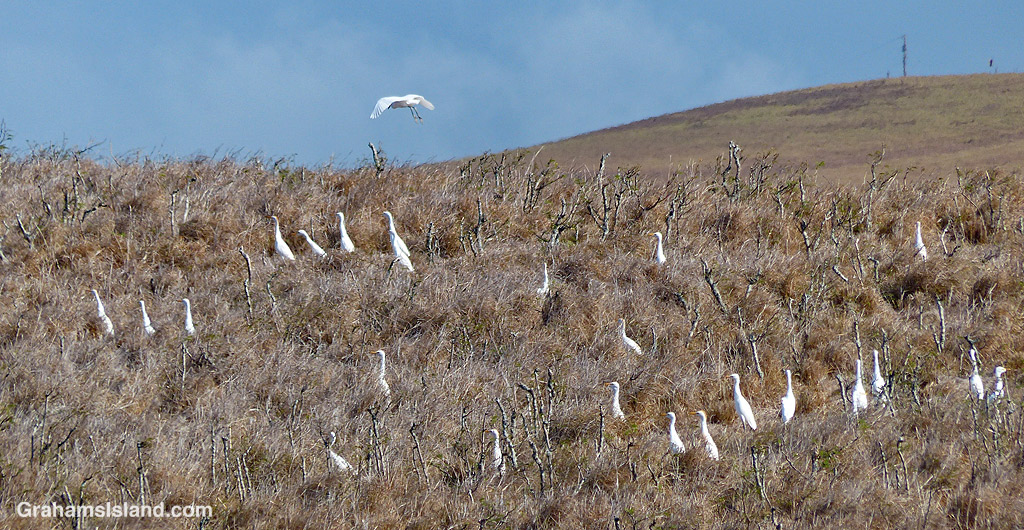
When they don’t have others to stir up these things, they do it themselves. This group of cattle egrets methodically combed a scrubby field, eating as they went. As they moved across the field, birds from the back would fly forward and take up their position at the front. By the time a line of birds ended up at the back of the bunch, they’d probably scoured their section of field of easy pickings, so they leapfrogged to the front again.
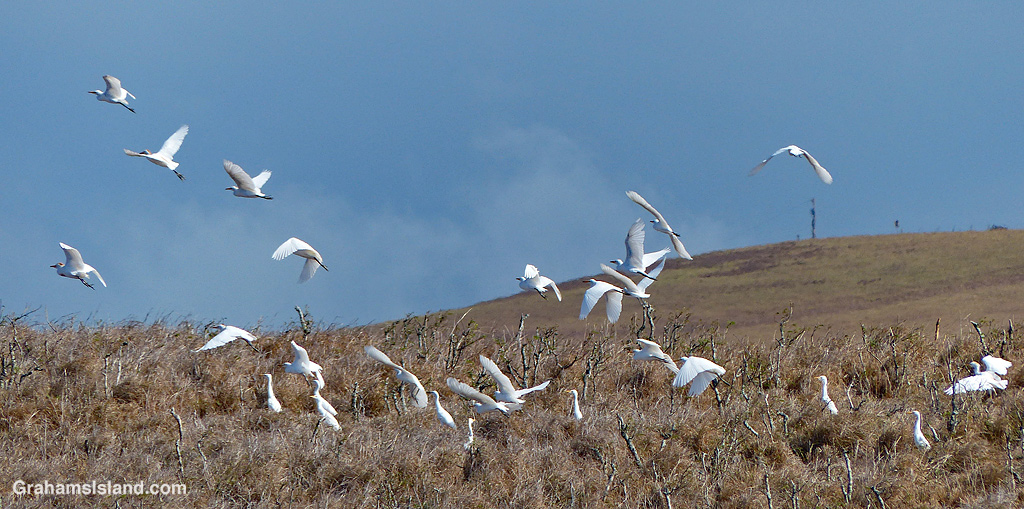
When they reached the fence at the end of the field, they moved higher on the hill and began the whole process again. Finally, they reached the top of the hill and, after a while took off, first in ones and twos, and then in greater numbers until they had all gone.
 Graham's Island
What an interesting observation. Unlike naturebackin, we are getting more cattle egrets in our suburbs now (same country) because of the invasion of cattle into the suburbs – largely because of the drought.
LikeLiked by 1 person
Ah water, such a precious commodity and its presence or scarcity can cause so many changes.
LikeLiked by 1 person
Interesting Graham and I enjoyed the photos. Cattle Egrets used to be common in the suburbs here but are seldom if ever seen these days. I don’t know why that is the case. Even in the local farmlands they seem rarer but we do see them in game reserves – they occur here naturally, unlike where you are.
LikeLiked by 1 person
That is odd. They’re thriving here, that’s for sure.
LikeLiked by 1 person
Wow, what a show! The last time I saw a big flock of egrets was at the local swimming pool where they were hanging out (one was on the lifeguard stand) and me with no camera! Interesting that they have clever means of surviving!
LikeLiked by 1 person
It was fun watching them working along the field. I quite like seeing them though they are something of an invasive species here and probably way too numerous for the good of the ecosystem.
LikeLiked by 1 person