
A small fish, possibly a blenny, waits in a tide pool. The movement of the water in the pool created the interesting visual effect.

A small fish, possibly a blenny, waits in a tide pool. The movement of the water in the pool created the interesting visual effect.

This is a typical pose for an arc-eye hawkfish, keeping very still as it nestles in a head of cauliflower coral. But the coral is not well. This patch is mostly bleached. The causes of coral bleaching include warmer than normal water temperatures, pollution, and sunscreens containing coral-killing ingredients.
Because of this third factor, Hawaii has passed a bill which will ban the sale of sunscreens containing oxybenzone and octinoxate. This law goes into effect January 1, 2021. While this will help, it won’t do anything to keep harmful chemicals out of water runoff, and it won’t do anything to prevent the warming of the Pacific Ocean.
Last fall, we had a coral bleaching event here because of warmer ocean temperatures. It wasn’t as bad as feared, but still did damage to corals that were just recovering from previous bleaching events. There are one or two snorkeling sites here that I don’t visit anymore because the state of the coral is just too depressing. I’d like to think that this degradation can be reversed but, honestly, I’m not optimistic about that.
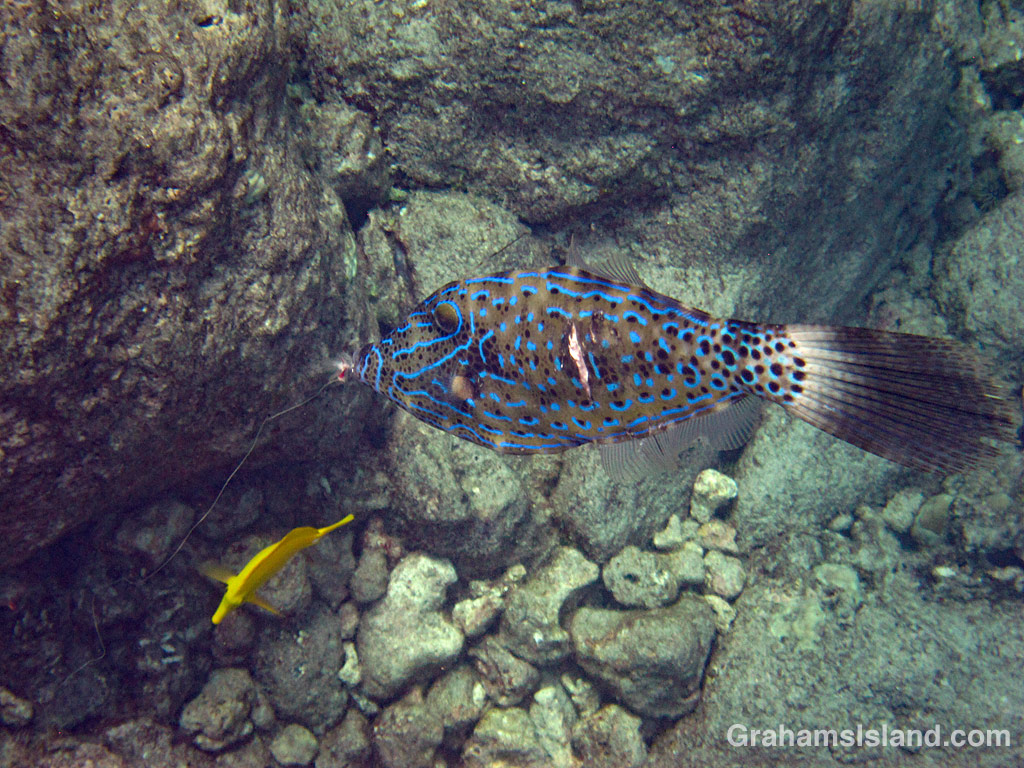

I noticed this scrawled filefish because it was catching the sunlight, as they sometimes do, and the blue scribbles on its side were beautifully illuminated.
The photo on the left is the first sighting I had of the fish, and as it dove I noticed something trailing it. This can just be seen below the tail. It looked like fishing line. So I followed it and got the top photo where I could clearly see that the fish was trying to dislodge a hook and line from its mouth. Not only that, but it had a good-sized slash in its side.
I had visions of trying to grab the line and remove the hook, but the fish kept going down, away from me and out of my reach. It disappeared from view and I was left only with the photos and the rather sad image of the struggling fish.
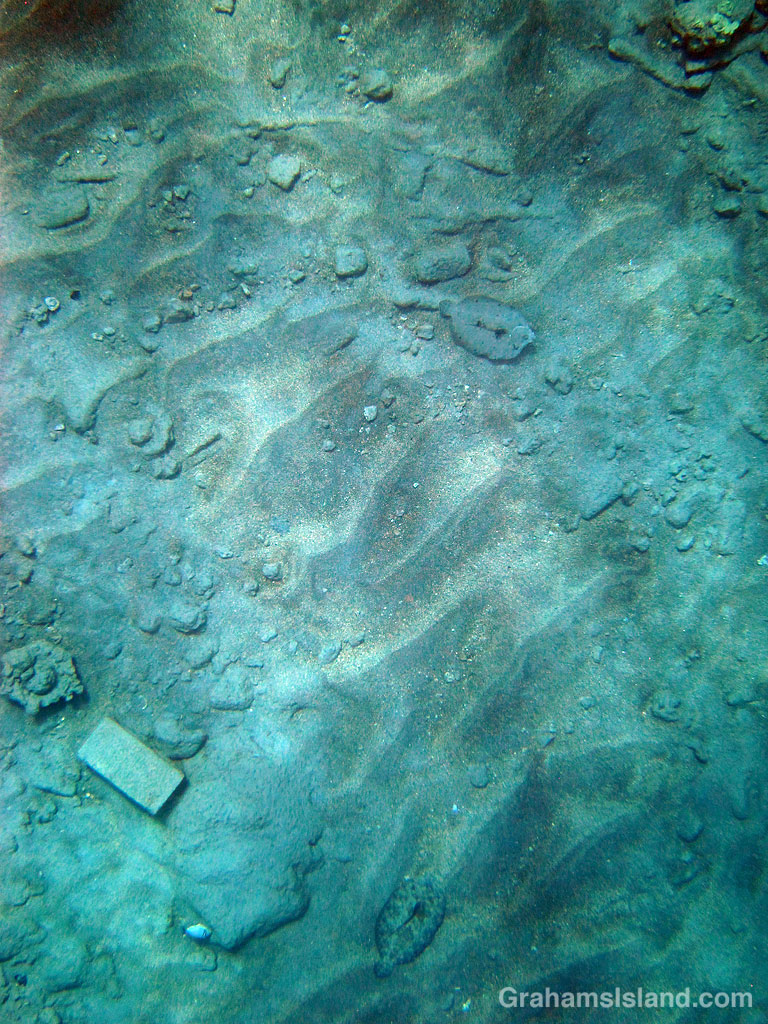
Two flowery flounders don’t exactly stand out on a sand and rubble sea floor, but I’m sure you can spot them.
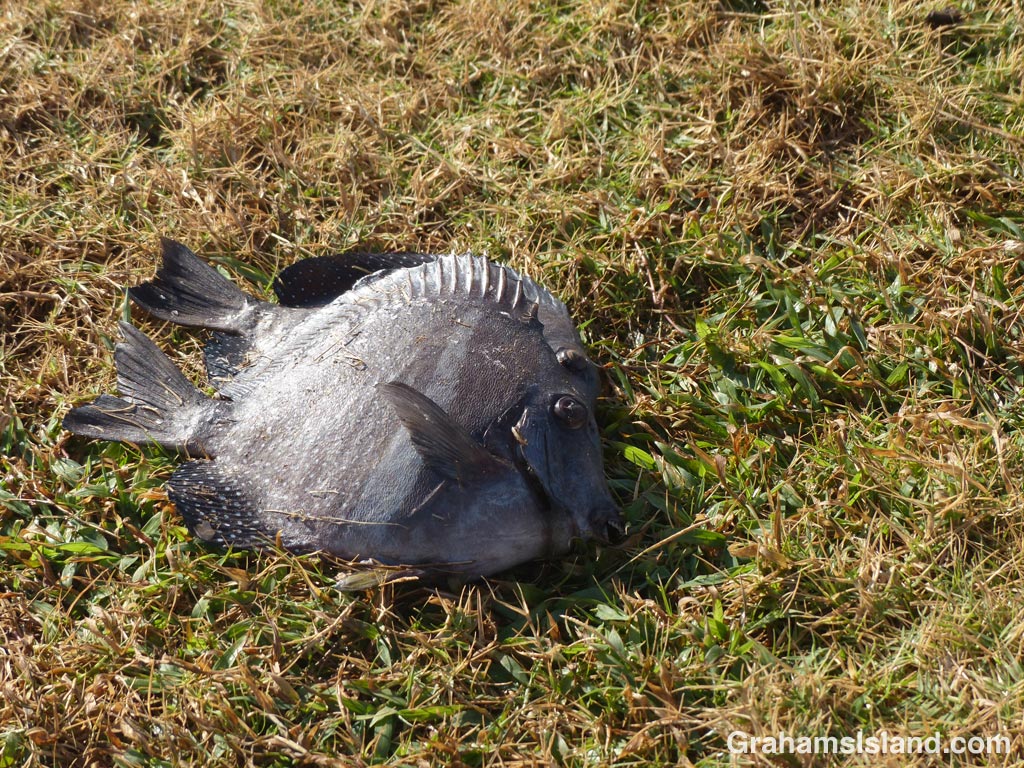
A pair of whitespotted surgeonfish caught, but not wanted.
Posted in response to Bushboy’s challenge to post the last photo taken in February 2020. See challenge rules and more responses here.


This week’s Friendly Friday challenge theme is ‘Sea Creatures.’ See more responses here.
I go snorkeling two or three times a week and feel fortunate to see a great variety of sea creatures while I’m out. Some of these can be quite unusual or exotic. I recently saw my first titan scorpionfish, and threadfin jack juveniles are weird and wonderful. And then there was my one and only encounter with a pyrosoma.
But for this challenge, I’ve opted to go with some fish I see most times I get in the water. Yellow tangs are probably the most noticeable reef fish around. Bright yellow, they putter around in the shallows, and are easily visible in the water and from shore. Trumpetfish look nothing like yellow tang, but often take on a yellow color and blend in with shoals of yellow tang in the hopes of surprising small fish, which are their main prey.
In these photos, a trumpetfish is doing just that. While it might seem like it would be pretty obvious that the long trumpetfish is quite different from the rest of the shoal, when seen from the front, which is the business end of the trumpetfish, the distinction isn’t so great. And if the trumpetfish can get close enough, it will suck its prey in and devour it.


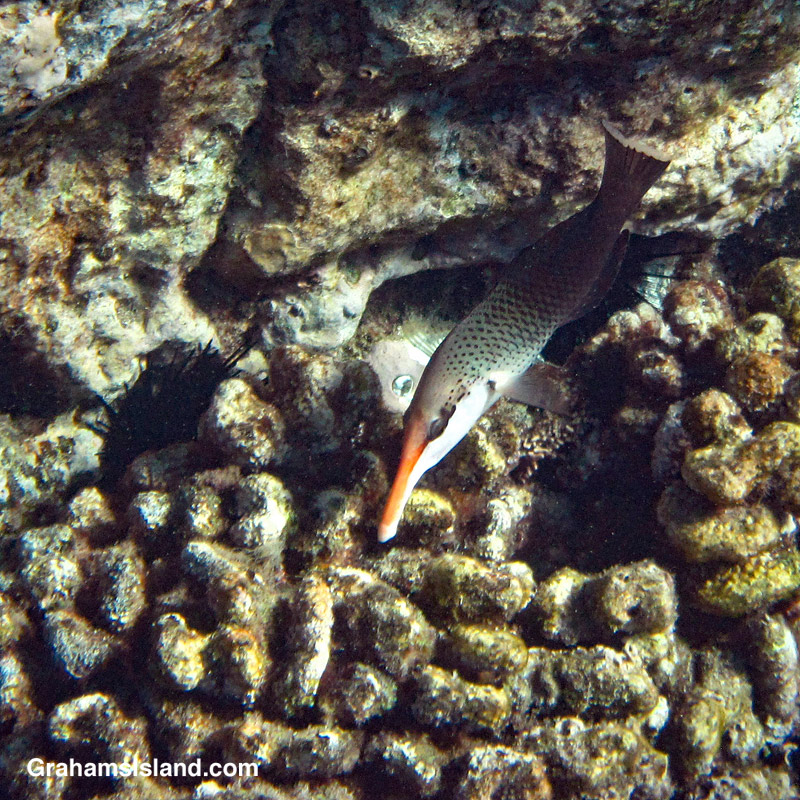
Bird wrasses are quite distinctive. The long ‘beak’ is used for winkling out crabs and shrimp from nooks and crannies in the reef. The top photo shows a blue and green supermale, with its lighter green blaze above the pectoral fin. To the right is a more subduedly-colored initial phase bird wrasse, that could be male or female.
These are one of those fish that seem to be in constant motion. I have taken many photos of them where they aren’t in shot by the time I push the button. I got lucky with these two.
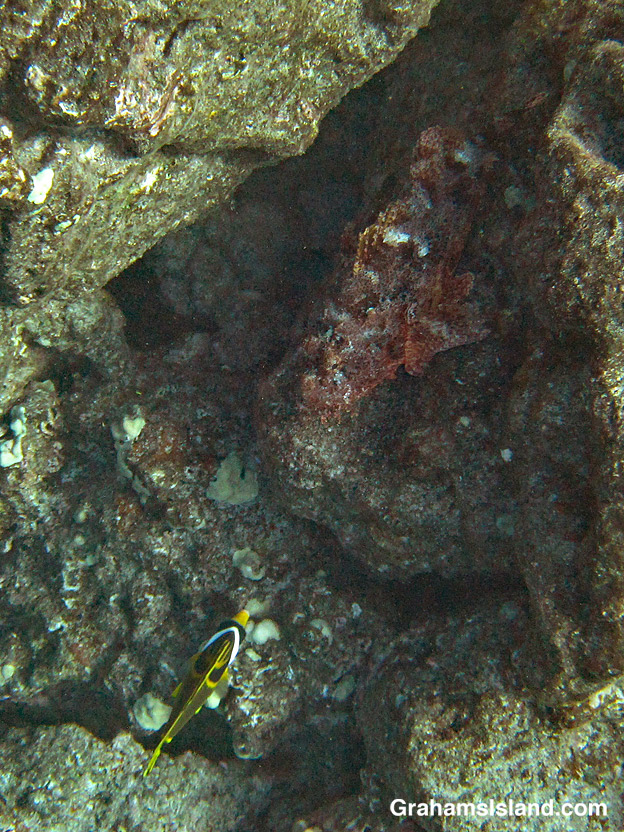
I was snorkeling recently, when I saw something distinctive on some rocks. At first I thought it was an octopus, but it didn’t look right. A lobster perhaps, but again something was amiss. Then I realized that the fin shapes I was seeing those of a scorpionfish. I focussed in with my camera and the fish scooted forward and disappeared into a crack and beneath a boulder before I could get a shot.
When I got home, I looked at my fish book and figured out that I’d probably seen a titan scorpionfish. The only scorpionfish I’ve seen previously have been devil scorpionfish, which are easily identified by their distinctive and colorful pectoral fins. The titan scorpionfish is more colorful overall but without such a distinctive signature. However, it’s the largest scorpionfish in Hawaii and the one I saw was big.
Next day, I was snorkeling in the same general area and I saw a reddish, mottled fish moving. ‘That looks familiar,’ I thought. This time the fish plunked down onto a rocky area and stayed put so I was able to get a good look at it and take some photos, of which this was the best. It was indeed a titan scorpionfish, probably the same one I’d seen the day before. I even saw the loose flaps on its lower jaw which are a prime identifying mark.
Even though I knew where it was, there were times when I looked and thought it had moved on before I could pick it out again, so well does it blend in with its surroundings.
 Graham's Island