The reddish color of this day octopus is an indication that I had startled it. If it felt threatened, it would turn white. I like how the patterns on the rock it’s on looks like sucker marks from its tentacles.

The reddish color of this day octopus is an indication that I had startled it. If it felt threatened, it would turn white. I like how the patterns on the rock it’s on looks like sucker marks from its tentacles.


Cushion stars (Culcita novaeguineae) look just like their name implies – small but comfy-looking cushions that would not look out of place on your couch. However, these cushions would move around on their little tube feet, which might be a bit disconcerting.
They come in several colors including red, yellow, and tan and there’s often quite a bit of variety in their markings. Cushion stars feed on living coral, which they eat by pushing their stomach out and consuming the coral where it sits.
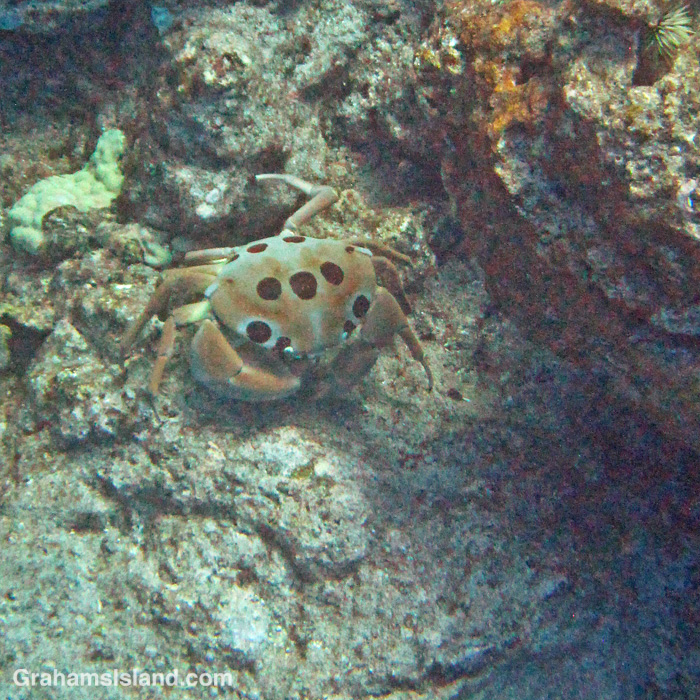
I’ve only seen one or two seven-eleven crabs (Carpilius maculatus) before, and not for several years. My wife had never seen one. One reason for this is that the crabs are active at night. But we saw this one a few days ago, scuttling over the rocks and sand. It was quite early in the morning, so the crab was probably headed for its home.
These crabs are quite large and have the distinctive markings that give it its name. There are the two spots alongside each eye and three across the center of the shell. Four more spots are less obvious on the back edge of the shell.
In Hawaii, these crabs are called ‘alakuma. Legend has it that a god caught an ‘alakuma, but the crab struck back and drew blood. This happened a second time, before the god finally snagged the crab. But the crab’s descendants continue to bear the markings of the god’s bloody fingerprints.
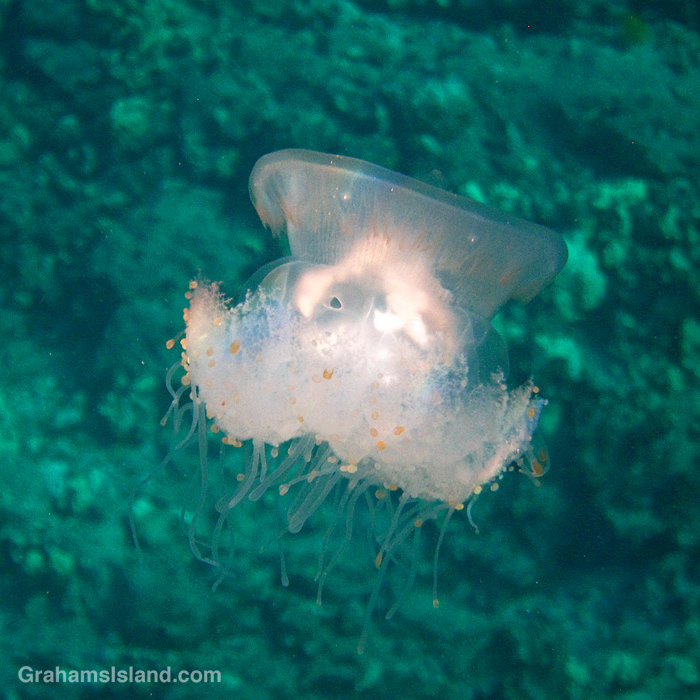

I saw this crowned jellyfish on a recent swim and was taken by how bright it looked as it pulsed along.
Posted in response to Becky’s April Squares challenge theme of ‘Bright.’ See more responses here.

This month, Becky’s April Squares challenge theme is ‘Bright.’ (See more responses here.) First up I thought I’d share something very unusual, which I consider myself lucky to have seen.
You’ve probably heard of stick insects, but the stick swimming crab is a far less often encountered creature. Most crabs scuttle about on the sea floor, but swimming crabs have flattened segments on their legs, which they use to propel them through the water. But even with this different method of propulsion, swimming crabs tend to stay close to the bottom.
The stick swimming crab (Charybdis baculum) has a different approach. It heads for the bright light at the surface where it paddles along, maneuvering with its spindly legs. It will sometimes snag bits of floating debris and attach them to its body to enhance its appearance. Its goal is to look like a small, drifting haven for juvenile fishes and other marine organisms that often gather under such floating islands, which offer them some protection from predators. With the stick swimming crab, that safety is an illusion. Instead, they’re part of the crab’s lunch box, to be picked off at its leisure.
Stick swimming crabs spend most of their time at the surface, but return to the sea floor for periodic molts. This one looks like it has recently molted.
Oh wait, it’s just a stick.
Also posted in response to this week’s Friendly Friday challenge theme of “Something Learned.” See more responses here.

A pair of reef lizardfish rest on a patch of lobe coral. I usually see lizardfish by themselves so this was unusual. Their complete lack of movement was not unusual. That’s what they do unless you get too close.


I hadn’t seen a spotted eagle ray in quite some time before I saw this one, hunting in deeper water. It looked in very good condition and had a fine array of spots.
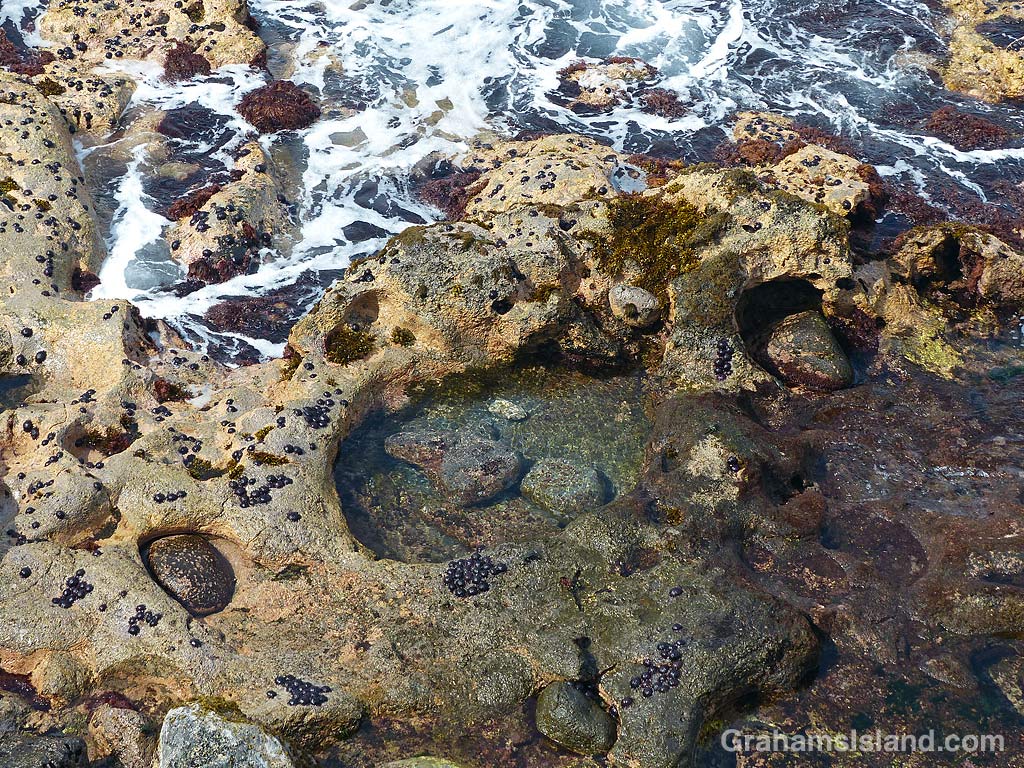
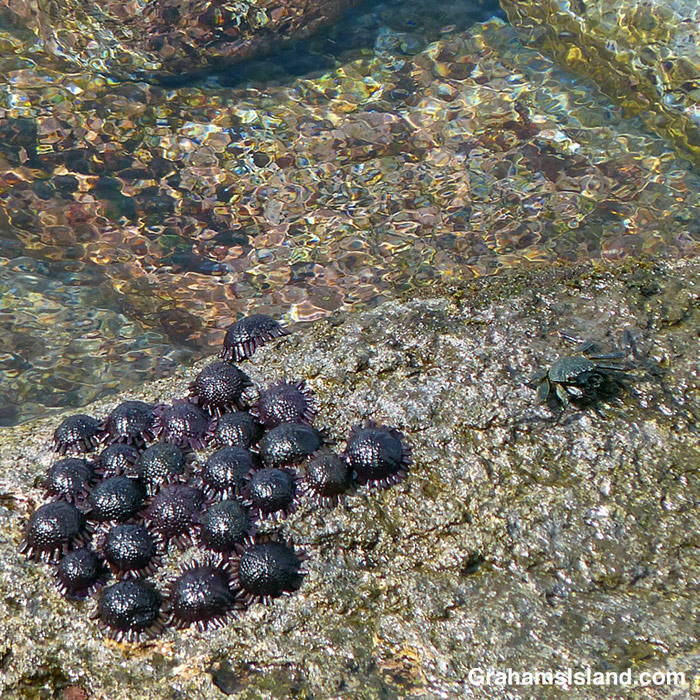
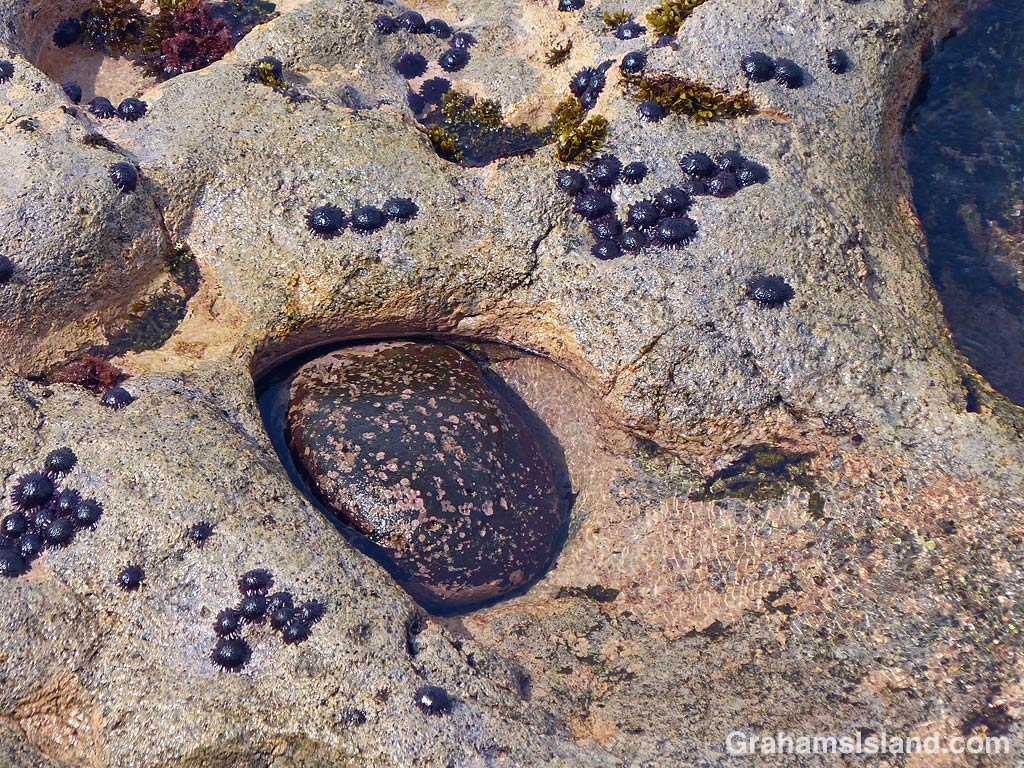
This scene drew my attention because of the smooth, round rock nestled into a matching recess in the shore (bottom left in the top photo). It was when I zoomed in (bottom photo) that I noticed the large number of helmet urchins stuck to the shoreline. These cheerful-looking purple blobs live in the harsh tidal zone, and area of crashing waves and surging water. They feed on algae that grows there.
In the middle photo, an a’ama crab skirts a colony of urchins. When the tide comes in, the crab will move to higher ground, but the urchins will stay put, tenaciously defying everything the ocean throws at them.