Category Archives: Marine Invertebrates

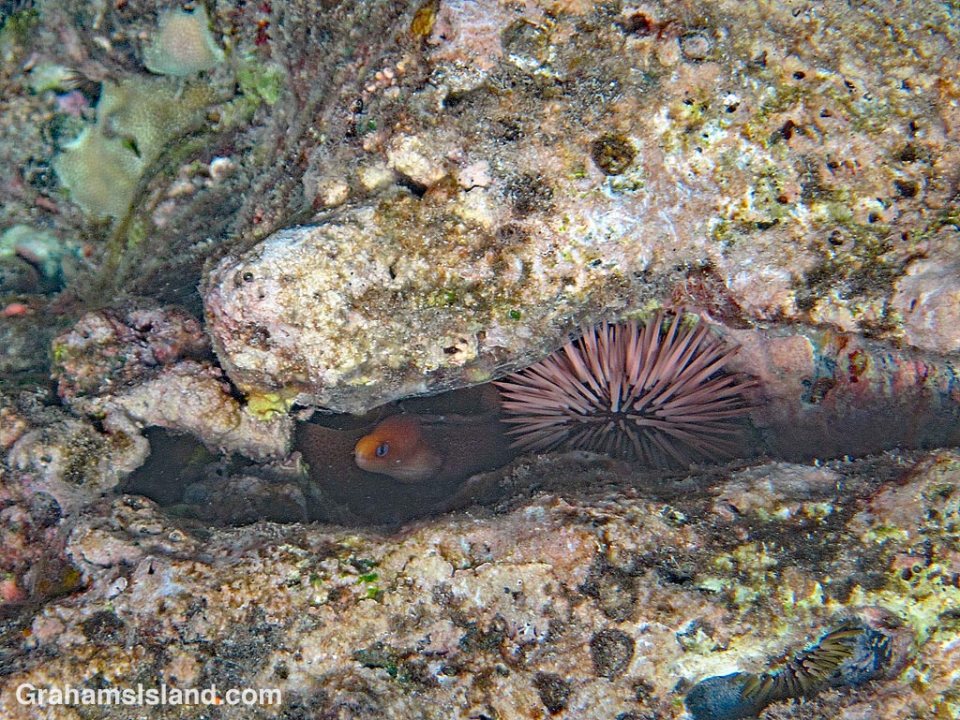
Twisty whitemouth moray eel

Whitemouth Moray Eel in dead coral

Whitemouth Moray EelI’m always amazed and entertained by the ability of eels to disappear into a seemingly solid lump of coral or rock and then, a few moments later, emerge from some unexpected location. I mean, how do they know they’re going to find a way out? There must not be too many claustrophobic eels in the world.

This whitemouth moray eel illustrates the concept in a small patch of dead coral.

Posted in response to this week’s WordPress Photo Challenge ‘Twisted.’


Cauliflower coral not spawning

Cauliflower coral and arc-eye hawkfish

Cauliflower coral

Cauliflower coral was once a mainstay of reefs along the west coast of the Big Island, but has been in decline for a while. Then, in late 2015, high water temperatures caused a huge coral bleaching event, which resulted in a die-off of more than 90% of the area’s cauliflower coral. In some places, nothing was left. Because of this, the reproduction of surviving corals has become of increased importance.

Different corals have different methods of reproduction. Cauliflower coral reproduces in a synchronized spawning event. During this event, the corals release gametes (eggs and sperm) into the water, creating a milky cloud. For many corals, the spawning event takes place at night, but research indicates that cauliflower corals spawn shortly after sunrise, two or three days after the May full moon. At least, that’s what I was told.

Consequently, twice last week, I got up at an early hour in order to be in the water before 7 a.m. in the hope of witnessing a cauliflower coral spawning. Yes, that’s the kind of life-on-the-edge that I lead.

The first priority was to find some live cauliflower coral, easier said than done. There were a few patches in deeper water, but since visibility was not great, it would be almost impossible to tell if and when they spawned. After some finning around, I found a shallow spot with three small clumps and decided to pin my hopes on them. The live coral was part of a larger mass, part of which had died, as can be seen in the photos. Also to be seen in the photos are an arc-eye hawkfish (above), and two four-spot butterflyfish (second photo) among others. Corals are very important to fish stocks because many small fish, and the young of bigger fish, use the coral for protection, a place to hide when threatened.

What’s not to be seen in the photos is any evidence of spawning, because I didn’t see any. It was unlikely that I would. Conditions might not have been right for the coral or my timing could have been off. The May full moon is actually on the 29th so it might be that the spawning will be at the end of the month, not the beginning. I’ll try again then.

Posted in response to this week’s WordPress Photo Challenge ‘Unlikely.’

Abstracts: A’ama crabs and sea spray

Abstracts-A'ama crabs and sea spray

One of the first things anyone visiting a rocky seashore here will see is lots of little black shapes skittering away. Those shapes are a’ama crabs.

On this day, I had, as usual, spooked the crabs into motion, but after putting a little distance between me and them, they settled down again. Where they settled was on this sloping rock next to a blowhole. Moments later, water shot out of the blowhole creating this scene.

Where I would have been squealing and running from the sudden deluge, the a’ama crabs remained. I guess, living on these rocky shores, they are well used to this sort of thing.

Touching octopuses

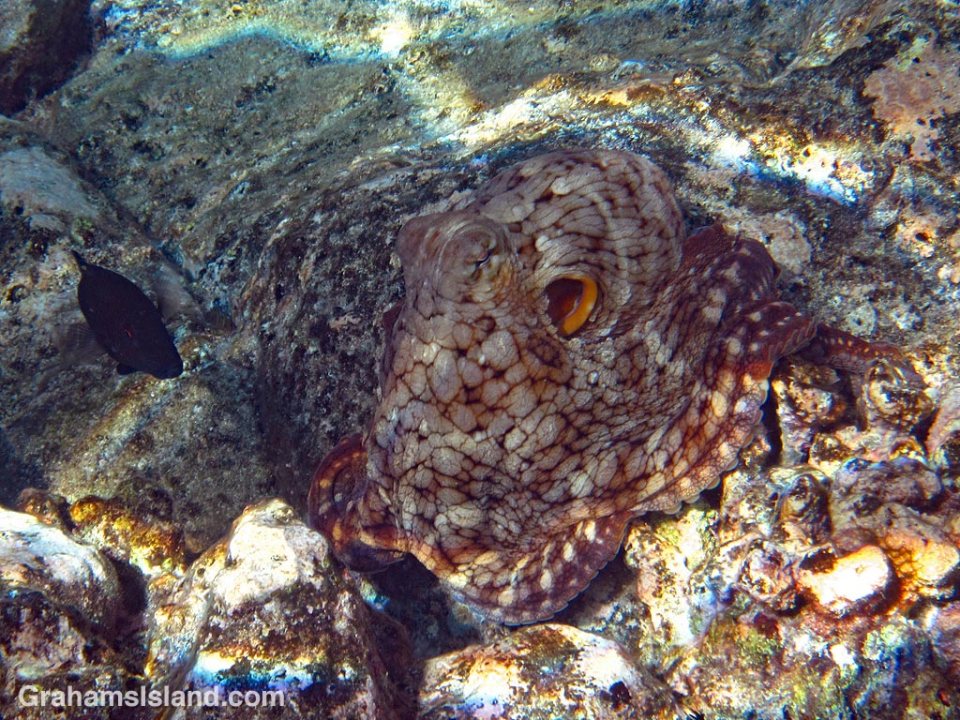
For Valentine’s Day I offer this photo of two day octopuses. It comes with a little story.

One day, while I was snorkeling, I noticed a stocky hawkfish about to plop onto a bit of coral. Before it could settle, a blue goatfish butted it away, getting my attention. I wondered if its presence might mean there was an eel or octopus around since they sometimes hunt together. Almost immediately, just beyond the goatfish, I noticed a day octopus glued to the side of a rock.

I took a couple of photos but knew they wouldn’t be very good; the octopus just looked like another lump of rock. So I began the usual dance I do with an octopus. I edge away, as though I’m leaving, keeping an eye on the octopus out of the corner of my eye. I know the octopus is watching me. Often, when I’ve gone a ways, the octopus will rise up onto whatever rock it’s hiding behind. If I’m quick, I can turn and get a photo before the octopus slides back down again. It’s like we’re connected by a line: I go away, the octopus rises. I return, the octopus sinks.

I swam behind a large chunk of rock, then peeked around the side. Still there, still hidden. A bit farther, another peek. Still there, still hidden. And again. And then I looked away momentarily and when I looked back, the octopus was gone. I think they, like many other creatures, watch a person’s eyes and if the person looks away, off they shoot.

It was a matter of a moment so I knew it couldn’t have gone far. I looked around, examining the rocks. Nothing. They can squeeze into tiny spaces so it was always possible I wouldn’t see it even if it was close by. Then, as I turned around, I caught a glimpse of movement and saw the octopus zip behind a bit of rock. Except then I immediately saw a second octopus follow the first.

I swam around the rock and saw the two of them, each in its own separate crack, a few feet apart. Again I took a couple of photos and then moved away. This time I went farther and waited, watching from a fair distance. Eventually, the octopus on the right of the photo emerged and moved toward the other one. I edged closer and began taking photos. It was then that that octopus slowly eased a tentacle toward the other one, sliding over the rock until it reached up and over the front of the other octopus. It was such a sweet and tender gesture, as though the octopus sought reassurance in making physical contact with its companion.

I took the photo and swam off, leaving them in peace.

Crowned jellyfish

A crowned jellyfish in the waters off the Big Island of Hawaii

Conditions weren’t great during a recent swim. Their were ocean swells and an onshore wind made the water choppy. The visibility was only fair, with a lot of coral polyps, the little dots in the photo. But then, literally out of the blue, I saw this crowned or crown jellyfish (Cephea cephea).

There followed a protracted dance where I tried to get close enough to the jellyfish to take a photo, without getting close enough to be stung (though my marine invertebrates book notes ‘The author has handled it with no ill effects.’). This wasn’t easy given the state of the water. The jellyfish just eased up and down quite smoothly, but I was swooshing back and forth with the water. So I’d get myself into a decent position, ready to take a photo, and a swell would propel me in the jellyfish’s direction prompting me to churn the water and head away.

The photos weren’t great because of this toing and froing and the murky water. This is the best of them, which I quite like as it captures the luminosity of the jellyfish as well as showing various parts – the crown with its arms on the top, the tentacles below.

A little later I saw another, smaller one of these. Normally, crowned jellyfish are found in deeper water, but sometimes they’re driven inshore by swells, as I think these two were.

Abstracts: Jellyfish

A tiny jellyfish floats in the waters off the Big Island of Hawaii.

Every so often, when I go snorkeling, the water is full of small pink filament-like things. Swimming through them leaves me feeling slightly itchy and I’ve been told they’re baby jellyfish. A few days ago, in amongst these little pink blobs was a somewhat larger one, still only an inch or two long, but definitely a jellyfish.

This was the best photo I got, but I liked how the water swirled around above it with the pink-rimmed hole looking like it might just have beamed the jellyfish down.

Pallid ghost crab

A Pallid Ghost Crab blends in with the sand.A Pallid Ghost Crab waits by the entrance ot its burrow.

This week’s WordPress photo challenge seeks distractions and for me, one thing that gets my attention is movement. I see something out of the corner of my eye and I wonder what it was, then try to find out.

In this instance, I was crossing a beach when I noticed bits of it get up and scurry away. Closer inspection revealed several of these pallid ghost crabs. They’re beautifully camouflaged, but if that cover is blown, they zip away, and I do mean zip. They take off like Usain Bolt, then stop and disappear again.

If that doesn’t work, say because some annoying individual with a camera stays hot on the trail, the crab will head for its burrow, perch on the edge, and at the slightest unwelcome movement, disappear from view.