
Ambon tobies are little pufferfishes that are usually found fairly close to shore. This colorful little fish is liberally covered with blue spots and lines.

Ambon tobies are little pufferfishes that are usually found fairly close to shore. This colorful little fish is liberally covered with blue spots and lines.


Yesterday, when I was out snorkeling, I was spotted this entity hanging in the water. When I first saw it, I thought it might be a pyrosoma. I was lucky enough to see one of those last year, which I posted about here. Pyrosoma are colonies of many individual tunicates and this new sighting looked somewhat similar. But where that pyrosoma looked like a gelatinous tube with little purple dots in it, this tube was longer, thinner, and had much larger, and clearly visible, brown spots in it.
After some research, I’m pretty sure this is a chained salp. Like pyrosoma, chained salps are colonies of individuals. The individuals have a heart, gills and a spinal cord, which makes them quite advanced in evolutionary terms. They move around by pumping water through their bodies. When they form chains, the individuals in the chains communicate with electrical signals so the the chain moves in harmony.
Typically, salps are creatures of the open ocean, and not often seen in Hawaii, so I feel quite fortunate to have seen this one.

A gargantuan blenny hunkers down in a crack between two rocks.
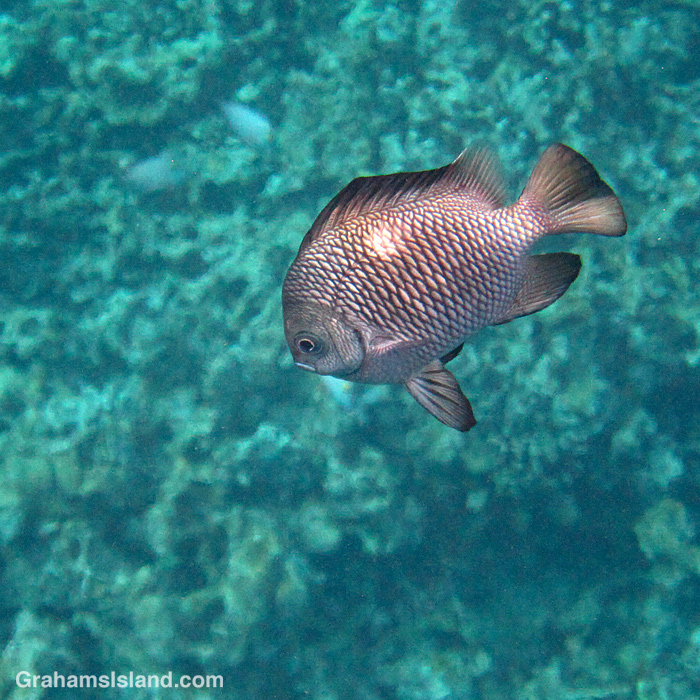
The Hawaiian dascyllus is an endemic damselfish. I see them most often when they’re feeding, usually some way below the surface of the water. This one was a bit higher than most.

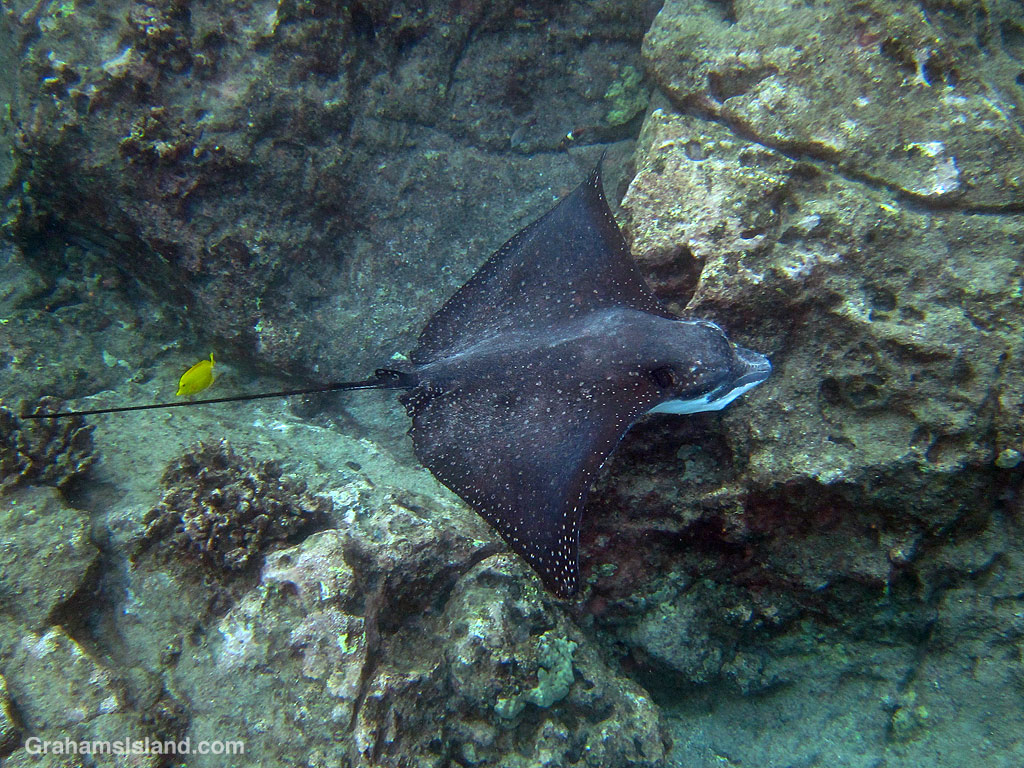
This week’s Friendly Friday challenge theme is ‘Two Ways,’ the idea being to show a photo processed in different ways or to show two photos of the same thing taken at different times in different conditions. (See more responses here.)
I’ve gone with a photo taken yesterday morning showing it before and after processing. In the water, I use a basic point-and-shoot camera in a waterproof case. I don’t use lights or a flash so I shoot mainly on auto, because if my big fingers started pushing little buttons, my subject would be halfway to Japan before I got a photo. This approach can lead to some erratic results, including the image appearing somewhat murky, but usually this can be cleaned up during processing. On this day, the visibility in the water was cloudy, but not as bad as it looks in the before photo.
For photo processing, I use an older version of Photoshop Express (PE), which is a stripped-down version of Photoshop. Using the full version would be like me driving a Ferrari to the local store – way more power and features than I need. My version of PE has a ‘haze reduction’ feature, which is a sort of automatic one-stop processing step, but I prefer to do my own adjustments.
While the two versions look quite a bit different, the change is mainly down to simple adjustments in ‘shadows and highlights’ and tweaking the tones and colors in ‘levels.’ Besides that, I removed a few of the little red flares that often occur in these underwater images, and bumped up the sharpness a hair. That’s it.
Since I follow the same routine when processing all my photos, it goes very quickly. This one was all done in 5 minutes, and the result was worth it.

During a recent swim, this large school of bluefin trevallies swam by, catching the light beautifully.

If you like graphic violence, you’re at the right place today. This is a triton’s trumpet sea snail devouring a cushion star, which has been turned on its back. These snails are the largest in the island and feed on echinoderms, which include stars, cucumbers, and urchins.
Posted in response to Becky’s October Squares challenge theme of ‘Kind.’ See more responses here.

I tried counting these Heller’s barracudas, but kept losing count. There are at least 20 and this is a typical view of them. They hunt at night, but during the day they rest, while cruising in close groups such as this one.
Posted in response to Becky’s October Squares challenge theme of ‘Kind.’ See more responses here.
 Graham's Island