A little snapshot of things tucked into the rocks along the Big Island. There’s a red pencil urchin and blue-black urchin, a patch of cauliflower coral, and a cowry, probably a reticulated cowry. And if you look closely, there’s a bright-eyed damselfish swimming between the coral and red pencil urchin.
I have a tendency, when out snorkeling, to revisit places where I’ve seen something interesting. So if I’ve seen a frogfish, a shark, or gargantuan blenny in a particular place, I go back there to see if it’s still there. Bear in mind that these are creatures that extremely mobile and move around a good deal.
And yet, there’s method in this madness. Many fish are territorial and so do occupy a very limited area which they defend with great vigor. Others might be more transient, but tend to feed in certain areas.
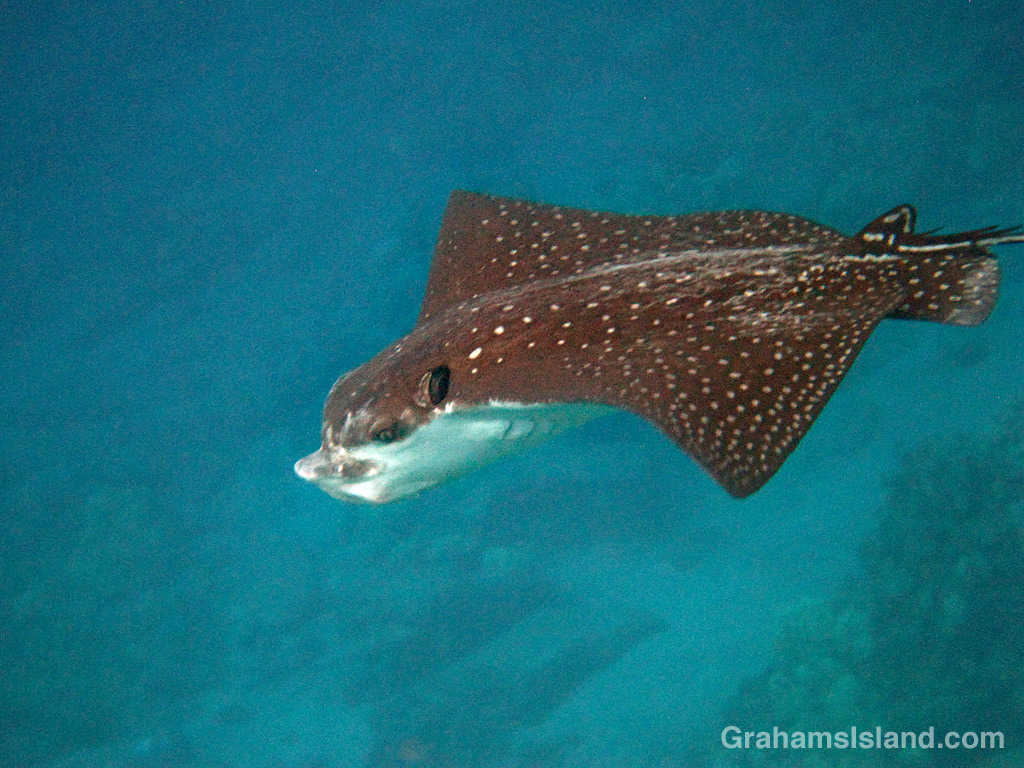
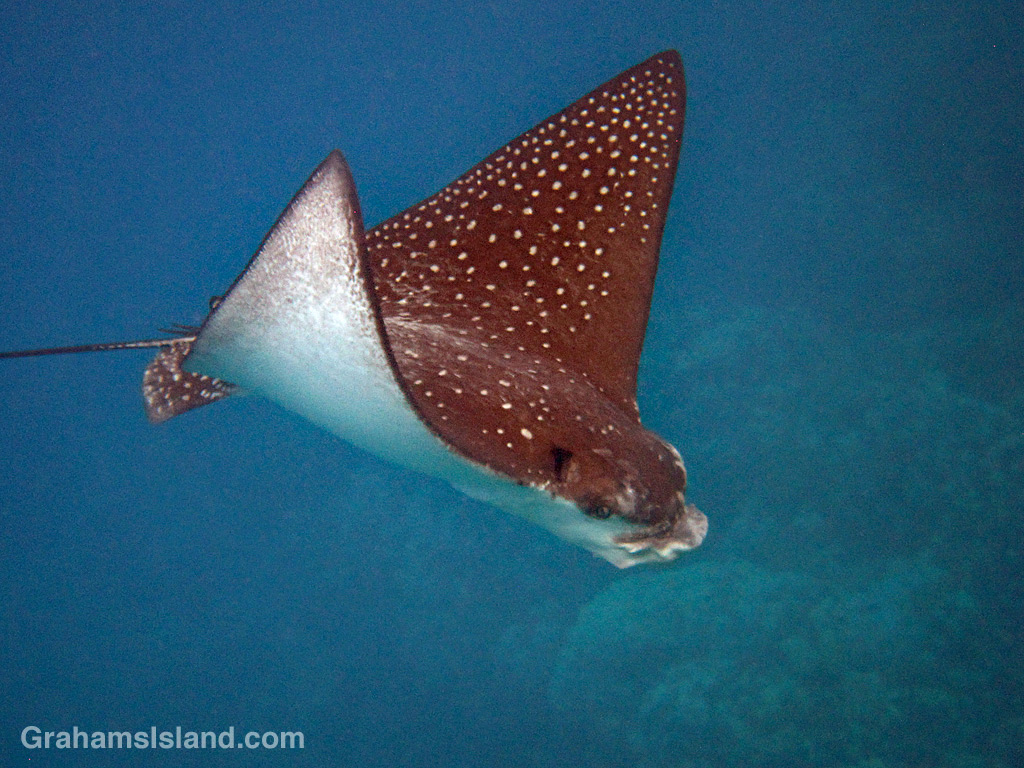
Spotted eagle rays fall into this latter category. They can cover large distances, but tend to feed on sandy bottoms, shoveling the sand with their bills to uncover the marine invertebrates that they feed on.
This eagle ray was dong just that, cruising low over the sand, pausing occasionally dig for potential prey. But after a long spell of this activity, it rose in the water, cruised around, and made a close pass, clearly checking me out. It did this a couple of times before heading back down and in toward the shore in search of food.
I don’t think there was any reason for this behavior other than a curiosity to see what this ungainly creature was that was following it. And it’s not alone in this behavior. Manta rays also do this along with dolphins, sharks, and a fair number of smaller fish. They’re curious about us; we’re curious about them. This is what makes getting in the water fun.
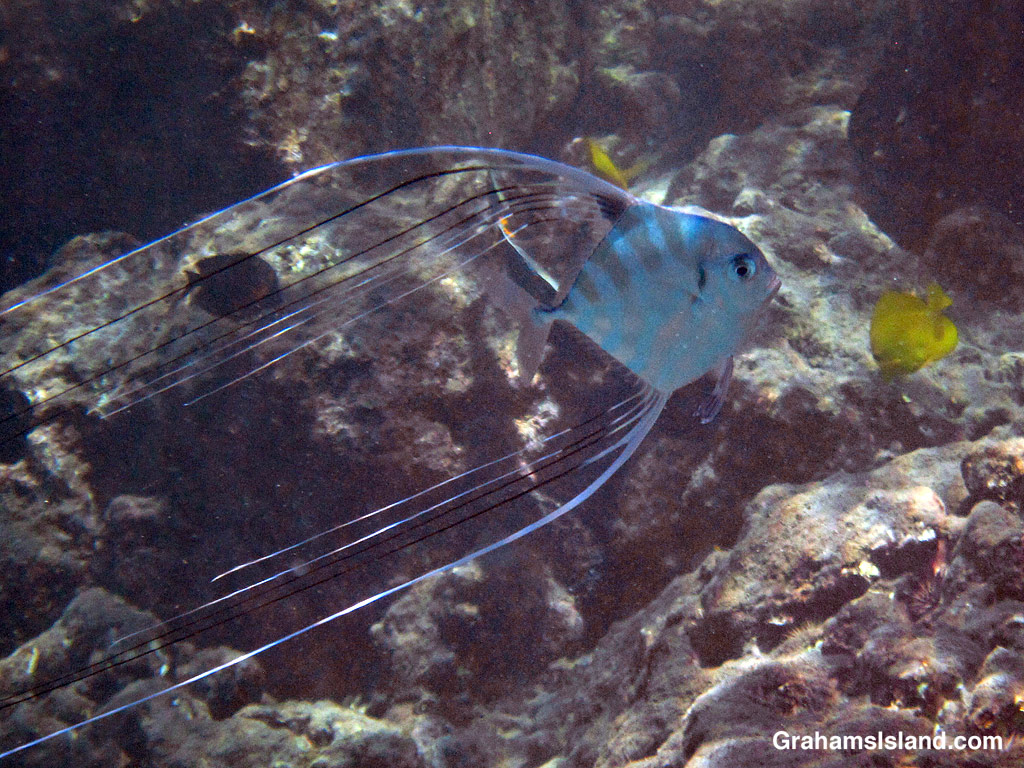
This week’s Friendly Friday challenge theme is ‘Fake.’ See more responses here. I don’t really have many photos that fit this bill, but this one does. This exotic-looking little fish is a juvenile threadfin jack. This is a fish that will grow up to become large and blocky, living in deep water and rarely seen by snorkelers of divers.
But as a juvenile, while still not often seen, it hangs around in shallow waters towing this extraordinary array of filaments. The theory is that the filaments make it look like a jellyfish and thus much less appetizing to predators. The fish will putter along, then throw in a few moves that make the filaments ripple. The first time I saw one doing this, I thought it was a jellyfish. It faked me out, which is exactly the point.
Usually, each year I see one, two, or even three of these juveniles in my local snorkeling bay, but this year I haven’t seen any or heard of them being spotted by anyone else. Not sure why this is. The water has tended to be murkier than is usual in the summer, but otherwise not much has changed. May and June is the usual time to see them, but I have seen them as late as September, so there’s still time. (This photo is taken from a previous year.)
I hope one or two do show up. Seeing them is one of the highlights of the snorkeling year for me.
It’s common to see shoals of small fish, like those in the photo, close to shore in the surge area, where waves crash ashore. Swimming in groups gives these young fish their best chance of making it to adulthood, and staying near rocks in shallow water is another form of defense for them.
I find it amazing that even little fish like these will accelerate and change direction almost as one.
The longnose butterflyfish gets its name for fairly obvious reasons, though it could equally be called the yellowsquare butterflyfish, blackspot butterflyfish or pailfin butterflyfish.
There are actually two different kinds of longnose butterflyfish. This one is the common longnose butterflyfish while there is also a big longnose butterflyfish, which is a little larger and has a slightly longer nose. The Hawaiian name for both these fish is lauwiliwili nukunuku ’oi’oi which, according to John Hoover in his book The Ultimate Guide to Hawaiian Reef Fishes, Sea Turtles, Dolphins, Whales, and Seals, is the longest of all Hawaiian fish names. In the Hawaiian name, lauwiliwili means ‘leaf of the wiliwili tree,’ nukunuku means ‘beak,’ and ’oi’oi means ‘best’ or ‘sharp.’
These two photos were taken at different times, different years in fact, of one of the beaches at Kaloko-Honokohau National Historical Park. The park is just north of Kailua Kona, the largest population center on the west side of the island. It’s a park I visit at least two or three times a year because it’s easily accessible and is a good place to see turtles, on the beach or in the water, and also birds on ’Aimakapa Fishpond, on the inland side of the sand.
The top photo looks north (that little lump on the wet sand is a resting green turtle). The bottom photo looks south (those little white specks are people). The thing is, these two photos are how the beach looks every time I visit. A few people will walk along it, but most go to the more protected beach at the south end of the park. And this situation is similar to many on the Big Island. If you’re willing to walk a quarter or half mile from any beach nearest the parking lot, then peace and solitude is almost certainly yours.
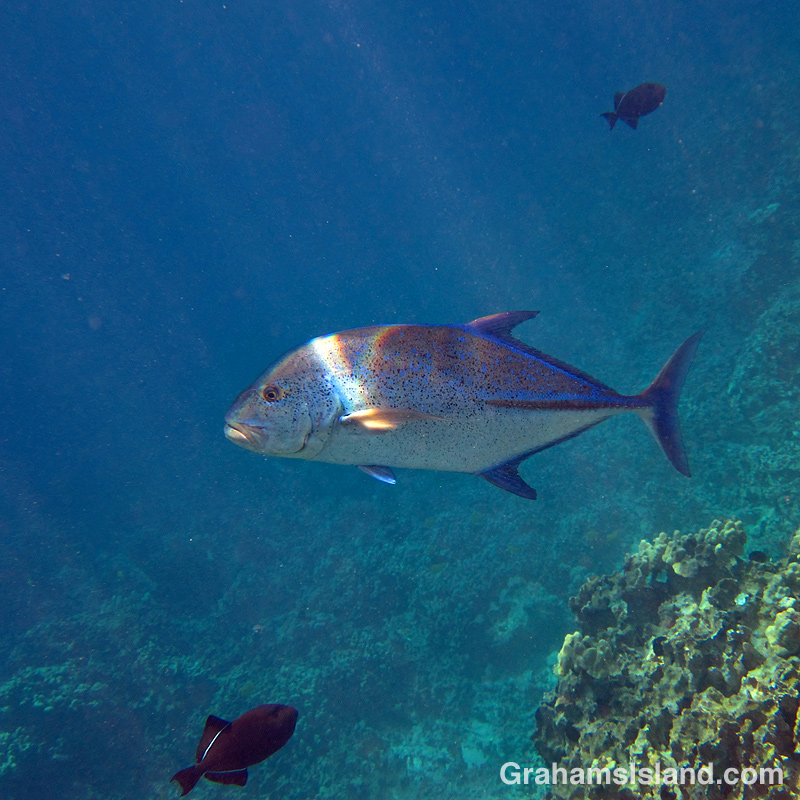
A couple of bluefin trevallies seen while snorkeling in Kealakekua Bay. The area is a marine conservation district where fishing is prohibited. In general, I’ve found that fish in such districts are less skittish and more likely to approach snorkelers, so it’s a good place to get photos of some otherwise elusive fish.
Bluefin trevallies aren’t exactly elusive, but these two passed close by, unperturbed by my presence.
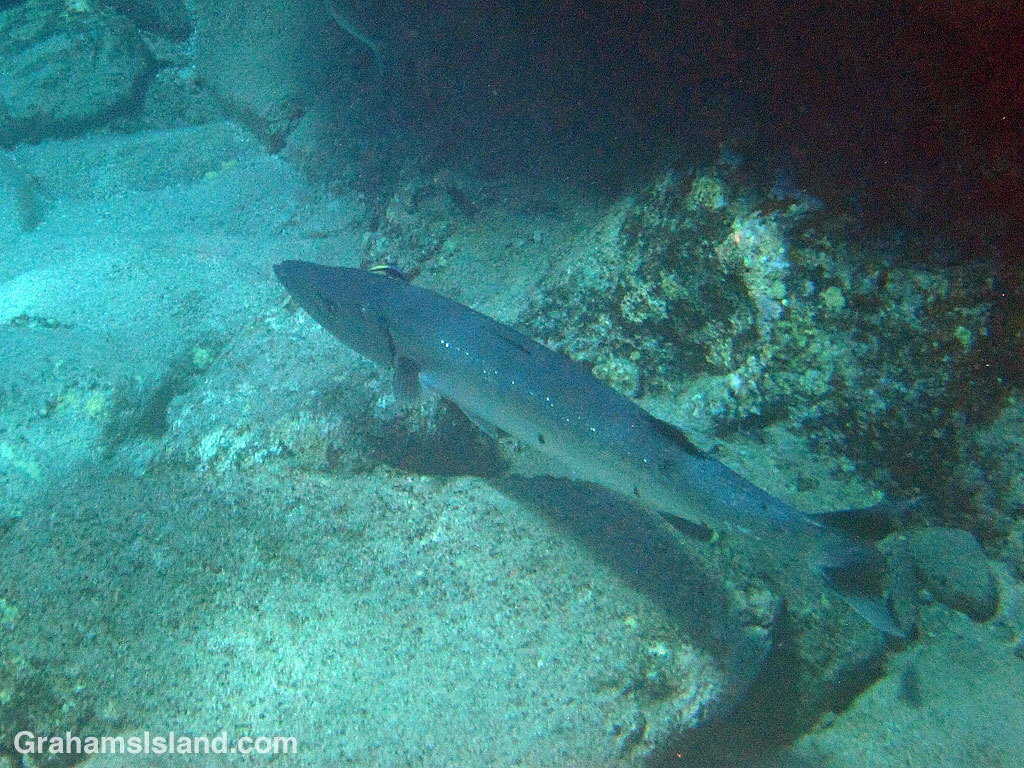
Great barracudas give me the willies, more so than sharks or most anything else in the ocean. There’s something about their appearance and how they hang motionless in the water that I find unnerving.
A little way south of my usual snorkeling spot, there’s a concentration of these fish that always rattles me as I swim through. Most of the barracudas I see are two feet long or less, but there a few among them that are much bigger than that. When I run into them, I’m leery about pointing my camera at them in case that upsets them in any way, because they don’t look like fish that would take kindly to being upset.
On this day, I was swimming with a friend when we came upon this very large great barracuda, just hanging in the water. Turned out it was being cleaned. The little blue and yellow fish above the head of the barracuda is a cleaner wrasse. These little fish set up store in different areas and clean mucus, dead tissue and parasites off other fish, which make regular visits to take advantage of this service.
Many fish being cleaned have an aura of great contentment while it’s going on, and this barracuda also looked quite relaxed, to such an extent that I lost my trepidation about it and got a bit closer than I normally would.
The wrasse is probably around 3 inches in length which would mean this barracuda is probably around 4 feet long.



 This week’s Friendly Friday challenge theme is ‘Fake.’ See more responses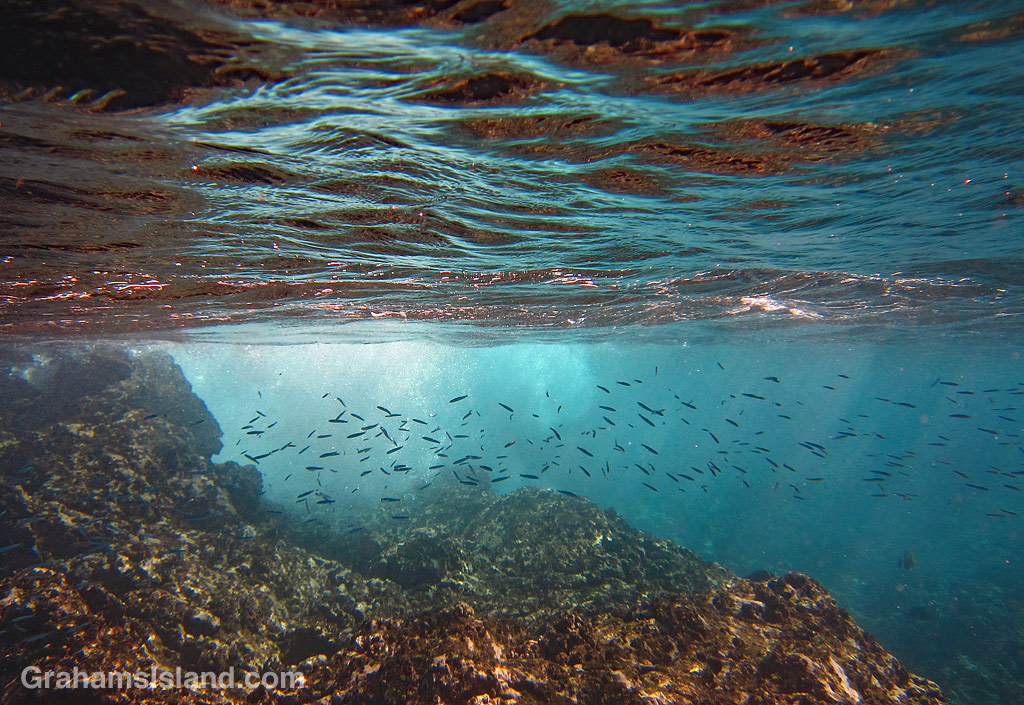


 Graham's Island