Category Archives: In The Water

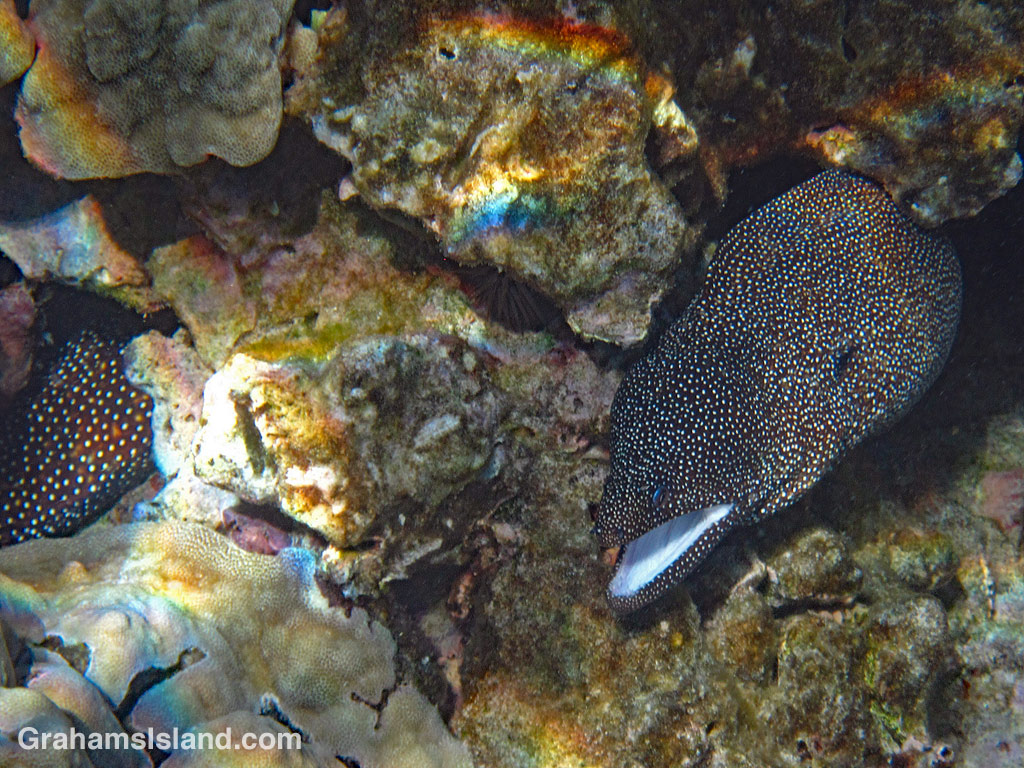
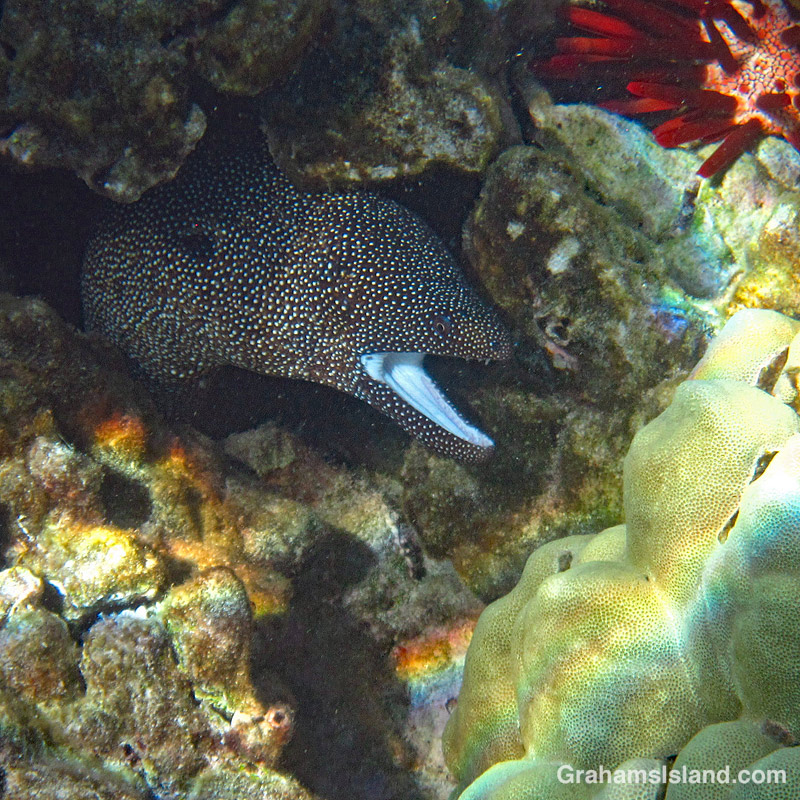
Whitemouth moray eel in a tight spot

Whitemouth moray eels can squeeze into the tightest spots on the reef and are often seen with just the head sticking out. They’re easy to identify with their bright white mouths, which they’re constantly opening and closing. While this activity looks somewhat menacing, they’re actually forcing water over their gills in order to breathe. That’s not to say that, if you waggle your finger in the face of an eel, it won’t bite it off so, as with most creatures in the water, it’s best to keep at a reasonable distance and be respectful of them.

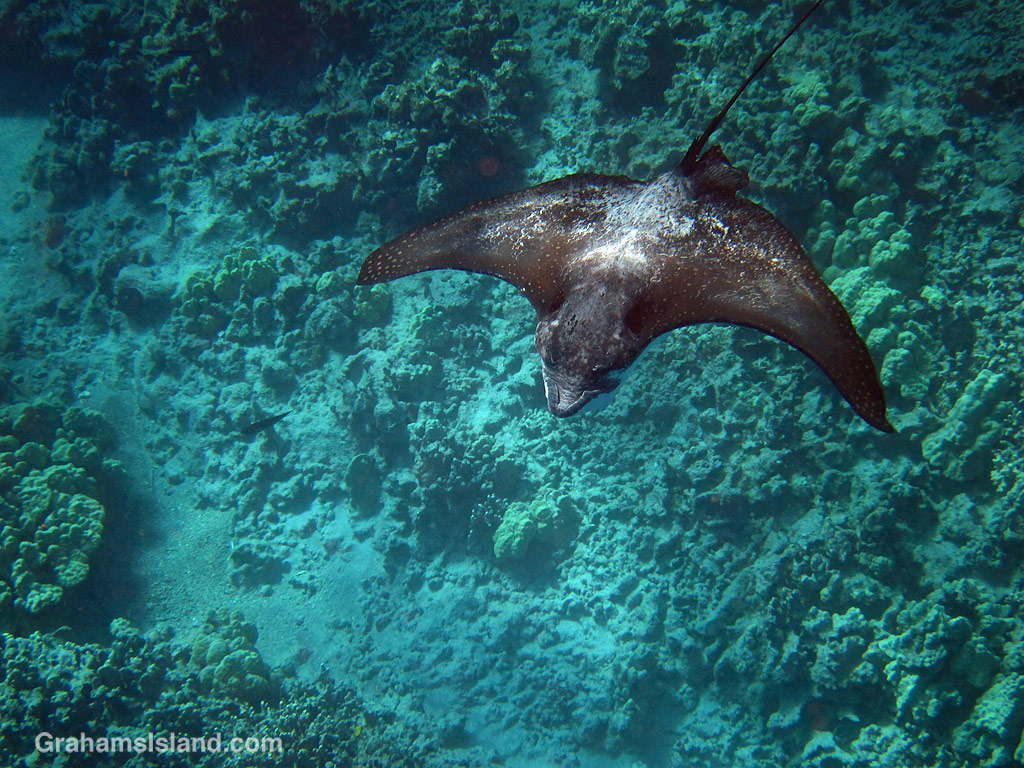
A senior spotted eagle ray

This spotted eagle ray is a regular visitor to one of the spots where I go snorkeling. It’s not the largest one I’ve seen but it is certainly bulky and has the biggest head I’ve ever seen on an eagle ray. It looks like an older ray which has been in the wars, with a number of scars and bits missing here and there.

The top photo shows the eagle ray headed my way. It curled up over the rocks and coral and then veered around and headed back out to deeper water. The middle photo gives a good view of the head as the ray prepares to use its large, duck-billed nose to dig into the sand in search of molluscs and other organisms that they feed on. The photo below shows the ray cruising a little way above the sea floor.

Peacock groupers

Peacock groupers are easily identified by their iridescent blue spots and, in larger specimens, lighter vertical bars toward the tail. They tend to be skittish fish, diving for cover when anything approaches. But these two were in an area where fishing is prohibited and I’ve noticed that the fish in these areas have figured out they don’t have to worry about people in the water (probably a big mistake).

Another trait of peacock groupers is that they will often hunt with eels and octopuses. That’s what these two were doing on this day. On the right of the photo, the tail of the eel can be seen sticking out from whatever cranny the eel was disappearing into.

But the thing I like best about this photo is the fish just above the head of the top peacock grouper. Not much can be seen of it except for two white areas that look like a mischievous grin. I suspect that these white spots are the bill of a large parrotfish, but I was never able to get enough of a look to be sure.

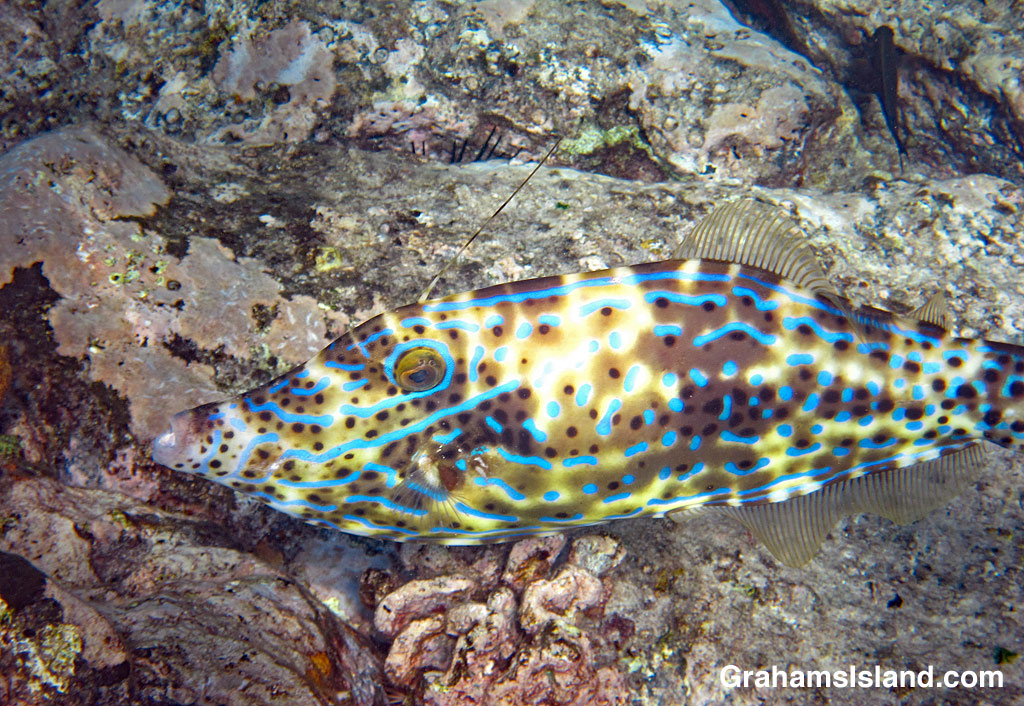
Scrawled filefish

Scrawled filefish are at their most scenic when they catch the light. The blue scribbles that cover their bodies glow with intensity. They’re a peculiar-looking fish with a flat body and long tail, and they can quickly change color to a camouflage pattern when needed.

In this photo, the two dorsal fins are visible. The forward one is just a thin spine which can be raised and lowered. The other one is very fine and often hard to see. In this photo it has a bit of a wave going on.

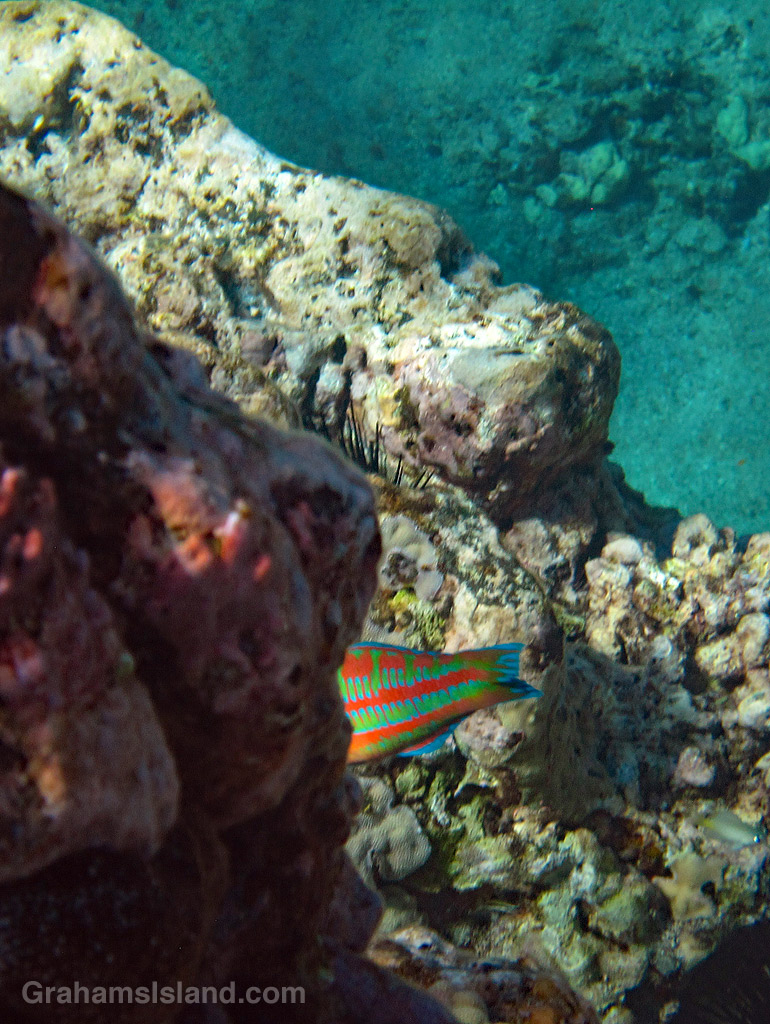
Crunchy parrotfish

This is, I think, an initial phase bullethead parrotfish. Parrotfish can go through several phases and look quite different in each one. Some also change sex.

So why is this titled ‘crunchy parrotfish?’ Well, I was watching this fish feed and when it feeds, it uses that big, white-rimmed beak to scrape algae and coral polys off the rocks. While it was doing so, I could clearly hear the quite loud crunching noise it made.

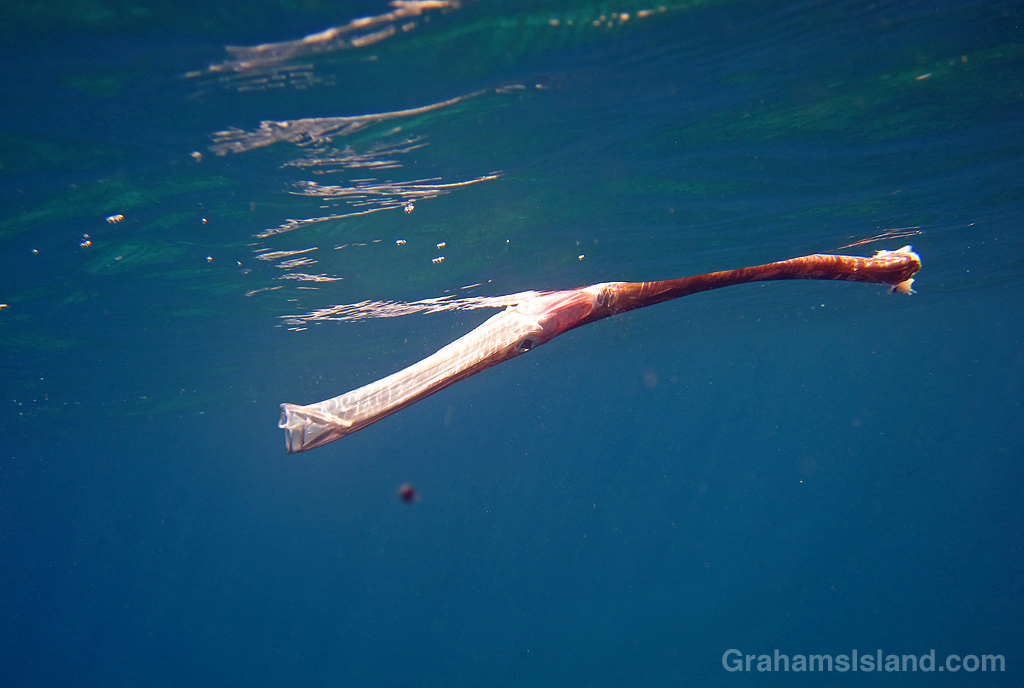
Better Days: Half a trumpetfish

I was swimming one day when I came across this. At first I thought it was a bit of wood, but then I saw the distinctive mouth of the trumpetfish, then the eye. It looked like it was once a good-sized trumpetfish until it encountered something that reduced it to its current state.

I swam around it taking a few photos, until I noticed a large barracuda swimming along with me. I thought, perhaps, it wasn’t a good idea to be near part of a dead fish with an apex predator in the vicinity, so I swam off, leaving the barracuda to make what it wanted of the remains.