Tag Archives: Barracudas

Great Barracuda

A Great Barracuda in the waters off Hawaii

Great Barracudas were a fish that really gave me the willies, more-so than sharks. But I’ve got used to them over the years and, while they still look mean and grouchy, I’ve found their actions are less threatening, not that I’m taking any liberties!

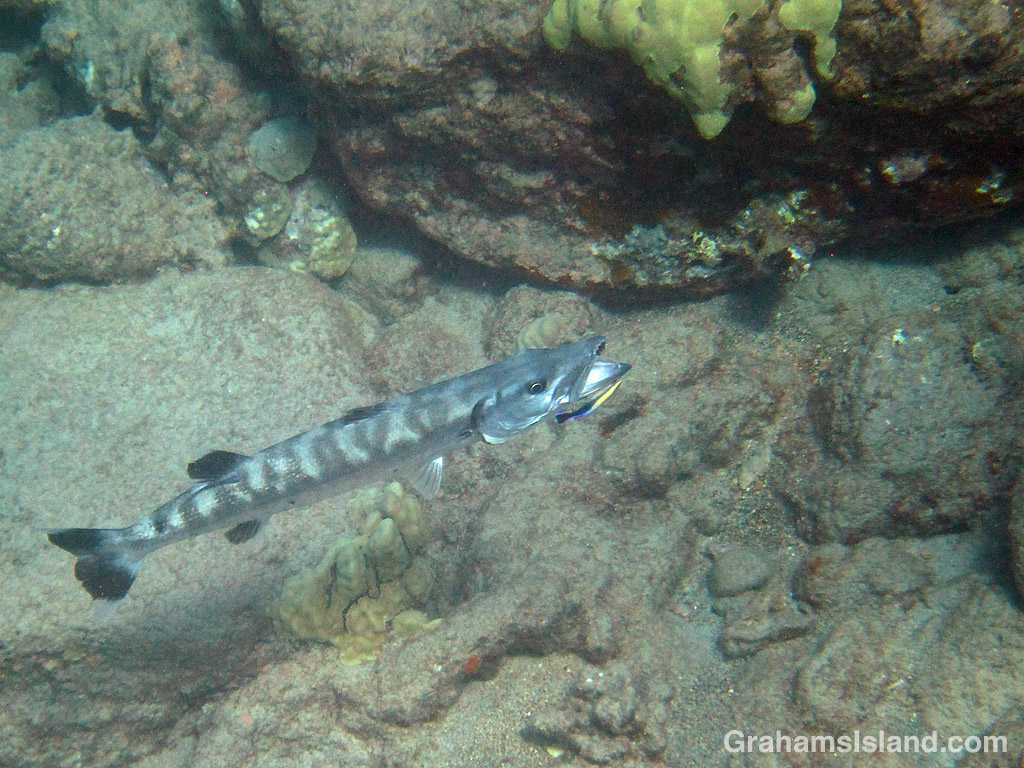
Yesterday, I saw the fish in the top photo heading straight towards me, before veering away at the last moment. Just checking me out I think. That one was in the two- to three-foot range. The one below was bigger, three- to four-foot, and it was getting cleaned. I always find this sight amusing as this giant fish hangs still in the water while little Hawaiian Cleaner Wrasses nibble away at parasites and mucus on the body and even inside the mouth!

A Great Barracuda in the waters off Hawaii

Getting the look

A Great Barracuda in the waters off Hawaii

My regular swim these days, passes through the territory of the local Great Barracuda ohana. It’s quite common for them to gather in the wake of swimmers, mostly I think, in case the swimmers are spear fishing and might snag something they can steal.

Last week, this barracuda approached me from the front and gave me quite the look, but since it was no more than a foot long, I wasn’t too concerned.

A couple of days ago, I had a similar encounter with a similar-sized fish. This time the barracuda approached from dead ahead and only turned away at the last minute.

A great barracuda in the waters off Hawaii

Had either of these been one of the giants, which can be three or four feet long and much bigger around, I’d probably have been wetting myself!

The second photo is posted for Bushboy’s Last on the Card photo challenge. See more responses here.

Meet the ohana

Great barracudas swim in the waters off Hawaii

A week or so ago, I was snorkeling when I happened to glance behind me and saw I was being followed by the local barracuda ohana. Ohana is the name for family in Hawaiian and these were Great Barracudas, which sometimes congregate together in this way. I think they follow people swimming in the hope that they’re spear fishing, and might catch something which they can steal. I offered no such rewards, so they soon moved on.

I see 10 in this photo, but I counted a dozen in the water, and there might have been more. They were all what I call small barracudas, perhaps a foot to 18 inches in length. The biggest around here get to be three- to four-feet long and much bigger around.

Fish at Viper Rock

Fish swim in the waters off Hawaii

On the coast where I snorkel, there’s a spot known locally as Viper Rock. This is where a very large Viper Moray Eel used to reside in a recess in the rock. I haven’t seen him lately, but it’s also a good spot for a variety of fish so I go down there regularly.

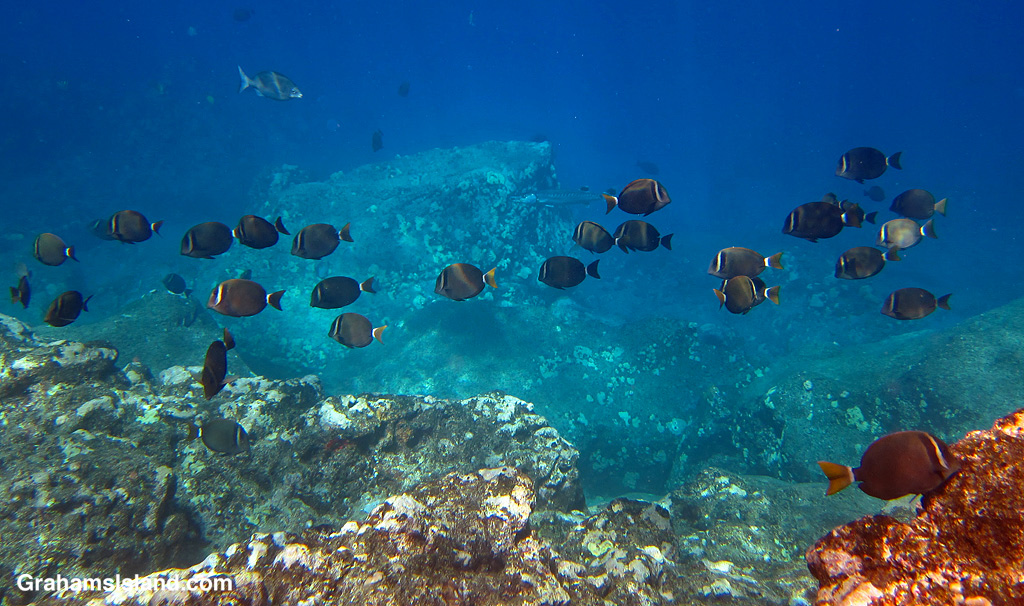
On this day, I approached the rock from the shore side and noticed these Whitebar Surgeonfishes swimming by. Then I noticed the Great Barracuda that can be seen in the background against the edge of the farther rocky outcropping. A few moments later I saw another one, and then a third.

It appeared that the barracuda ohana that frequents that area was around in force. Rather than cross to the other side of the ridge by Viper Rock, where the barracudas were, I returned the way I came. A couple of barracudas looked like they might follow, but quickly lost interest. Their interest in people appears to be related solely to the possibility that those people will snag some fish which the barracudas will then hope to steal.

Milkfish at Lahuipua’a Fishpond gate

Milkfish congregate at Lahuipua'a fishpond gate at Mauna Lani Hawaii
A sign next to Lahuipua'a Fishpond at Mauna Lani, Hawaii

Fishponds were places where the early Hawaiians used to raise fish for consumption. Lahuipua’a Fishpond at Mauna Lani is a very large pond which holds many Milkfish. Awa is their Hawaiian name.

These Milkfish were congregated at the entrance gate, no doubt hoping for someone to open it and let them out. The gates can be used for either purpose, but the idea of the ponds is that small fish can enter, but as they get bigger, they can’t get out. The fish in the top photo are far too big to escape through the grill.

There is another way out, as the sign in the second photo notes. Jacks and barracudas sometimes manage to get into the pools and will feed on the juvenile fishes. There are supposedly a couple of very large barracudas in this pool that have so far evaded capture and they’re probably living well off the inhabitants there.

A great barracuda

A great barracuda off the coast of Hawaii

I’ve mentioned before that great barracudas give me the willies more than sharks do. But the truth is, that while they look menacing, I’ve yet to see one being aggressive. The black fish in this photo wasn’t far from the barracuda, but was ignored by it as it swam by.

Even though they unnerve me, there are times when I just have to laugh. A couple of weeks ago I was snorkeling, puttering along as I looked around for things of interest, and I happened to look behind me. One of the very large barracudas was following me, about a body length behind. The instant I looked back, the barracuda turned away. It could have been a great photo, but I wasn’t ready for it and then the fish was gone. It was also a good illustration of the fact anything that might attack me in the water is highly likely to take me completely by surprise.

Barracudas will follow spear fishers in the water, hoping to snatch their catch, and I think because of this, they’ll follow anyone in the water in the hope that they might be in the fish acquisition business, too.

Cleaning a barracuda

A small cleaner wrasse works at removing parasites, dead tissue and mucus from a great barracuda. The service they provide is recognized by larger potential predators, which don’t harm these little blue and yellow fish, even when they go inside the mouth to clean.

Great barracudas are generally mostly silver with black marks on the tail fins and second dorsal fins. However, some great barracudas, such as this one, have black marks on other fins and their silvery sides are mottled with darker markings.