
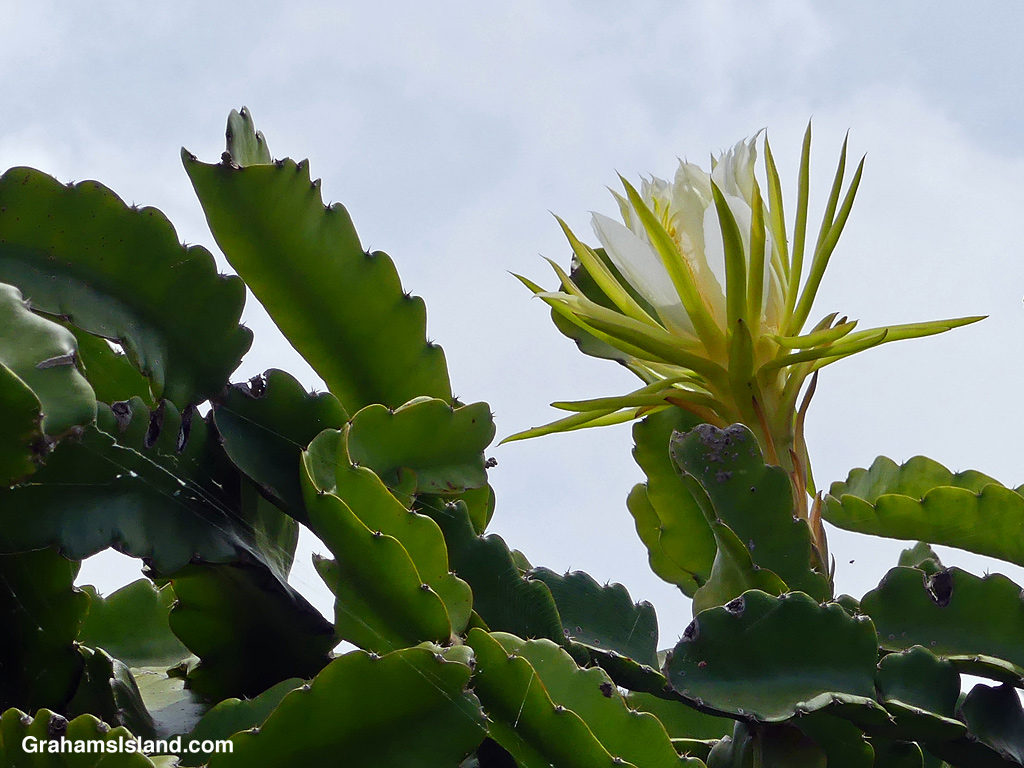
Dragon fruit is native to Central America, but is found in tropical and subtropical places worldwide these days. It grows on what used to be called the Hylocereus cactus, now known as Selenicereus cactus. It comes in three varieties, but the most common, with pink-skinned fruit and white flesh, is Selenicereus undatus.


This cactus is a climber and the one I’ve been taking photos of is growing up a tree branch in my neighbor’s yard. It takes a while for the plant to become mature enough to flower. The flowers bloom at night and are short-lived. I didn’t know this when I was driving to work one early morning and, in Kawaihae, saw two dragon fruit plants with a stunning array of blooms. I thought, I must get a photo of those on the way home and, amazingly, remembered this later in the day. But when I passed through Kawaihae, every single bloom had already wilted!
I did get photos of the neighbor’s flowers, but they were equally short-lived. After that it takes a while for the fruits to form, with the dead flower still hanging from it.


The fruit grows over time, but it’s not until it starts turning pink that it needs to be more closely watched. Ripe fruit will become a little softer to gentle pressure, as with avocados, and the scaly spikes sticking out from the fruit will start to turn brown and wilt.

Once the fruit is ripe, it can be cut open to reveal the seed-speckled flesh, which can easily be scooped out with a spoon. The flavor is a bit like a cross between kiwifruit and pear.
 Graham's Island