Tag Archives: Snorkeling

Red Reef Lobster molt

A Red Reef Lobster molt in the waters off Hawaii

I saw this scene almost immediately after getting in the water, the bright red catching my eye. At first I thought it was some kind of garish fishing lure, snagged in the rocks. Then I saw other details and figured it must be some kind of marine invertebrate and probably a molt.

When I got home, checked the photos, and consulted my marine invertebrates book, I realized it was the molt of a Red Reef Lobster. Its sensory hairs can clearly be seen on the claw. These lobster are active at night and so rarely seen, but they can live in shallow waters and they molt every 6 weeks or so.

I doubt I’ll ever see a live Red Reef Lobster, so this is probably as close as it gets.

Spot the Scorpionfish

A Devil Scorpionfish in the waters off Hawaii

When I get to the end of a swim, I keep looking around because, as the water shallows, it’s possible to see a wide variety of fish and marine invertebrates.

Recently, I was about 10 feet from my exit point when I saw the Devil Scorpionfish in the photos. That’s right, there’s a fish in the top photo and it’s not the Bright-eye Damselfish on the left. The second photo gives a better view, where the fins stand out a bit and a flash of orange can just be seen on the left pectoral fin. A Devil Scorpionfish will flash these orange fins, probably as a warning to predators, since it has venomous spines.

Don’t feel bad if you can’t find the fish in the top photo. I wouldn’t have spotted it if it had been stationary, but in the shallow water, I noticed a small movement and quickly realized what I was looking at. I’ve seen a Devil Scorpionfish in this area before so this might be the territory of this same fish.

Whitemouth Moray Eel

A Whitemouth Moray Eel in the waters off the Big Island Hawaii

I’d just got in the water recently when I saw this Whitemouth Moray Eel hunting with some Bluefin Trevallies. The trevallies carried on, but the eel was torn between joining them and retreating into the crack it was emerging from. In the end it did neither and I got a few photos before carrying on with my swim.

Dwarf Moray Eel hunting

A dwarf moray eel swimming in the waters off Hawaii

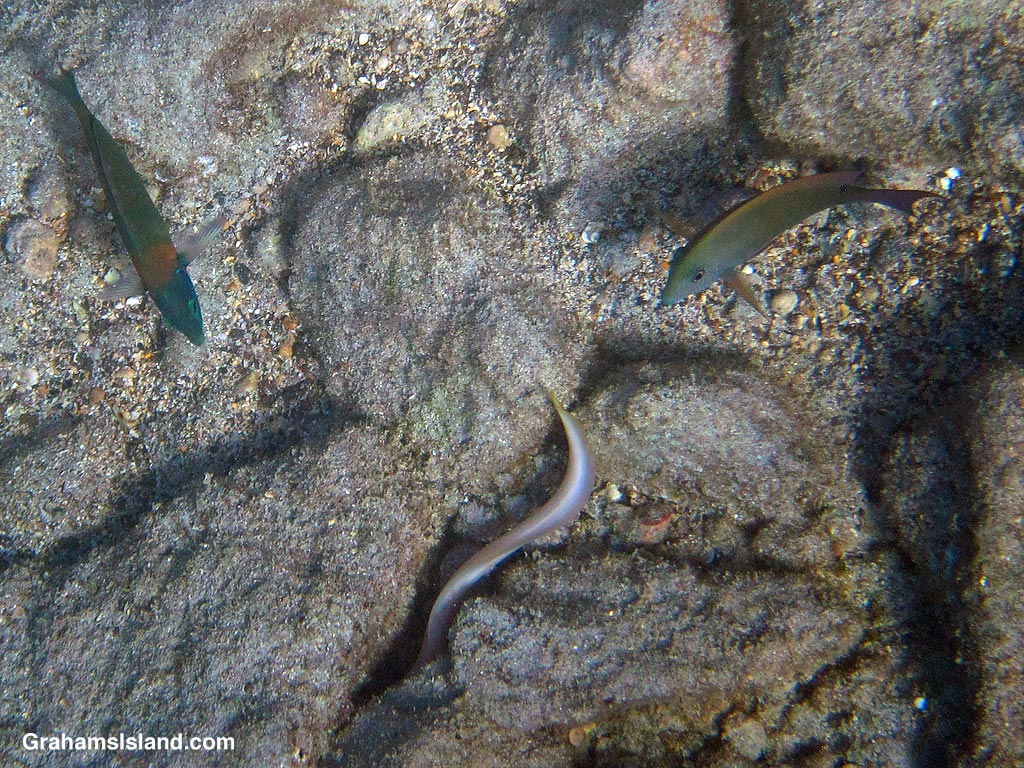
I was snorkeling recently when I saw this Dwarf Moray Eel hunting with a small Saddle Wrasse. It promptly disappeared under a rock and I didn’t expect to see it again. But I was in no hurry, so moved away a bit and kept watch. After a while the eel poked its head out, hesitated, then swam out.

I snapped these two photos, the first as it emerged and the second as it disappeared again. I like how, in the top photo, the eel oozes out of a hole no bigger around than it is, which is less than an inch! These small eels typically are less than a foot long.

A dwarf moray eel swimming in the waters off Hawaii

Hawaiian Gregory

An endemic Hawaiian Gregory in the waters off Hawaii

This endemic damselfish is mostly black or brown with a mottled distribution of light and dark scales, but it’s easily identified by its yellow eyes. It eats filamentous algae and is said to ‘farm’ the algae in its territory, which it defends vigorously against other algae-eaters after its crop.

Convict Tangs and a Surge Wrasse

A surge wrasse swims in front of a school of convict tangs in the waters off Hawaii

I was photographing this school of Convict Tangs when I saw this initial phase Surge Wrasse swimming in the opposite direction. This is not a fish I see too often and it’s one which my fish book describes as ‘one of the most difficult Hawaiian fish to photograph.’ I think this is because of its scarcity and it’s tendency to spend a lot of its time close to shore in shallow, surging water.

A Manta Ray zips by

A manta ray swims in the waters off Hawaii

It’s been quite a while since I last saw a Manta Ray while snorkeling, so I was thrilled a few days ago when I saw a familiar shape heading towards me. It was low down in the water and when it saw me it veered away a bit, carrying on at a good clip despite swimming into the current running that day.

The manta was big, with a 10 to 12 foot wingspan, and a lot of pale markings on top. It seemed in good shape though its left wingtip appeared to be permanently curled up. I hoped it might slow down or turn, but that was not to be and it soon disappeared to the south.