Monthly Archives: June 2016

Bluefin trevally

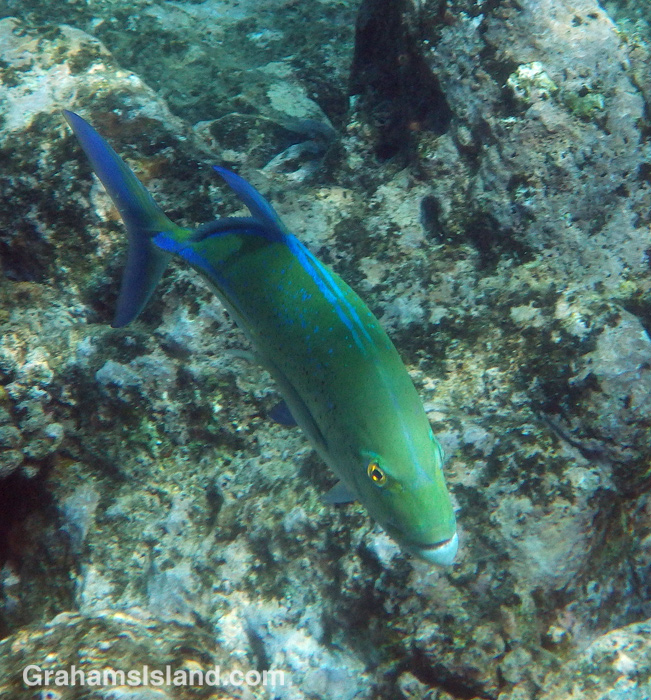
A large adult Bluefin Trevally.A bluefin trevally in Big Island waters.
These are another of those fish that look quite different when they catch the light, with blue highlights standing out. They also look different as they age. The top photo is a large adult, the other two, a small younger adult.

These fish are big time predators, eating many other species of fish. I find this interesting because I often see bluefin trevally when I’m in the water. I see them pass by other fish and I’ve never seen them strike or seen other fish particularly bothered by their presence. One day …

In my attempts to identify what I see in the water, I use John P. Hoover’s book The Ultimate Guide to Hawaiian Reef Fishes, Sea Turtles, Dolphins, Whales, and Seals. His website is hawaiisfishes.com.


A small adult bluefin trevally.

Signs: Temporary closure

This section of the Ala Kahakai trail on the Big Island has been temporarily closed for 10 years now.
Back in 2006, an earthquake off the west coast of the Big Island caused extensive damage. One of the casualties was this trail. Part of the cliff it traverses slid into the sea and the path was deemed unsafe. But this wasn’t just some local trail. It’s the Ala Kahakai trail, also known as the King’s Trail, which followed the coast from North Kohala all the way along the west and south coasts to the Puna District in the southeast of the island.

Just beyond this sign is a private gated community and specifically a very large, very expensive house (currently available for 10 or 11 million dollars – it’s been for sale for a while). The trail wasn’t popular with the home’s original owners, who put up a barbed wire barrier (well, I suspect they didn’t actually do the work).

Anyway, the trail has been temporarily closed for 10 years now and, as is the way around here, I suspect it will remain permanently temporarily closed. That is, until the next significant earthquake detaches another stretch of cliff and sends the big house sliding into the ocean. Then, who knows?

Palenose parrotfish

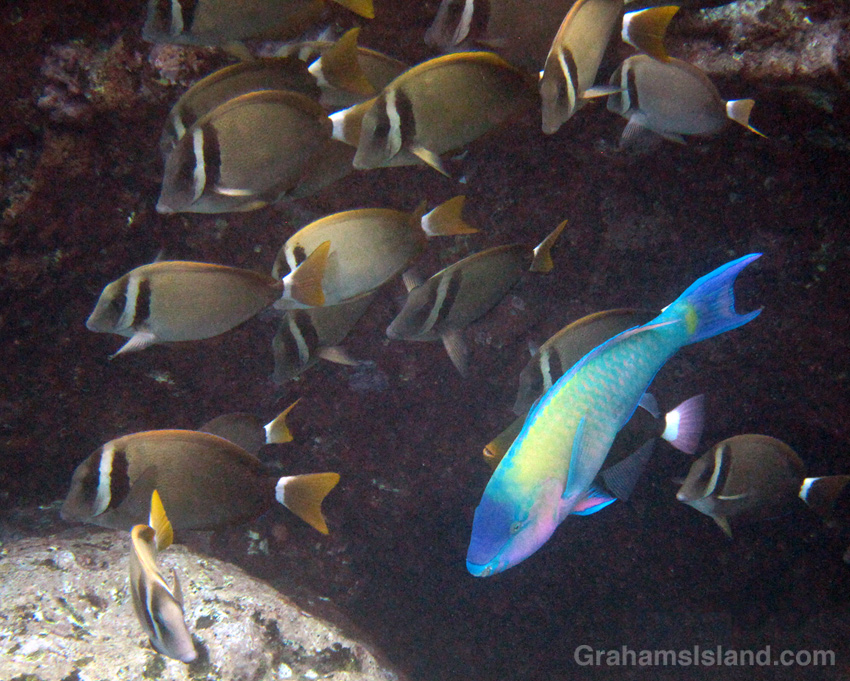
A palenose parrotfish swims with a school of whitebar surgeonfish.
This is a palenose parrotfish passing through a school of whitebar surgeonfish. Most parrotfish attain this kind of color when they reach adulthood. Often times it appears somewhat muted, but when the sun catches them they are iridescent and stand out as much or more than anything else in the water.

In my attempts to identify what I see in the water, I use John P. Hoover’s book The Ultimate Guide to Hawaiian Reef Fishes, Sea Turtles, Dolphins, Whales, and Seals. His website is hawaiisfishes.com.