

This week’s Friendly Friday challenge theme is ‘Unusual.’ See more responses here.
Nēnē, the endemic Hawaiian geese, are long-distant relatives of Canada geese. They were listed as an endangered species, until the end of last year when their status was changed to ‘threatened.’
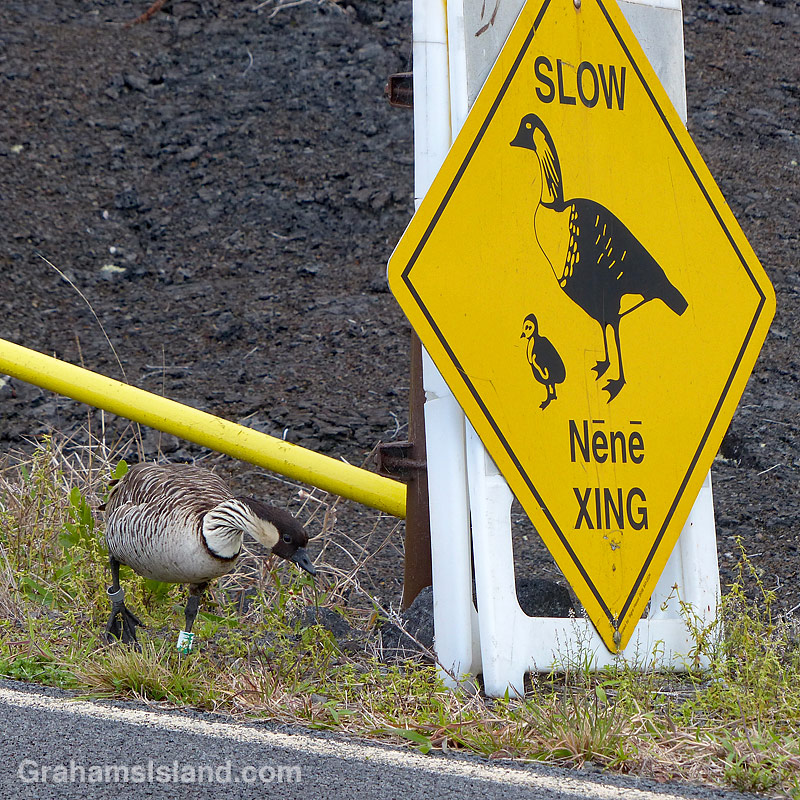
Because of the nēnē’s precarious numbers, it isn’t unusual to see “Slow, Nēnē Crossing” signs, particularly in areas where nēnē breed. Because their numbers are on the rebound on the Big Island, it’s also not unusual for me to see nēnē, on my daily walks or when I was working. But in my years on the island, I never saw a nēnē anywhere near one of the warning signs, until earlier this year, just before the lockdown. This sign and these two birds were in Hawaii Volcanoes National Park, where a fair number of the birds live and breed.
I had to stop and get a photo of this unusual event, fortunately without getting myself or the birds killed (it’s a busy, narrow road). The only disappointing thing about this encounter was that neither of the nēnē actually crossed the road. I guess I’ll have to wait another seven years to witness that.
 Graham's Island
Well in the first photo the Nenes’ necks are crossing …
LikeLiked by 1 person
You know, I never even thought of that!
LikeLiked by 1 person
😊
LikeLiked by 1 person
How fortuitous that you were there to capture that moment. Like a broken clock, the sign was right some of the time.
Thanks for joining in on the Friendly Friday challenge, Graham.
LikeLiked by 1 person
Right place, right time, but I guess that’s half the battle in photography.
LikeLike
Indeed. Timing is it determines light and subject matter.
LikeLiked by 1 person
I seem to think that at one point there was more birds in captivity in the U.K. being bred for possible reintroduction than there was left in the wild.
LikeLiked by 1 person
They were basically extinct in the wild here in the 1950s. There was a breeding program on the Big Island and also at Peter Scott’s Slimbridge Wetland Center, and the numbers here were restored from those birds. It’s actually quite a success story though they’ll likely need some kind of continuing protection to maintain that progress.
LikeLike
It was the Slimbridge birds I was thinking of.
LikeLiked by 1 person
I believe they still have a good number of the birds there.
LikeLike
I had to look and compare to a Canada goose to see the difference. They are similar. The stuff I learn from your site Graham!
LikeLiked by 1 person
You’re on shaky ground learning anything from me!
LikeLiked by 1 person