Category Archives: Fish

A fivespot of fourspots

A group of Fourspot Butterflyfish
These are fourspot butterflyfish, so called because the two spots seen here on each of them are matched by two more on the other side.

In my attempts to identify what I see in the water, I use John P. Hoover’s book The Ultimate Guide to Hawaiian Reef Fishes, Sea Turtles, Dolphins, Whales, and Seals. His website is hawaiisfishes.com.

Whitemouth moray eel in a tight spot

A whitemouth moray eel off the Big Island
Whitemouth moray eels are typically seen wedged into cracks, usually with just a head sticking out. This good-sized eel was jammed in particularly tightly, under a lump of overhanging coral. I think I saw the same eel again, a couple of days later, in a different spot, but in equally cramped conditions. Perhaps it’s a bit agoraphobic.

Bluespine unicornfish

A bluespine unicornfish swims off the Big Island.
When I’m out snorkeling, some fish don’t seem at all bothered by my presence, continuing to go about their business. Others will dart away the moment I appear (nothing personal I hope). Bluespine unicornfish fall somewhere in between. Mostly when I see them they appear unconcerned, but the distance between us inexorably grows.

No prizes for deducing how they get their name.

In my attempts to identify what I see in the water, I use John P. Hoover’s book The Ultimate Guide to Hawaiian Reef Fishes, Sea Turtles, Dolphins, Whales, and Seals. His website is hawaiisfishes.com.

Hawaiian whitespotted toby

A female Hawaiian whitespotted toby preparing to lay eggsA pair of Hawaiian whitespotted tobies preparing to lay and fertilize eggs
Hawaiian whitespotted tobies are small pufferfish, under 4 inches long. The one in the top photo is a female, probably looking for a spot to deposit her eggs. The toby following her (second photo) is a male. After she’s deposited her eggs he’ll fertilize them. Neither will stay with the eggs.

A couple of days after taking this photo, I was in a different location when another pair of these tobies zipped up to me and went by a foot away. In that case, it was two males, the one vigorously defending its territory from the interloper.

In my attempts to identify what I see in the water, I use John P. Hoover’s book The Ultimate Guide to Hawaiian Reef Fishes, Sea Turtles, Dolphins, Whales, and Seals. His website is hawaiisfishes.com.

Happy gray chub

A gray chub in the waters off the Big Island
I watched a small shoal of gray chubs going back and forth in shallow water and was pleased to get a photo of this happy fish. To me, it looks like it might be about to break into a song and dance routine.

In my attempts to identify what I see in the water, I use John P. Hoover’s book The Ultimate Guide to Hawaiian Reef Fishes, Sea Turtles, Dolphins, Whales, and Seals. His website is hawaiisfishes.com.

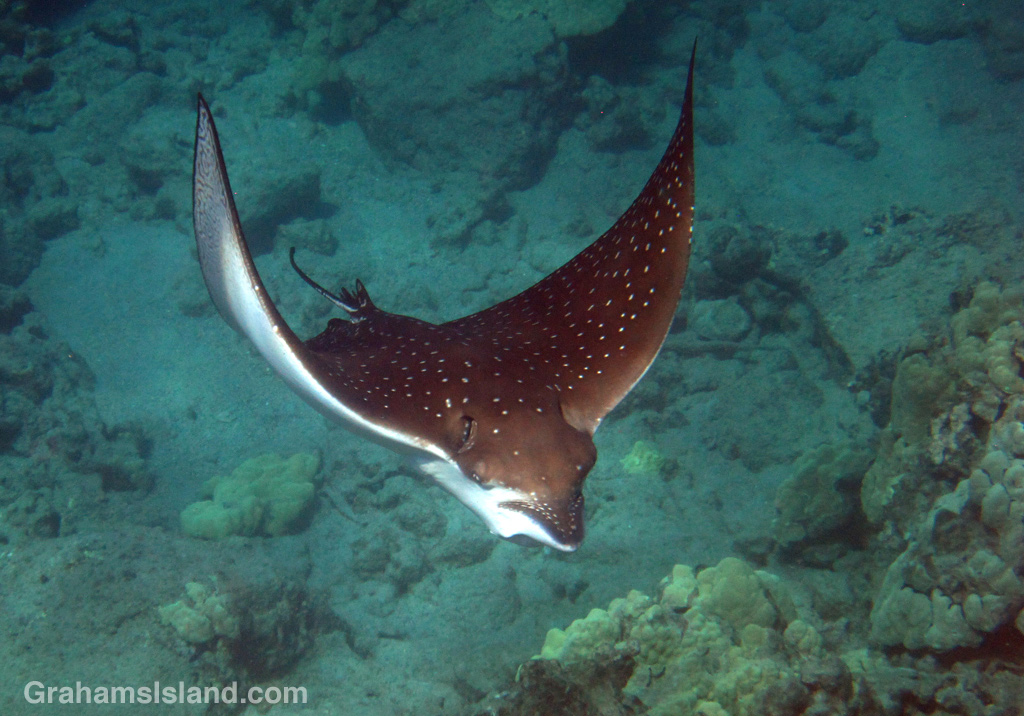
Spotted eagle ray

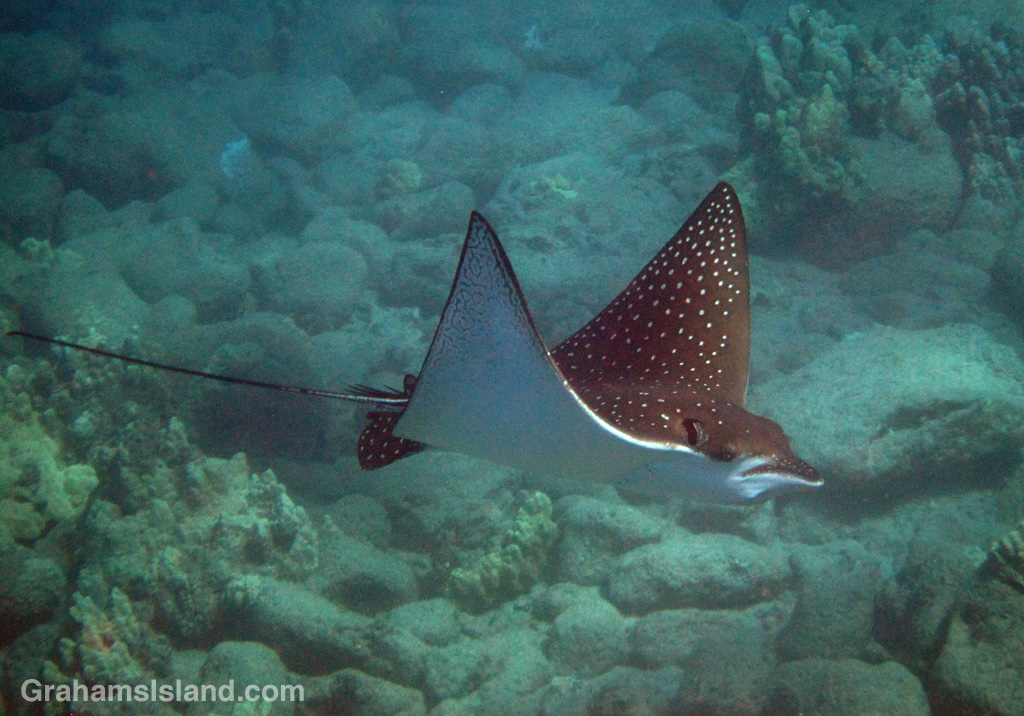
A spotted eagle ray swimming off the Big Island.A spotted eagle ray swimming off the Big Island.

During the summer months, the west coast of the Big Island sees more southwest or westerly swells. These tend to roil the waters and reduce visibility. So it was a pleasant surprise recently, to dip into the water and find good visibility for the first time in a while.

The good visibility wasn’t matched by the appearance of rarely seen, exotic fish. Only the ‘usual suspects’ were to be found, which is no bad thing. I enjoy watching even the most common of fish. However, I confess I was feeling a tad disappointed at having my camera and good conditions, but not seeing anything that especially fired my enthusiasm.

As if on cue, I looked up to see three spotted eagle rays coming toward me. One quickly slipped away and a second came and went. The third (second photo) cruised back and forth nearby, keeping an eye on me as I kept an eye on it. It had clearly lost its tail at some point. I’m not sure if a new one will grow back. In the bottom photo, the venomous spines at the base of the tail can be seen, though the venom is not nearly as toxic as that of some ocean dwellers.

After a while, the two remaining rays headed out toward deeper water and disappeared taking with them any disappointment I’d been feeling.

For more information about eagle rays, go to bioweb.uwlax.edu/bio203/s2014/hayward_paig/index.htm
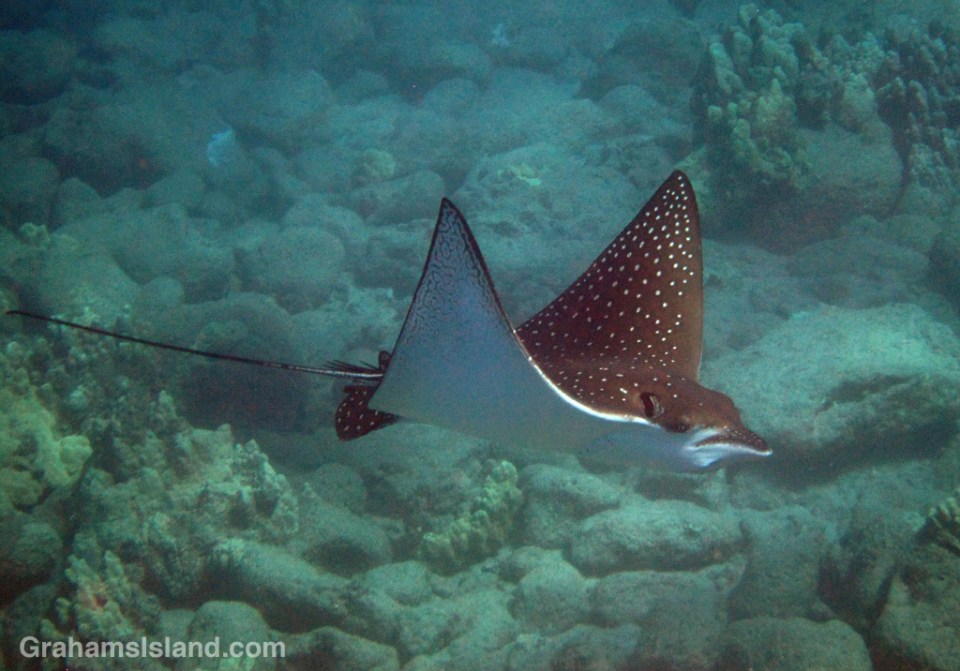
A spotted eagle ray swimming off the Big Island.

Hawaiian flagtails

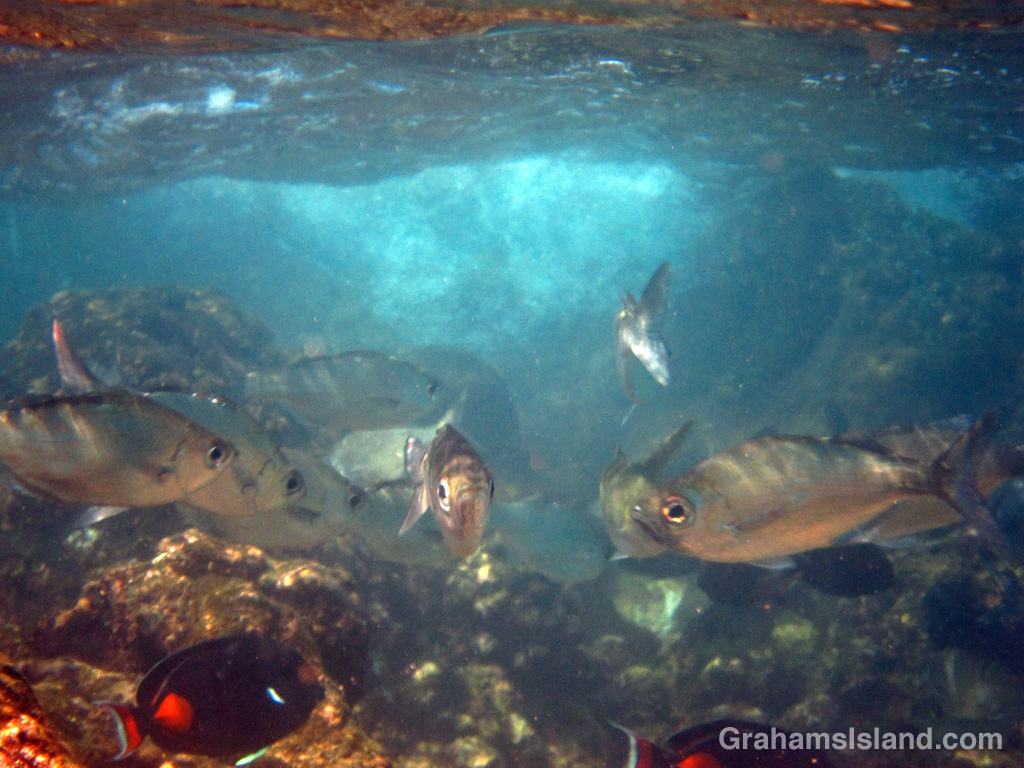
Hawaiian flagtails and achilles tangs in shallow surging water
Hawaiian flagtails are night feeders, but by day they congregate in shallow areas with a lot of surge as a protection against predators. This shoal was swooshing back and forth in the company of several achilles tang.

In my attempts to identify what I see in the water, I use John P. Hoover’s book The Ultimate Guide to Hawaiian Reef Fishes, Sea Turtles, Dolphins, Whales, and Seals. His website is hawaiisfishes.com.

Ember parrotfish

An ember parrotfish and christmas wrasse.

As parrotfish grow, they go through two phases, initial and terminal. Initial phase parrotfish can be male or female, but in some species are always female. I ran a photo of an initial phase ember parrotfish here.

This ember parrotfish is in its terminal phase and is what is known as a supermale. Terminal phase parrotfish are always male and, as John Hoover notes, ‘supermales are almost always reversed-sex females.’ Supermales also tend to brightly colored, like this one.

The smaller, following fish is a Christmas wrasse. Parrotfish are often trailed by one or other of the wrasses, looking to latch onto things to eat, dislodged by the larger fish grazing for algae on the coral.

In my attempts to identify what I see in the water, I use John P. Hoover’s book The Ultimate Guide to Hawaiian Reef Fishes, Sea Turtles, Dolphins, Whales, and Seals. His website is hawaiisfishes.com.