
This group of young humuhumu-nukunuku-ā-pua-a are almost certainly wishing everyone Mele Kalikimaka as they circle their coral tree.

This group of young humuhumu-nukunuku-ā-pua-a are almost certainly wishing everyone Mele Kalikimaka as they circle their coral tree.
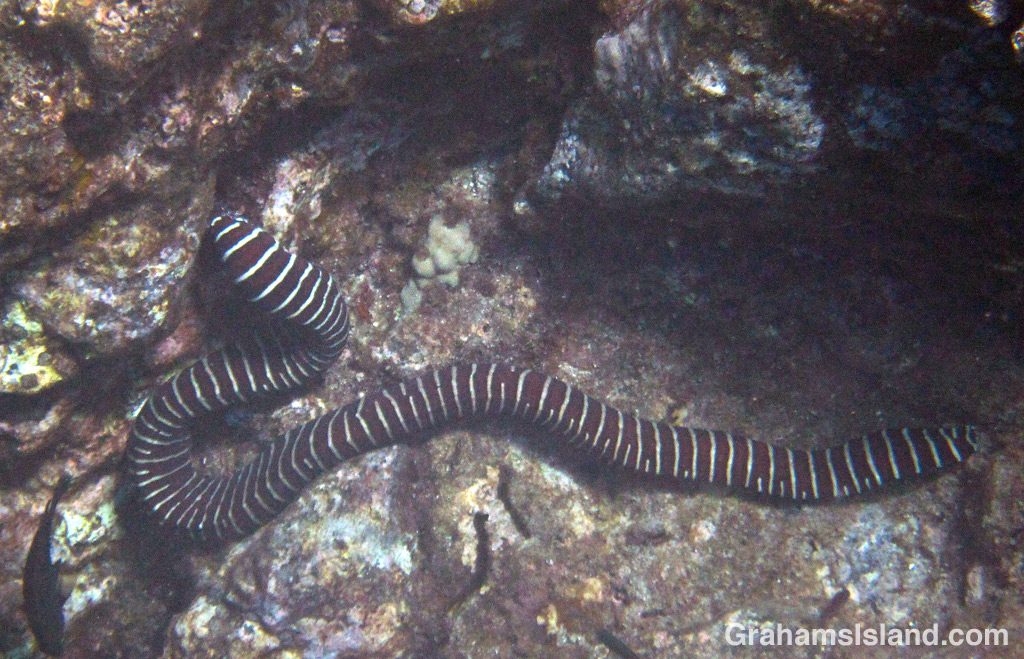
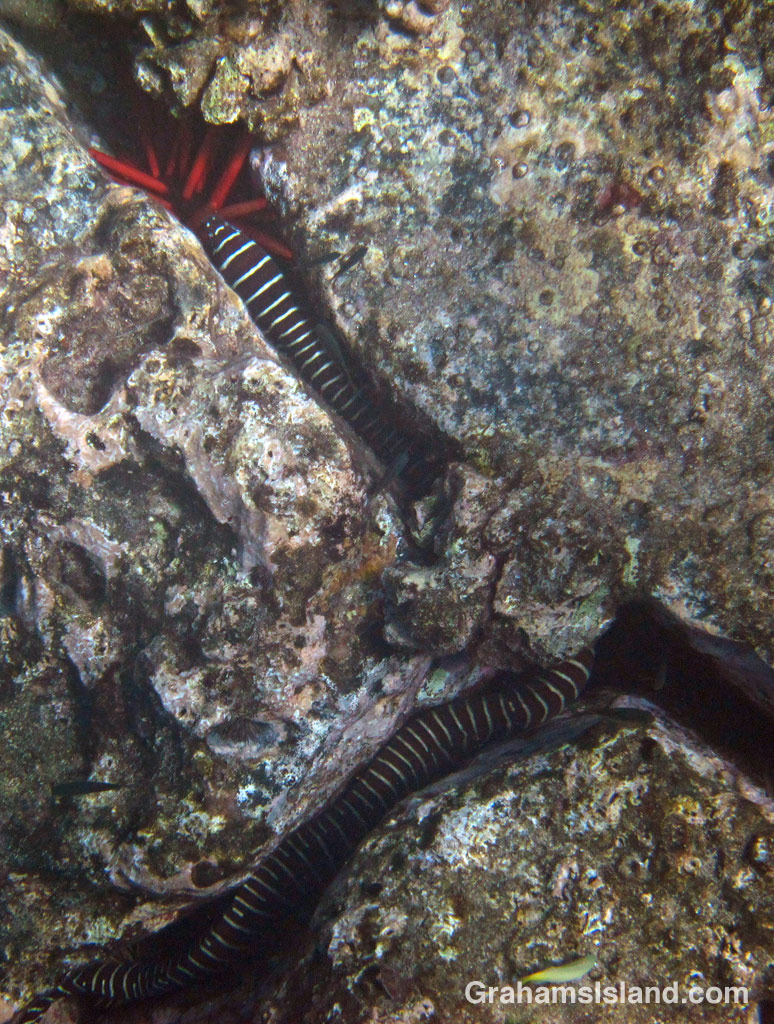
The distinctive markings of a zebra moray eel make it easy to spot when it’s out in the open, but they’re not as common as whitemouth morays. This one was in a relatively shallow area, working through cracks in the rock and coral.

A pair of moorish idols swim in shallow water at Kaloko-Honokohau National Historical Park.
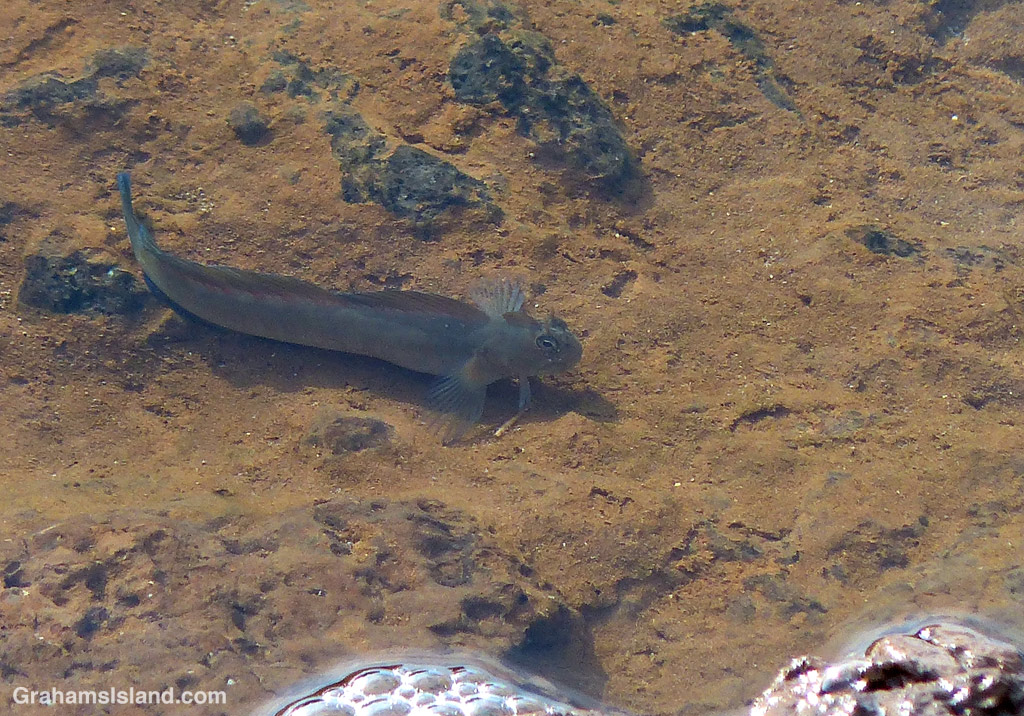
Hawaiian zebra blennies are a staple of rocky tide pools, living off organic detritus that accumulates in the pools. Taken by surprise, they’ll shoot off, over the rock, into the next tide pool.
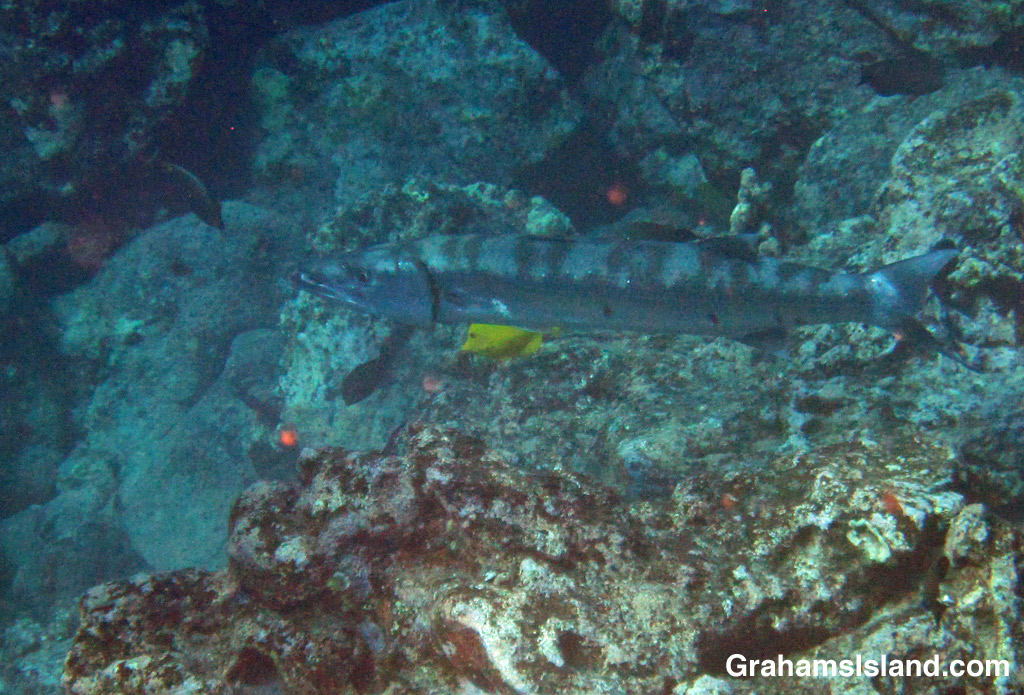
Great barracudas are a fish I see every once in a while when I’m snorkeling. They’re generally about two feet long, with a somewhat menacing look, and a languid swimming style. They tend to keep their distance, easing away until they melt into the distance, which is fine with me since they’ve been known to attack humans.
Recently, I was snorkeling at a regular spot and approaching a shallower area where I usually find a variety of reef fish. I spotted the fish above from quite a distance. It was hanging motionless in the water. As I closed in I could see that this barracuda was huge, twice the size of any I’d seen previously in both length and girth.
I wanted to get closer for a photo, but I was also wary. Previous barracudas that I’d seen had looked capable of inflicting a nasty bite. This one looked like it could remove a limb. I snapped a few photos as the fish drifted out toward deeper water. Then it swished its tail and vanished at warp speed.
John Hoover says that great barracudas “grow to about 5½ feet, but are usually half this size in Hawaii.” I’d estimate this one was around four feet long, so a big one for these waters. (The yellow tang just behind it is probably six to eight inches long.) He also notes that “large individuals tend to increase in girth rather than length,” which was certainly true in this case.
In my attempts to identify what I see in the water, I use John P. Hoover’s book The Ultimate Guide to Hawaiian Reef Fishes, Sea Turtles, Dolphins, Whales, and Seals. His website is hawaiisfishes.com.

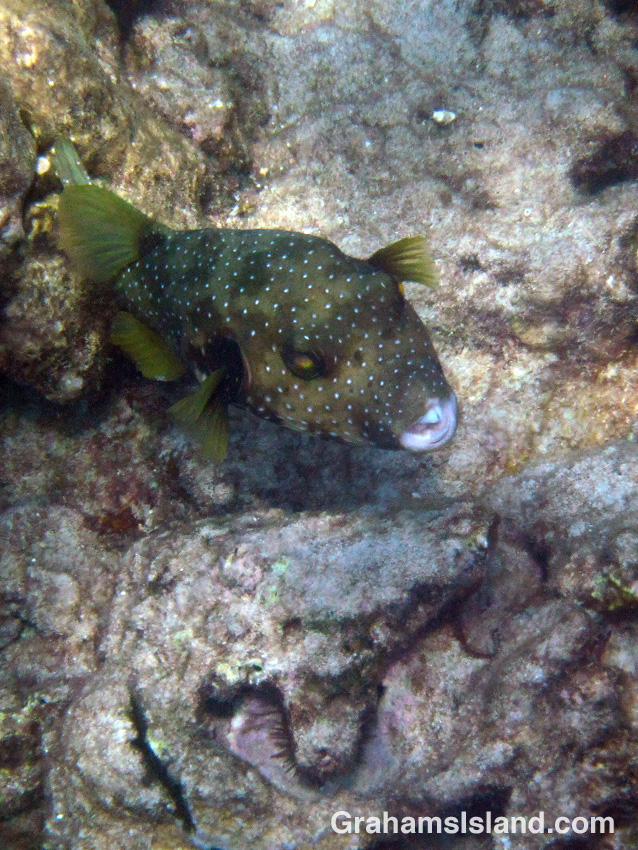
Most pufferfish are extremely toxic and the stripebelly pufferfish is no exception. The stripebelly differs from other pufferfish in that its skin is unusually high in toxins, rather than being concentrated in internals organs.
These pufferfish will eat most anything and have a powerful beak (see the second photo) that can inflict a nasty bite. People have lost fingers and toes to these fish, so they aren’t to be messed with. That said, they mostly hang around just above the sea bottom and, as a result, I’ve never actually seen the striped belly that gives them their name.
In my attempts to identify what I see in the water, I use John P. Hoover’s book The Ultimate Guide to Hawaiian Reef Fishes, Sea Turtles, Dolphins, Whales, and Seals. His website is hawaiisfishes.com.
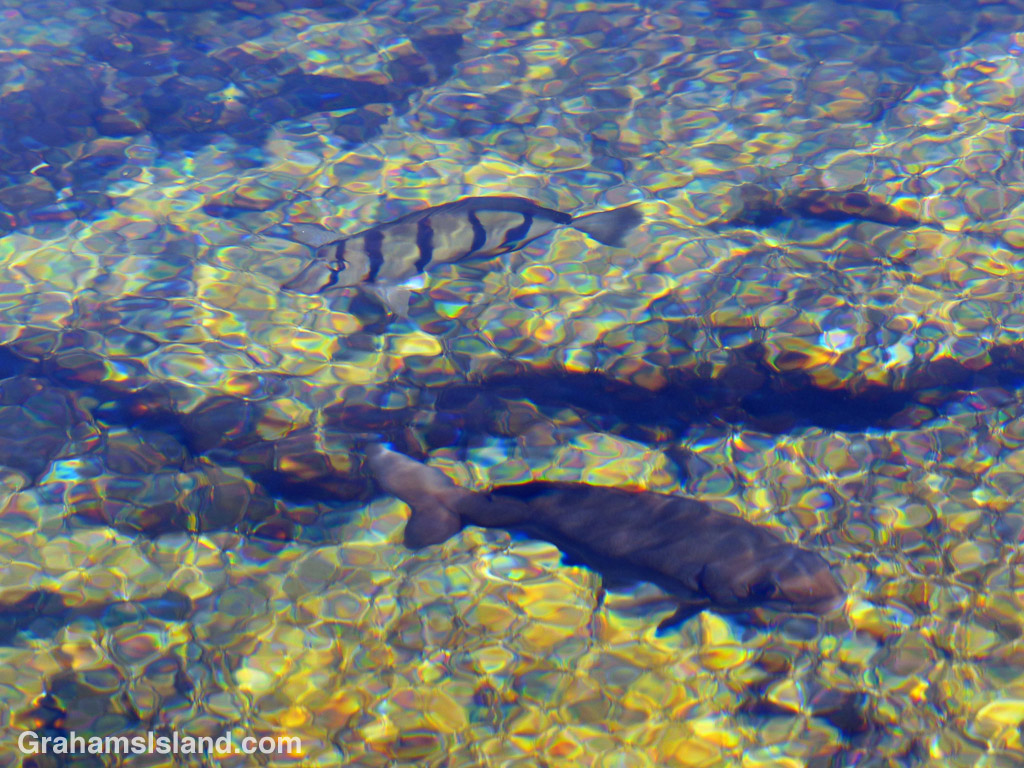
Kaloko-Honokohau National Historical Park, just north of Kailua Kona, contains a feature known as the Queen’s Bath. This is an anchialine pond, containing a mix of freshwater and saltwater. Freshwater seeps into the pond from rainfall. Saltwater infiltrates through cracks in the lava. Because of this, the water level rises and falls with the tide. I can verify this as I took this, and other photos, sitting on a rock near the water’s edge. Just before I left, I realized my feet were now resting in water, the level having risen.
Anchialine ponds are unique ecosystems and this one contained several fish including these two. The one in the back is a convict tang. Not sure what the other one is. What I liked about the pond is the stained glass effect it created.
For more information about Kaloko-Honokohau National Historical Park, go to bigislandhikes.com/kaloko-honokohau-park/.
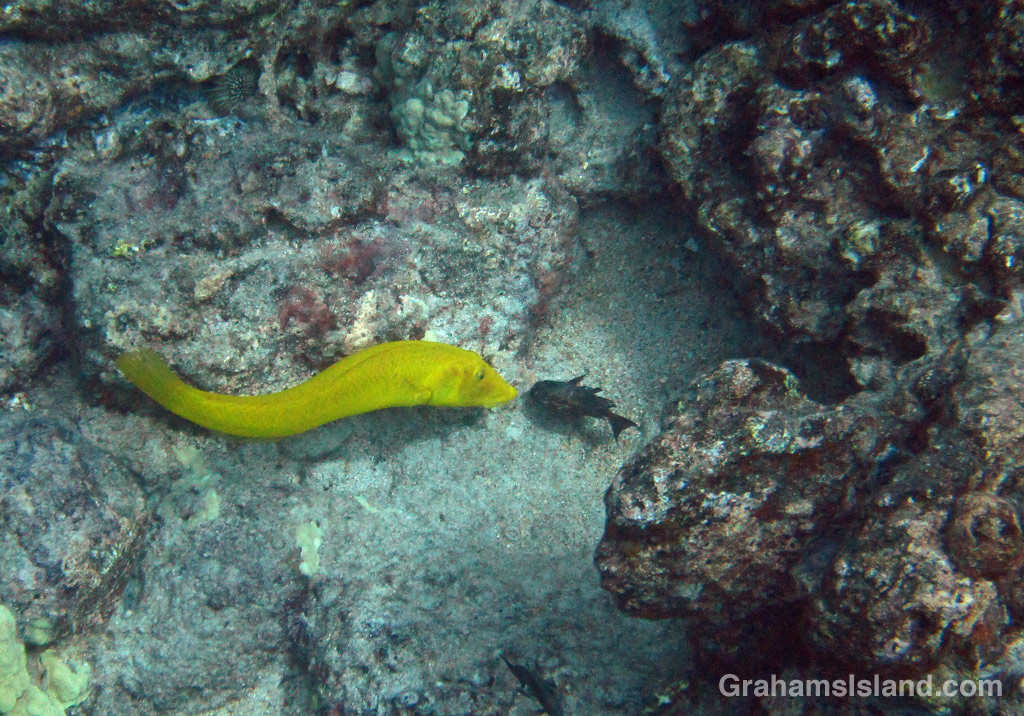
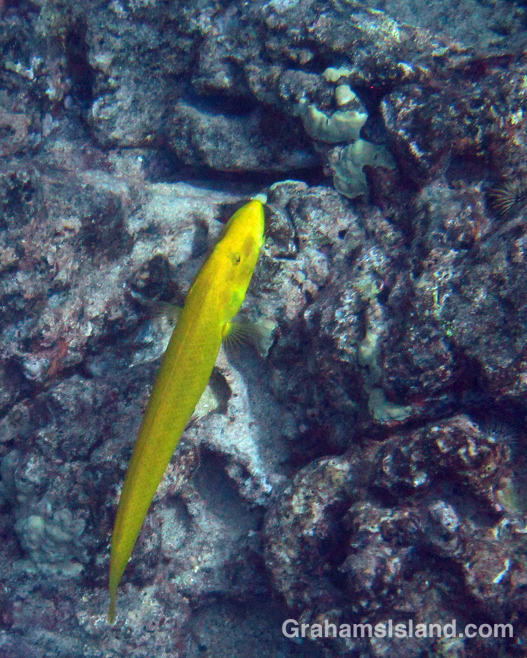
Perhaps not the best of photos, but ones that marked a first for me. I am constantly reading about how this fish preys on that fish and that fish preys on this creature, but the only feeding I’d seen is various fish grazing on algae on the coral.
On this day, however, I noticed, a good way below me, this female cigar wrasse with a small fish in her mouth. In the photo above the poor creature has just been dropped in front of her momentarily. In the second photo, the fish is firmly held in the cigar wrasse’s jaws.
The prey looked like some kind of small damselfish, which is interesting because John Hoover notes that cigar wrasse “feed on a variety of invertebrates.” Also of interest is that I mostly see cigar wrasse swimming among shoals of yellow or convict tang. Perhaps I should give them the heads up about the danger in their midst.
In my attempts to identify what I see in the water, I use John P. Hoover’s book The Ultimate Guide to Hawaiian Reef Fishes, Sea Turtles, Dolphins, Whales, and Seals. His website is hawaiisfishes.com.

