Category Archives: In The Water

More fins

Spinner dolphins swim in the waters off Hawaii

Yesterday, I posted photos of a manta ray encounter (here), noting that, if fins are seen in the water, manta rays are one likely reason. After the post went live, I went for a swim. I didn’t see anything unusual and was heading back in when I turned and saw fins in the water. This time, they were clearly dolphin fins.

Sometimes, the dolphins zip by as if they’re late for an appointment, but these were proceeding in a very leisurely fashion, so I thought I’d swim back out a ways and see if any came to check my out. As I swam, I’d pop up to see what was going on. Quite a few dolphins went by in small groups, but I saw more were following.

Spinner dolphins swim in the waters off Hawaii

Luckily, one of these groups was traveling closer to shore than the others and as I ducked my head underwater, I saw them approaching. The lead dolphin did veer in my direction, but carried on its way, followed by a trio that maintained impressive formation as they passed. The whole encounter lasted just a few minutes, but I was thrilled to see them and happy to get a few decent photos.

Spinner dolphins swim in the waters off Hawaii

Right time, right place

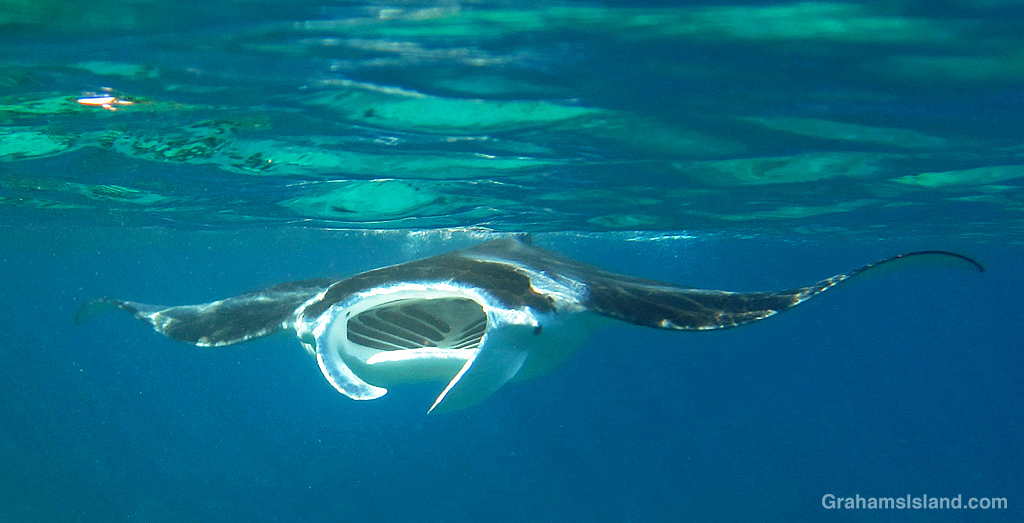
A manta ray swims in the waters off Hawaii

A couple of days ago, my wife and I arrived at our usual snorkeling spot and, when we got out of the car, she spotted fins in the water. Fins generally belong to dolphins, sharks or rays. Each has a different look and these had the look of manta ray wingtips. We could see that there were at least two mantas in the bay. Sometimes, especially with dolphins, the fins will be on the move as the bearers move along the coast. These mantas did not seem in a hurry to go anywhere, but were just puttering around the bay. We hustled down to the water and swam off in the general direction of where we’d seen activity.

A manta ray swims in the waters off Hawaii

We were swimming along when I saw the first manta heading towards me. I stopped and started taking photos. It came fairly close before veering away and heading back the way it came. Then it turned, came back past us and continued on its way.

A manta ray swims in the waters off Hawaii

When it became clear it wasn’t coming back we continued on our way. A little farther along we saw the second manta. It was doing barrel rolls and then came our way. Again, we stopped and watched. This one was more curious, passing by quite close and then looping around several times. Sometimes it went a fair distance away and we’d pop up and follow its progress when it was close to the surface.

Eventually, it seemed to head off in the general direction of the other manta. We lost track of it and popped up in the water to decide what to do next. When I ducked under the water again and turned around I saw the manta again. It made a couple more passes before heading out towards deeper water.

A manta ray swims in the waters off Hawaii

Black Nerite Snails

Black Nerite Snails on the coast in Hawaii

Recently, I was sitting on a rock, preparing to get in the water. There were a lot of little black bumps on the rocks, which I’ve seen before, but never really paid attention to. Except, this time, I noticed some of the bumps were moving.

These bumps are Black Nerite Snails which live just above the waterline. They’re about half-an-inch long and graze on small plants that grow in that zone.

Undulated Moray Eel

An undulated eel with other fish
An undulated eel in the waters off Hawaii

I saw this Undulated Moray Eel out in the open recently and, rather than dart for shelter, it remained where it was opening and closing its jaws. While this looks threatening, it’s typical of most eels, the purpose being to push water over its gills, the equivalent of breathing. However, that’s not to say it’s a good idea to dive down and interact with the eel.

My fish book describes the Undulated Moray Eel as “one of the nastiest.” Its narrow jaws hold three rows of teeth, one running down the middle of its mouth. It’s usual prey includes small fish, but this eel was accompanied by a changing group of fish, and neither seemed too bothered about the other.

In Hawaii, this eel is often called the chainlink eel, for obvious reasons.

An undulated eel in the waters off Hawaii

Punalu’u Black Sand Beach Park

Punaluu black sand beach in Hawaii

Punalu’u is one of the more popular places to visit on the Big Island. For one thing, it’s a black sand beach that’s easily accessible. It’s also a great place to see Green Turtles and sometimes Hawksbill Turtles. There’s picnic tables and restrooms, you can camp there, and it’s a beautiful stretch of coastline to wander along.

On my most recent visit, I was happy to see that the area where the turtles tend to rest has been more obviously identified with a rock wall and signs. This is part of the ongoing efforts to deter the ‘Let’s get a picture of little Billy riding the turtle’ crowd. Oh yes, they exist and, sadly, they’re nowhere near as endangered as the turtles. There is one turtle in this photo, but it looks like a rock.

Punaluu black sand beach with turtle resting area

Here’s a closer look.

Punaluu black sand beach with turtle resting

And a close up (with a zoom lens), getting some much needed rest.

Punaluu black sand beach with turtle resting

I really like Punalu’u, especially early in the day as this was. Later on, it can get very crowded.

Jeweled Anemone Crab

A Jeweled Anemone Crab in the waters off Hawaii

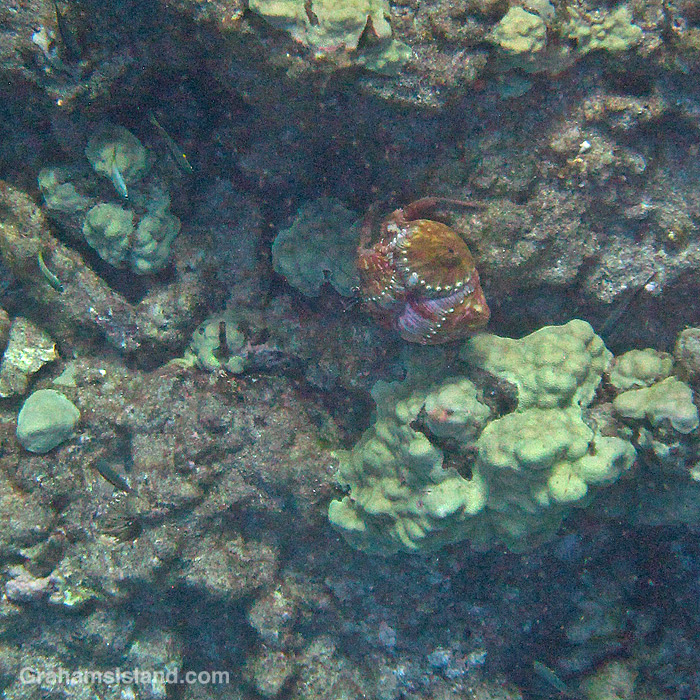
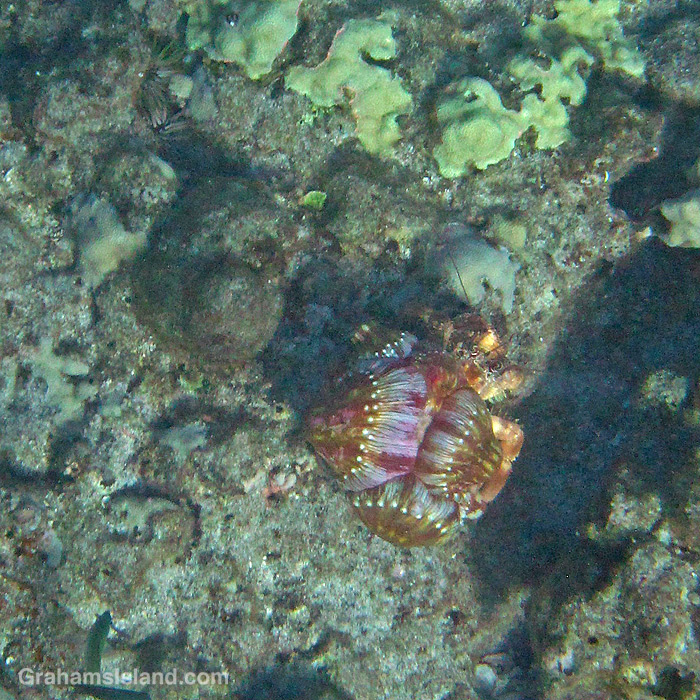
I spotted this Jeweled Anemone Crab scuttling over some very uneven rock and coral, but it was still able to move at a pretty good pace. The Jeweled Anemone Crab is a hermit crab, meaning it lives in a snail shell, either one it found unoccupied, or one from which is evicted the current tenant.

This one looks to have found a colorful shell, but looks are deceiving. The shell isn’t visible at all, because it’s covered by at least four large anemones! These are Calliactis polypus anemones. They give the crab some protection because, if disturbed, they shoot out stinging threads. In return, they get transportation and possibly scraps of food from the crab.

Siphonophore

A siphonophore in the waters off Hawaii

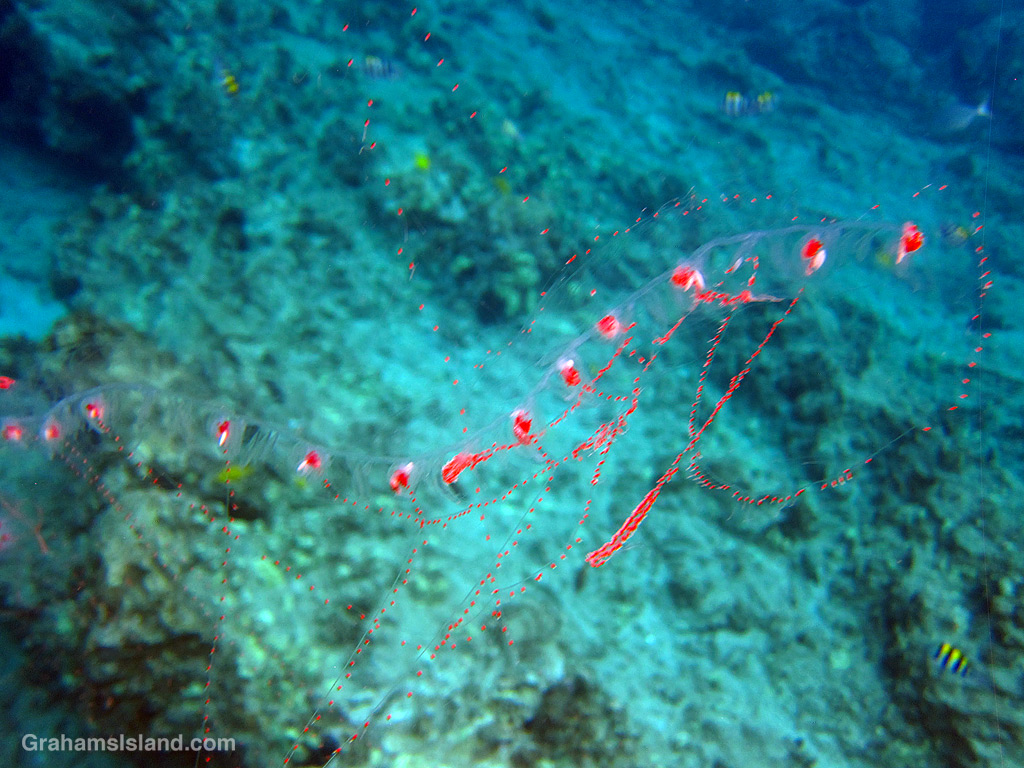
I was snorkeling recently when I saw this strange tubular stringy thing. That’s not a scientific term. My first thought was that it was a Chained Salp, a tunicate that is a colony of individual Salps. But this one seemed a bit different. There was the main tube, but also thinner strings hanging off it.

I started taking photos, which was a bit of a trick in the lumpy swell. I wasn’t worried about getting too close since Chained Salps are harmless. I wasn’t worried until I got too close and realized I’d been stung on the hand by some those tendrils! That was enough for me and I headed to shore.

Back at the house, I couldn’t identify it in my book so I emailed a fellow snorkeler who is well-versed in these sort of things. She had encountered these before and identified it as a Siphonophore (Thanks, Wendy.). Like the Chained Salp, this is a colony of individuals, but unlike the harmless salps, siphonophores have stinging tentacles which they use to catch prey.

Possibly the best known Siphonophore is the Portugese Man-Of-War, one of which had stung a fellow snorkeler just a few days earlier. His wounds were very painful, but I got off easily, with just red welts and a mild burning sensation for a couple of hours.

A siphonophore in the waters off Hawaii