
Sea urchins can have a wide variety of looks as illustrated by these two I saw on a recent swim. That’s a Collector Urchin in front and a Red Pencil Urchin behind it.

Sea urchins can have a wide variety of looks as illustrated by these two I saw on a recent swim. That’s a Collector Urchin in front and a Red Pencil Urchin behind it.

There’s an area where I swim where large numbers of Pyramid Butterflyfishes could always be seen. Over the years their numbers have diminished or they’ve moved elsewhere. But this year there has been something of a resurgence in that area. That’s where I saw these two.


In the area I usually swim, there’s a bit of a cliff with rocky parts protruding above the water. One of these, we call Viper Rock, because a very large Viper Moray Eel could often be seen in a small cave below the peak.
When the eel is not home, others sometimes take up residence. I’ve seen other eels, lobsters, and crabs in there. Yesterday, I saw this Giant Porcupinefish occupying the space. Sometimes fish will make a quick escape, but this one just watched me. It was only when I got home that I noticed, in one of the photos (not a good one alas), a small Giant Porcupinefish. So perhaps it wasn’t just this fish, but a family occupying the space.


This is Hawaii’s largest nudibranch and can reach a foot long. Mostly active at night, the best chance for snorkelers to see signs of this nudibranch, is to see one of their egg sacs, such as the one in the top photo, attached to a rock. These rose-like sacs are quite beautiful and waver as the water swirls around them.
I’ve only seen an actual Redmargin Spanish Dancer once (second photo). My marine invertebrate book says it resembles fatty ground beef, which is a pretty good description!

According to my fish book, Finescale Triggerfish are rare in Hawaii, except for the west coast of the Big Island. I see one or two most times I get in the water, and when I see them, I try to take photos. Most of the photos are terrible.
Finescale Triggerfish are, by some way, the largest triggerfish in Hawaii’s waters, so they’re not hard to spot, and with their dorsal and anal fins flopping from side to side as they swim, they’re easy to identify. However, they do present problems. For one thing, they’re generally a blotchy grey or brown color so they tend to blend into the background. While they can be seen close to shore, they usually swim nearer the bottom than the top. And they’re skittish. When I do see one nearer the surface, it’s usually seen me first and is headed down and away.
This one was a bit trapped in a relatively shallow area, so I got a few photos, though unfortunately the water was very hazy that day so the quality wasn’t great.


Cleaner wrasses establish territories where they remove mucus, parasites, and dead tissue from other fish. These cleaning stations can exist in the same place for years and can have several wrasses performing those services. Their clients can be anything from other small reef fish to eels and sharks.
In these photos, a Hawaiian Cleaner Wrasse services a Whitebar Surgeonfish.

A couple of creatures in the water that are like to blend into the background. The Titan Scorpionfish is fairly easy to spot in this one, but the Whitemouth Moray Eel is a bit trickier.
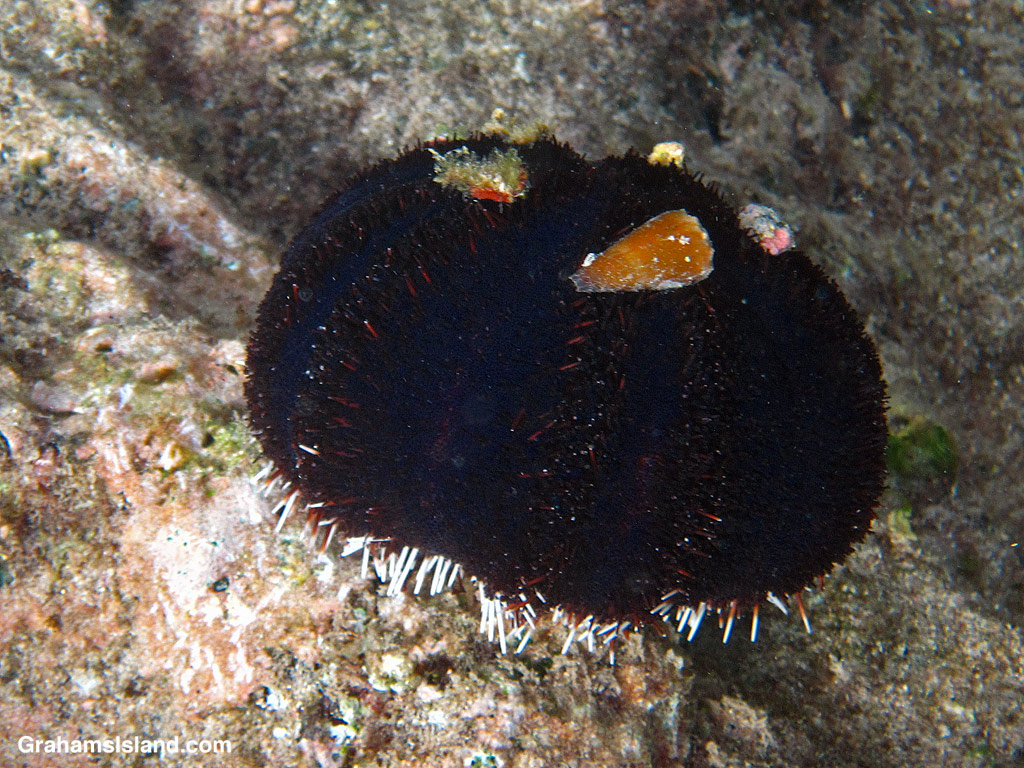
I like to keep an eye out for Collector Urchins to see what bits and pieces they have found to attach to their spines (here). What caught my eye with this one is that the shell on its back is that of a Yellow Cone. They do attach shells so I expect this was one of those rather than a living cone.

