Category Archives: In The Water

Bird wrasse

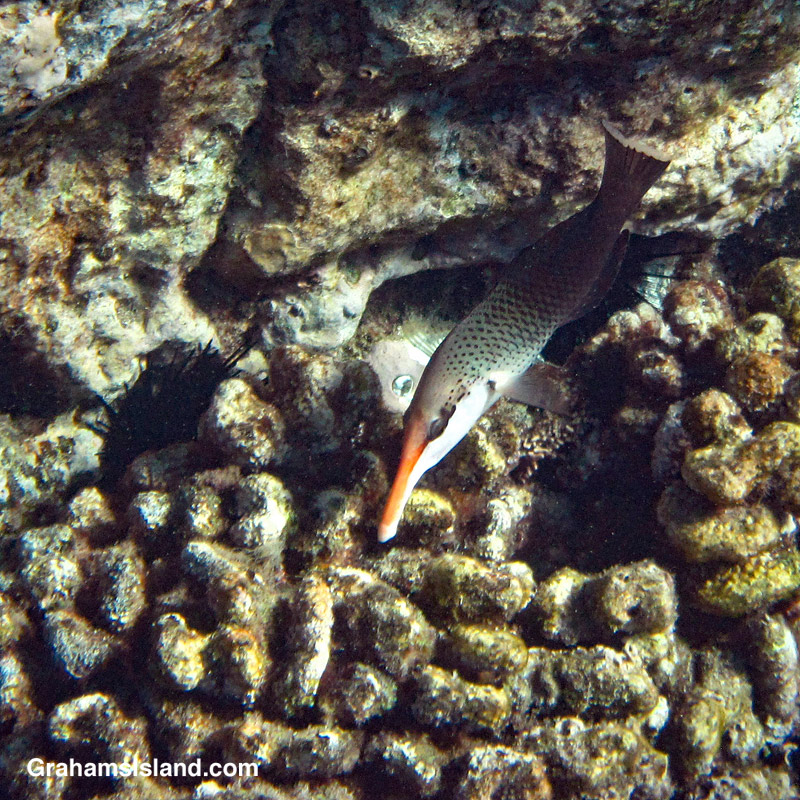
Bird wrasses are quite distinctive. The long ‘beak’ is used for winkling out crabs and shrimp from nooks and crannies in the reef. The top photo shows a blue and green supermale, with its lighter green blaze above the pectoral fin. To the right is a more subduedly-colored initial phase bird wrasse, that could be male or female.

These are one of those fish that seem to be in constant motion. I have taken many photos of them where they aren’t in shot by the time I push the button. I got lucky with these two.

Titan scorpionfish

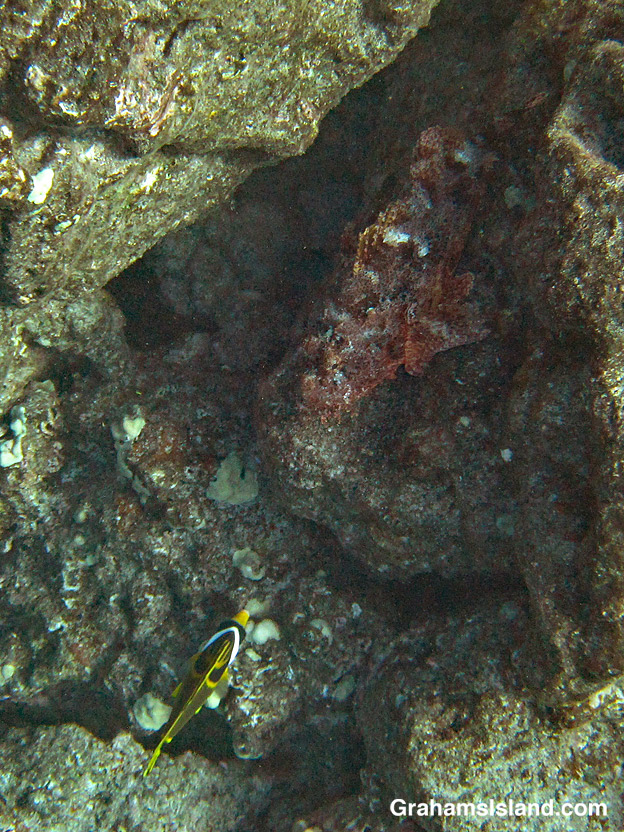
I was snorkeling recently, when I saw something distinctive on some rocks. At first I thought it was an octopus, but it didn’t look right. A lobster perhaps, but again something was amiss. Then I realized that the fin shapes I was seeing those of a scorpionfish. I focussed in with my camera and the fish scooted forward and disappeared into a crack and beneath a boulder before I could get a shot.

When I got home, I looked at my fish book and figured out that I’d probably seen a titan scorpionfish. The only scorpionfish I’ve seen previously have been devil scorpionfish, which are easily identified by their distinctive and colorful pectoral fins. The titan scorpionfish is more colorful overall but without such a distinctive signature. However, it’s the largest scorpionfish in Hawaii and the one I saw was big.

Next day, I was snorkeling in the same general area and I saw a reddish, mottled fish moving. ‘That looks familiar,’ I thought. This time the fish plunked down onto a rocky area and stayed put so I was able to get a good look at it and take some photos, of which this was the best. It was indeed a titan scorpionfish, probably the same one I’d seen the day before. I even saw the loose flaps on its lower jaw which are a prime identifying mark.

Even though I knew where it was, there were times when I looked and thought it had moved on before I could pick it out again, so well does it blend in with its surroundings.

Black-crowned night heron catches a fish

This week’s Sunday Stills challenge theme is ‘For the Birds.’ See more offerings here.

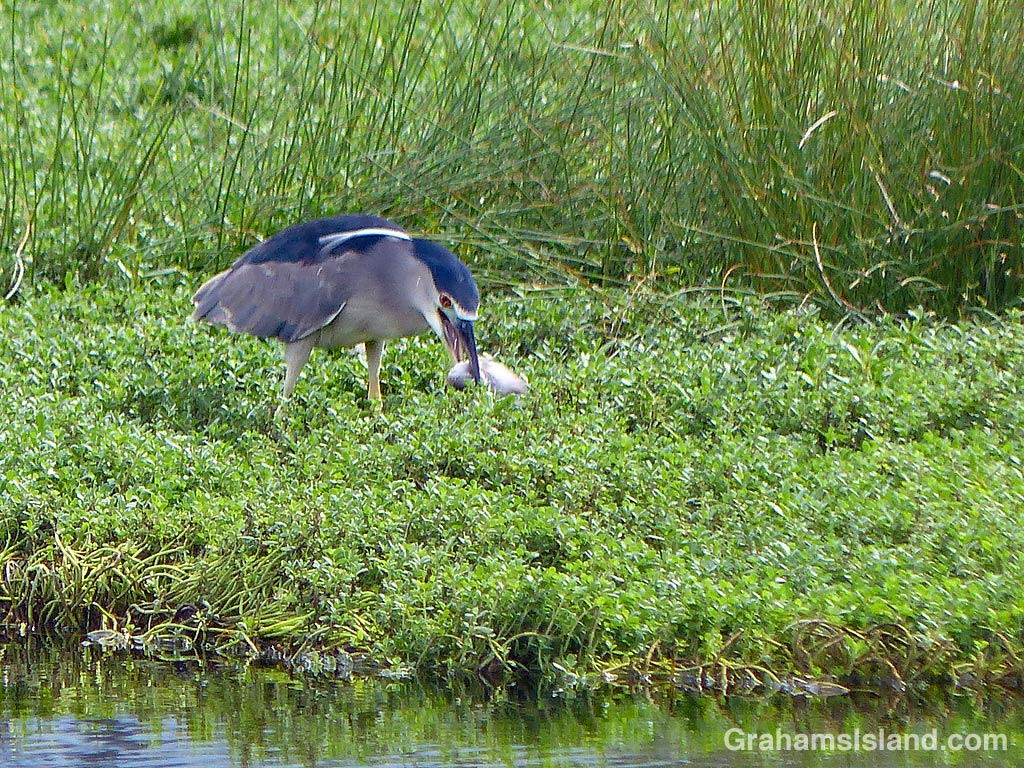
Bird baths and bird feeders are a couple of subjects for this theme and these photos are of what is, in effect, a bird feeder. It’s a fish pond at Hualalai Resort and where there’s a fish pond, there will likely be herons. I saw half a dozen perched around one of the ponds there, but this adult black-crowned night heron was the only one I saw catch anything.

It lunged its beak into the water and pulled this good-sized fish out onto the bank. After a few minutes of tossing the fish around to get it lined up properly, the bird swallowed it whole. The photo at right shows the fish on its way down.

Black triggerfish

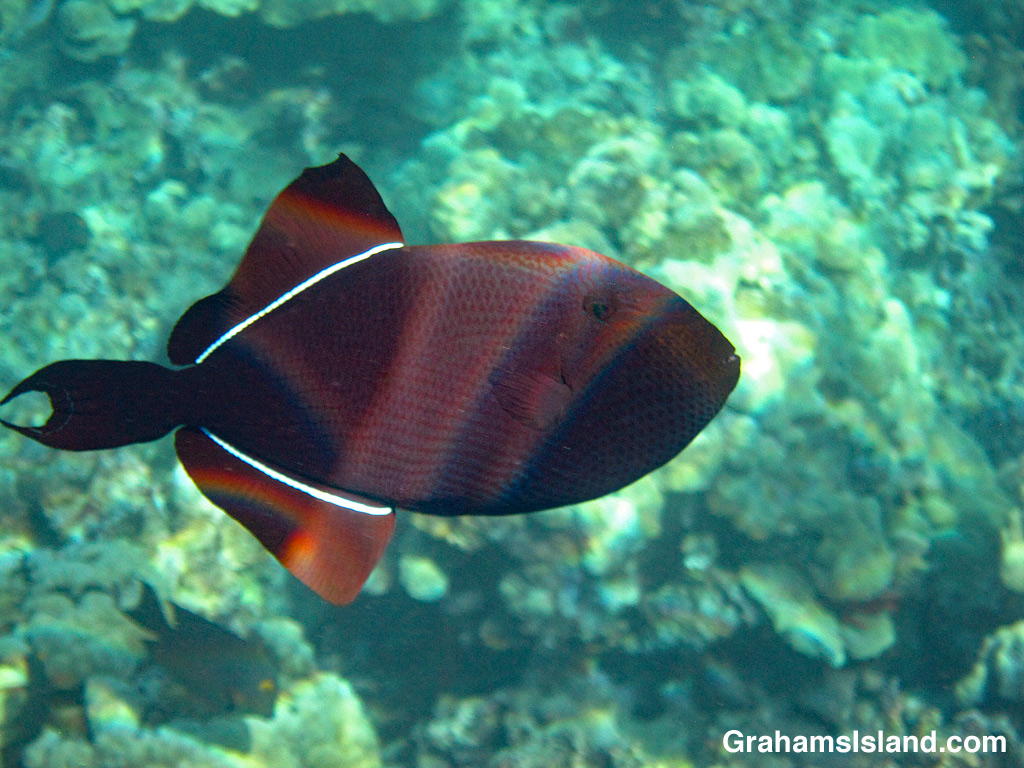
Black triggerfish are one of the most common fish on the reef, at least in certain areas. They are unremarkable in appearance being mostly black with bright, pale blue lines at the base of the dorsal and anal fins (top photo).

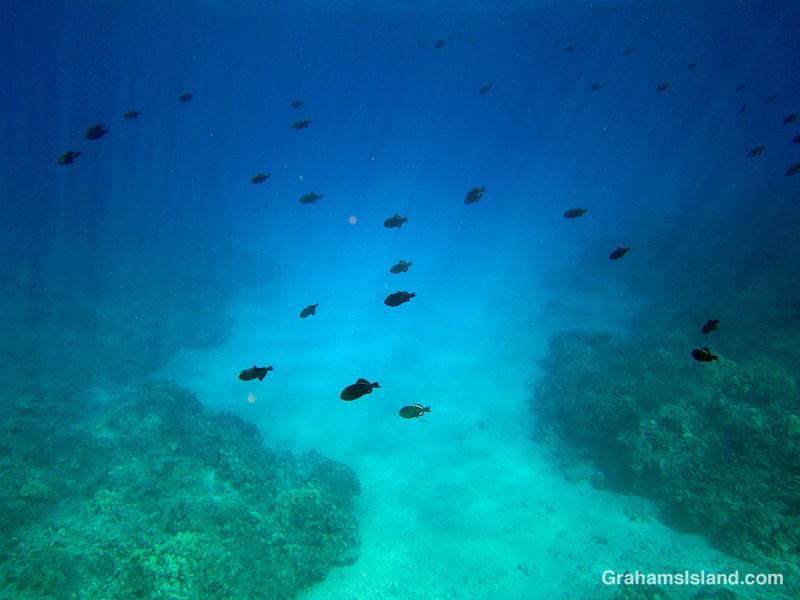
They are usually seen in large groups, moving through the water as they feed on plankton and algae (middle photo).

But when they’re agitated, bright blue lines radiate from around the eye. The more agitated, the more coloration, until they can appear like the fish in the bottom photo, with blue-green lines over the whole body.

Swimming with a manta ray

First sight of the manta ray coming toward me.
Sliding by to one side, showing an eye and its cephalic fins, while it catches the light.
Dipping lower in the water, its upper markings clearly visible.
Heading away over the coral.

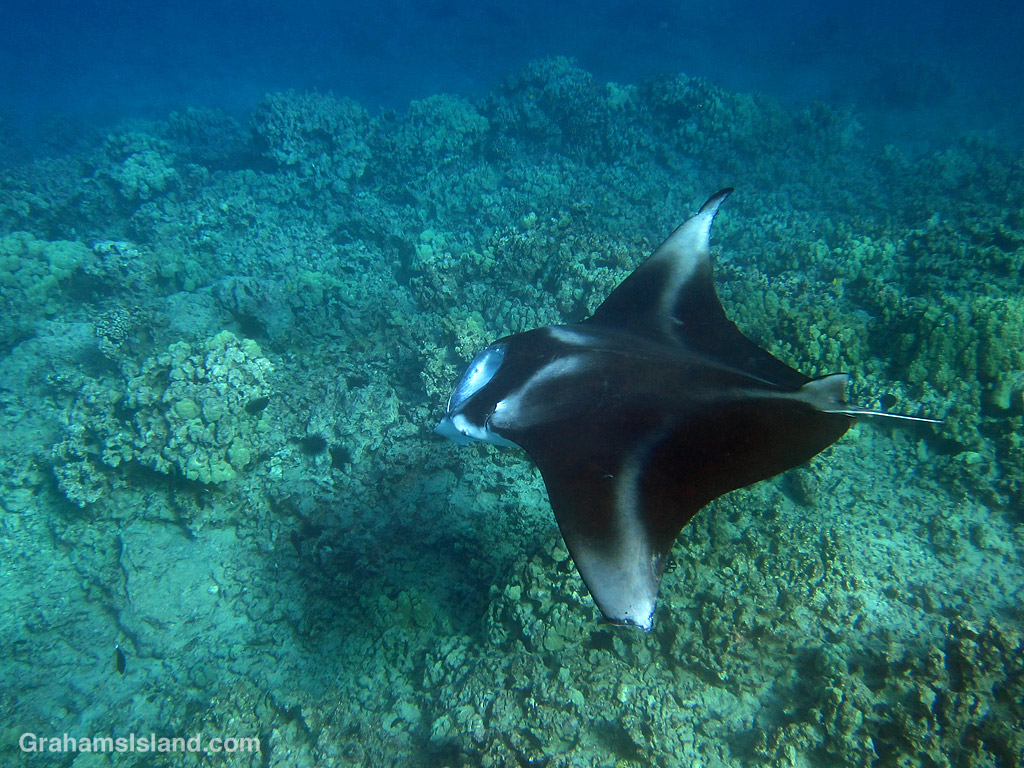
My usual posts feature a single photo or perhaps two or three, but today I wanted to give an idea of a recent encounter I had in the water with this manta ray. The photos are a sequence, top to bottom, from the time I first saw it, to it fading from sight into deeper water, about a 10 minute period. The ray swam quite slowly during that time, allowing me to keep up with it.

There are two kinds of manta rays. M. birostris, also known at the ocean manta, is the larger of the two species with a wingspan of 20 feet or more. The manta in these photos is M. alfredi, or reef manta, with a wingspan of 18 feet or less. This one was probably around 12 feet across.

Starting to turn.
Crossing below me.
Coming back up over some coral.
Out of the way, little fish.
Heading my way, mouth open, but mantas aren’t menacing.
Time to say goodbye.

Abstracts: Yellowhead moray eel

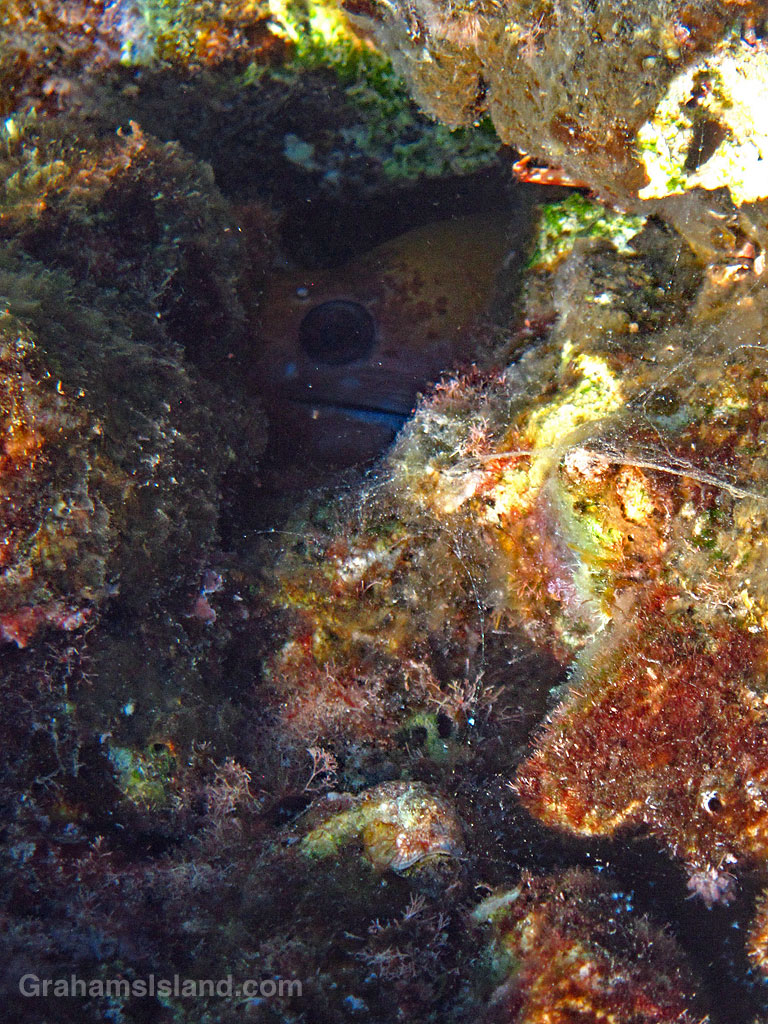
At one of my regular snorkel spots, there’s a place where a small whitemouth eel had taken up residence. I saw it there several times, head sticking out from a hole in the rock, flashing its white mouth. Then one day it was gone, but there was clearly something else in there. It looked like another eel, but I only saw a smooth patch of skin, it was curled in there so tightly.

Recently though, I saw that the creature had turned around and, in the small opening, part of its head could be seen, revealing it to be a small yellowhead moray eel. In the photo, the eel’s eye peers out from its lair, which is surrounded by rock covered with different-colored growths.