Category Archives: In The Water

Scrawled filefish

Scrawled filefish are at their most scenic when they catch the light. The blue scribbles that cover their bodies glow with intensity. They’re a peculiar-looking fish with a flat body and long tail, and they can quickly change color to a camouflage pattern when needed.

In this photo, the two dorsal fins are visible. The forward one is just a thin spine which can be raised and lowered. The other one is very fine and often hard to see. In this photo it has a bit of a wave going on.

Crunchy parrotfish

This is, I think, an initial phase bullethead parrotfish. Parrotfish can go through several phases and look quite different in each one. Some also change sex.

So why is this titled ‘crunchy parrotfish?’ Well, I was watching this fish feed and when it feeds, it uses that big, white-rimmed beak to scrape algae and coral polys off the rocks. While it was doing so, I could clearly hear the quite loud crunching noise it made.

Better Days: Half a trumpetfish

I was swimming one day when I came across this. At first I thought it was a bit of wood, but then I saw the distinctive mouth of the trumpetfish, then the eye. It looked like it was once a good-sized trumpetfish until it encountered something that reduced it to its current state.

I swam around it taking a few photos, until I noticed a large barracuda swimming along with me. I thought, perhaps, it wasn’t a good idea to be near part of a dead fish with an apex predator in the vicinity, so I swam off, leaving the barracuda to make what it wanted of the remains.

Milkfish

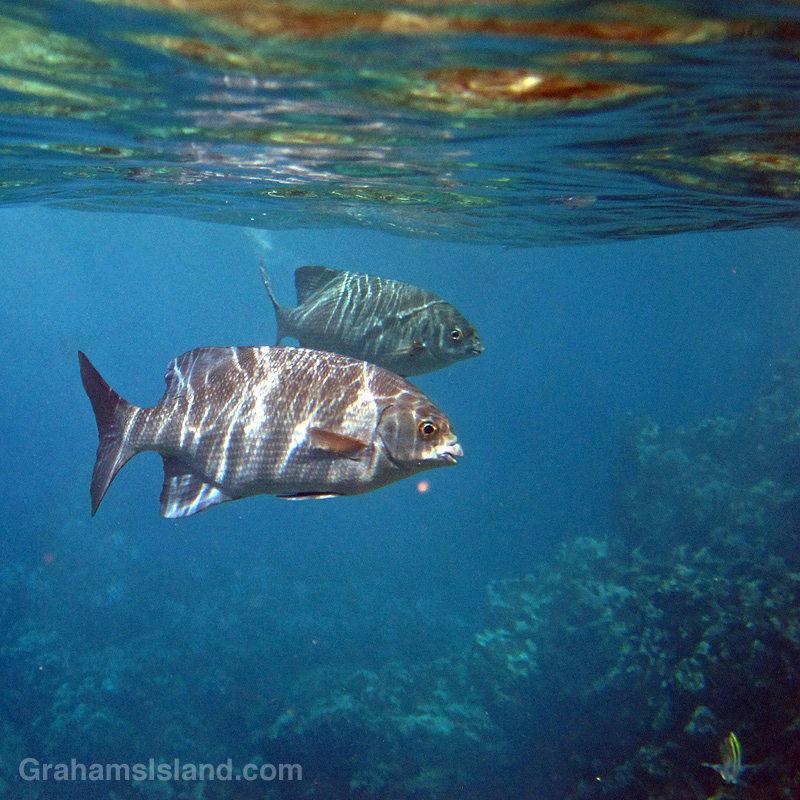
During a recent swim I was somewhat startled by the sudden appearance of these two large fish. I was close to shore when they shot past. At first I thought they were sharks, but quickly realized that wasn’t the case. They were just very big fish.

Their size, and the shape of their tails, made me think of jacks, and initially I identified them as rainbow runners, but later I realized they’re actually milkfish. Milkfish are the sole member of their species and my fish book calls them ‘among the most ancient and primitive of bony fishes.’

The larger of these two, in the top photo, was probably around three-and-a-half feet long. Those smaller, dark fish are around 9 inches long.

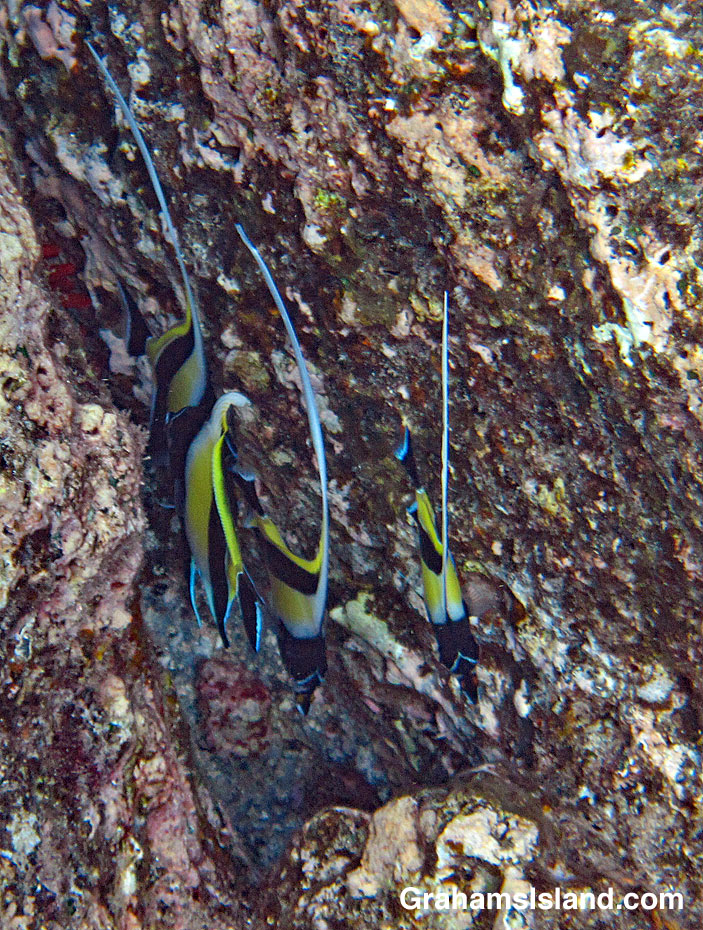
Moorish idol

A moorish idol foraging for food. These quite common fish are easy to identify because of their bold patterns, strong colors, and distinctive shape with a tapering head and long snout.

Lobster molt

Until I moved to Hawaii, I was not aware that lobsters molt. I only learned this when a local diver presented my wife with a lobster molt he’d recovered.

I’d seen live lobsters here, scuttling around on the sea floor, and others looking like the one in the photo. This one was moving, but only because of the action of the water on it. I used to think these were either dead or resting lobsters. In part this was because adult lobsters, which molt once or twice a year, discard a remarkably complete exoskeleton. It then takes them a few weeks for their new exoskeleton to fully harden.

This is probably a molt from a banded spiny lobster. True lobsters and their relatives have enlarged pincers on their front pair of legs. Spiny lobsters (family Palinuridae) are among the lobster varieties that don’t have those enlarged pincers.

Eagle ray and marine debris

An ongoing problem, both here in Hawaii and in all the oceans of the world, is marine debris. There are floating garbage patches of such a size that nations will surely soon be fighting over whose territory they are. There’s debris washed up onto beaches that is both unsightly and dangerous. And then there’s discarded or lost items that are a danger to marine creatures everywhere.

Sadly, I saw one such example recently. I hadn’t seen an eagle ray in a while, so I was excited to see this one. But it’s progress seemed a bit odd and I quickly realized that it was, unwillingly, towing some kind of marine debris. It looked like an old net or something similar, on the end of a loop of line that had become hooked over the beak of the ray.

In the top photo, the clump of debris can be seen on the right, above the black triggerfish swimming in the opposite direction. The loop of line can also be seen. In the second photo, the line can be seen looped over the bill of the ray. I shared this photo with several people, alerting them to the situation, and some thought the line was caught in the ray’s mouth, but I don’t think that’s the case, though it has clearly dug a furrow into the face of the ray.

While I spread the word about this, there’s not a lot that can be done. I didn’t see the ray again and, to my knowledge, no one else has either. Even if they do, the chances of being able to approach the ray and free the line are slim. The debris is probably part of some fishing gear, which is lost in great abundance around here.

Hopefully, the ray will find some way to dislodge its unwanted haul, but while that could happen, it’s also possible that the ray is stuck with its burden. And, in the end, that might tip the balance in its chances of survival.