Category Archives: In The Water

Bright-eye damselfish

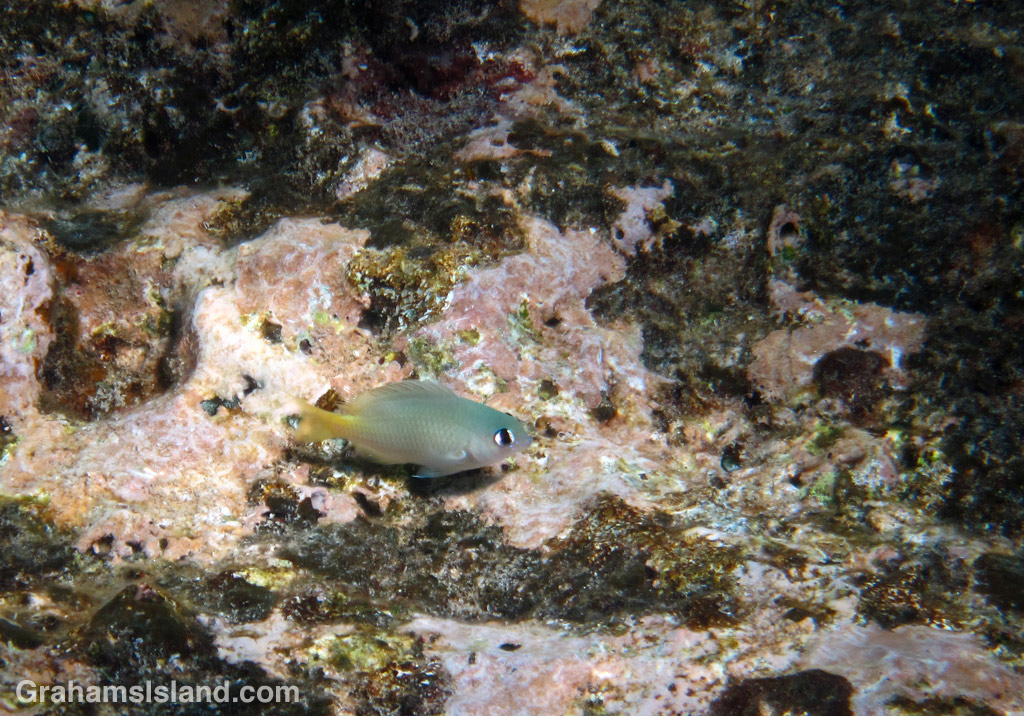
A bright-eye damselfish in the waters of the Big Island
The aptly-named bright-eye damselfish is a tiny fish around 1 to 2 inches long. Despite its small size it aggressively defends its territory, usually a nook or hollow in the rock. It’s not unusual to see it come charging out at some much larger fish that has strayed too close.

Given that these fish spend all their time in one small area, often just hovering in the water, it would seem a simple matter to get a photo, but no. When they hover, they’re constantly moving, almost vibrating. And then they shoot off in one direction or another.

I’ve taken many of photos of bright-eye damselfish and the majority of them turn out to be pictures of bits of rock or coral. Locating the tiny fish on my screen is no easy matter, keeping it there, harder still. When I do manage that, often the fish is a blur or just a tail fin heading out of shot. Thus, this photo is something of an against-the-odds triumph – an entire bright-eye damselfish reasonably in focus.

Oval butterflyfish

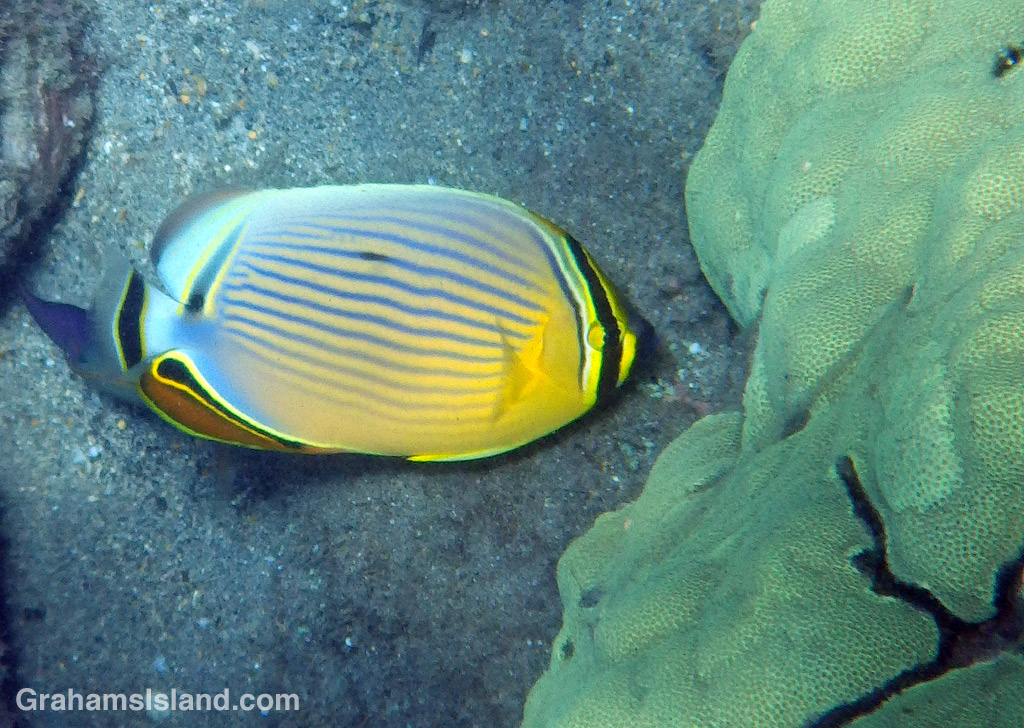
A brightly-colored oval butterflyfish grazes on polyps of living coral head.
A brightly-colored oval butterflyfish grazes on polyps of living coral head. Since this is almost the only thing they eat, it makes them unsuitable for keeping in home aquariums.

In my attempts to identify what I see in the water, I use John P. Hoover’s book The Ultimate Guide to Hawaiian Reef Fishes, Sea Turtles, Dolphins, Whales, and Seals. His website is hawaiisfishes.com.

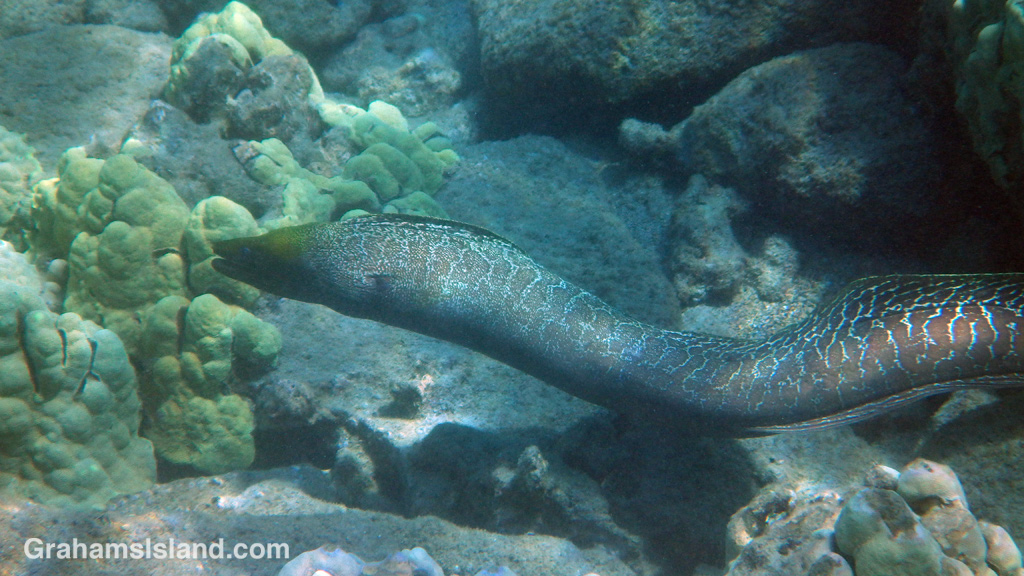
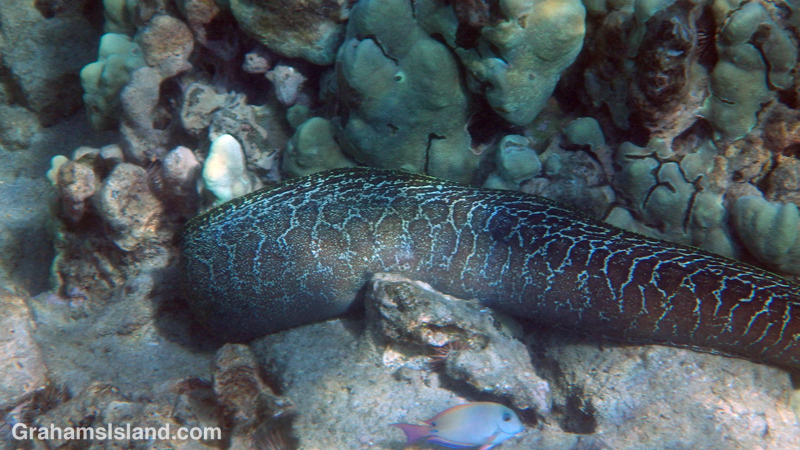
Undulated moray eel

A large undulated moray eel cruising in shallow water off the Big Island.A large undulated moray eel disappears into a crack in the coral
I saw this large undulated moray eel cruising in shallow water until it disappeared into, what appeared to me to be a tiny crack in the coral. John P. Hoover says of the undulated moray eel, “One of the commonest Indo­-Pacific morays, it is also one of the nastiest; do not attempt to play with it or feed it.” Words to live by.

In my attempts to identify what I see in the water, I use John P. Hoover’s book The Ultimate Guide to Hawaiian Reef Fishes, Sea Turtles, Dolphins, Whales, and Seals. His website is hawaiisfishes.com.
Coastal manta ray

A coastal Manta Ray in the waters off the Big Island of Hawaii.
Not the greatest photo – swell had churned up the water – but I post it for two reasons.

One is, it’s the first manta ray I’ve seen outside of a tour where they set up lights and an unruly mob of people hung onto floats while the manta’s fed off plankton attracted by the lights. The manta’s were fabulous; the rest of the experience was weird, bordering on unpleasant. To top it off, I didn’t get any photos.

The second reason is how I came to spot this manta in the first place. A group of three women was swimming about 100 feet ahead of me. They had masks and snorkels but not fins. I happened to pop my head above water and heard a scream from one of the women, followed by a huge froth of whitewater in their vicinity. They’d obviously seen something dramatic and my first response was to find out what it was, never mind that a scream and churning water might be a strong indicator of a shark attack.

As I swam forward, this great creature came into view, angling across my path. At first it wasn’t clear what it was, but then the two distinctive cephalic flaps became clear. Manta’s use these to funnel water into their mouths when feeding. Manta’s are plankton feeders and harmless. Many rays have stingers in the tail area, but manta’s don’t. John Hoover says an 8 to 12 foot wingspan is most common for manta’s in these waters and this one certainly fell in that range.

With little effort, it glided past me toward deeper water. As it did so I saw a second manta join the first, then they disappeared into the murk.

A few minutes later I talked to one of the women who’d been in the group ahead. She said she’d screamed because she was startled by the sudden, unexpected appearance of this huge creature. I sympathized. I’ve had a similar response when unexpectedly meeting sharks and eagle rays at close quarters. But at the same time, such chance encounters are magical and memorable and I am grateful for them.

In my attempts to identify what I see in the water, I use John P. Hoover’s book The Ultimate Guide to Hawaiian Reef Fishes, Sea Turtles, Dolphins, Whales, and Seals. His website is hawaiisfishes.com.