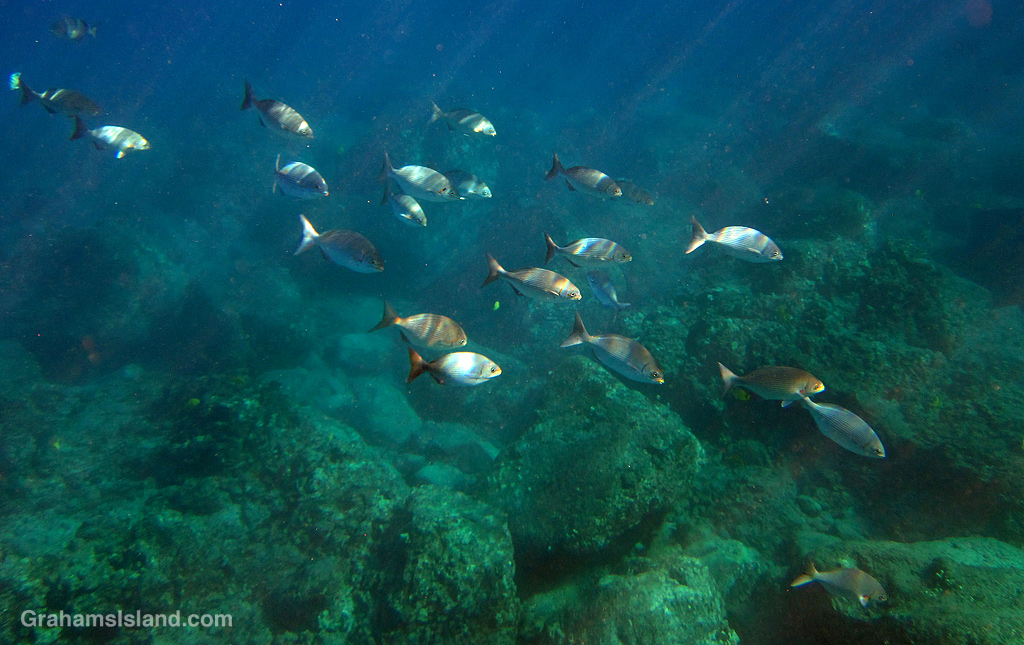
One of the many things I like about chubs is how they catch the light as they cruise close to the surface.
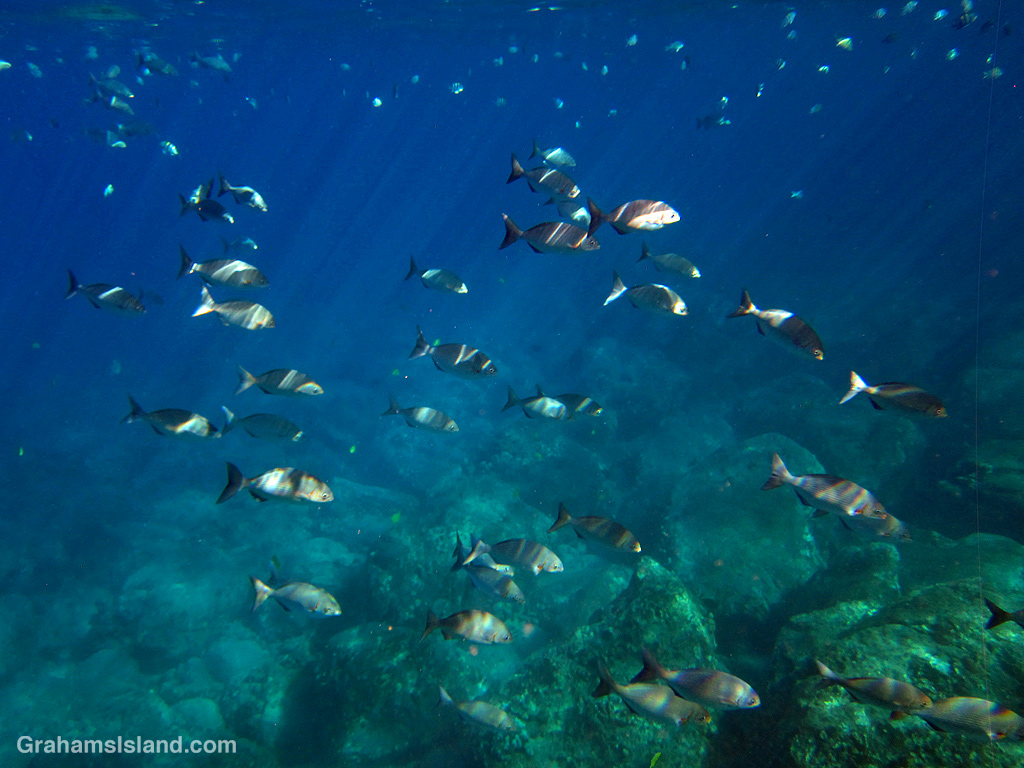

One of the many things I like about chubs is how they catch the light as they cruise close to the surface.

It’s not unusual to see a variety of fish performing the same maneuver as this chub. I think what it’s doing is rubbing off parasites that attach themselves to fish. They seem to like this particular rock, possibly because of its rounded top and just the right amount of abrasiveness.

The Bicolor Chub is one of several chubs here, but the only one endemic to Hawaii. While it has a lot of similarities to the Gray Chub, the two-tone coloring makes it easy to identify. Some Bicolor Chubs are dark at the back and light at the front. This one also has the dark top to its head and face. Some of them also have dark backs so that the only light part is the belly area.

Conditions have been terrible for snorkeling lately. There’s been one swell after another barreling in from the northwest, which is good news for surfers, but which churns up the water and makes it hard to see anything.
Despite this, there can be clear patches and it was passing through one of these that I saw this school of chubs swimming by me, nicely illuminated by the sunlight.


A variety of fish swim in the surge over a shallow part of the reef. The yellow chub is an unusual color variant of the gray chubs swimming with it.

Fish swim just below the surface in surging water. The big fish are highfin chubs and the smaller fish are acute halfbeaks.

A variety of reef fish – including yellow tang, goldring surgeonfish, whitebar surgeonfish, brassy chub, and ember parrotfish – forage on a shallow rocky shelf.

The yellow chub in this photo is actually a gray chub, but a few individuals, such as this one, can be yellow, white, or multicolored. This one is something of a regular at one spot on the North Kohala coast.
The orangespine unicornfish is seen in many places along the coast and always has a grumpy look. In this case, it looks like it’s upset that the chub has swum into its territory.
 Graham's Island