
Shoals of little fish look like silver bullets zipping back and forth just below the surface of the water.

Shoals of little fish look like silver bullets zipping back and forth just below the surface of the water.


On a recent swim I saw these two fish passing by. They looked like chubs, but not ones I’d seen before. I snapped a quick photo, not expecting it to be great, but hoping it would help me identify the fish. I need not have worried.
After they passed, they made a series of approaches and retreats. They appeared as curious about me as I was about them, which is something of a characteristic of chubs. Eventually, they moved away and I carried on, catching up to two others I had been swimming with. I asked them if they’d seen these fish and they said no.
I was describing what they looked like when the two of them showed up again. Once more they looped around, checking out these new people before finally heading south, not to be seen again.
When I got home it was easy to identify them as rainbow chubs, also known as blue-stripe chubs, with their distinctive blue markings. What was interesting is that their home is the Eastern Pacific, from Ecuador north to California. But some can get carried over to the Central and Western Pacific. As such, they’re rare in Hawaii, so this is one of those fish I might never see again. A matter of being in the right place at the right time.
In my attempts to identify what I see in the water, I use John P. Hoover’s book The Ultimate Guide to Hawaiian Reef Fishes, Sea Turtles, Dolphins, Whales, and Seals. His website is hawaiisfishes.com.
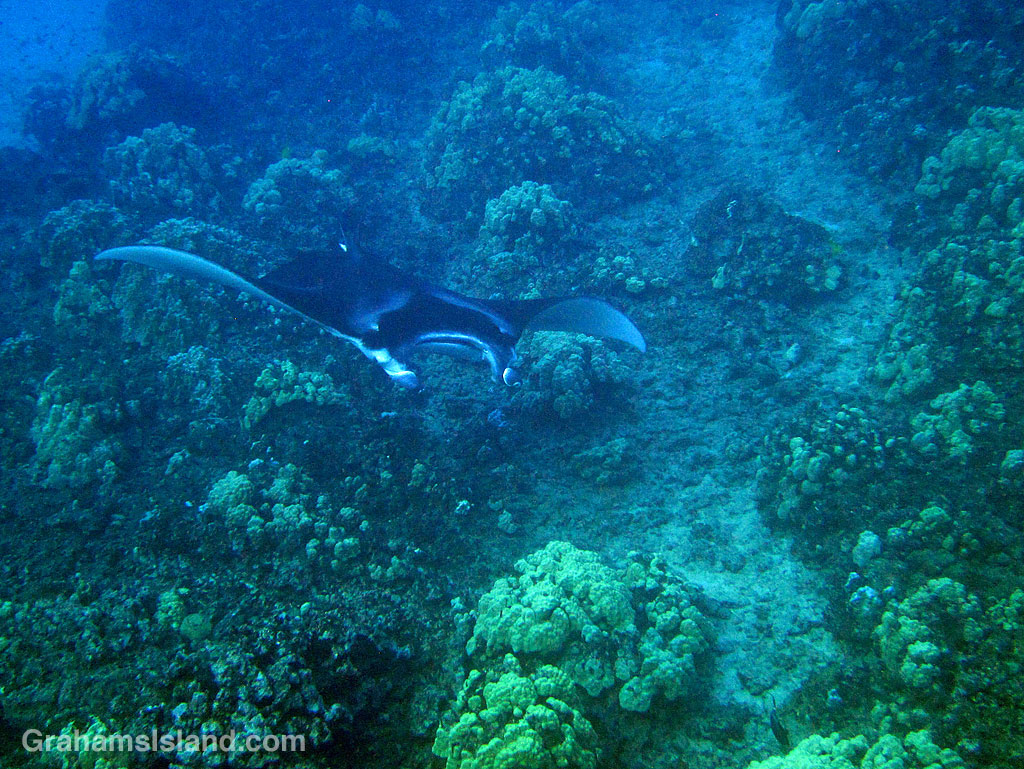
On a recent snorkel, this large manta ray made an appearance. It cruised around close to the coral outcroppings before heading north. I don’t chase mantas, or any other fish really, as most anything in the water can leave me behind at any time it wants to.
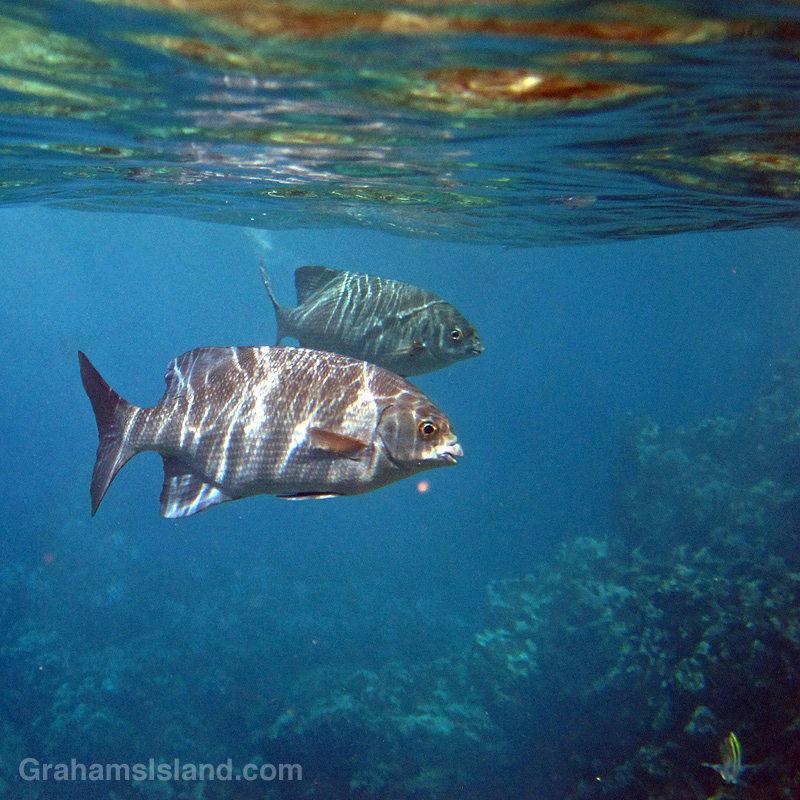
A pair of highfin chubs catch the light as they cruise just below the surface. These large fish are quite common and are typically seen fairly close to shore and near the surface of the water.
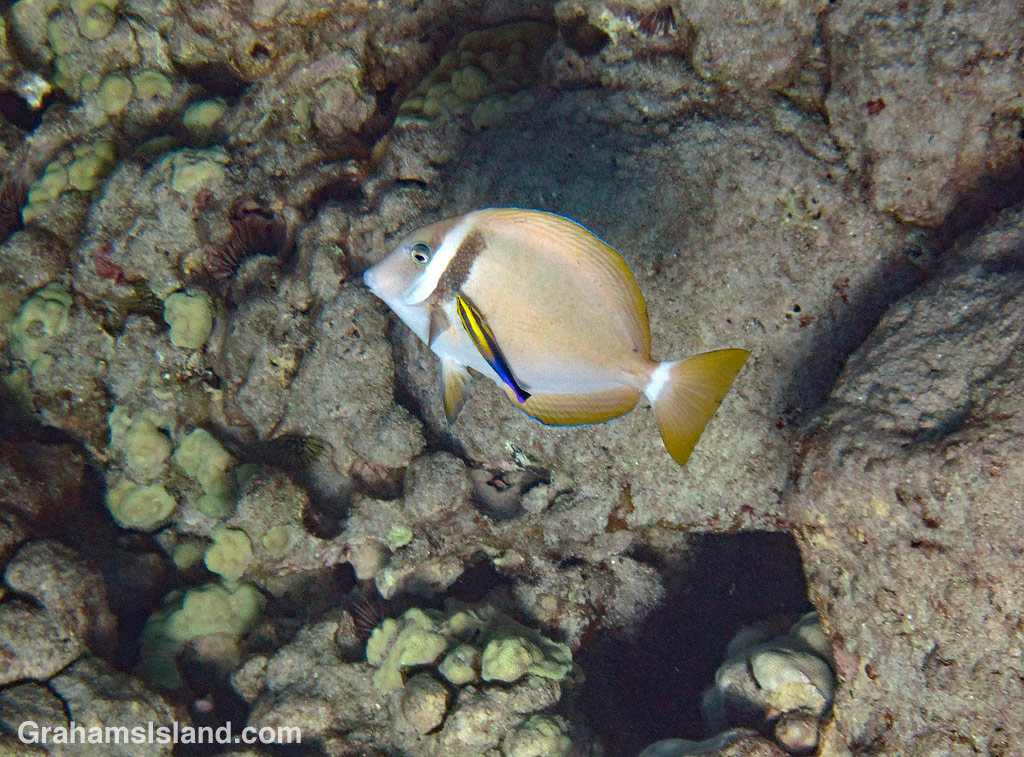
A cleaner wrasse performs its service on a whitebar surgeonfish. Cleaner wrasse establish stations where other fish can visit to be cleaned of mucus and parasites.
When I’m snorkeling, I enjoy visiting these stations to see what’s going on and which fish are availing themselves of the services offered. Some of these fish are predators who, in other circumstances, might be expected to make a meal of a cleaner wrasse. But because of the beneficial service they offer, cleaner wrasse get a free pass with predators.
I have a tendency, when out snorkeling, to revisit places where I’ve seen something interesting. So if I’ve seen a frogfish, a shark, or gargantuan blenny in a particular place, I go back there to see if it’s still there. Bear in mind that these are creatures that extremely mobile and move around a good deal.
And yet, there’s method in this madness. Many fish are territorial and so do occupy a very limited area which they defend with great vigor. Others might be more transient, but tend to feed in certain areas.
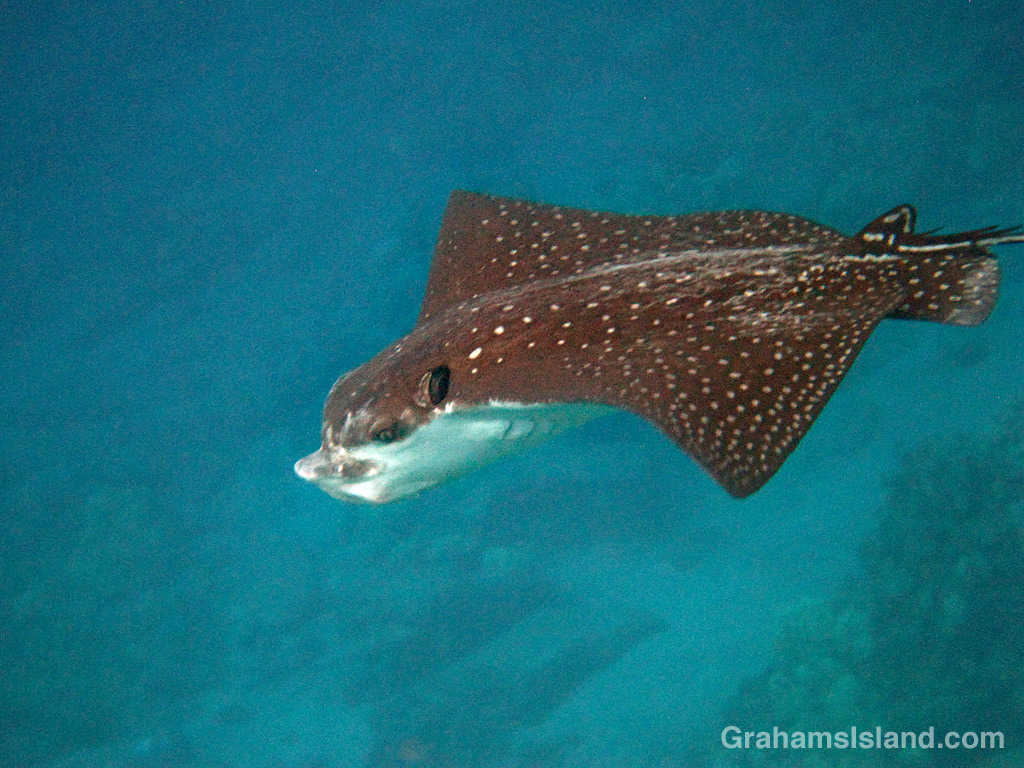
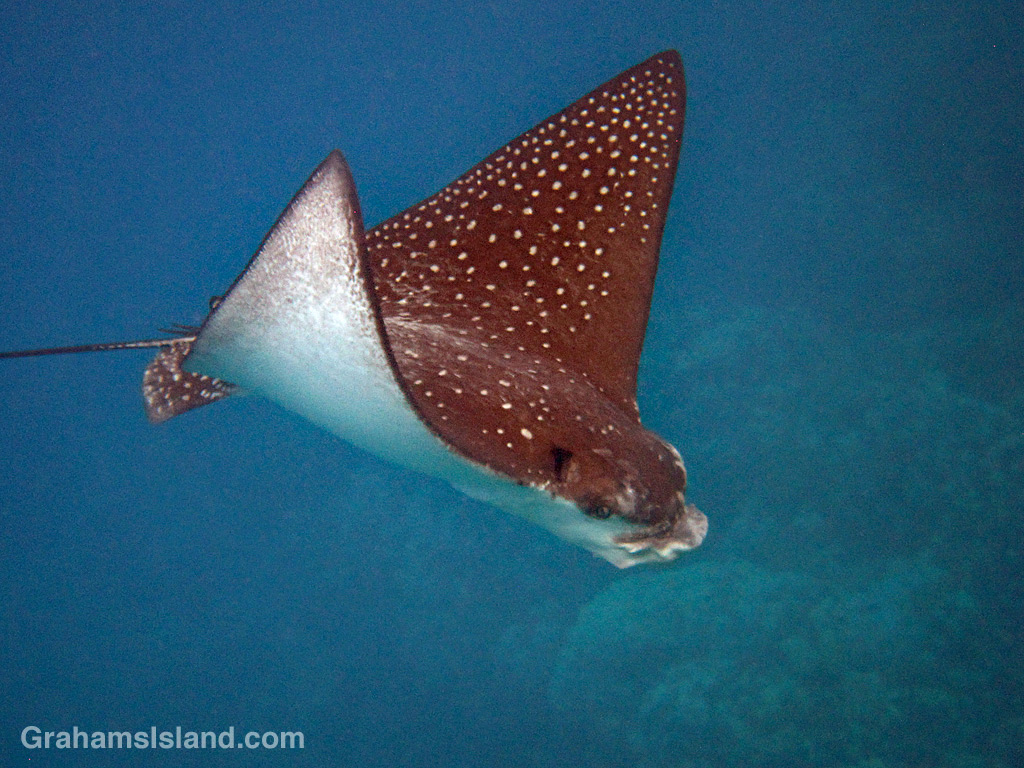
Spotted eagle rays fall into this latter category. They can cover large distances, but tend to feed on sandy bottoms, shoveling the sand with their bills to uncover the marine invertebrates that they feed on.
This eagle ray was dong just that, cruising low over the sand, pausing occasionally dig for potential prey. But after a long spell of this activity, it rose in the water, cruised around, and made a close pass, clearly checking me out. It did this a couple of times before heading back down and in toward the shore in search of food.
I don’t think there was any reason for this behavior other than a curiosity to see what this ungainly creature was that was following it. And it’s not alone in this behavior. Manta rays also do this along with dolphins, sharks, and a fair number of smaller fish. They’re curious about us; we’re curious about them. This is what makes getting in the water fun.

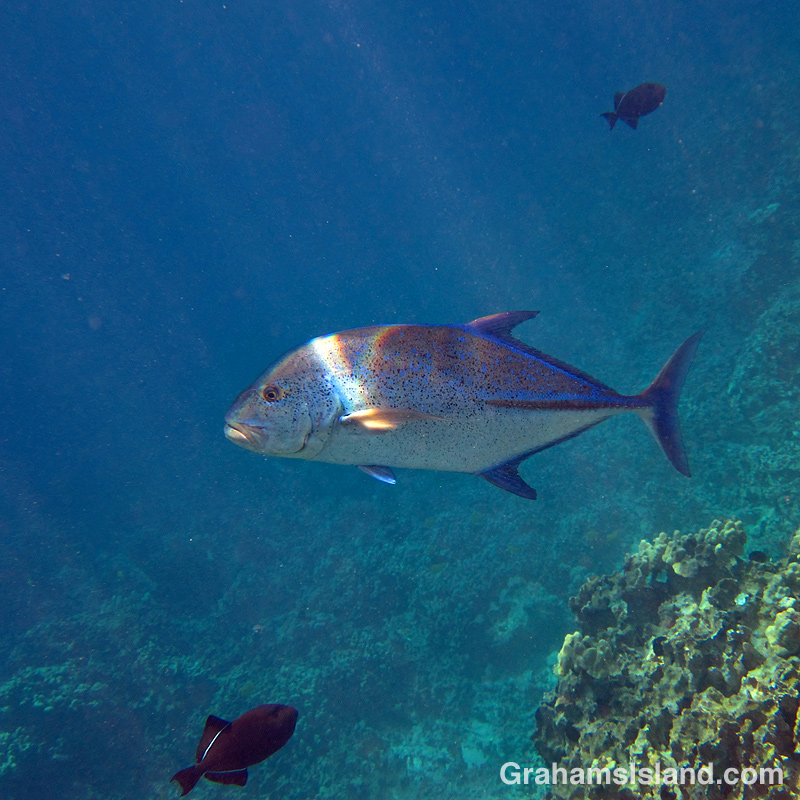
A couple of bluefin trevallies seen while snorkeling in Kealakekua Bay. The area is a marine conservation district where fishing is prohibited. In general, I’ve found that fish in such districts are less skittish and more likely to approach snorkelers, so it’s a good place to get photos of some otherwise elusive fish.
Bluefin trevallies aren’t exactly elusive, but these two passed close by, unperturbed by my presence.
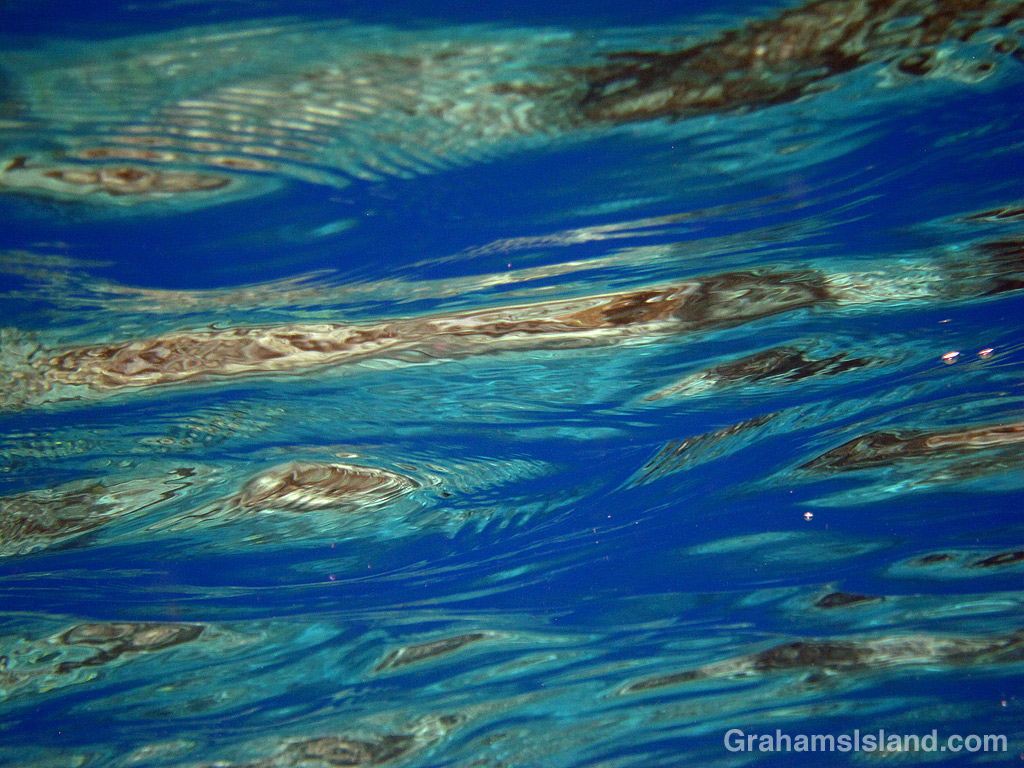
I like seeing the different colors and patterns of the water’s surface from below. It’s like a kaleidoscope with it’s ever changing appearance.
 Graham's Island