Tag Archives: Snorkeling

Abstracts: Floating branch

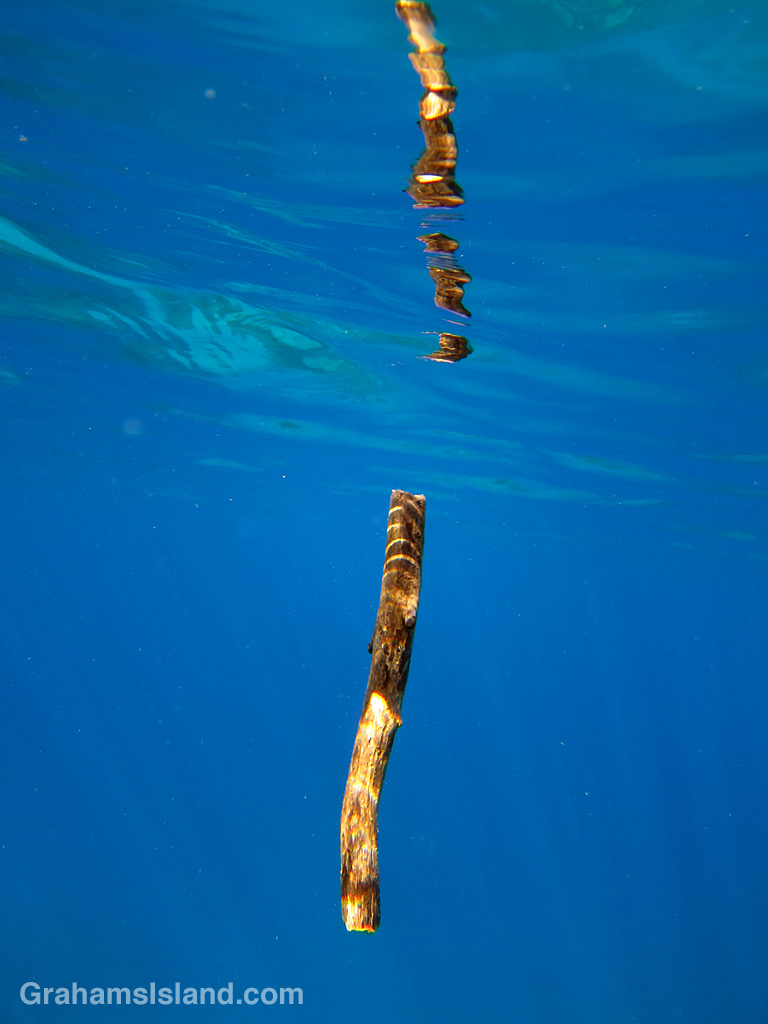
A branch floats in the water off the Big Island of Hawaii

The last of this week’s posts in response to the WordPress photo challenge on the theme of ‘transient.’

High winds resulted in a bump in the amount of debris in the water. This branch could be on its way back to shore or headed for somewhere across the Pacific, depending on how wind and currents move it.

A pushmi-pullyu eel?

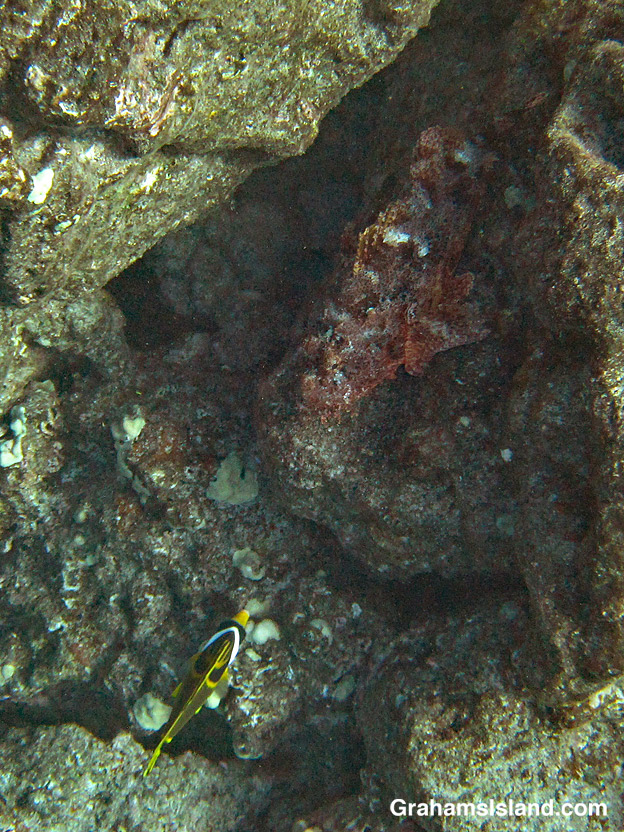
two whitemouth moray eels wedged into the same space behind a clump of coral
At first I thought this was something straight out of Doctor Dolittle, a pushmi-pullyu eel. Alas, no. Instead, it’s two whitemouth moray eels wedged into the same space behind a clump of coral. While whitemouth moray eels are a fairly common sight in the water, this is the first and only time I’ve seen two together. I don’t know whether this proximity was related to breeding. Perhaps they were just helping each other stay warm! Looks like they must be pretty good friends.

A manta ray glides by

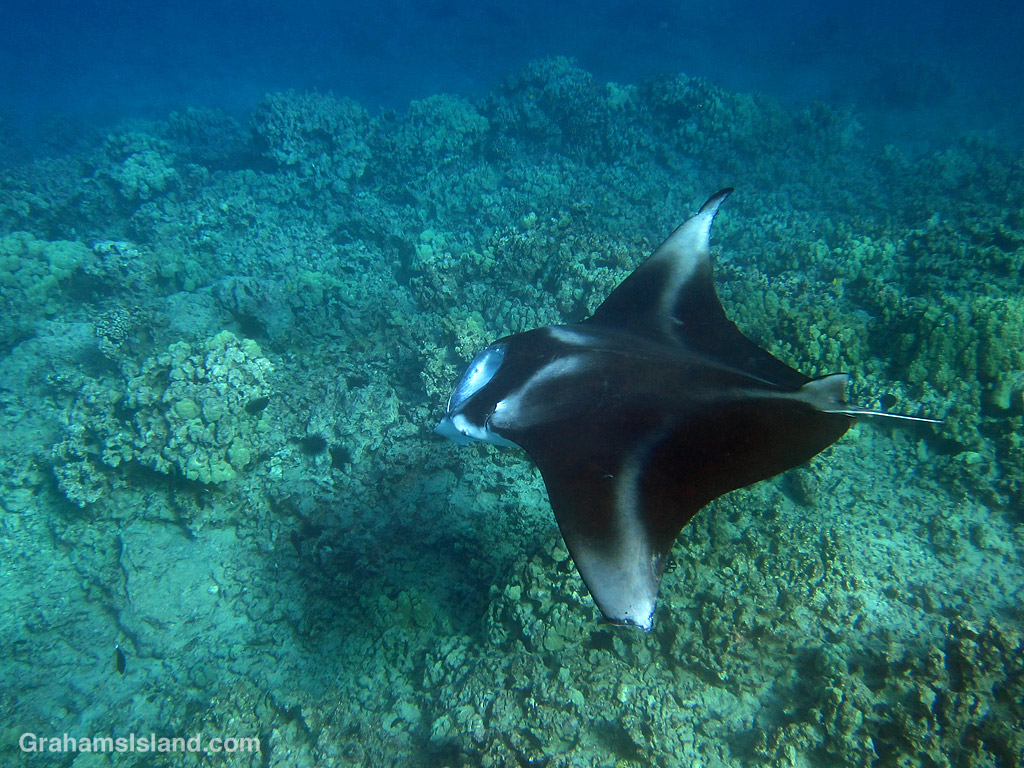
A manta ray glides through the water off the Big Island of Hawaii
Most weeks I post something in response to the WordPress photo challenge. This week’s theme is ‘evanescent,’ a word I wasn’t familiar with. The definition provided is “soon passing out of sight, memory, or existence; quickly fading or disappearing,” or, put simply, ‘a moment in time.’

To me, this is what any photo is, a snapshot of a given moment. Even the look of a fixed object, a landscape, a building, a monument, is always changing. It could be the light, weather, activity around the subject. Everything is in constant flux, sometimes in obvious ways, sometimes only in the detail. With birds, animals, bugs, even plants – blowing in the wind – those changes of passing moments are more obvious.

So I thought I’d take this week’s challenge as my theme for the week (or at least the remaining six days of the challenge). I start off with this photo of a manta ray. One of the great joys of snorkeling is never knowing what I’ll see that day. It could be a common fish engaged in some activity I’ve never seen before. It could be a glimpse of something unexpected. It could be something seen only at a certain time of year. Whatever it is, it almost always gives me a little jolt of ‘wow.’

While out snorkeling, I got a jolt of ‘wow’ when I saw this manta ray gliding along in the opposite direction. I turned and followed its effortless progress for several minutes until it headed into deeper water and disappeared. An evanescent experience? I think so, though it won’t soon disappear from my memory.

Coastal manta ray

A coastal Manta Ray in the waters off the Big Island of Hawaii.
Not the greatest photo – swell had churned up the water – but I post it for two reasons.

One is, it’s the first manta ray I’ve seen outside of a tour where they set up lights and an unruly mob of people hung onto floats while the manta’s fed off plankton attracted by the lights. The manta’s were fabulous; the rest of the experience was weird, bordering on unpleasant. To top it off, I didn’t get any photos.

The second reason is how I came to spot this manta in the first place. A group of three women was swimming about 100 feet ahead of me. They had masks and snorkels but not fins. I happened to pop my head above water and heard a scream from one of the women, followed by a huge froth of whitewater in their vicinity. They’d obviously seen something dramatic and my first response was to find out what it was, never mind that a scream and churning water might be a strong indicator of a shark attack.

As I swam forward, this great creature came into view, angling across my path. At first it wasn’t clear what it was, but then the two distinctive cephalic flaps became clear. Manta’s use these to funnel water into their mouths when feeding. Manta’s are plankton feeders and harmless. Many rays have stingers in the tail area, but manta’s don’t. John Hoover says an 8 to 12 foot wingspan is most common for manta’s in these waters and this one certainly fell in that range.

With little effort, it glided past me toward deeper water. As it did so I saw a second manta join the first, then they disappeared into the murk.

A few minutes later I talked to one of the women who’d been in the group ahead. She said she’d screamed because she was startled by the sudden, unexpected appearance of this huge creature. I sympathized. I’ve had a similar response when unexpectedly meeting sharks and eagle rays at close quarters. But at the same time, such chance encounters are magical and memorable and I am grateful for them.

In my attempts to identify what I see in the water, I use John P. Hoover’s book The Ultimate Guide to Hawaiian Reef Fishes, Sea Turtles, Dolphins, Whales, and Seals. His website is hawaiisfishes.com.

Spotted eagle ray

A spotted eagle ray swimming off the Big Island.A spotted eagle ray swimming off the Big Island.

During the summer months, the west coast of the Big Island sees more southwest or westerly swells. These tend to roil the waters and reduce visibility. So it was a pleasant surprise recently, to dip into the water and find good visibility for the first time in a while.

The good visibility wasn’t matched by the appearance of rarely seen, exotic fish. Only the ‘usual suspects’ were to be found, which is no bad thing. I enjoy watching even the most common of fish. However, I confess I was feeling a tad disappointed at having my camera and good conditions, but not seeing anything that especially fired my enthusiasm.

As if on cue, I looked up to see three spotted eagle rays coming toward me. One quickly slipped away and a second came and went. The third (second photo) cruised back and forth nearby, keeping an eye on me as I kept an eye on it. It had clearly lost its tail at some point. I’m not sure if a new one will grow back. In the bottom photo, the venomous spines at the base of the tail can be seen, though the venom is not nearly as toxic as that of some ocean dwellers.

After a while, the two remaining rays headed out toward deeper water and disappeared taking with them any disappointment I’d been feeling.

For more information about eagle rays, go to bioweb.uwlax.edu/bio203/s2014/hayward_paig/index.htm
A spotted eagle ray swimming off the Big Island.

Abstracts: Bubble machine

Surging water creates storms of bubbles.
In the water, it’s wise to be aware of what waves and swell are doing. Caught unawares, it’s easy to get tumbled over rock and coral. But I like to get close enough to see fish sluicing back and forth, and also to see the waves crashing around the rocks leaving little whirlpools and storms of bubbles.

Peacock grouper

A young peacock grouper on the Big Island
One difference in taking photos as a snorkeler rather than a diver, is that I can’t follow fish when they dive or hug the bottom. Also, when a fish is 30 feet down, the water affects how they look and the sun doesn’t reach them as much.

I mention this because I most often see peacock groupers in 20 to 30 feet of water where they look somewhat dull in color. They also tend to be quite shy, hurrying for cover under ledges or whatever other shelter is at hand.

However, as with many kinds of fish, juveniles can often be found in shallower water. I happened on this young peacock grouper one day and it promptly headed for cover. Before it did though, I got a couple of good images that captured the sun bringing out the spectacular blue patterns that I never see when they run deeper.

In my attempts to identify what I see in the water, I use John P. Hoover’s book The Ultimate Guide to Hawaiian Reef Fishes, Sea Turtles, Dolphins, Whales, and Seals. His website is hawaiisfishes.com.