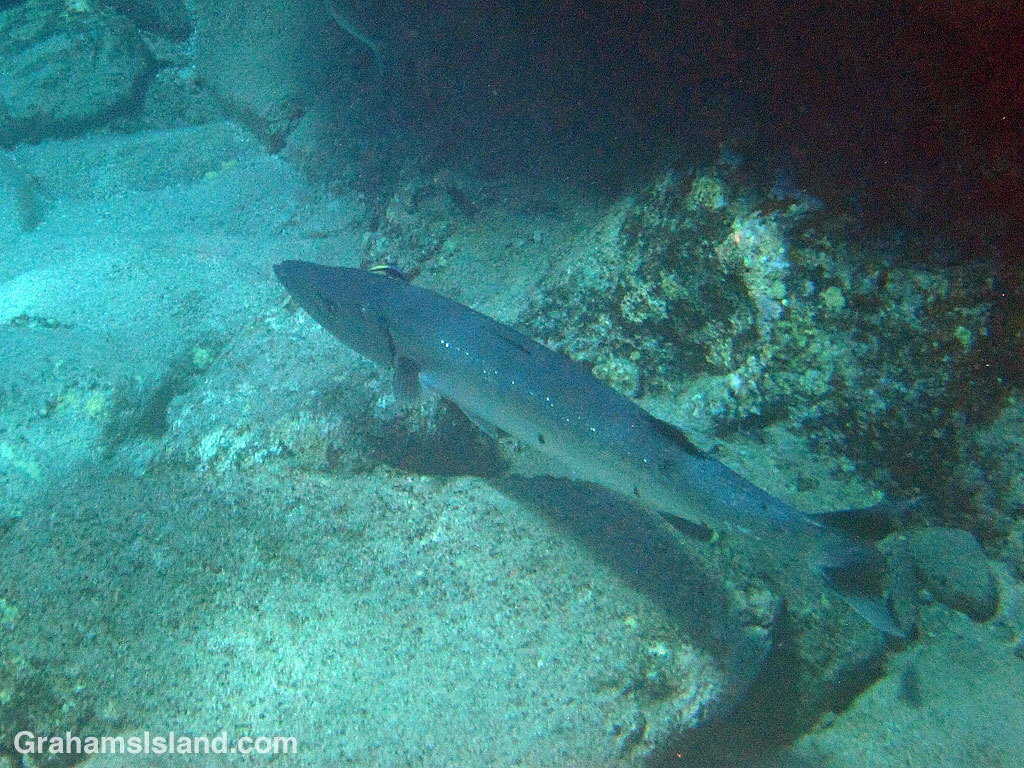
When I saw this flowery flounder swimming, it promptly plopped down on this rock where it didn’t blend in quite as well as flounders usually do. It watched me as I took a few photos. I swam away and when I looked back the flounder had gone.

When I saw this flowery flounder swimming, it promptly plopped down on this rock where it didn’t blend in quite as well as flounders usually do. It watched me as I took a few photos. I swam away and when I looked back the flounder had gone.

Commonly known as spider lily, crinum asiaticum has beautiful, delicate flowers, and sword-like leaves. The flowers are popular with gardeners, though possibly not with those who have kids since the plant is poisonous.


When I took this photo, I thought it was of two variable ladybugs mating. However, when I processed the photo, I noticed that the lower ladybug didn’t look the same as the top one. I think, instead, it’s a seven-spotted ladybug. I also noticed that that top ladybug is climbing up the side of the other one, which is not the usual mating approach.
So now I don’t know what’s going on. It could be that the top ladybug is trying to mate and has just got things seriously wrong. Or it could be a ladybug traffic accident, with the one bug getting in the way of the other. Perhaps they’re fighting. I guess I’ll never know.

A photo of a leaf of a monstera plant, probably monstera deliciosa, also known as the Swiss cheese plant. No prizes for figuring out why that is.

This week’s Sunday Stills challenge theme is ‘Frozen.’ (See more responses here.) Usually, when I post in response to a challenge, I hunt through my files to see what I have that fits. With this theme, I thought about a photo of snow on Mauna Kea, but I had none in my files and Mauna Kea was bare. While much of the U.S. battles winter blasts of one kind or another, Hawaii chugs along in its usual warm to very warm range. Last week, an unusual north wind dropped temperatures into the low 60s and – gasp – even the 50s. Oh, how we whined about the cold. But, ‘frozen?’ No.
So I thought of a few options and went out to see what I could shoot. Luckily, my first stop at a local grocery store met my needs. Most gatherings in Hawaii are outdoors and while barbecues feature in most of them, coolers are a must for all. Going to the beach? You’ll need a chair, towel, and cooler. To the local park? Picnic fixings, games for the kids, and a cooler. In your own backyard? Barbecue and cooler. And when I say cooler, it’s usually plural.
All those coolers need ice and most stores have ice freezers to meet those needs. This one was handily placed next to a display of silk flower leis, a Hawaiian party accessory. And, as if that wasn’t enough, moments after I took the first photo, the ice delivery man wheeled in fresh supplies and gave me a look, wondering why this strange person was taking photos of his freezer.

This week’s Friendly Friday challenge theme is ‘Comfort Zone.’ (See more responses here.) In my youth, swimming in the sea wasn’t something I enjoyed. This wasn’t because I was afraid, but rather that I was so skinny, I was instantly cold when I got in. Here in Hawaii, that’s no longer a problem. I’ve added a few pounds and the water’s warmer, so when I go snorkeling, I feel at home. There can be strong currents, big waves, and sharks with more sharp teeth than seems necessary, but I don’t worry about any of this. I try not to do stupid things in the water, but instead enjoy putting along and watching the fish.
Lately, I haven’t been able to get in as much and, because of a series of large swells, when I have, the water quality hasn’t been great. A couple of days ago I popped down hoping to cash in on some calm waters before a new swell filled in. Alas, the swell was bigger than the previous day, with some large sets rushing in and crashing ashore.
I thought the day was doomed, but got in anyway and immediately couldn’t see a thing. The water was all stirred-up sand. But visibility is often better farther from shore so I swam out. It did improve and by the time I got to one of the areas I usually visit, the visibility was OK, if not exactly great. By way of compensation, lots of fish were active, milling around near the surface and in deeper waters.
I was checking out these fish when I glanced to one side and saw this manta ray coming my way, not 20 feet away. It was a big one, with a wingspan of 8 to 10 feet. I hadn’t seen it before, but it was traveling fast enough that I wasn’t surprised by that. I snapped a couple of quick photos (including the one below) and then it was past and heading into the murk. I turned to follow.
One thing I’ve learned is that it’s mostly a futile activity chasing fish of any kind. In the water, I’m a model T Ford in a world of turbocharged Ferraris. The manta was swimming with little effort but easily outpacing me. But I noticed that it was heading into the bay and I thought that if I cut straight across the bay, I might see it again as it swung out.
Sadly, the visibility got worse the farther I went and I resigned myself to not seeing it again, right about the time the manta emerged from the gloom heading toward me. It cut across in front of me and I took the middle photo. It says something about how close the manta was that I was able to get a decent photo in such murky water.
Once again the manta disappeared with languid ease, heading south. I followed for a bit before I gave up and started looking around to see what else was in the water. Moments later the manta reappeared, again heading my way. Again it slipped by in front of me (top photo). Again, I followed, lost it, and then saw it coming toward me. The manta ray was clearly curious, checking me out, wondering this thing what in the water was that apparently could barely swim.
After it disappeared again, I waited a while but didn’t see it again and headed back to shore. When I got out, I saw another swimmer about to get in. “Did you see it?” he asked. I told him what had happened. “It’s still there,” he said, and then got in to see if he could find it.
Sure enough, the manta was visible from shore, its back showing through disturbed water, and its wingtips occasionally breaking the surface. As I watched, the manta ray swam back and forth, staying in the center of the bay, not that far from shore. I’d been in the water with it for about half an hour, and watched from the shore for another 20 minutes. When I left, it was still there.
I’ve been on a manta ray tour and there are others that take snorkelers to swim with the dolphins or to watch whales, but there is nothing quite so exhilarating or rewarding as a chance encounter. I headed out with low expectations and little enthusiasm, and returned energized. It’s moments like this that make living in Hawaii, indeed just living, worthwhile.


These are probably gray chubs, but might also be brassy chubs, or even a mixture of both. The two species look similar and are found in similar locations, in the surge zone. I like to find a safe spot, just outside this zone, and watch the swells roiling in and see chubs and other fish swish back and forth with the swell.
Chubs are quite common and they aren’t shy. They’ll pass quite close, often with a cheerful, engaging look, which makes them a fun fish to encounter.

Once upon a time, I used to know the International Regulations for Preventing Collisions at Sea, also known as the rules of the road for shipping. Like those for automobiles, the rules are designed to keep traffic flowing safely. They govern such things as which vessel has the right of way, what sounds signals they should make, and what lights they should show.
Most of that knowledge has faded from my memory, like a ship into a fog bank, but every so often something brings bits back into view. These photos illustrate one such event.
At night, ships and small boats display lights, the idea being that people on other vessels will be able to identify those lights, interpret what they’re looking at, and avoid running into them. In the top photo, the red lights on the tug and barge indicate that’s the port (left) side of the vessel. In the second photo, the green light indicates that’s the starboard (right) side of the vessel. Seeing these lights and how they move in relation to your own position gives a good indication of how close the other vessel will pass. For example, is you can see both the red and green lights, that means the vessels is coming directly towards you and the likelihood of a collision is high. In this case one or both vessels should change course.
As an aside here, I was on the bridge of an oil tanker in the Strait of Malacca, near Singapore, when a ship traveling in the opposite direction suddenly turned 90°, heading directly across our path. This occurred during the day, so the correct action for our ship was to sound the horn for five short blasts, which is the nautical way of expressing ‘What the *&%# are you doing?’ The officer on the bridge duly pounded the horn button to send this message, except that after three short blasts it wheezed into silence (it was an older ship). Three short blasts mean ‘my engines are going astern,’ which was the exact opposite of what was actually going on. About three seconds later, the captain shot through the door and wanted to know why the hell we were going in reverse. We all lived through the experience, but I’m never surprised when ships collide or run aground; there are a lot of factors involved.
Back to the photos and what prompted this post. On the tug’s mast are three white lights. That means it’s a power-driven vessel engaged in towing – it’s a tug after all – but, and I remembered this, the three lights mean the length of the tow is greater than 200 meters. Granted, in the photo, the length of the tow is less than 200 meters, but that’s because they’re arriving in port and the barge has, deliberately, been allowed to ease up close to the tug, prior to maneuvering it alongside the jetty.
Having unburdened myself, I can now slip the lines on that pearl of nautical wisdom and let it drift back out into the gigantic, floating garbage patch that is my memory.