Category Archives: Activities

Goat brigands

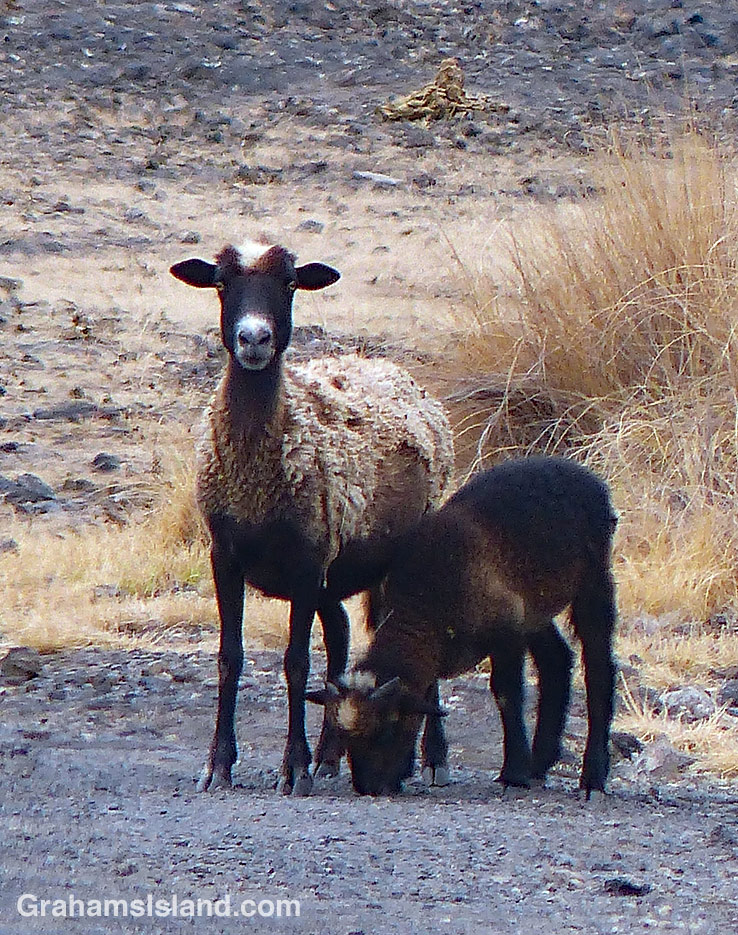
Hiking on the 1871 trail, heading south from Pu’uhonua o Hōnaunau National Historical Park, I came on this scene. A herd of goats blocked the trail. They watched me from the shadows. Two of them raised themselves onto their hind legs and repeatedly butted heads.

In the deep shade of the trees they carried the look of a gang of brigands, ready to relieve hikers of their valuables or, more likely, since they’re goats, something to eat. That could be just about anything from a carrot to the hiker’s shoes.

As I got closer, the goats filtered into the trees and scrub, disappearing from view. Perhaps next time I won’t be so lucky.

For more information about the 1871 Trail, and other hikes on the Big Island, go to bigislandhikes.com.

For more information about Pu’uhonua o Hōnaunau National Historical Park, visit https://www.nps.gov/puho/index.htm.

Posted in response to this week’s WordPress Photo Challenge, ‘I’d rather be…,’ because I’d rather be hiking.

Bluespine unicornfish

Bluespine Unicornfish

On any given day, I’d rather be snorkeling. There’s always something interesting to see in the water here.

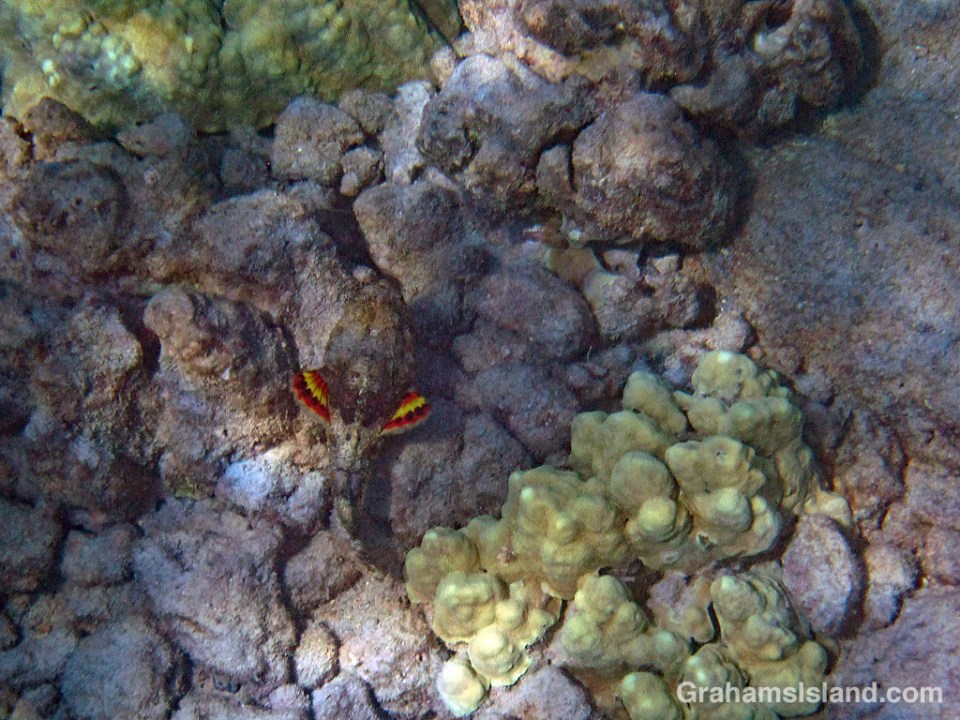
This fish is a bluespine unicornfish, a name which is pretty self-explanatory. The blue spines by the base of the tail are very visible as is the prominent horn. Not all unicornfish have horns.

The horn helps make the bluespine unicornfish look permanently grumpy, which is perhaps why these fish tend to lead solitary lives. They also tend to be wary around snorkelers, maintaining their distance or easing away when approached. This one, however, appeared more curious and made a couple of closer passes before disappearing.

Posted in response to this week’s WordPress Photo Challenge, ‘I’d rather be…

Pu‘u Loa petroglyphs

Not far from the coast, in Hawaii Volcanoes National Park, is Pu‘u Loa petroglyphs trail. It’s only a mile and a half round trip, but visits a place with a huge number of petroglyphs. A raised boardwalk circles part of this area, giving a good view of the petroglyphs without adversely impacting them.

One of the main features of this area and its petroglyph field is explained on a display seen in the second photo. It reads, ‘The name Pu‘uloa (large hill) carries a kaona (hidden meaning)—hill of long life. Families with genealogical ties to these lands come here to place the piko (umbilical cord) of their child. Their hope is that the mana (spiritual guiding energy) of Pu‘uloa would bless that child with a long and prosperous life, and root them to their ancestral lands. Each puka (hole) is created to house a single child’s piko. Of over 23,000 petroglyphs found at Pu‘uloa, 16,000 are piko-related carvings—a testament to the importance of both Pu‘uloa and ‘ohana (family).’

For more information about Pu‘u Loa petroglyphs, go to https://www.nps.gov/havo/learn/historyculture/puuloa.htm.

(On the park’s website, Pu‘u Loa is two words, but on the sign it is one word, hence the inconsistency.)

Resting shark

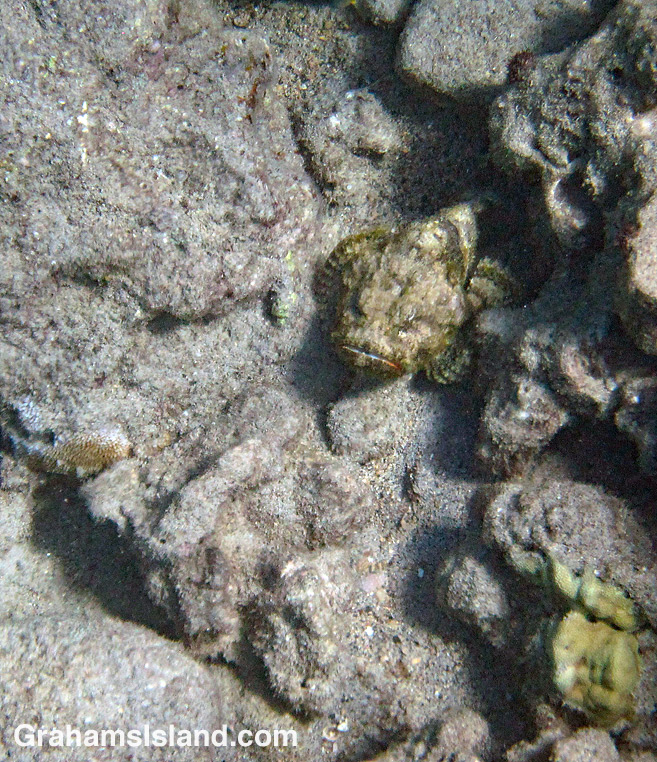
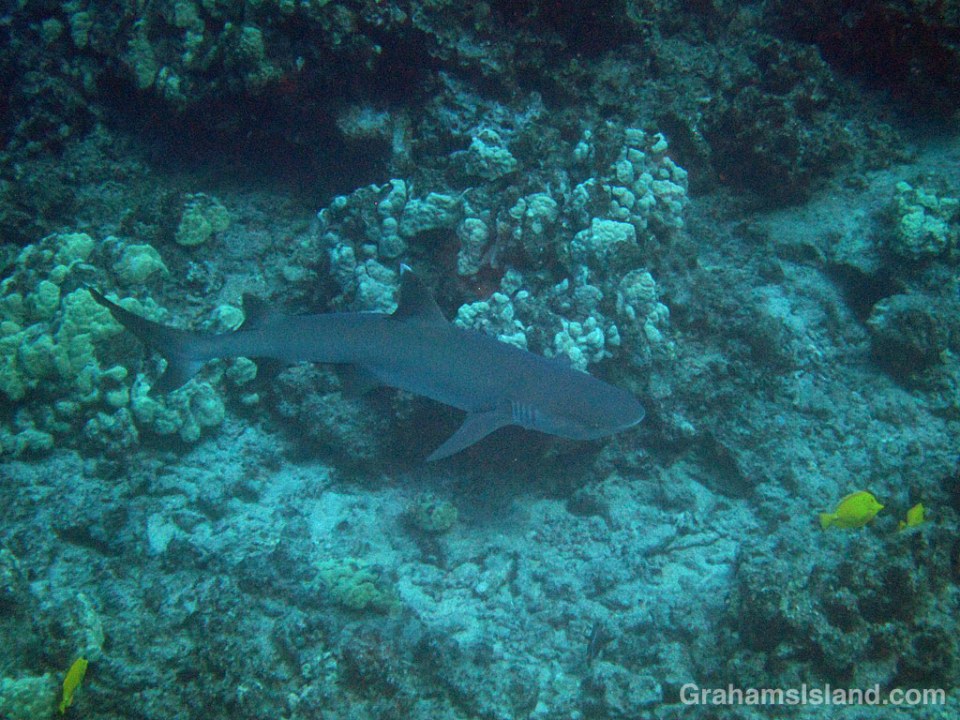
While out snorkeling one day I came across this scene. It’s not a great photo (though the murkiness adds a little to the menace, I think), but still enough to identify it as a shark, resting on the sandy bottom. Later in the day, it was still there. It was more visible with its head out from under the ledge, but the water was cloudier so I didn’t take photos.

I’m pretty sure this is a whitetip reef shark as I’ve heard about one hanging out in that area. The white tips, that give the shark its name, are on the dorsal and tail fins so aren’t visible in this image.

In response to WPC ‘A face in the crowd.’

Touching octopuses

For Valentine’s Day I offer this photo of two day octopuses. It comes with a little story.

One day, while I was snorkeling, I noticed a stocky hawkfish about to plop onto a bit of coral. Before it could settle, a blue goatfish butted it away, getting my attention. I wondered if its presence might mean there was an eel or octopus around since they sometimes hunt together. Almost immediately, just beyond the goatfish, I noticed a day octopus glued to the side of a rock.

I took a couple of photos but knew they wouldn’t be very good; the octopus just looked like another lump of rock. So I began the usual dance I do with an octopus. I edge away, as though I’m leaving, keeping an eye on the octopus out of the corner of my eye. I know the octopus is watching me. Often, when I’ve gone a ways, the octopus will rise up onto whatever rock it’s hiding behind. If I’m quick, I can turn and get a photo before the octopus slides back down again. It’s like we’re connected by a line: I go away, the octopus rises. I return, the octopus sinks.

I swam behind a large chunk of rock, then peeked around the side. Still there, still hidden. A bit farther, another peek. Still there, still hidden. And again. And then I looked away momentarily and when I looked back, the octopus was gone. I think they, like many other creatures, watch a person’s eyes and if the person looks away, off they shoot.

It was a matter of a moment so I knew it couldn’t have gone far. I looked around, examining the rocks. Nothing. They can squeeze into tiny spaces so it was always possible I wouldn’t see it even if it was close by. Then, as I turned around, I caught a glimpse of movement and saw the octopus zip behind a bit of rock. Except then I immediately saw a second octopus follow the first.

I swam around the rock and saw the two of them, each in its own separate crack, a few feet apart. Again I took a couple of photos and then moved away. This time I went farther and waited, watching from a fair distance. Eventually, the octopus on the right of the photo emerged and moved toward the other one. I edged closer and began taking photos. It was then that that octopus slowly eased a tentacle toward the other one, sliding over the rock until it reached up and over the front of the other octopus. It was such a sweet and tender gesture, as though the octopus sought reassurance in making physical contact with its companion.

I took the photo and swam off, leaving them in peace.

Green Sand Beach

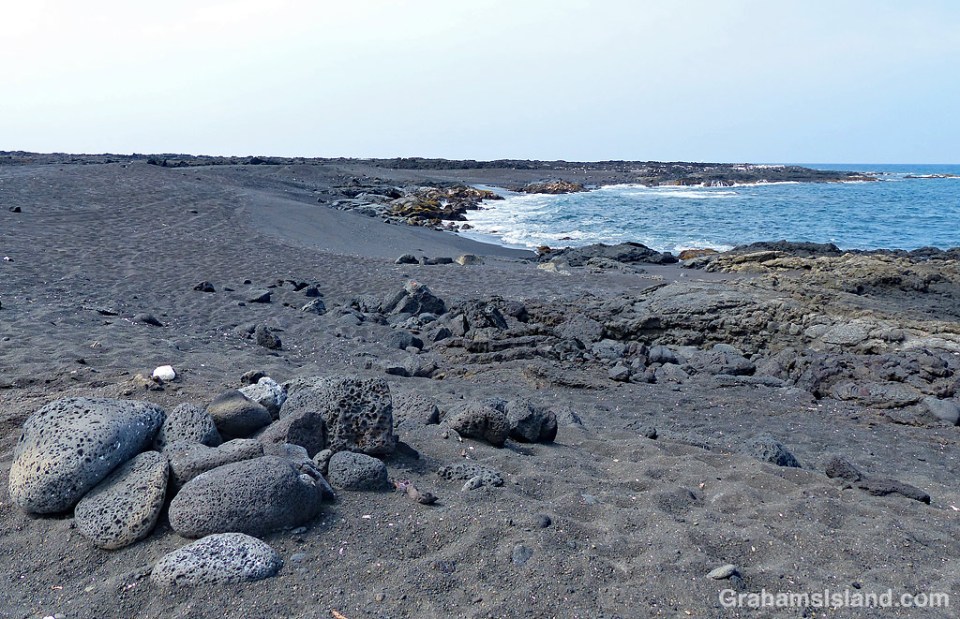
This week’s WordPress photo challenge is ‘Tour Guide’ which I’m happy to use as my theme for this week’s posts. Since this is Hawaii, a good place to start is at the beach. This one is Papakōlea Beach, better known as Green Sand Beach. It’s about 3 miles northwest of South Point, the most southerly point in the United States.

The beach lies in a bay formed when the ocean eroded one side of an old cinder cone, Pu’u Mahana. The green color of the sand is a result of olivine in the lava. Since it’s heavier than other things in the lava, it stays on the beach. Swimming is possible in the shelter of this deep bay, but be careful. This coast is notorious for dangerous surf and strong currents.

It’s 2 1/2 miles to the beach from the parking area. There’s a very rough four-wheel drive road, which you can drive, or locals will ferry you out for a fee. The other alternative is to hike out along the coast, which is what I did.

You’re not likely to have the beach to yourself, but you will have a share of a beautiful, remote beach, a view all the way to Tahiti (you might have to stand on a rock), and the opportunity to broil on the distinctive green sand.

Clouds from Pu’u Wa’awa’a

A few days ago I did another hike up Pu’u Wa’awa’a, a large cinder cone north of Kona. I planned the hike to coincide with one of the days of latest sunrise here, just after 7 a.m.. My idea was to arrive at the trailhead at 6 a.m., when the gate opens, and head up as quickly as I could in order to get the best shot at early morning light from the summit. This meant getting up by 4 a.m. and setting out by 5 a.m.

Defying all historical precedents, I was there five minutes early. The new automated gates opened before me and in no time I was hotfooting up the trail, flashlight in hand, in order to avoid breaking an ankle in the one of the many potholes in the old road that makes up the first part of the trail.

One advantage of hiking in the dark is that I didn’t stop every five minutes to take a photo of a goat or bug. Still, an hour into the hike, as the light improved, I couldn’t help but pause when I spotted a large wild pig excavating – no other word for it – a large hole in the hillside in the search for worms and the like (alas the photos weren’t great – not enough light).

By 7:30 a.m. I reached the top of the climb. I already knew I wasn’t going to get the hoped-for blaze of early morning sun – too many clouds from the get-go – but this photo shows the moody light that greeted me. I considered this a worthy consolation prize. And then there was the fact that I had the summit to myself for 90 minutes, and the mamane trees on the west side were in bloom and attracting Hawaii ‘amakihi and hordes of bees (look for several dozen photos of these in the near future!).

For more information about Pu’u Wa’awa’a and its trails, go to puuwaawaa.org.