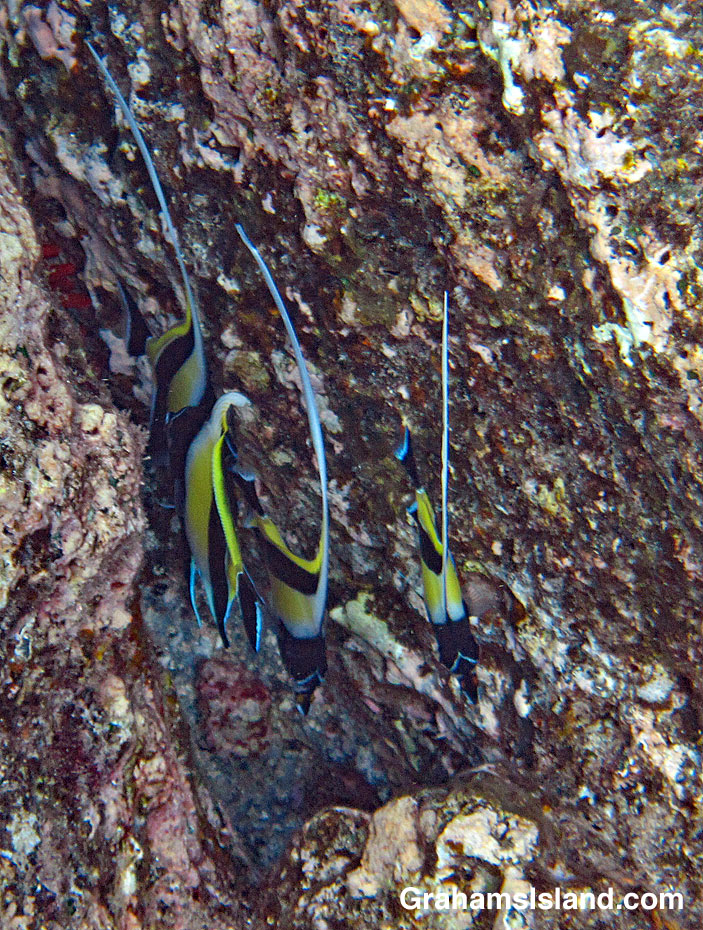
A moorish idol foraging for food. These quite common fish are easy to identify because of their bold patterns, strong colors, and distinctive shape with a tapering head and long snout.

A moorish idol foraging for food. These quite common fish are easy to identify because of their bold patterns, strong colors, and distinctive shape with a tapering head and long snout.

I saw these black triggerfish clustered in a very tight ball and wondered if they were feeding or being fed upon. Many of the triggerfish were showing colors that indicate arousal or agitation, but I didn’t see anything conclusive either way and my attention was quickly distracted when I saw this mysterious tube.


This longnose butterflyfish was cruising around, probing for tasty morsels, when it disturbed this surgeonfish. I think it might be a Thompson’s surgeonfish, but it disappeared before I could make a positive ID.

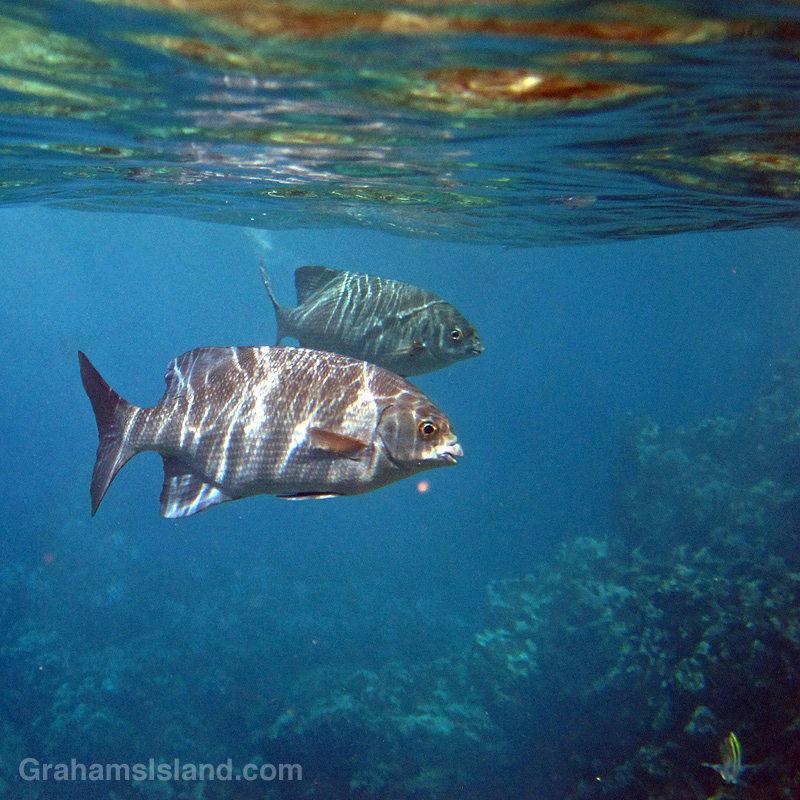
Nearing the end of a long swim, I noticed these two fish swimming towards me. At first I thought they might be bluefin trevallies, but I could see the coloration was wrong. The other thing I noticed is that the two fish never deviated in their course, which took them right by me. Most fish, when they see someone coming their way, will zip away or at least cautiously ease around the interloper. Because they passed so close to me, I was caught by surprise and only managed to get these two shots before they were gone.
The fish are greater amberjacks, which spend most of their time in deeper waters, but occasionally venture in shallower waters as these two did. The fish are easily identified by the dark diagonal bar through the eye and the yellow stripe along the sides, though that isn’t always visible.


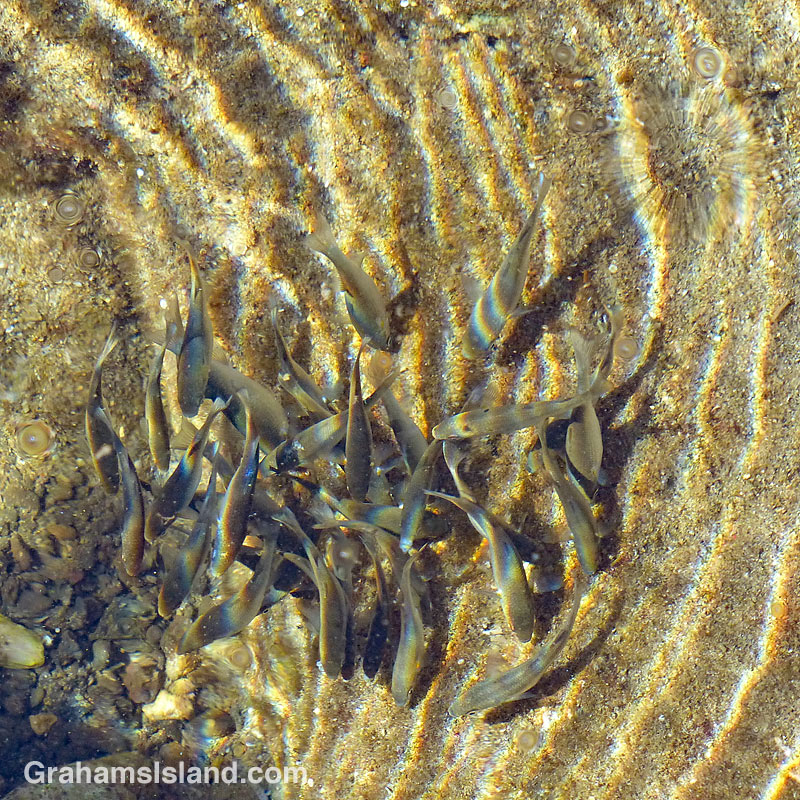
These little fish were swimming back and forth in the golden pools of Keawaiki. The gold color comes from a kind of algae that grows in the pools.


These three were swimming together, the two goatfish probing for prey and the saddle wrasse hanging about to snaffle up tasty tidbits stirred up by the two other fish.

This little lemon-yellow beauty is a juvenile Commerson’s frogfish. Frogfish are rarely seen by snorkelers because they blend in so beautifully. Typically they look like bits of the reef but some, such as this one, mimic sponges and so are more easily seen.
Frogfish are anglers. They sit motionless on the bottom. When potential prey approaches, they flick their first dorsal fin forward. This is tipped with a fleshy lure that hangs over its mouth. If the prey takes the bait, the frogfish strikes. It can expand its mouth to swallow quite large fish and it strikes with such speed that other fish in the vicinity are generally unaware what’s happened, thus allowing the frogfish to remain in place and continue fishing.
In this photo, the frogfish’s eyes and mouth are visible, as are its pectoral fins that are adapted to help it hang on to the reef and to move about.
This frogfish was spotted by my wife and we watched it for a while before we were interrupted by three whales breaching. They were half-a-mile or more away, but this was the first time I’d seen whale activity from the water and it was pretty impressive, if almost impossible to photograph.
When the whales settled down, I dipped my head below the water to try and locate the frogfish again and the first thing I saw was a white-tipped reef shark cruising by. I suspect it had been attracted by my feeble attempts to dive and photograph the frogfish, probably thinking there was some easy prey to be had. It quickly disappeared again, but it made for a memorable few minutes.
This fish is a gray chub, so why is it yellow? That’s a question with no good answer. Locals used to think that yellow-colored chubs were ‘queens’ of their schools, but there’s no evidence to support that. Instead, it’s regarded as simply a color variation, seen in a few fish, that is without significance. This is the first one of these I’ve seen.
Gray chubs’ usual coloration can be seen in the photo below.