
This spotted pufferfish came up to take a little look at me before scooting off to deeper waters. I have yet to see a pufferfish inflated, but this one looked fairly round, even if that’s its normal shape.

This spotted pufferfish came up to take a little look at me before scooting off to deeper waters. I have yet to see a pufferfish inflated, but this one looked fairly round, even if that’s its normal shape.
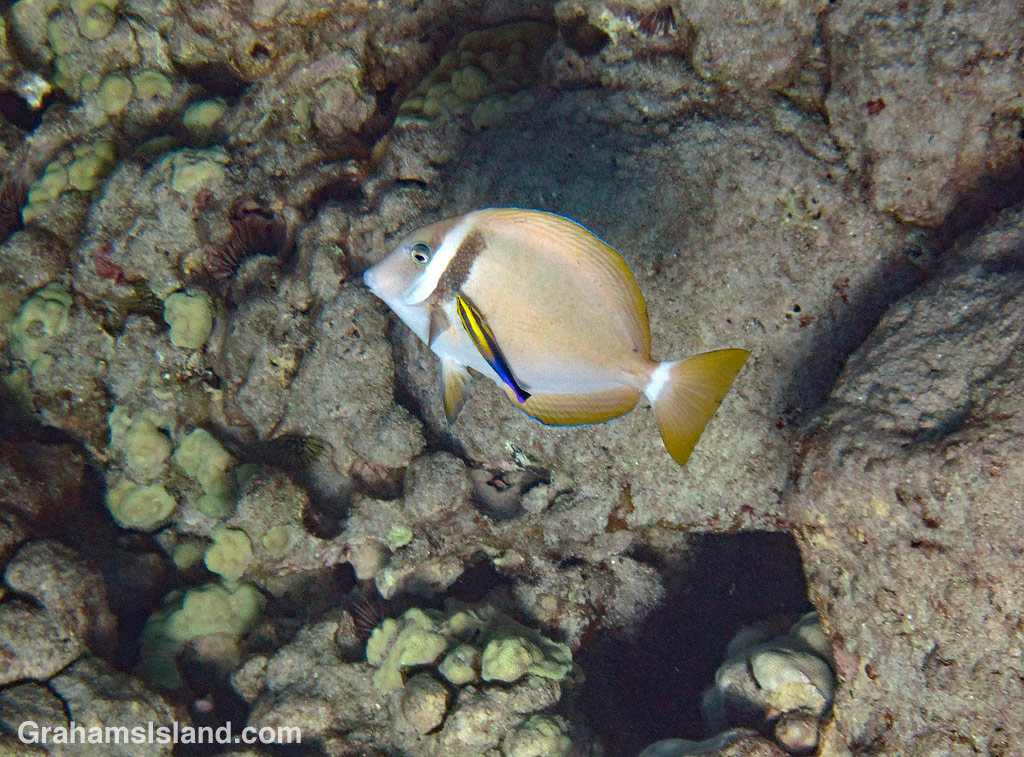
A cleaner wrasse performs its service on a whitebar surgeonfish. Cleaner wrasse establish stations where other fish can visit to be cleaned of mucus and parasites.
When I’m snorkeling, I enjoy visiting these stations to see what’s going on and which fish are availing themselves of the services offered. Some of these fish are predators who, in other circumstances, might be expected to make a meal of a cleaner wrasse. But because of the beneficial service they offer, cleaner wrasse get a free pass with predators.
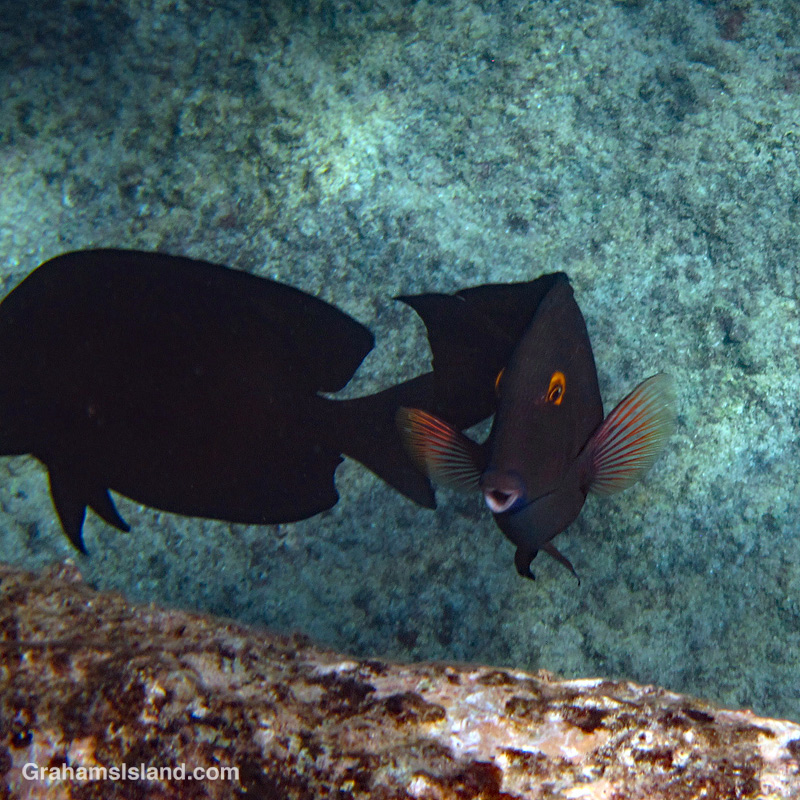
This goldring surgeonfish is so named because of the colorful ring around its eyes. This one came up to take a look at me. I like how it looks like it’s casting a giant shadow, but that’s actually a different fish (another goldring surgeonfish I think) passing behind it.

This is a photo that comes with a story. There’s a place where I often snorkel that is home to a large group of barracudas. Most of these barracudas are around a foot and a half in length, though a few are much larger than that. I’ve mentioned before how barracudas give me the willies. They have not attacked anyone in Hawaiian waters to my knowledge, but they just have a certain look about them.
On this day I had passed the barracudas’ territory closer to the shore than I usually do. I didn’t see a single one of them. On my return, I swam farther out and, at one point, saw this barracuda and a second one (the jaw of which can just be seen in the photo) coming toward me. This was a bit unnerving but they slid by to one side, which is when I took this photo.
I turned my head and saw them curl around behind me. This wasn’t unusual; I’ve often had barracudas track me as I pass. Then I noticed a couple more arrive. This was less reassuring. I kept swimming steadily because I didn’t really have any other options. There was no way I was going to outrun them. Pretty much everything in the ocean moves faster than me and that probably includes some snails and sea cucumbers. Equally, I didn’t feel like turning to face them because the possible results of doing that included some I didn’t much like.
It seemed like every time I turned my head to see where they were, another barracuda had joined the pack. There must have been eight or nine of them at one point. Luckily, I didn’t see any of the very large barracudas among them, as that would definitely have made me even more nervous.
After a while I reached a rocky islet, a place where I usually first encounter the barracudas. They were all still behind me when I got there, but soon after I passed they were gone. While I’ve seen them in many different areas, this spot does seem to mark some edge to the territory of the main group.
I swam on, looking behind from time to time, and feeling more relaxed each time I did so. At least until I looked ahead one time and saw one of the huge barracudas heading right at me. It too passed by and I didn’t see it again, but it was time for me to get out of the water.

Lizardfish are fairly small and hide by remaining motionless on rocks and coral, relying on their patterned colors to blend in. This works very well and I rarely see them, but I noticed this one in motion moments before it plopped down where you see it. I think this one is a reef lizardfish.


A little snapshot of things tucked into the rocks along the Big Island. There’s a red pencil urchin and blue-black urchin, a patch of cauliflower coral, and a cowry, probably a reticulated cowry. And if you look closely, there’s a bright-eyed damselfish swimming between the coral and red pencil urchin.
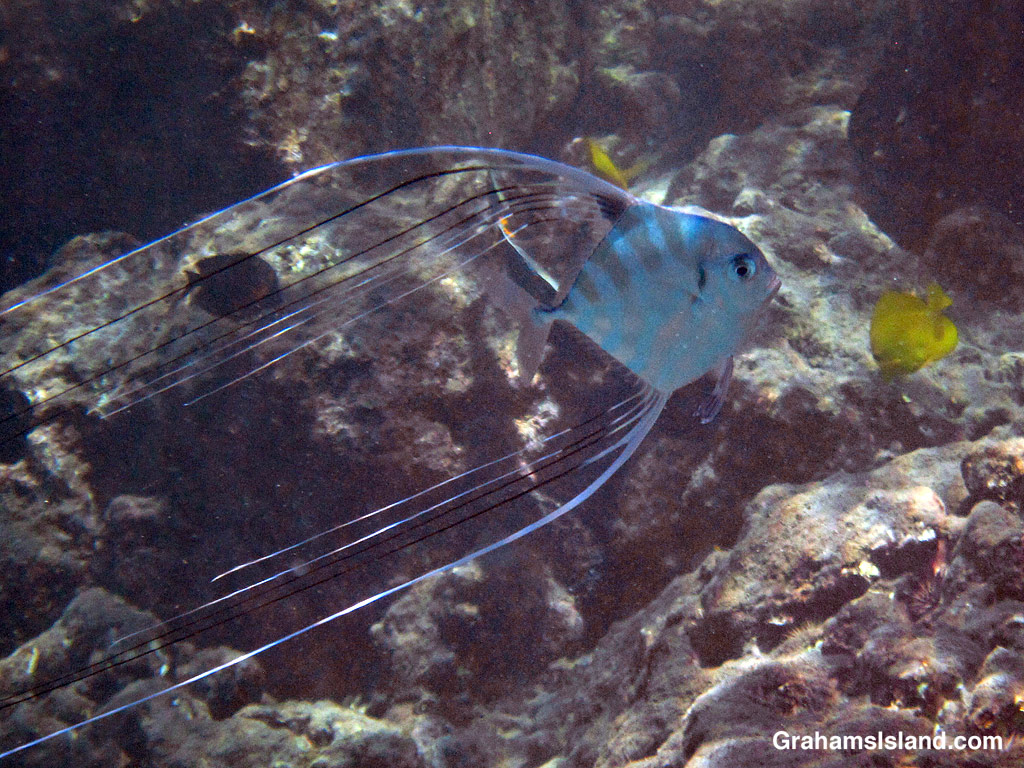 This week’s Friendly Friday challenge theme is ‘Fake.’ See more responses here. I don’t really have many photos that fit this bill, but this one does. This exotic-looking little fish is a juvenile threadfin jack. This is a fish that will grow up to become large and blocky, living in deep water and rarely seen by snorkelers of divers.
But as a juvenile, while still not often seen, it hangs around in shallow waters towing this extraordinary array of filaments. The theory is that the filaments make it look like a jellyfish and thus much less appetizing to predators. The fish will putter along, then throw in a few moves that make the filaments ripple. The first time I saw one doing this, I thought it was a jellyfish. It faked me out, which is exactly the point.
Usually, each year I see one, two, or even three of these juveniles in my local snorkeling bay, but this year I haven’t seen any or heard of them being spotted by anyone else. Not sure why this is. The water has tended to be murkier than is usual in the summer, but otherwise not much has changed. May and June is the usual time to see them, but I have seen them as late as September, so there’s still time. (This photo is taken from a previous year.)
I hope one or two do show up. Seeing them is one of the highlights of the snorkeling year for me.
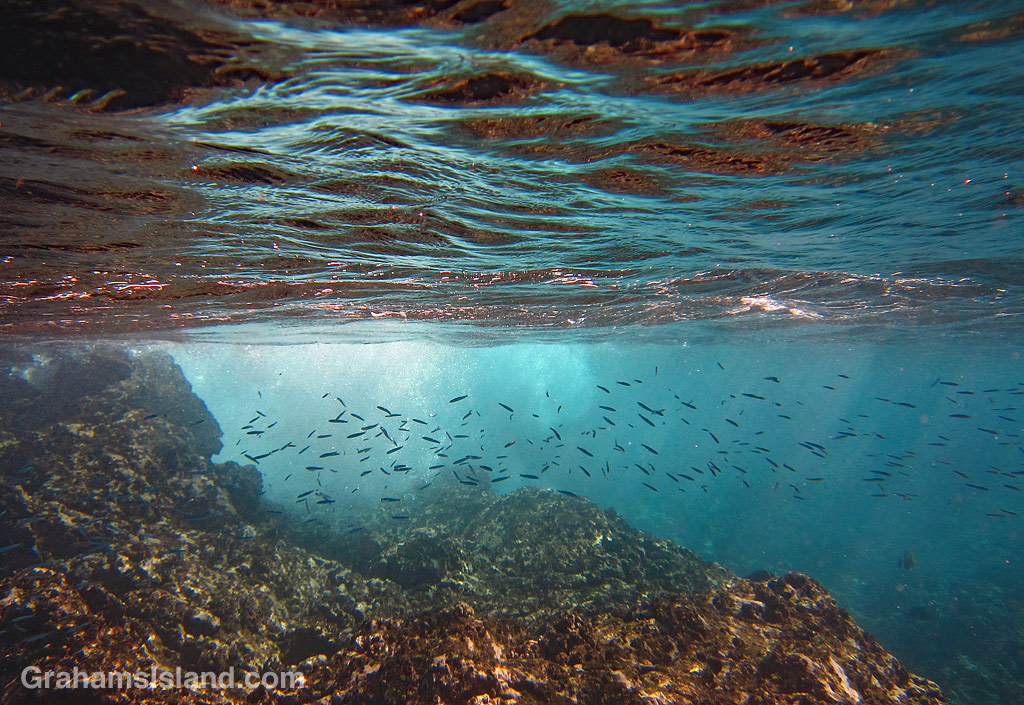
It’s common to see shoals of small fish, like those in the photo, close to shore in the surge area, where waves crash ashore. Swimming in groups gives these young fish their best chance of making it to adulthood, and staying near rocks in shallow water is another form of defense for them.
I find it amazing that even little fish like these will accelerate and change direction almost as one.
 Graham's Island