

Bluestripe snappers are particularly distinctive with their four blue stripes, which glow when the light hits them right. Often seen in schools (the fishy kind), they’re also liable to be seen in pairs or alone as this one was.
Category Archives: In The Water
Abstracts: Green turtle swimming

A green turtle swims through rippling shallow water at Kaloko-Honokohau National Historical Park.
Stocky hawkfish
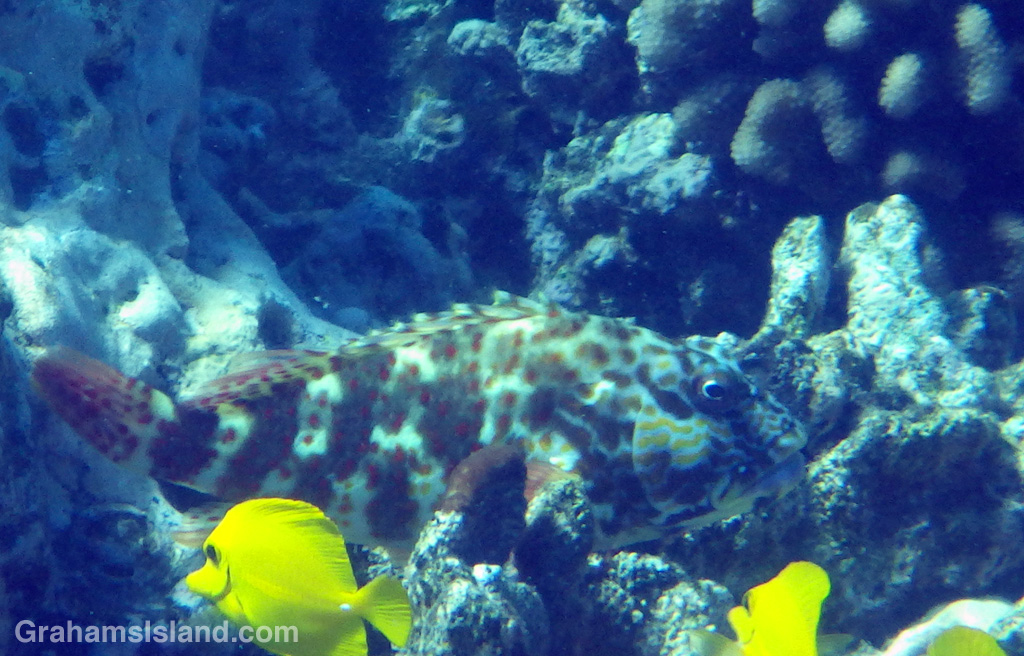
Stocky hawkfish have terrific camouflage They rest in the coral and can be very difficult to pick out.
Barred filefish

A barred filefish grazes on a coral head.
Coastal manta ray

Not the greatest photo – swell had churned up the water – but I post it for two reasons.
One is, it’s the first manta ray I’ve seen outside of a tour where they set up lights and an unruly mob of people hung onto floats while the manta’s fed off plankton attracted by the lights. The manta’s were fabulous; the rest of the experience was weird, bordering on unpleasant. To top it off, I didn’t get any photos.
The second reason is how I came to spot this manta in the first place. A group of three women was swimming about 100 feet ahead of me. They had masks and snorkels but not fins. I happened to pop my head above water and heard a scream from one of the women, followed by a huge froth of whitewater in their vicinity. They’d obviously seen something dramatic and my first response was to find out what it was, never mind that a scream and churning water might be a strong indicator of a shark attack.
As I swam forward, this great creature came into view, angling across my path. At first it wasn’t clear what it was, but then the two distinctive cephalic flaps became clear. Manta’s use these to funnel water into their mouths when feeding. Manta’s are plankton feeders and harmless. Many rays have stingers in the tail area, but manta’s don’t. John Hoover says an 8 to 12 foot wingspan is most common for manta’s in these waters and this one certainly fell in that range.
With little effort, it glided past me toward deeper water. As it did so I saw a second manta join the first, then they disappeared into the murk.
A few minutes later I talked to one of the women who’d been in the group ahead. She said she’d screamed because she was startled by the sudden, unexpected appearance of this huge creature. I sympathized. I’ve had a similar response when unexpectedly meeting sharks and eagle rays at close quarters. But at the same time, such chance encounters are magical and memorable and I am grateful for them.
In my attempts to identify what I see in the water, I use John P. Hoover’s book The Ultimate Guide to Hawaiian Reef Fishes, Sea Turtles, Dolphins, Whales, and Seals. His website is hawaiisfishes.com.
Sergeants feeding

It’s always fun to see fish active just below the surface of the water. Needlefish live in this area, but schools of sergeants also gather there to feed. The fish with the darker stripes and yellow patch on the upper back is the Indo-Pacific Sergeant. It’s a relatively new to Hawaii having arrived around 1990. The fish with less distinct stripes is the Hawaiian Sergeant, an endemic species. Apparently, the two species have been interbreeding, producing a fish with the coloration of the Hawaiian Sergeant, but with the more pronounced stripes of the Indo-Pacific Sergeant.
Saddleback butterflyfish
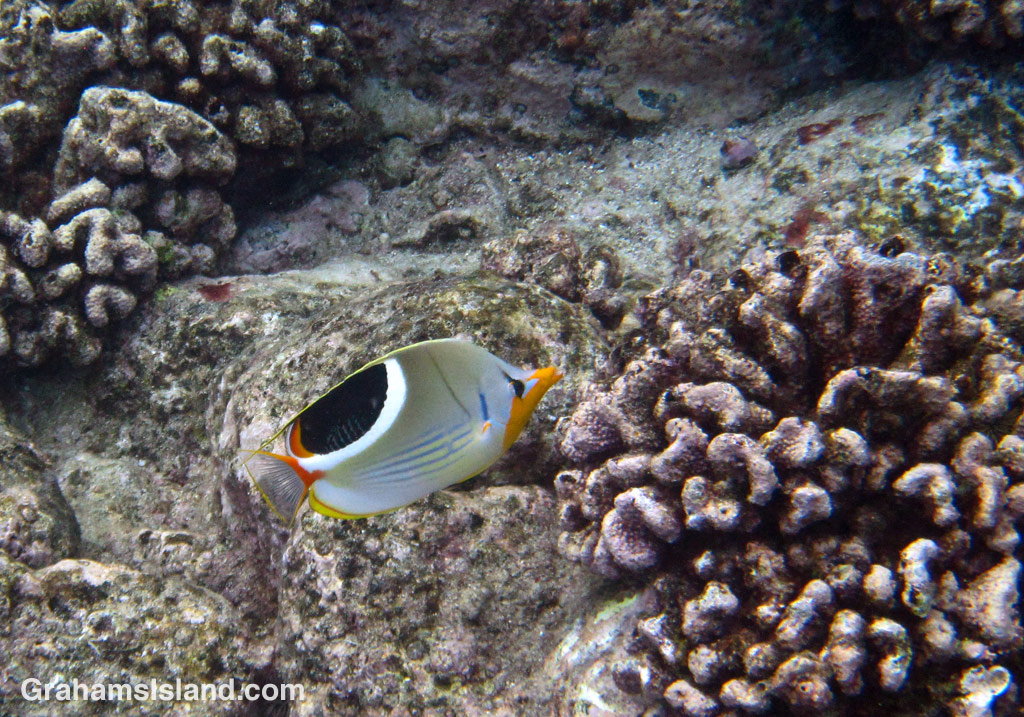
A saddleback butterflyfish cruises through coral heads. These colorful fish aren’t seen as often as many other kinds of butterflyfish so it’s always a treat to see one or, often, a pair of these striking fish.
Mongoose and dead turtle

I pondered about posting this photo. I’d emailed a contact at a marine animal facility with the news that I’d found a dead turtle with a broken shell washed up among some rocks. I asked if anyone would be interested in that information, thinking some marine biologist might want to check the remains to determine the cause of death, that sort of thing.
He asked me to send a photo, which I did. Then I got a response in which he said not to send more. He’d been expecting a ‘happy turtle photo.’ I suspect he’d missed the bit about it being dead with its shell broken in two.
This is a less graphic photo taken a day later, by which time mongooses had discovered the remains. My appearance distracted them, but not enough for them to flee. The mongoose is the poster animal for catastrophic invasive species, but in this case, it’s performing something of a service in cleaning up the remains. Probably other creatures, such as crabs, also gathered for the feast.
I don’t know what happened to the turtle. Possibly it was attacked by a tiger shark or it could have died for some other reason. I doubt the ocean caught it by surprise and swept it to its death. Turtles are very good swimmers.

