Category Archives: In The Water

Yellow tang-o

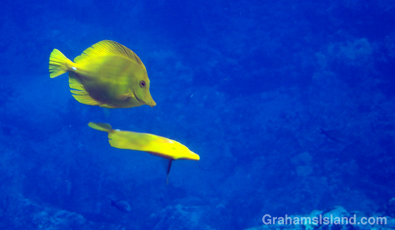
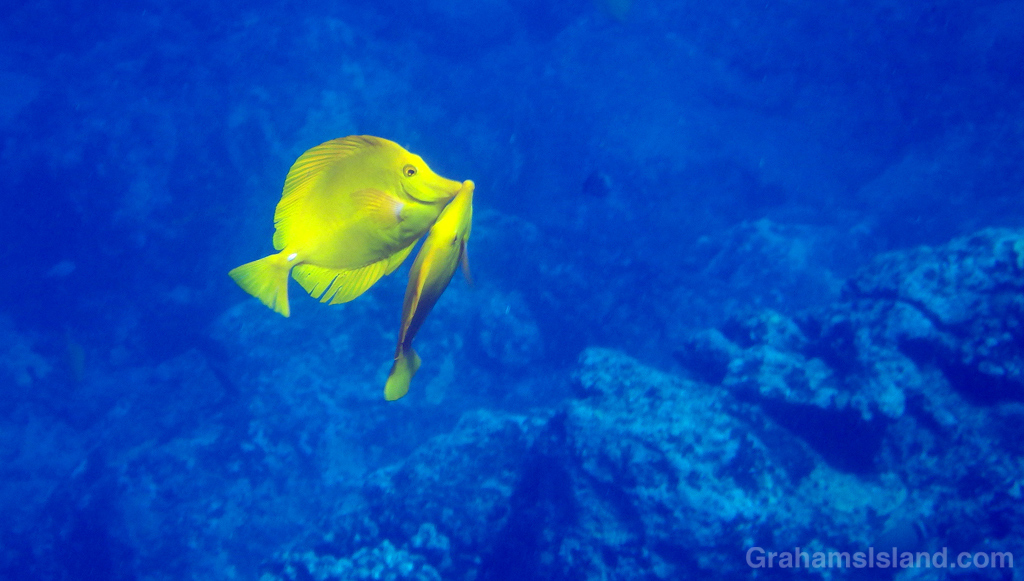
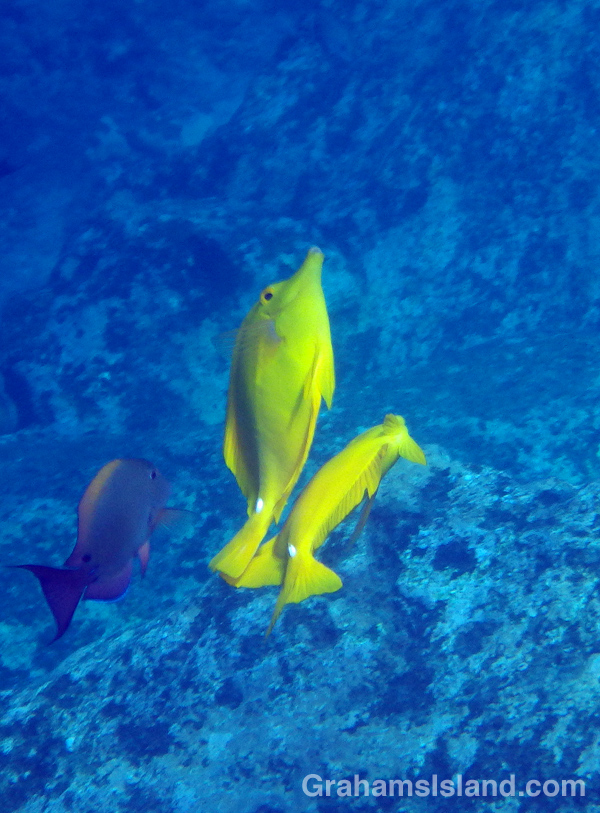
A pair of yellow tang dance in the sunlightA pair of yellow tang dance in the sunlight
Yellow tang are the most easily identifiable fish, both in and out of the water. Their bright yellow schools, cruising the shallows, are easily seen from shore. In the water, they stand out, especially when the sun catches them.

I watched this pair as they performed what I assumed was some kind of mating dance. They shimmied up and around, dancing apart and then coming together again with the most delicate and touching moves.

In my attempts to identify what I see in the water, I use John P. Hoover’s book The Ultimate Guide to Hawaiian Reef Fishes, Sea Turtles, Dolphins, Whales, and Seals. His website is hawaiisfishes.com.

A pair of yellow tangA pair of yellow tang dancing.

Octopus

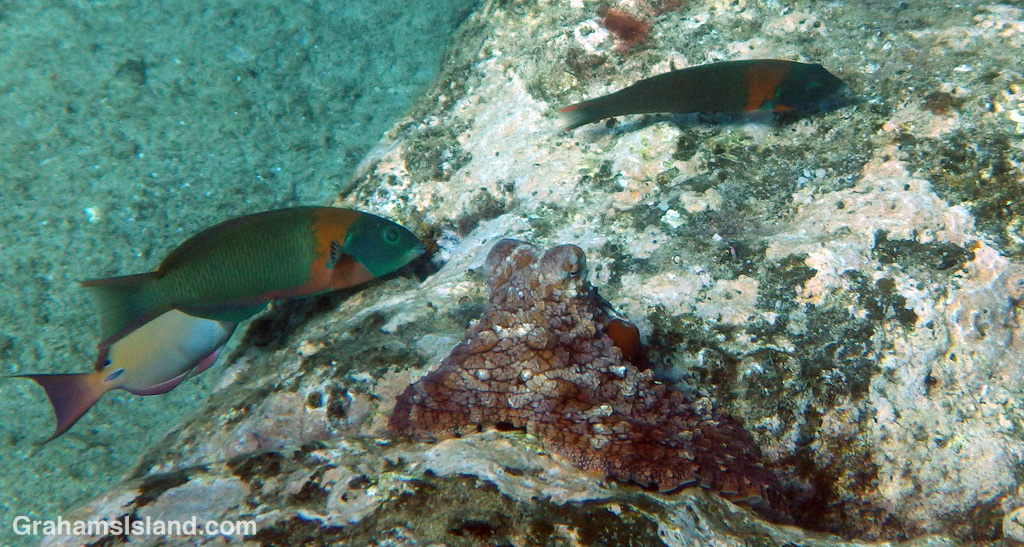
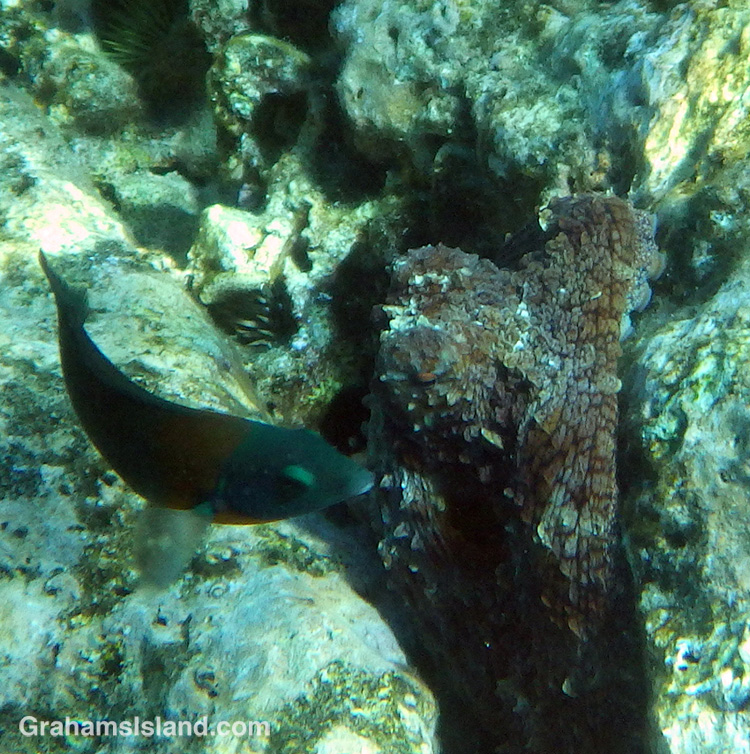
A day octopus and saddle wrasseA day octopus and saddle wrasseIt’s exciting to see an octopus. They’re extremely hard to spot. If it’s not moving, chances are I won’t see it at all. The reason for this is that the octopus is a master of changing color and texture to match its background.

I’ve been lucky enough to see quite a few, once three in one swim. But sometimes there are weeks between sightings. As for photos, the good news is that when I spot an octopus it rarely moves, meaning I have time to get a photo. The bad news is that they blend in so well I invariably end up with offerings where I have to say something like, “It’s right there, near that coral. No, that’s not a rock.”

On this occasion, I spotted movement just before the octopus dipped into a crack in the rock and changed color. We then began a little pas de deux. When I drifted away, the octopus eased up onto the rock. If I closed in again, it slipped back into the crack. The nice thing, from my point of view, was that when it was on the rock it stood out about as well as it was ever going to against a fairly plain background.

I believe this is a day octopus. They’re active during the day and one most commonly seen around here. The passing fish are saddle wrasse.

In my attempts to identify what I see in the water, I use John P. Hoover’s book The Ultimate Guide to Hawaiian Reef Fishes, Sea Turtles, Dolphins, Whales, and Seals. His website is hawaiisfishes.com.

Bluespotted cornetfish

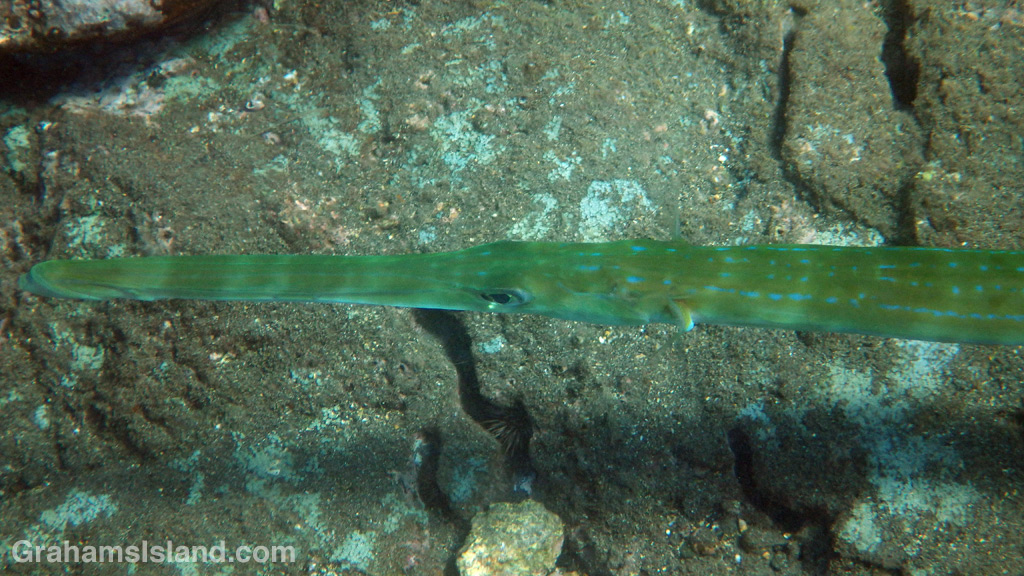
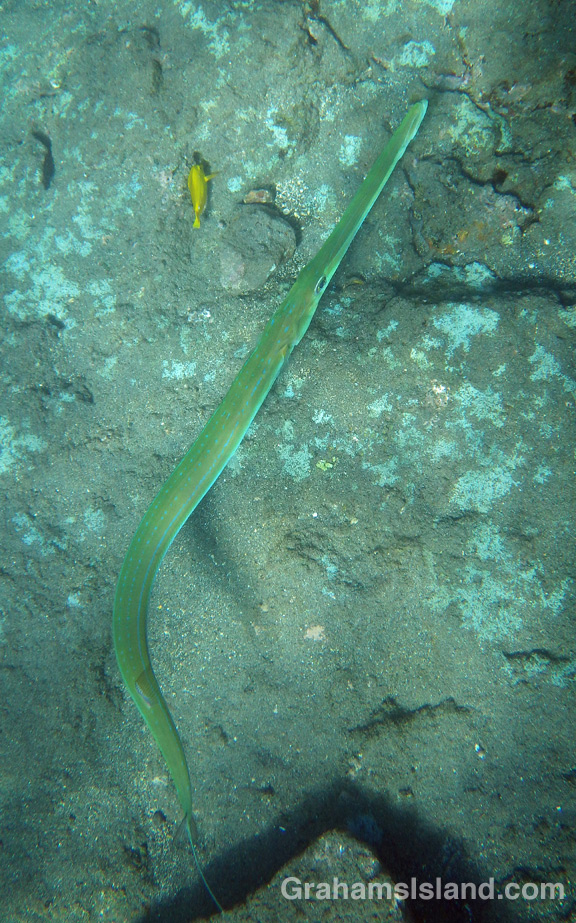
A bluespotted cornetfishA bluespotted cornetfish
This is a fish of many shapes and colors. Seen from the side they look skinny and long. From above they look much wider and, consequently, seem shorter. They look silvery from the side, green from above and they’ll add dark bars sometimes.

This one was hanging out in shallow water and showed no inclination to move on. It might have been guarding eggs, but that’s just speculation on my part. It shows a green tint and also the blue spots and lines that give it its name.

In my attempts to identify what I see in the water, I use John P. Hoover’s book The Ultimate Guide to Hawaiian Reef Fishes, Sea Turtles, Dolphins, Whales, and Seals. His website is hawaiisfishes.com.
Monk seal calisthenics

A Hawaiian monk seal resting in a tide pool
This is I05 who was the subject one of my first posts on this blog. In that photo he was resting. Here we see him doing calisthenics. Ha, just kidding. This was actually a brief position adjustment between two lengthy spells of resting.

Monk seals, though few in number, often haul out to rest around the island. It’s important not to get too close while they do so. Besides being illegal, disturbing their resting periods can be stressful and adversely affect their health. Also, if they get used to humans being close by, it’s only a matter of time before there’s an encounter where someone gets bitten. This is likely to result in the animal having to be relocated to the uninhabited northwestern islands.

This was the first time I’ve seen I05 in almost 5 months so it was good to see him again and still in such good shape. The green tinge to his skin around his nose and flippers is algae and he will likely molt in the none too distant future. Molting is usually an annual occurrence, during which he’ll shed the top layer of his skin and fur.

I05 is the brother of Waimanu and was the uncle of Elua, the subject of this post. I’m not sure why, but as far as I know I05 was never given a name. I confess that I call him Igor, though I can’t remember why.

For more information about Hawaiian monk seals, go to www.pifsc.noaa.gov/hawaiian_monk_seal/ or www.marinemammalcenter.org/hawaii.

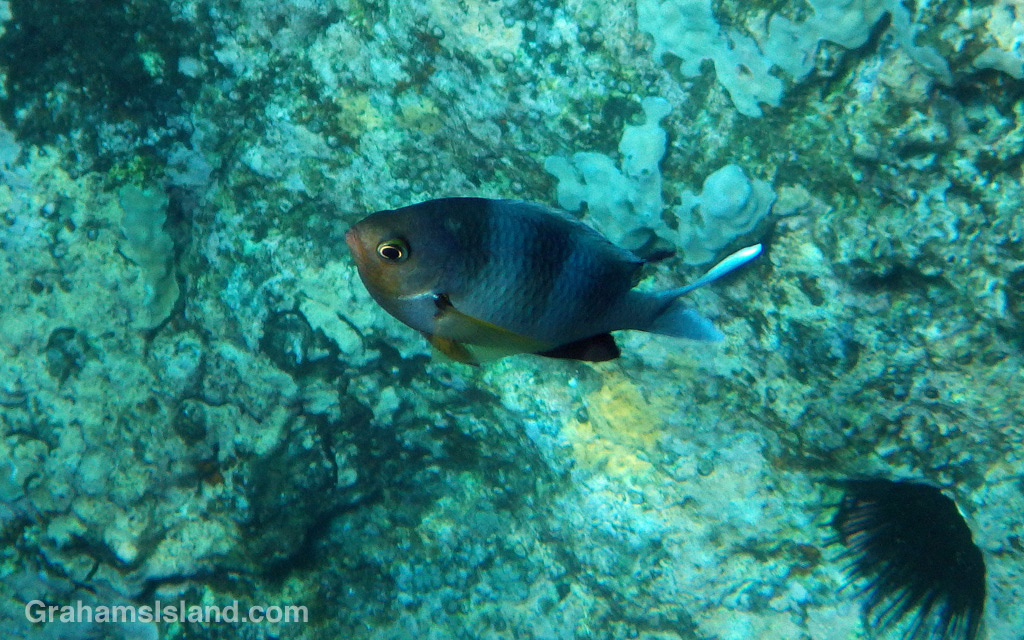
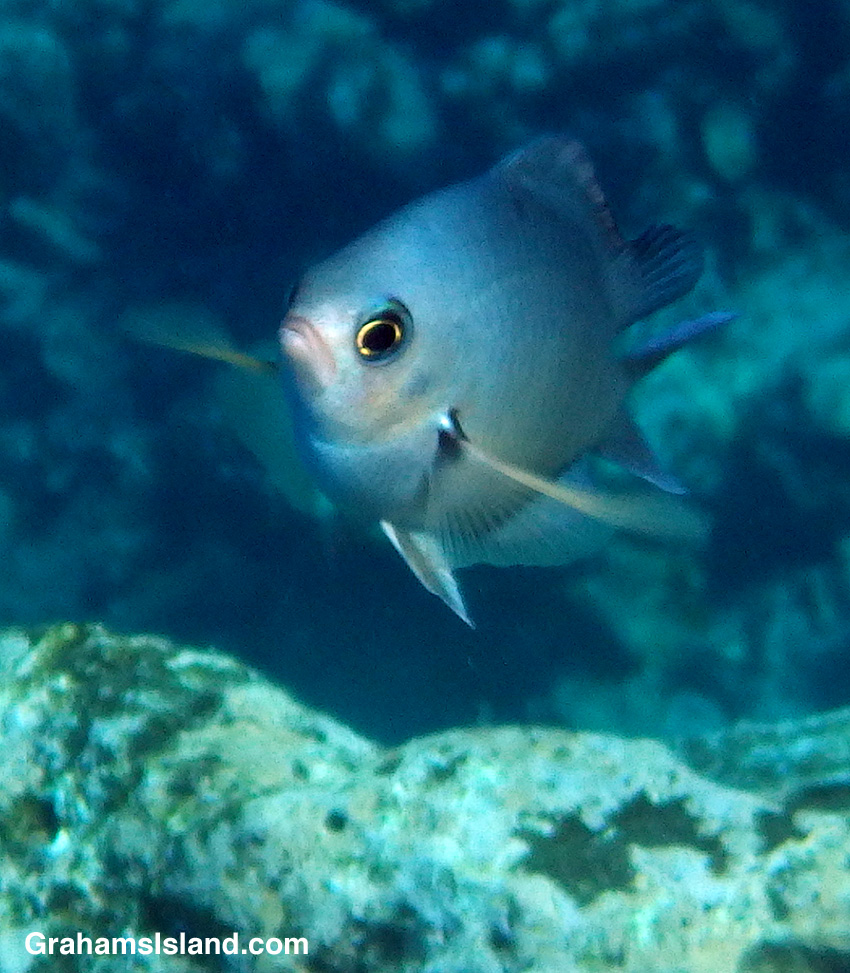
Oval Chromis

A male oval chromis fish in spawning colors

Oval chromis fish

These little fish can have quite different coloration. The silvery one to the right is a common sight. The one above is a male in his courtship and spawning colors. Later, when he’s guarding the eggs, he’ll be a more silvery blue with an orange patch on the lower jaw. Juveniles can vary from silvery blue to yellow.

Many other fish also have extensive color variations, which can make it difficult identifying individuals. Oval Chromis are one the larger family of damselfishes. While their colors and patterns vary quite a bit, they all have a similar ‘look,’ which, in this case, helped narrow down what I was looking at.

In my attempts to identify what I see in the water, I use John P. Hoover’s book The Ultimate Guide to Hawaiian Reef Fishes, Sea Turtles, Dolphins, Whales, and Seals. His website is hawaiisfishes.com.
Signs: Flying shark attack?

A 'shark sighted' sign on the fence at Upolu airport.

Last September, a 13-foot tiger shark attacked a spear fisherman off Upolu Point in North Kohala. Luckily he had friends there and they got him to hospital. En route, he posted photos of his serious wounds on Facebook!

Usually, when there’s a shark attack, nearby beaches are closed. In this case, it’s a somewhat remote area with no beaches so there were no closures. But any time there’s an attack or even a reported sighting, these ‘Shark Sighted – Keep Out” signs are posted. What I particularly liked in this case was that the sign was attached to the fence at Upolu Airport (which is no more than a lightly-used landing strip). Was this something new from the sharks? An air attack?

In fairness, there’s really no better place to post such a sign and the dirt road that runs alongside the fence is the one most people use when heading toward the coast. But I like to imagine that some tourist came by and wondering whether some shark had flown in in this instance.

The sign blew away within a couple of days by which time I expect the shark was also many miles away. Or perhaps not. Dun dun dun dun …

For more information about the shark attack off Upolu Point, go to westhawaiitoday.com/news/local-news/shark-attacks-man-upolu-point.


Scrawled filefish

Scrawled Filefish
This filefish is quite distinctive. It has a flattened body and long tail fin. Typically, it has a pale body with blue spots and scribbly lines, which is where it gets its name. It also has the ability to darken to a camouflage pattern, which is what this one was doing, though the blue lines are still visible. When sporting the camouflage pattern, they lie on the coral and blend in very well indeed.

In my attempts to identify what I see in the water, I use John P. Hoover’s book The Ultimate Guide to Hawaiian Reef Fishes, Sea Turtles, Dolphins, Whales, and Seals. His website is hawaiisfishes.com.