One day, when I got in the water, I dipped my head below the surface and saw a large barracuda idling a few feet away in murky water. Gathering myself, I took a few photos, none of which turned out.
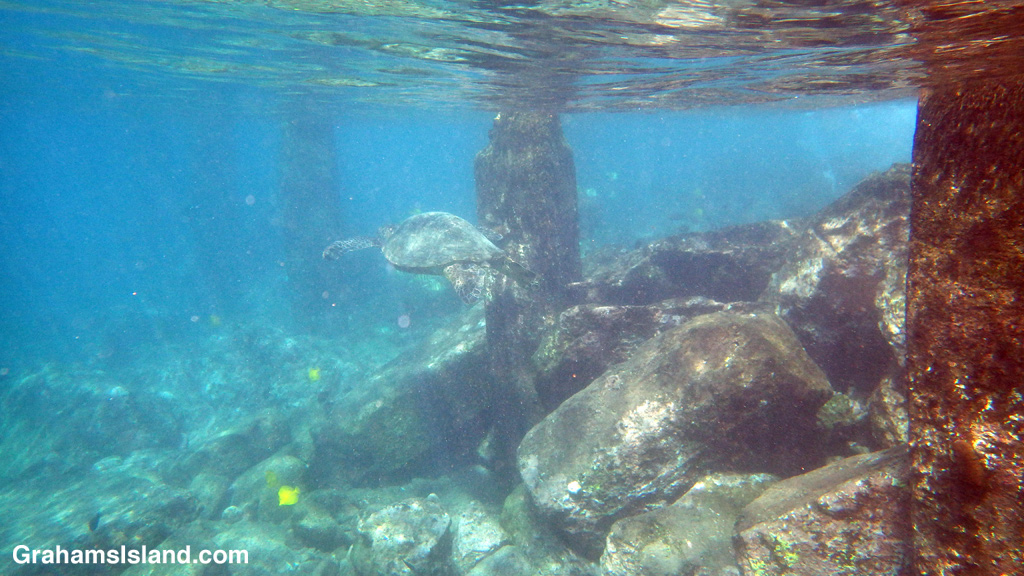
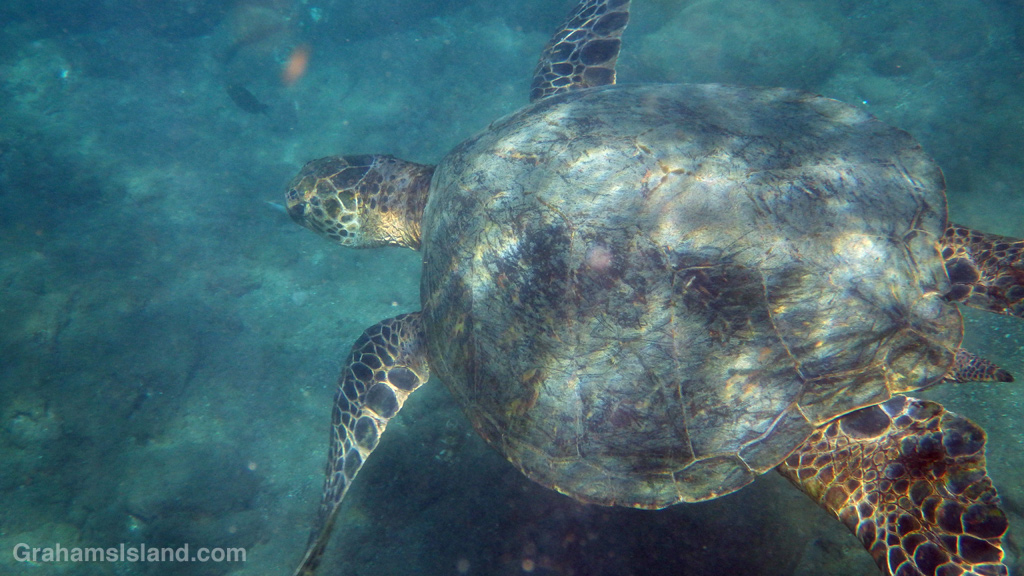
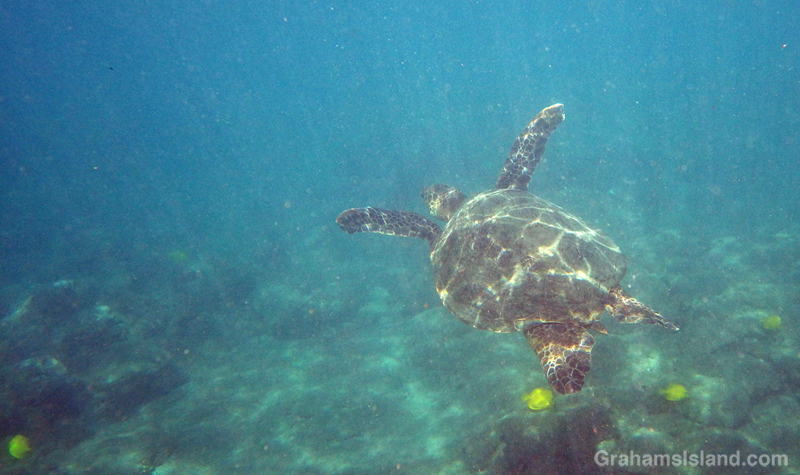
When the barracuda swam away, I tried to follow, but didn’t see it again. Instead, this green turtle slid by not two feet away. It pottered among the rocks, then came back out, passing me almost as close as before. I followed at a discreet distance, before it eased into the ruins of an old pier. I love seeing turtles in the water – they’re so graceful. First time I’ve had my camera with me.
In my attempts to identify what I see in the water, I use John P. Hoover’s book The Ultimate Guide to Hawaiian Reef Fishes, Sea Turtles, Dolphins, Whales, and Seals. His website is hawaiisfishes.com.
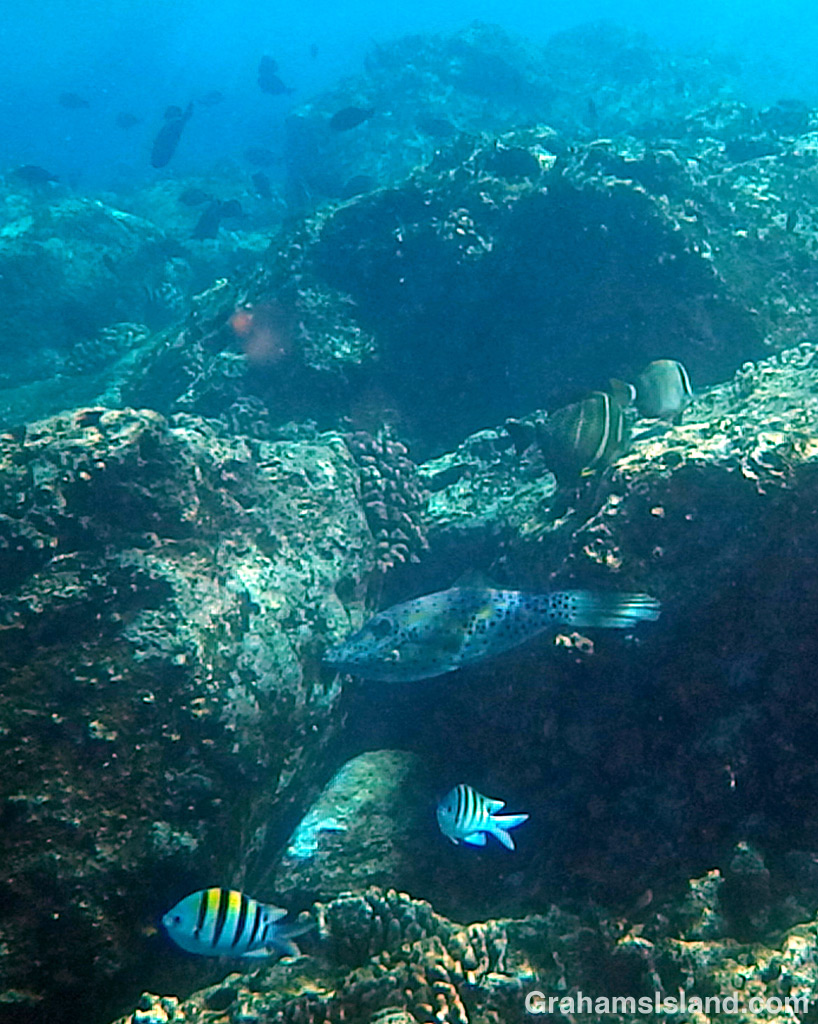
A great variety of fish make their home among the rocks and coral on the coast. From the bottom these are: two indo-pacific sergeants, a scrawled filefish, two or three whitebar surgeonfish, and in the background, a number of black triggerfish.
One of the pleasures of snorkeling here is that there’s always something to see and every day is different.
In my attempts to identify what I see in the water, I use John P. Hoover’s book The Ultimate Guide to Hawaiian Reef Fishes, Sea Turtles, Dolphins, Whales, and Seals. His website is hawaiisfishes.com.
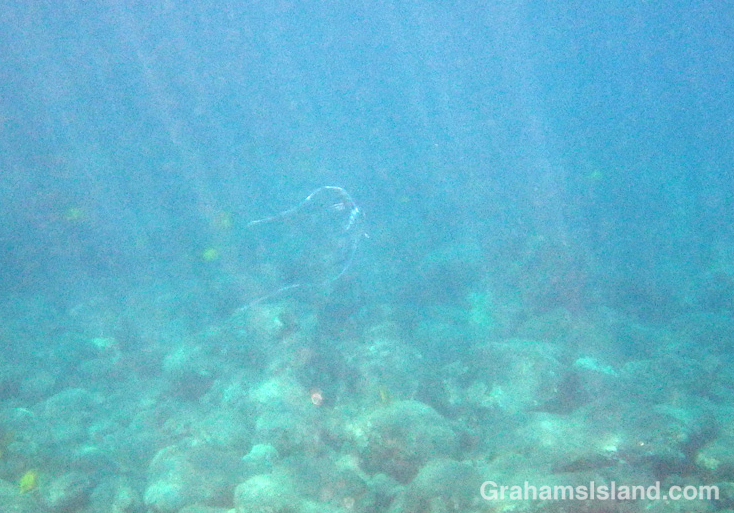
This little diamond-shaped fish is probably my favorite to see on the reef. The first time I saw one I thought it was a jellyfish, shimmering along with its long filaments wavering behind it. I got a little closer and realized it was actually an extraordinary fish.
The juvenile gives no hint of what it will look like as an adult. It grows to four feet in length, becomes stocky, loses the filaments entirely, and ends up looking like a nightclub bouncer.
It’s always a thrill to see one of these, its little tail thrashing back and forth, hauling the long filaments behind it as it putters through the water.
In my attempts to identify what I see in the water, I use John P. Hoover’s book The Ultimate Guide to Hawaiian Reef Fishes, Sea Turtles, Dolphins, Whales, and Seals. His website is hawaiisfishes.com.
When snorkeling, the tendency is to look down where numerous reef fish can be seen darting through rocks and coral. Needlefish, on the other hand, are surface swimmers and, as such, can be a little unnerving. Many times I’ve looked up and found myself in the midst of a shoal of needlefish, circling around me. At such times, I try not to think of Custer’s Last Stand.
In my attempts to identify what I see in the water, I use John P. Hoover’s book The Ultimate Guide to Hawaiian Reef Fishes, Sea Turtles, Dolphins, Whales, and Seals. His website is hawaiisfishes.com.
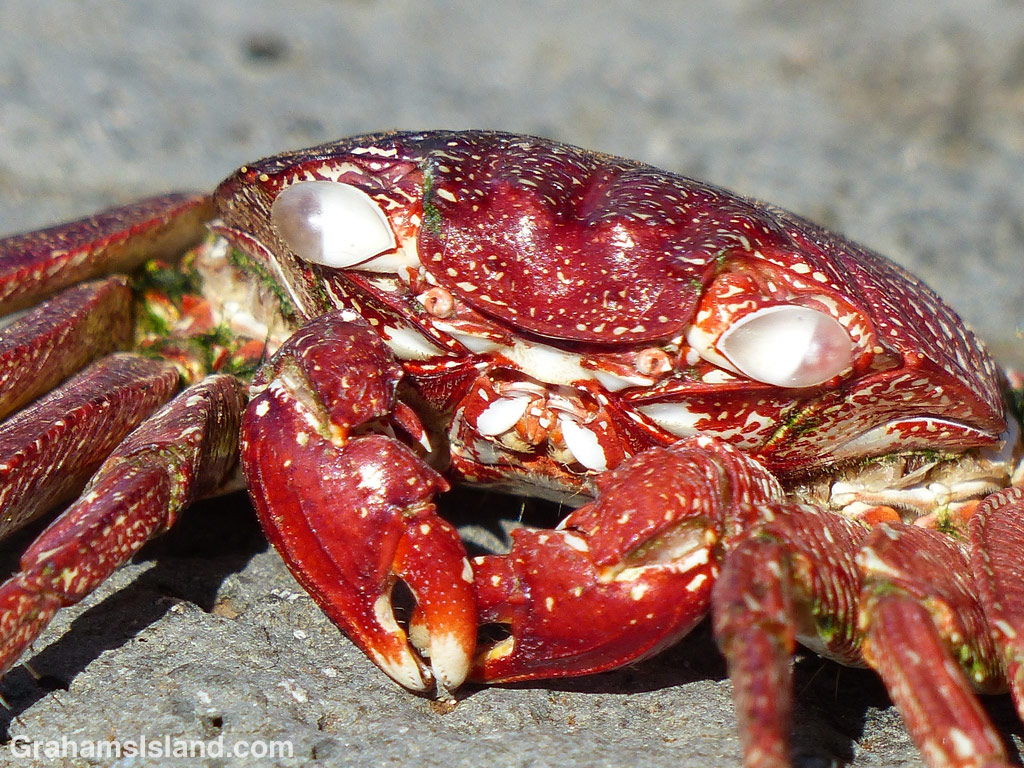
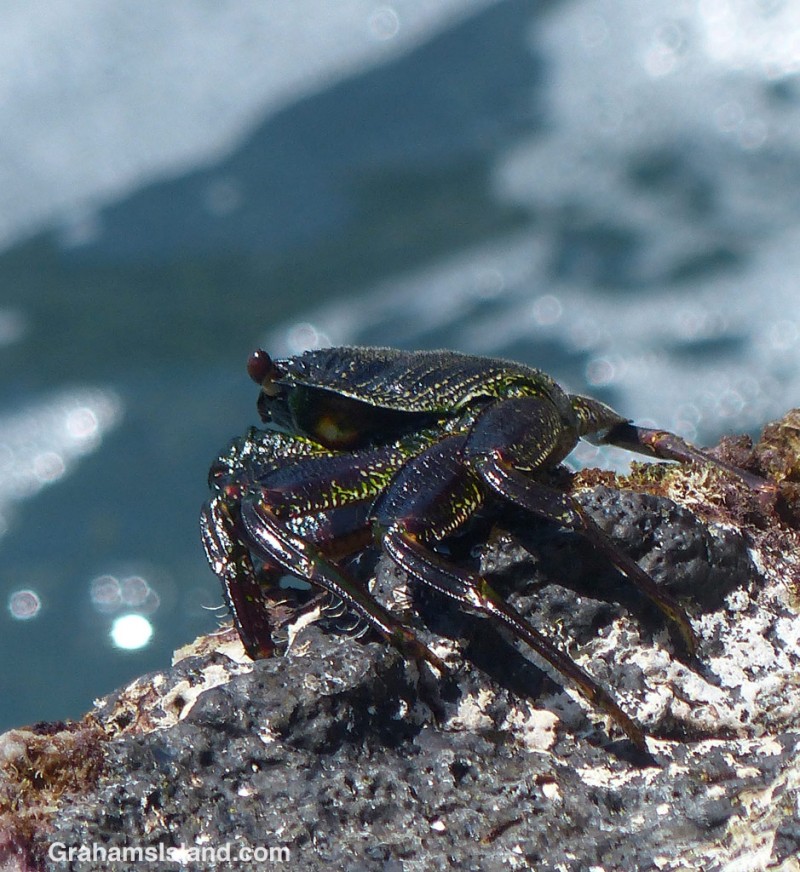
A’ama crabs can be seen on any visit to the shore. My appearance is usually met by a host of them scuttling for shelter. These crabs have cells called chromatophores that help camouflage them on the black lava rocks. When they shed their shells, the shell’s chromatophores are no longer alive and their true red color is revealed.
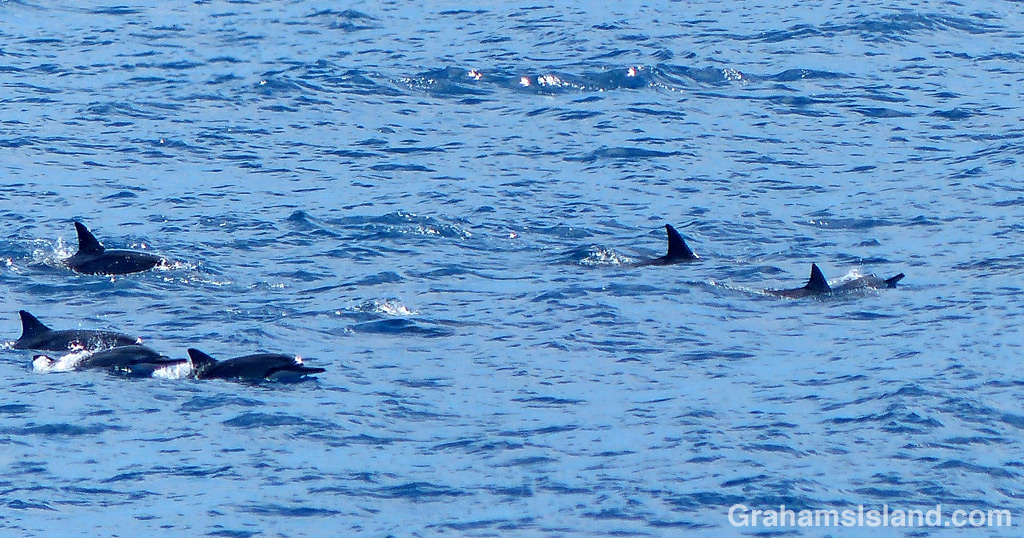
Pods of spinner dolphins patrol the coast. They get their name from their acrobatics. It’s great to see them looking like they’re having such a good time. It’s even more fun to be swimming when they’re around. Their speed, grace, and agility is amazing.
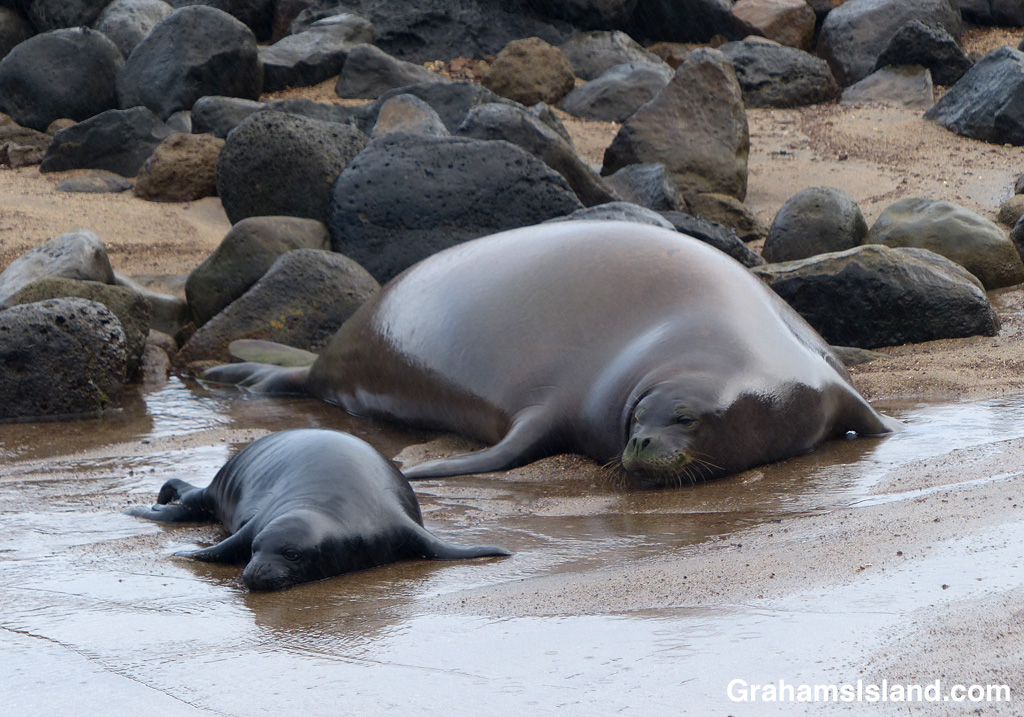
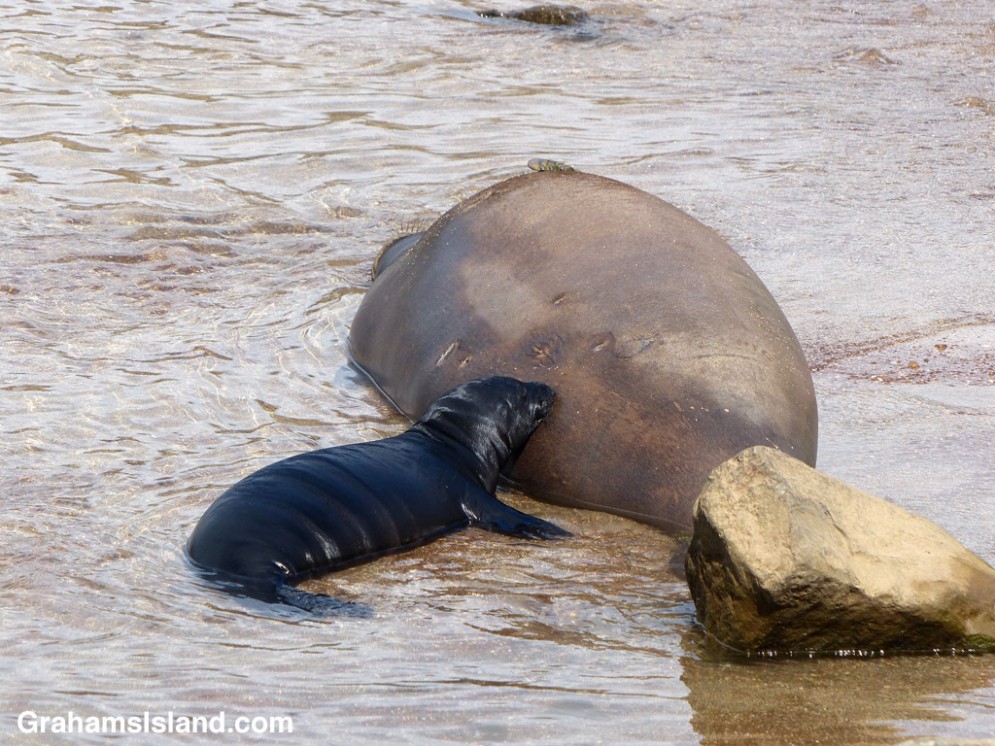
These photos are from November of last year. Not being on social media or especially well connected, it wasn’t until late November that I heard a monk seal pup had been born at Keokea Beach Park. The pup was born November 2 and was named Elua by the local community.
Elua means ‘two’ or ‘twice’ in Hawaiian. He was given the name because his mother, Waimanu (named after the valley where she was born), had given birth to another pup at the same spot two years previously. That pup was named Keokea, after the park. He died in his first year after swallowing a fishhook, a major hazard for monk seals around the islands.
I first stopped by on November 22 and returned on November 25 with a view to joining the volunteers who take shifts to monitor the pup. The idea is that these volunteers provide information about the pup, and monk seals in general, to people visiting the park and try to ensure that the seals aren’t unduly disturbed.
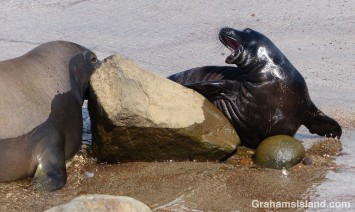
The general consensus was that Elua was doing very well and seemed to be picking things up fast. There was hope the pup would be ready to leave earlier than Keokea had when he was here. Indeed, Elua did seem livelier and more adventuresome, even at this early stage.
On November 26, Thanksgiving Day, Elua was found dead. My understanding is that a necropsy was unable to determine exactly what happened. I heard the cause was ‘blunt trauma’ resulting in edema (abnormal accumulation of fluid) in the lungs. As far as I know, what caused the ‘blunt trauma’ is unknown.
The loss of any pup is serious because there are so few monk seals. They’re a critically endangered species, with a current population of around 1,100. Most live in the northwestern atolls with about 200 around the main Hawaiian islands. In addition, the Hawaiian monk seal has a very low genetic diversity, which makes it potentially very vulnerable to disease and environmental changes.
I’ve seen this shoal of sharpnose mullets several times, always in the same area. They hang out where a ledge borders deeper water. On this day, breaking surf washed them back and forth over the ledge, along with an assortment of other fish and me if I’m not careful. It’s important to pay attention in these situations as it would be easy to end up in too shallow water and get raked over the coral – not good for it or me. When I got out of the water I met a friend who understood that. He’d had that happen to him just a few days earlier.
In my attempts to identify what I see in the water, I use John P. Hoover’s book The Ultimate Guide to Hawaiian Reef Fishes, Sea Turtles, Dolphins, Whales, and Seals. His website is hawaiisfishes.com.

 One day, when I got in the water, I dipped my head below the surface and saw a large barracuda idling a few feet away in murky water. Gathering myself, I took a few photos, none of which turned out.