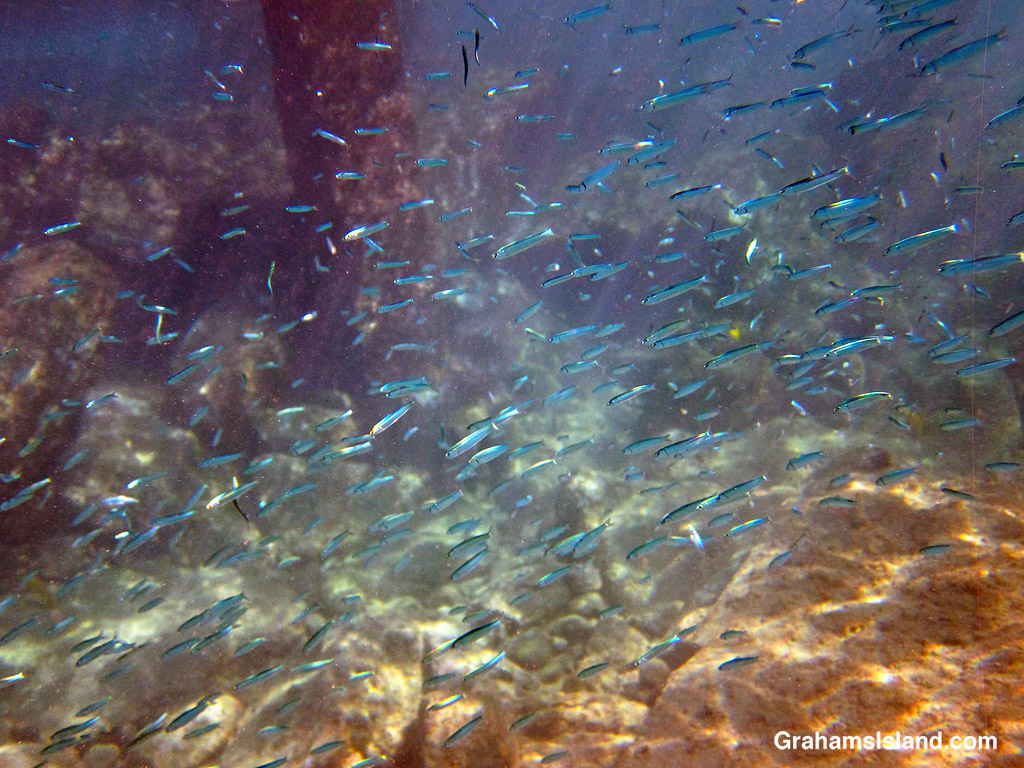
Recently, I’ve been seeing more Hawaiian Silversides, though not as many as in 2020. Still, there have been big enough schools of these little fish that sometimes I’ve found myself engulfed by them, zipping around in that wonderfully coordinated way that fish have.
I saw this ship off the coast of North Kohala, but couldn’t immediately identify it because it was too far offshore. Luckily, it hung around and a couple of days later I saw it much closer and stopped to take photos.
The ship is the Nautilus and it’s an exploration vessel operated by the Ocean Exploration Trust and was engaged in research, sponsored by the National Geographic Society. They were studying marine mammal vocalization and local shark diversity and abundance around Hawaii.
I saw this scene almost immediately after getting in the water, the bright red catching my eye. At first I thought it was some kind of garish fishing lure, snagged in the rocks. Then I saw other details and figured it must be some kind of marine invertebrate and probably a molt.
When I got home, checked the photos, and consulted my marine invertebrates book, I realized it was the molt of a Red Reef Lobster. Its sensory hairs can clearly be seen on the claw. These lobster are active at night and so rarely seen, but they can live in shallow waters and they molt every 6 weeks or so.
I doubt I’ll ever see a live Red Reef Lobster, so this is probably as close as it gets.
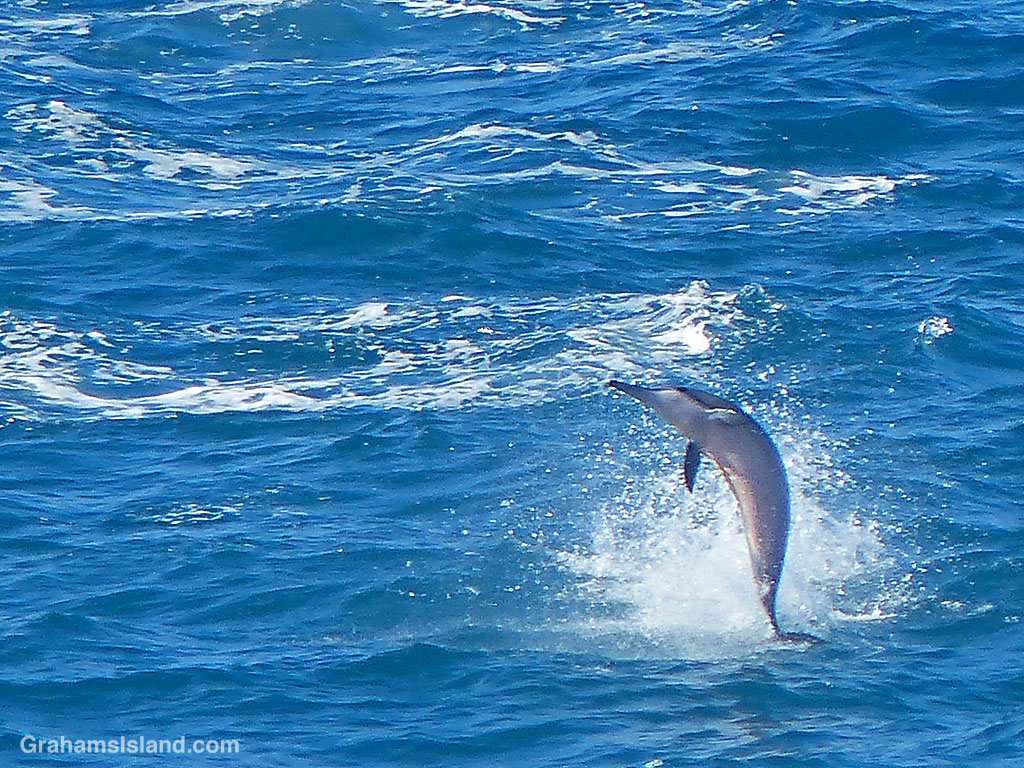
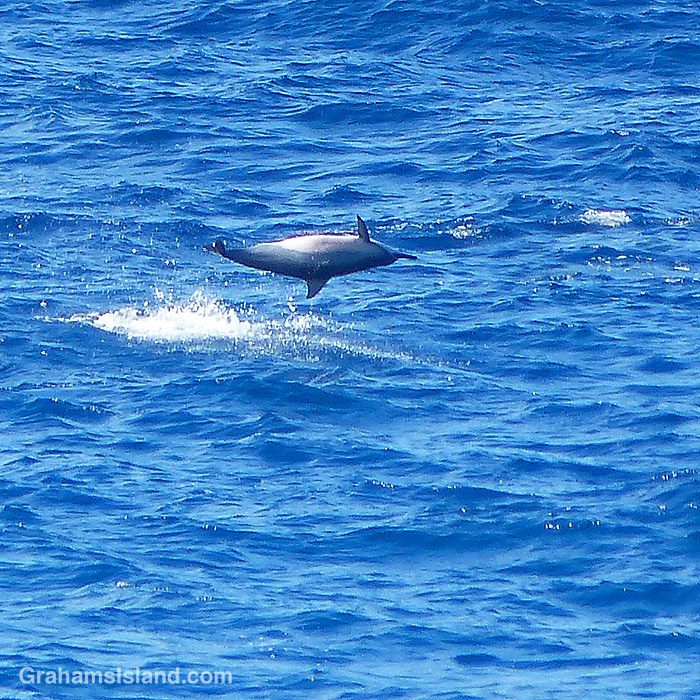
Wait a minute, I hear you say, isn’t that supposed to be swimming with dolphins? Usually yes, but in this case, I was walking along the coast when I noticed a splash in the water. Another followed and I quickly recognized the familiar shape and behavior of Spinner Dolphins.
For almost half an hour, I watched as a large pod of dolphins – at least 50 and possibly as many as 100 – cavorted offshore. We were all heading in the same direction and, in normal circumstances, dolphins would easily outpace me, but these were having fun. In addition to spinning, I saw a lot of other regular jumps. Sometimes the dolphins turned back the way they came or headed toward shore, surfing in the waves.
When I turned inland, to head back to my car, they were still in sight and still spinning and frolicking in the waves.
Posted for Jo’s Monday Walk. See more responses here.
When I get to the end of a swim, I keep looking around because, as the water shallows, it’s possible to see a wide variety of fish and marine invertebrates.
Recently, I was about 10 feet from my exit point when I saw the Devil Scorpionfish in the photos. That’s right, there’s a fish in the top photo and it’s not the Bright-eye Damselfish on the left. The second photo gives a better view, where the fins stand out a bit and a flash of orange can just be seen on the left pectoral fin. A Devil Scorpionfish will flash these orange fins, probably as a warning to predators, since it has venomous spines.
Don’t feel bad if you can’t find the fish in the top photo. I wouldn’t have spotted it if it had been stationary, but in the shallow water, I noticed a small movement and quickly realized what I was looking at. I’ve seen a Devil Scorpionfish in this area before so this might be the territory of this same fish.
I’d just got in the water recently when I saw this Whitemouth Moray Eel hunting with some Bluefin Trevallies. The trevallies carried on, but the eel was torn between joining them and retreating into the crack it was emerging from. In the end it did neither and I got a few photos before carrying on with my swim.






 Graham's Island