Number four of my rainbow colors in response to Becky’s April Squares challenge theme of ‘Bright.’ (See more responses here.)
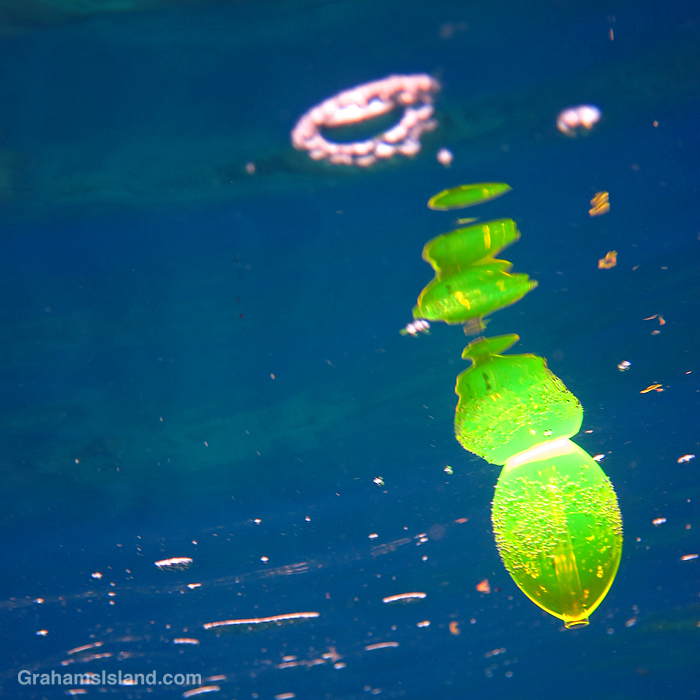
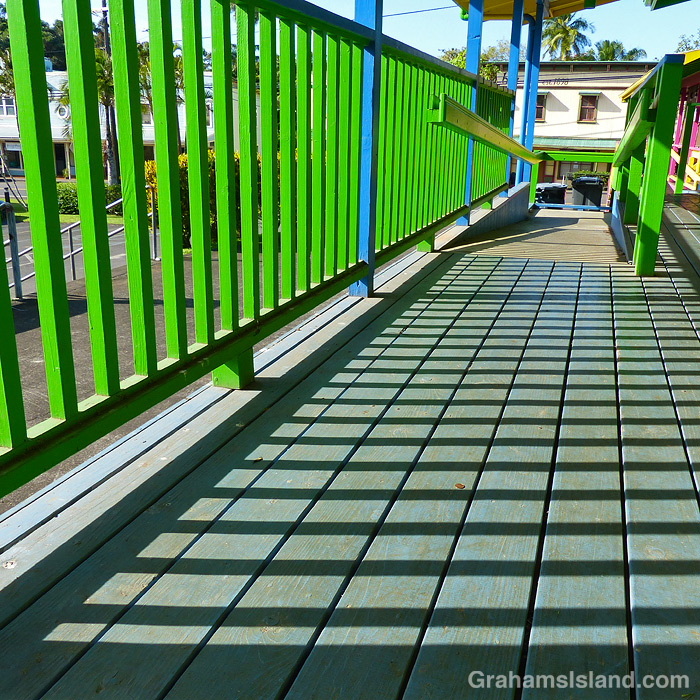
This rainbow soared over the tsunami siren above Kapaa Park on the Kohala coast. I found the stray float catching the sunlight as it drifted in the water. The buildings of the Kohala Town Center in Kapaau are painted in very bright colors, including this vibrant green railing.
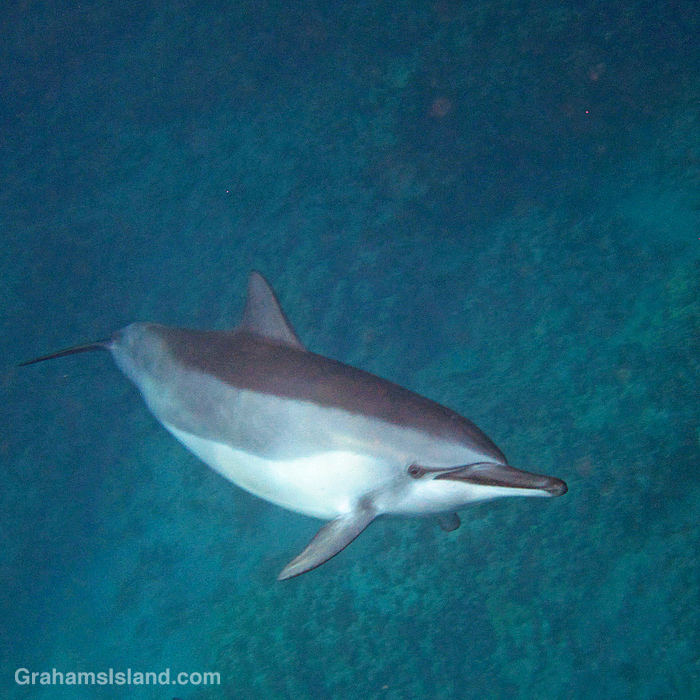
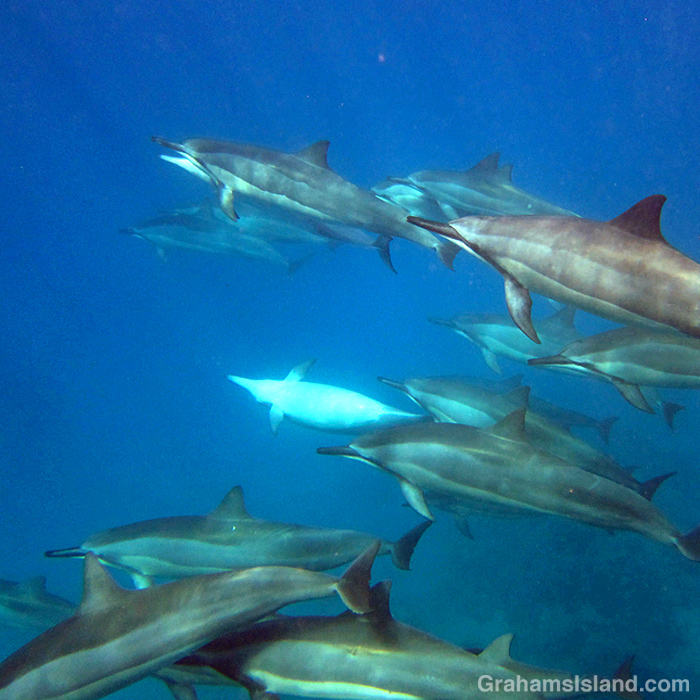
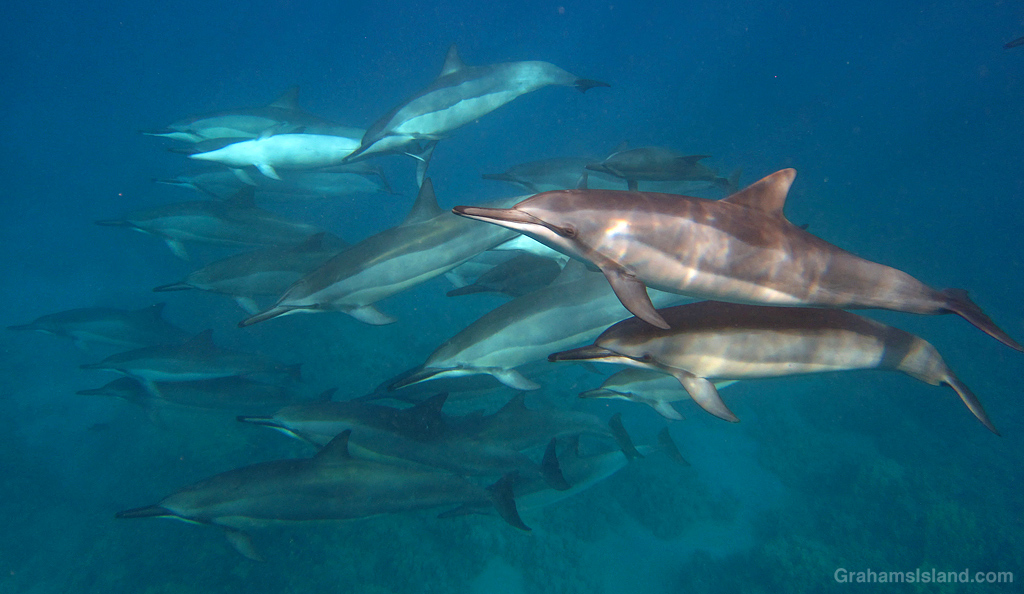
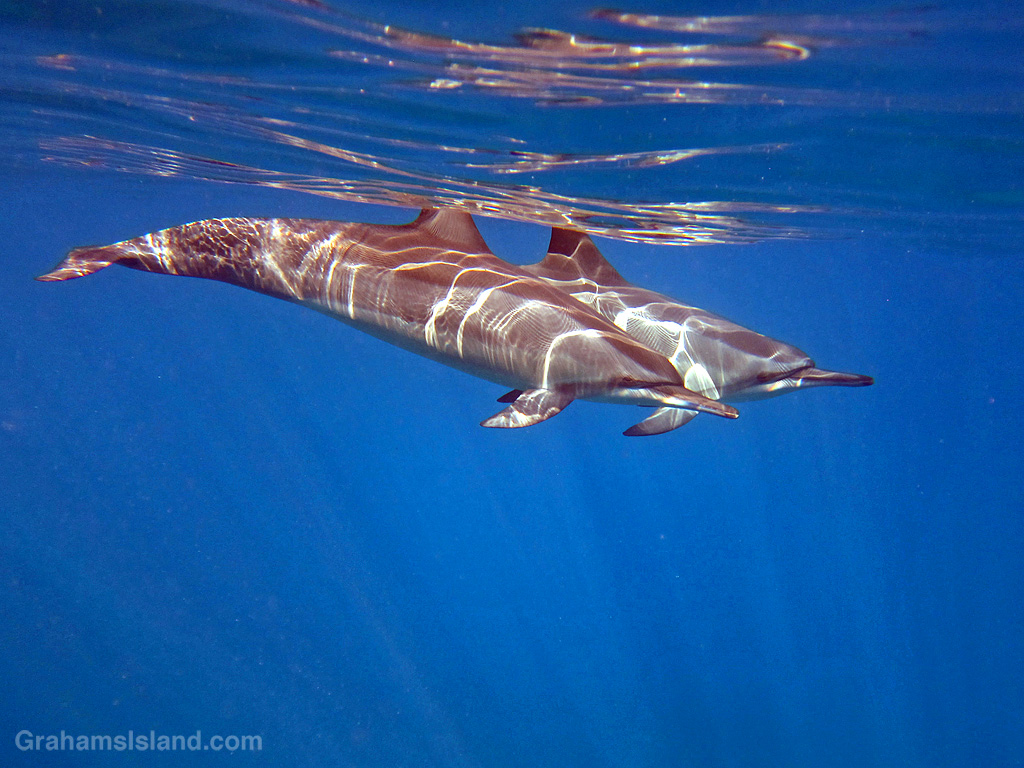
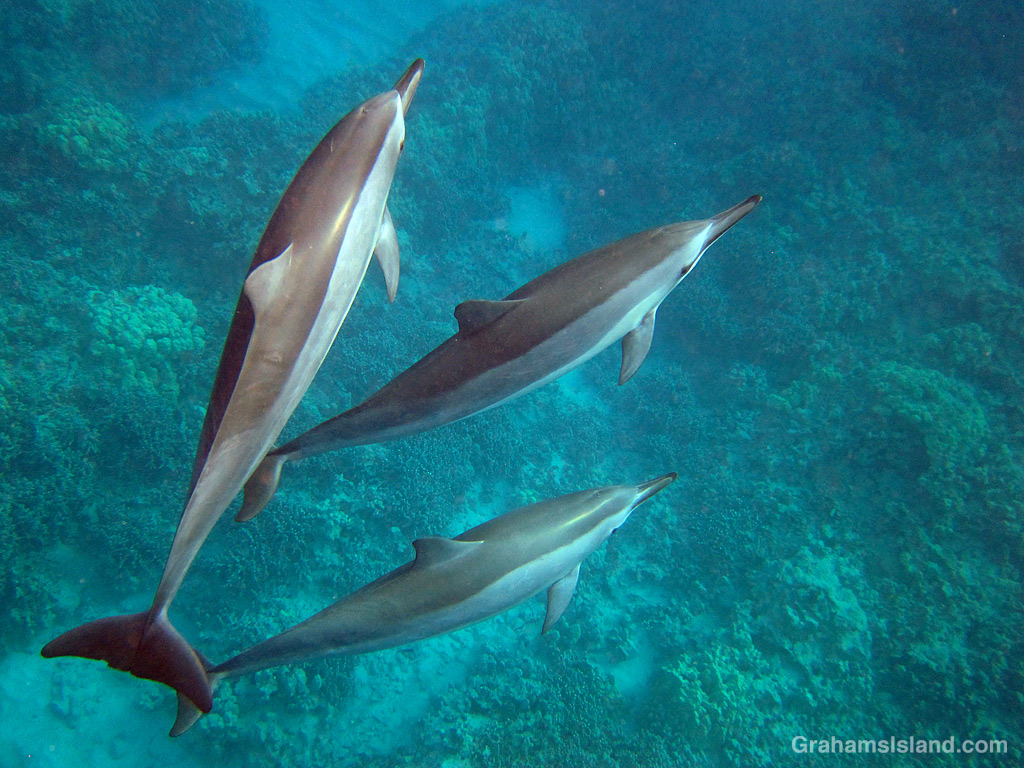
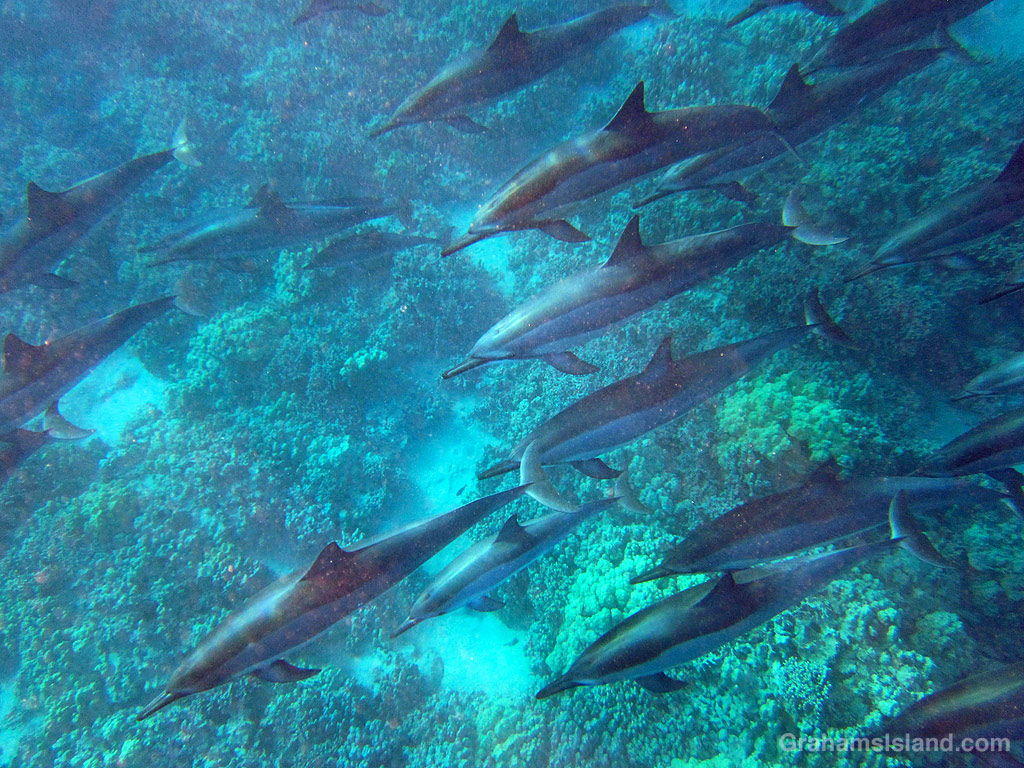
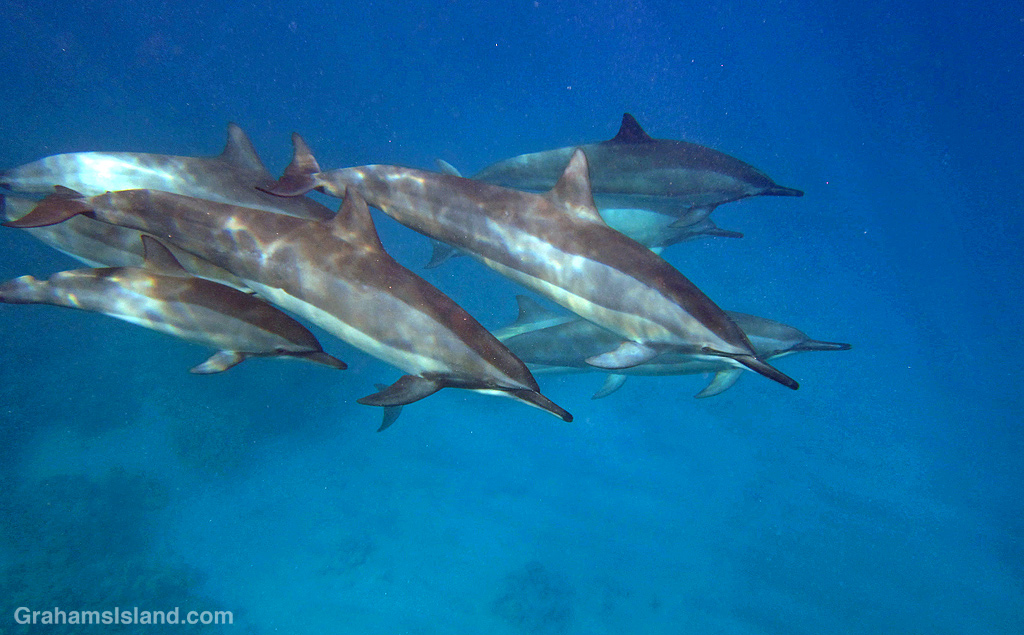
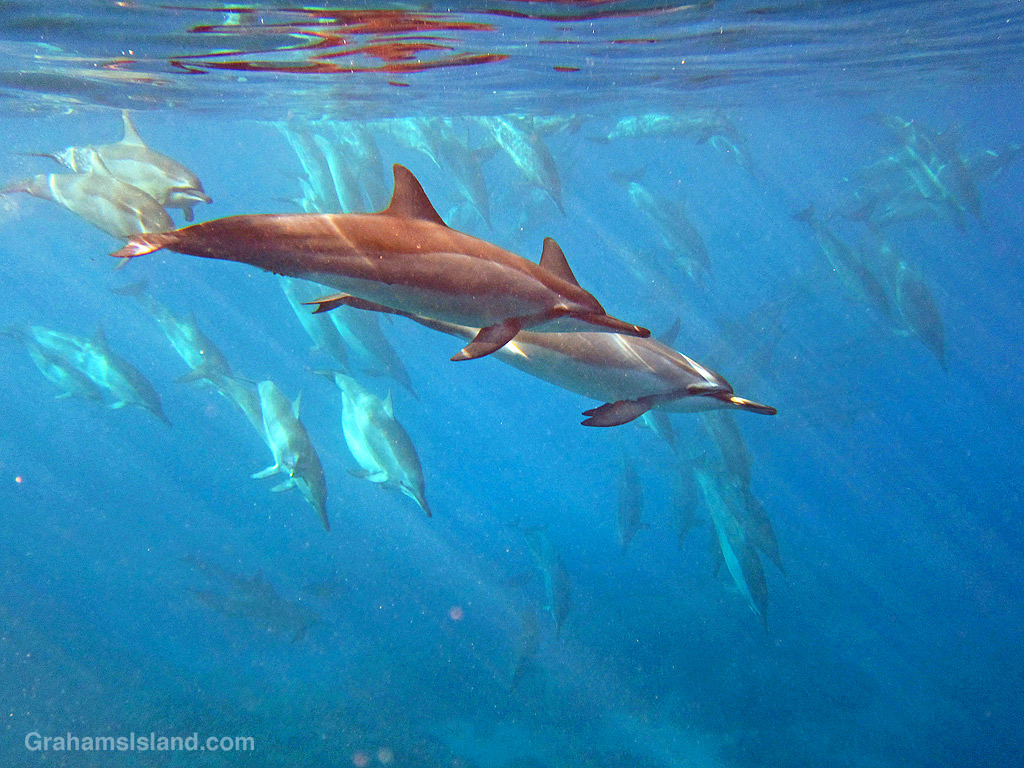
A couple more photos from my dolphin swim at the end March, for Becky’s April Squares challenge theme of ‘Bright.’ (See more responses here.)
Dolphins are bright in a couple of ways. They appear to be quite intelligent. One thing I noticed during this encounter was how much clicking noise the dolphins were making. It was more or less continuous. The clicking is basically the dolphin’s sonar, and it’s how they keep track of each other and their surroundings. It’s very precise and accurate.
Also, the markings of spinner dolphins in Hawaii differ from those elsewhere, which tend to be a more uniform gray. Hawaii’s spinners are only gray on top, with a pearly band along their sides, and a bright white underside, as prominently displayed by the dolphin in the center of the lower photo, showing off for the camera (possibly).
This is a follow up to yesterday’s post. These were taken just a few minutes after yesterday’s photos. It might well be the same whale, but here, it had moved along far enough that I was no longer shooting straight into the sun. The blue of the ocean comes out and my eyes also had a chance to recover!
Last weekend was the third and final of this year’s Sanctuary Ocean Count of humpback whales. Each year, counts are conducted between 8 a.m. and 12:15 p.m. on the final Saturday of January, February, and March. These months are the height of whale season in Hawaii, though whales can be seen here from November through April. The counts happen on Oʻahu, Hawaiʻi and Kauaʻi and are coordinated with similar events on Maui. Volunteers gather at sites around the islands to watch for whales and count their numbers and activities. This information is used to help researchers track how many whales come to Hawaii to calve and mate. Over the last few years, numbers have been in decline, but it’s not clear whether that’s due to drop in the whale population or a change in their migration patterns.
Volunteers for the counts are mostly local people, but more visitors are taking the opportunity to get involved while they’re here. This year, because of Covid restrictions, only site leaders took part in the count, but that will hopefully not be the case next year. I’ve done several of these counts and it’s fun to set aside the time to sit and watch the humpbacks. Sometimes they just cruise by, but often they splash and leap out of the water, putting on a show that’s wonderful to watch.
Posted in response to Becky’s April Squares challenge theme of ‘Bright.’ See more responses here. Also posted in response to this week’s Sunday Stills challenge theme of ‘Volunteering.’ See more responses here.
This is the first of a pair of similar posts for Becky’s April Squares challenge theme of ‘Bright.’ (See more responses here.)
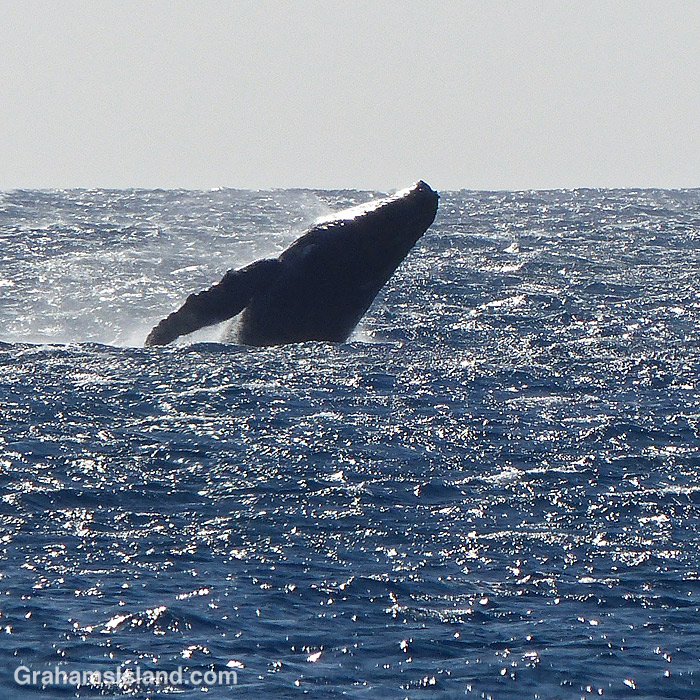
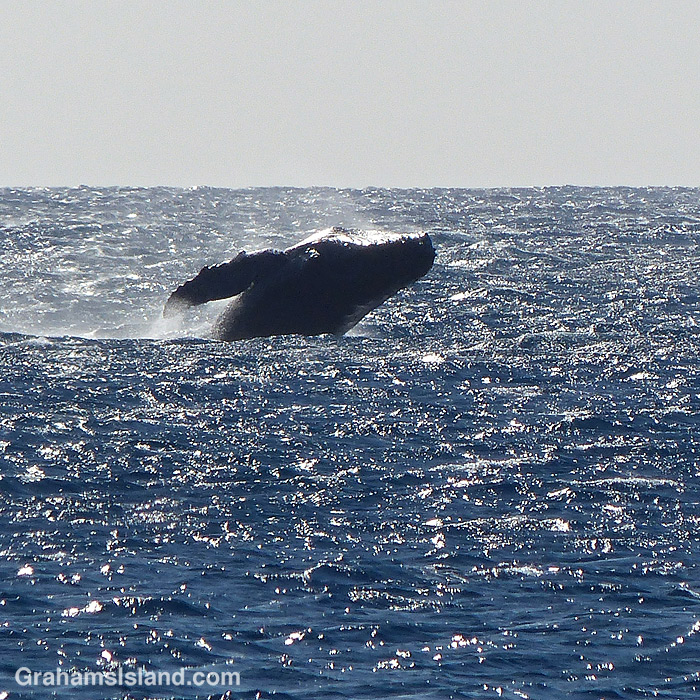
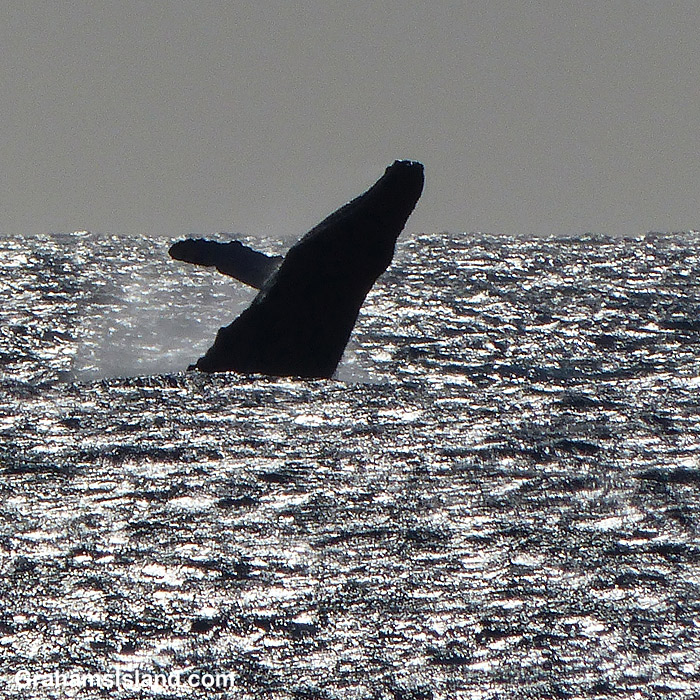
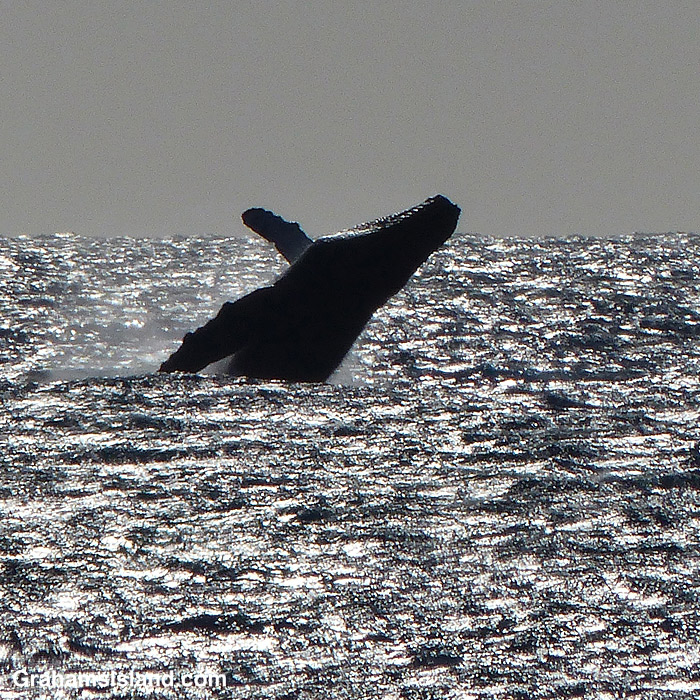
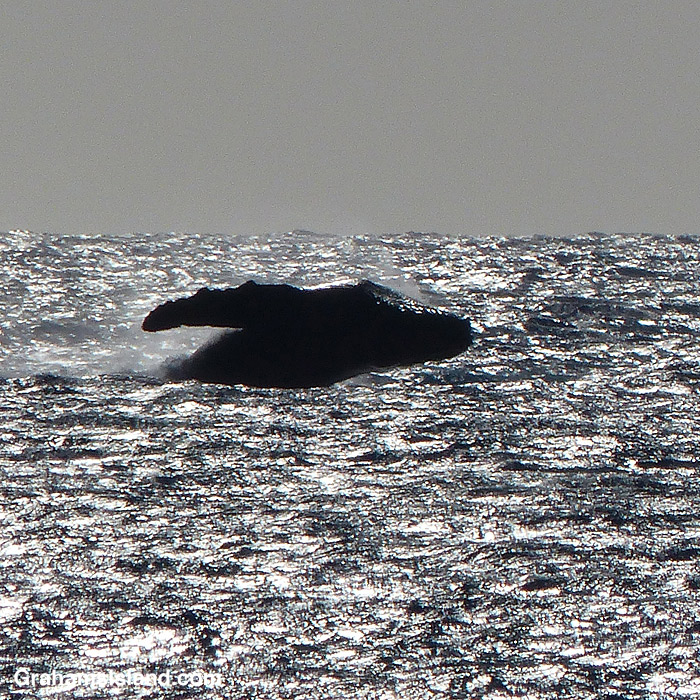
Early last month, I was nearing the end of a walk on a trail along a west-facing shore in North Kohala. I looked out toward the late-afternoon sun sparkling on the water and thought I saw a paddleboarder. A moment later, the paddleboarder fell into the water, then miraculously emerged again. I realized this was not a person, but a humpback whale slapping a pectoral fin. The whale was close enough to shore that the long fin appeared human-sized.
I moved to the shoreline, sat on a rock, and got my camera ready. The whale moved on underwater. So I returned to the trail, looked back one last time, and saw a different whale breach a little farther out. Back to the shoreline and my seat, camera again ready.
This whale was more cooperative and launched itself upward again. I was able to get these images which, shooting into the sun, look almost black and white.
This month, Becky’s April Squares challenge theme is ‘Bright.’ (See more responses here.) First up I thought I’d share something very unusual, which I consider myself lucky to have seen.
You’ve probably heard of stick insects, but the stick swimming crab is a far less often encountered creature. Most crabs scuttle about on the sea floor, but swimming crabs have flattened segments on their legs, which they use to propel them through the water. But even with this different method of propulsion, swimming crabs tend to stay close to the bottom.
The stick swimming crab (Charybdis baculum) has a different approach. It heads for the bright light at the surface where it paddles along, maneuvering with its spindly legs. It will sometimes snag bits of floating debris and attach them to its body to enhance its appearance. Its goal is to look like a small, drifting haven for juvenile fishes and other marine organisms that often gather under such floating islands, which offer them some protection from predators. With the stick swimming crab, that safety is an illusion. Instead, they’re part of the crab’s lunch box, to be picked off at its leisure.
Stick swimming crabs spend most of their time at the surface, but return to the sea floor for periodic molts. This one looks like it has recently molted.
Oh wait, it’s just a stick.
Also posted in response to this week’s Friendly Friday challenge theme of “Something Learned.” See more responses here.
On Saturday, my wife and I got going early and went snorkeling. There was some swell rolling in and the visibility wasn’t great, but that had been the case the day before and we’d been pleasantly surprised to find that it was much clearer farther out. So we swam out, angling to the north.
Suddenly, I saw something coming past me from the other direction. I pointed to it and turned to my wife, only to see her doing the same thing. It quickly became clear that these were spinner dolphins, about 15 or so we thought. A couple of them seemed interested in checking us out, but quickly the pod continued heading south.
It’s fairly common for dolphins to swim past the bay we were in, probably heading to the place they’re going to rest during the day. But after this pod passed, they stayed underwater for a while. Before they disappeared, their direction was somewhat into the bay, and I was curious where they’d resurface.
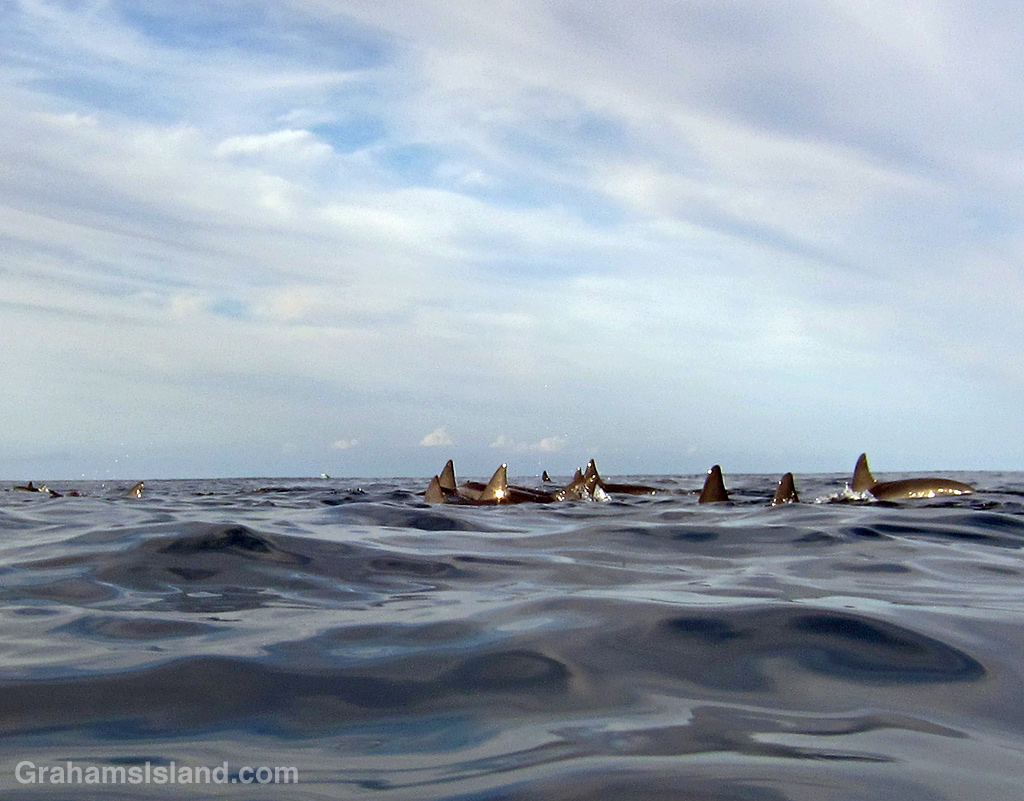
We swam back the way we’d come, popping up frequently to see if we could spot them. Sure enough, after a few minutes, we not only saw fins in the bay, but that they were coming our way. I got my camera ready and out of the hazy water the dolphins emerged. There were a lot more than we first thought. They swept beneath us and around us, hanging out for a short while, before taking off to the northwest. We watched them go, thrilled to have had this encounter.
A little later, as I was heading back into the bay, I looked up to see another snorkeler followed by a cluster of fins. The dolphins hadn’t gone away! They’d doubled back again. I swam slowly in their general direction. There was no point rushing. If the dolphins came my way, fine. If not, I was never going to be able to catch up with them even if I wanted to.
Sure enough, the dolphins came rocketing by, and for the next 10 or 15 minutes they zipped around the bay. I mostly stayed in the center of the bay, not trying to chase, and there was no need to. I’d watch a group whizzing by, see them recede, then turn around and spot another group coming my way. They were very active, twisting around each other as they swam, soaring up and down. When I’d see them heading for the surface, I popped up, hoping to get a photo of one spinning up into the air, but I didn’t see any doing that on this occasion.
After a while, the dolphins moved away from where I was and I decided to head in. My wife and I thought there must have been at least 30 dolphins in the bay, perhaps more. When I looked at my photos, I saw that in one of them (the bottom photo), I could identify at least 40 dolphins, and I knew I hadn’t taken a photo of all of them. Probably there were 50 or 60, though I joked that after a few years of recalling this encounter the pod would likely be well into the hundreds!
One thing I can say with some certainty, is that swimming with dolphins never gets old for anyone. It’s always a thrill to spend a little time with these wonderful creatures in their natural environment.
A pair of reef lizardfish rest on a patch of lobe coral. I usually see lizardfish by themselves so this was unusual. Their complete lack of movement was not unusual. That’s what they do unless you get too close.
I hadn’t seen a spotted eagle ray in quite some time before I saw this one, hunting in deeper water. It looked in very good condition and had a fine array of spots.