Category Archives: In The Water

Milkfish

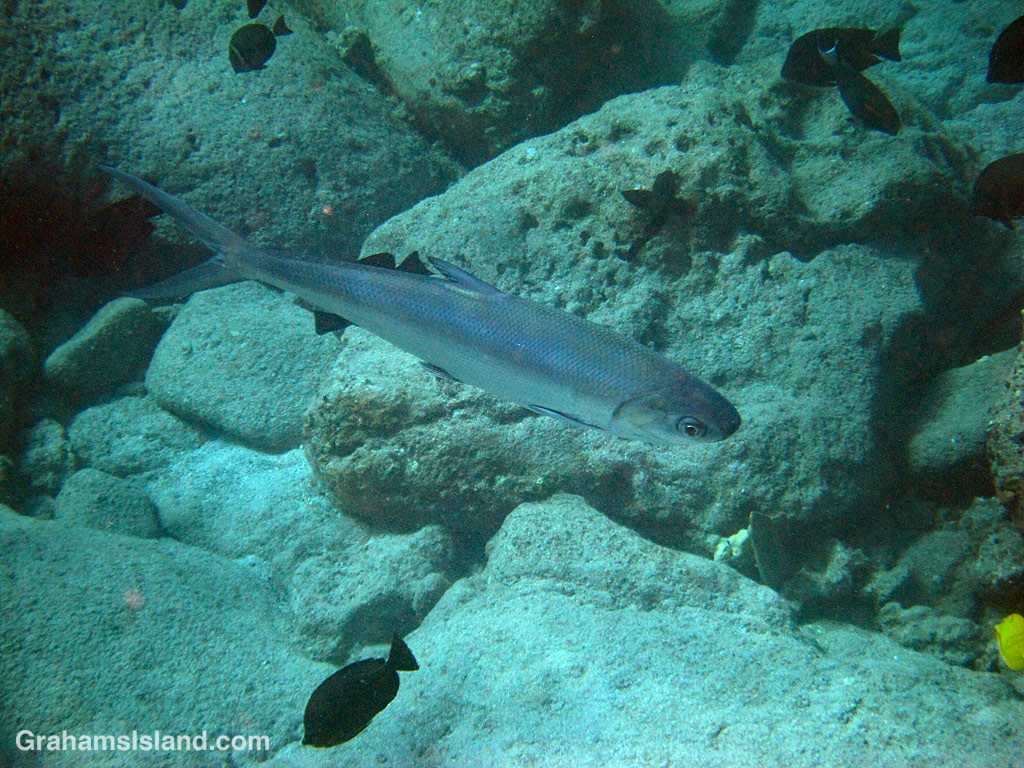
During a recent swim I was somewhat startled by the sudden appearance of these two large fish. I was close to shore when they shot past. At first I thought they were sharks, but quickly realized that wasn’t the case. They were just very big fish.

Their size, and the shape of their tails, made me think of jacks, and initially I identified them as rainbow runners, but later I realized they’re actually milkfish. Milkfish are the sole member of their species and my fish book calls them ‘among the most ancient and primitive of bony fishes.’

The larger of these two, in the top photo, was probably around three-and-a-half feet long. Those smaller, dark fish are around 9 inches long.

Moorish idol

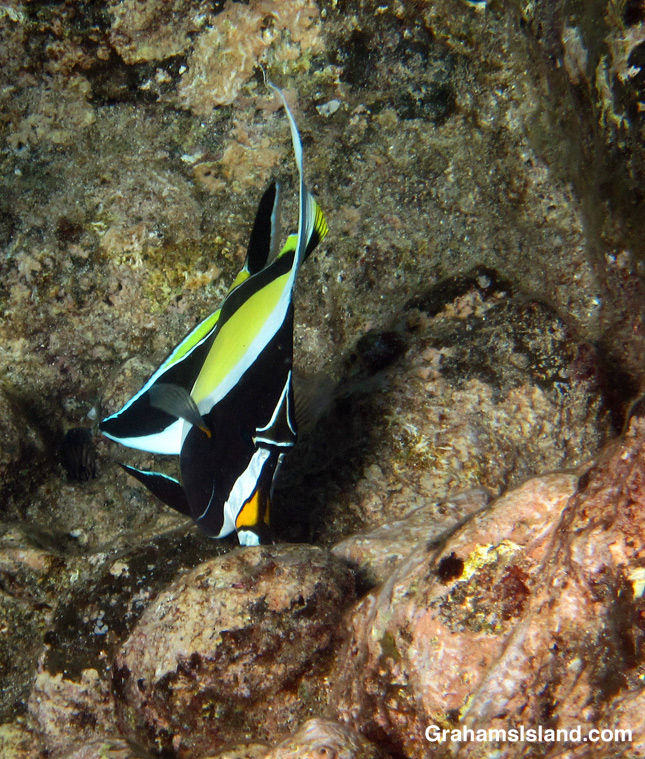
A moorish idol foraging for food. These quite common fish are easy to identify because of their bold patterns, strong colors, and distinctive shape with a tapering head and long snout.

Lobster molt

Until I moved to Hawaii, I was not aware that lobsters molt. I only learned this when a local diver presented my wife with a lobster molt he’d recovered.

I’d seen live lobsters here, scuttling around on the sea floor, and others looking like the one in the photo. This one was moving, but only because of the action of the water on it. I used to think these were either dead or resting lobsters. In part this was because adult lobsters, which molt once or twice a year, discard a remarkably complete exoskeleton. It then takes them a few weeks for their new exoskeleton to fully harden.

This is probably a molt from a banded spiny lobster. True lobsters and their relatives have enlarged pincers on their front pair of legs. Spiny lobsters (family Palinuridae) are among the lobster varieties that don’t have those enlarged pincers.

Eagle ray and marine debris

An ongoing problem, both here in Hawaii and in all the oceans of the world, is marine debris. There are floating garbage patches of such a size that nations will surely soon be fighting over whose territory they are. There’s debris washed up onto beaches that is both unsightly and dangerous. And then there’s discarded or lost items that are a danger to marine creatures everywhere.

Sadly, I saw one such example recently. I hadn’t seen an eagle ray in a while, so I was excited to see this one. But it’s progress seemed a bit odd and I quickly realized that it was, unwillingly, towing some kind of marine debris. It looked like an old net or something similar, on the end of a loop of line that had become hooked over the beak of the ray.

In the top photo, the clump of debris can be seen on the right, above the black triggerfish swimming in the opposite direction. The loop of line can also be seen. In the second photo, the line can be seen looped over the bill of the ray. I shared this photo with several people, alerting them to the situation, and some thought the line was caught in the ray’s mouth, but I don’t think that’s the case, though it has clearly dug a furrow into the face of the ray.

While I spread the word about this, there’s not a lot that can be done. I didn’t see the ray again and, to my knowledge, no one else has either. Even if they do, the chances of being able to approach the ray and free the line are slim. The debris is probably part of some fishing gear, which is lost in great abundance around here.

Hopefully, the ray will find some way to dislodge its unwanted haul, but while that could happen, it’s also possible that the ray is stuck with its burden. And, in the end, that might tip the balance in its chances of survival.

Pyrosoma

This week’s Sunday Stills challenge theme is ‘Fifth.’ (See more offerings here.) I was stumped as to what to post until I thought about looking back to see what photos I’d taken on the fifth of a given month. As it happened, these somewhat strange photos were taken just one month ago, on April 5th, and I was now ready to run them.

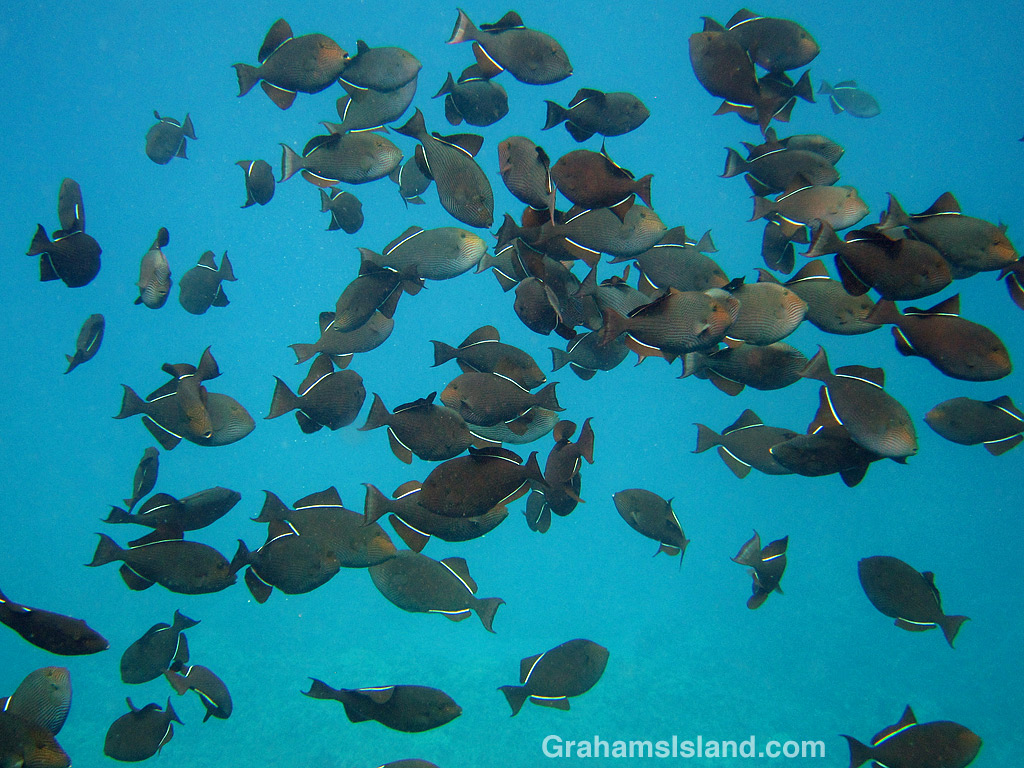
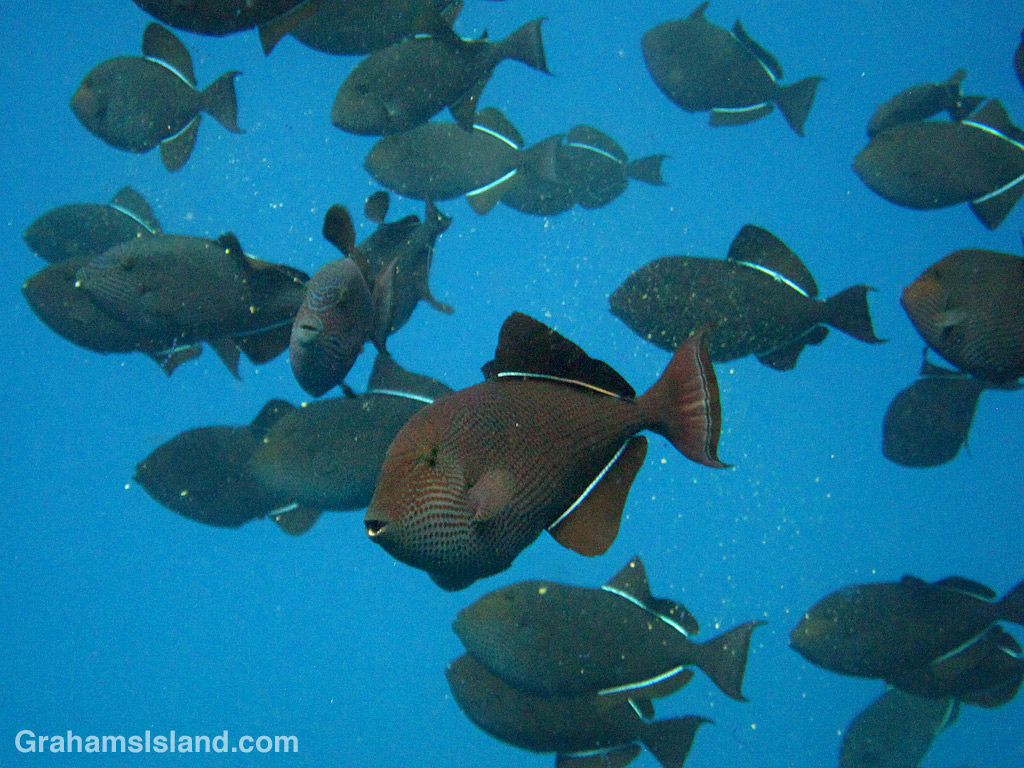
I was out snorkeling and was drawn to some black triggerfish, which were gathered in a very tight group. I took some photos and as I maneuvered around the group I became aware of something very close by.

The thing was at least two feet long and six inches or so in diameter. It was translucent, but with short lines of purple dots, and a milky central line through the tube. It was floating just below the water, changing shape, though not appearing to propel itself, but more being moved by the water. I thought it was some kind of egg sac, but really had no idea what it might be.

I wasn’t even sure I could get a photo of it, since I thought my camera might not ‘see’ it and instead focus on the fish beyond. I was also leery of getting too close. Perhaps it was some form of jellyfish or some other creature loaded with toxins.

When I got home, I was thrilled to find that some of the photos had turned out and registered what I’d seen, but I had no idea what it was. It didn’t really look like an egg sac, but what were the alternatives?

I had a browse in John Hoover’s Guide to Hawaii’s Marine Invertebrates and the closest thing I found was a prickly pyrosoma (pyrosoma atlanticum), but while the general shape was similar, the surface looked much less smooth than the thing I saw. So I shared the photos with some local snorkelers and divers and asked if they had any idea what it was. A couple of ideas were floated but nothing definitive. No one had seen anything like this before.

I looked online and found a few images that bore some resemblance. One of those links was to John Hoover’s website so I thought, ‘Why not ask someone knows about these things?’ and sent him an email with the photos. He quickly responded that it looked like a pyrosoma, a type of tunicate, and referred me to the listing in his book.

As we exchanged emails about a definitive identification, he noted, ‘Often microscopic examination is required to definitely identify tunicates, so unless you can get a piece of one, preserve it properly, and send it to a specialist we’ll probably never know exactly what it is.’

So what is this pyrosoma in the photos? Well, the name means ‘fire body’ and it can light up at night. It’s a colonial tunicate that can be 30 feet or longer (search online for pyrosoma and diver to see examples). Tunicates are filter-feeding creatures that either attach to hard surfaces or float free in the oceans. The colony is made up of zooids, individuals animals that are embedded in a gelatinous tube, which is open at one end and, apparently, is quite hard to the touch. One end of each zooid opens to the outside of the tube, the other end to the inside. Each zooid filters tiny cells from the water outside and expels filtered water to the inside of the tube.

Now, every time I get in the water, I’m looking around for another one. I probably won’t see one, but if I do get lucky, I just want to poke it, gently of course, to see what it feels like.

The photos show the shape and general composition of the pyrosoma. Some people have said it must have been huge because it dwarfs the fish in the photos, but the pyrosoma was only a couple of feet away. The fish were 20 or more feet beyond.

Monk seal pup update

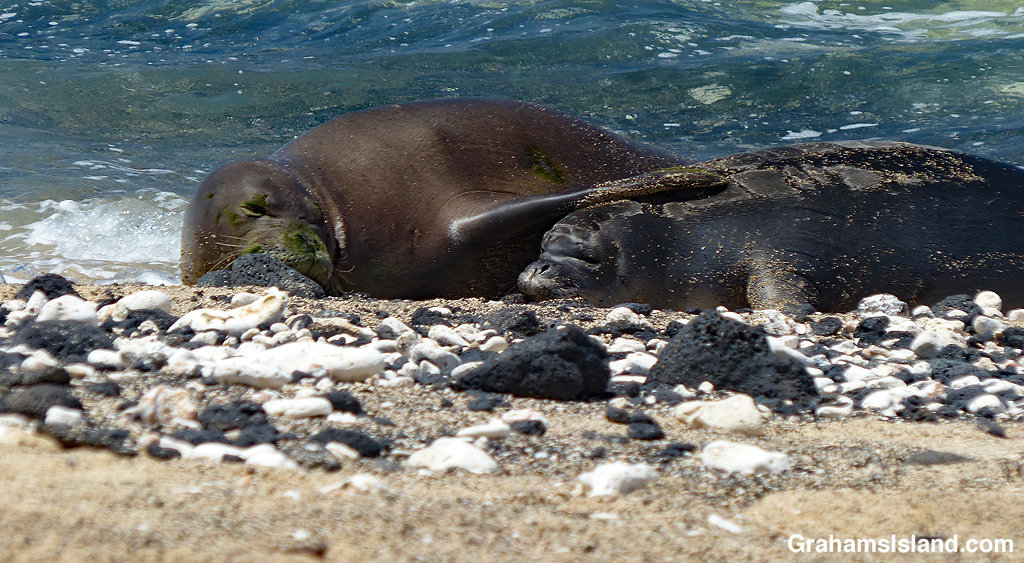
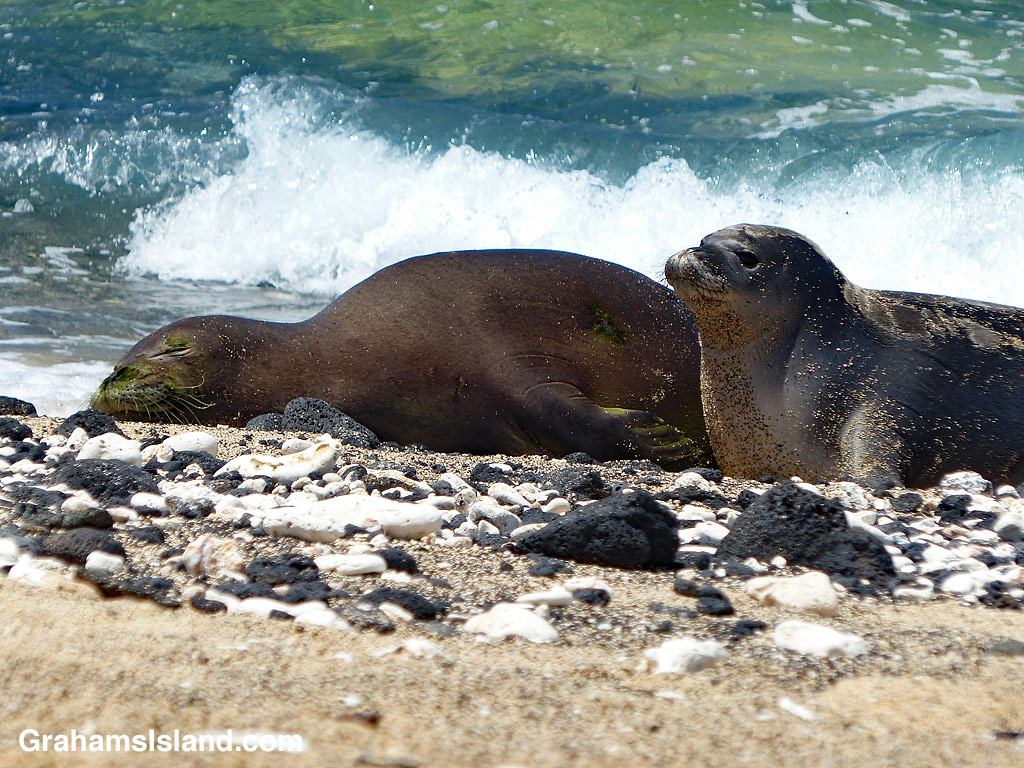
A few weeks back, I posted (here) about a new monk seal pup that had recently been born on the Big Island. I’m happy to report that the mother and pup both continue to do well.

The pup is now about six weeks old and is much closer in size to his mother than he was in the previous post. It’s likely that his mother, RA20, will soon leave him to fend for himself. She has lost a lot of weight and is also looking quite green on her head and flippers, so she will head out to feed and then to molt.

The pup’s sister, Manu’iwa, has been a regular visitor to the area, but the mother is very protective and drives her away. Once the mother leaves, it’s likely that the two siblings will spend some time together in the area. Eventually, the new pup will head out on his own and make his own way.

Manu’iwa has had a very good first year, which is often a very testing time for a new monk seal. Hopefully, the new pup will be equally successful and be another step toward boosting the endangered monk seal population to more sustainable levels.

I’m posting this in response to this week’s Friendly Friday challenge on the theme of ‘Posing.’ (More responses here.) The top photo in particular could easily have the caption, ‘That’s my boy.’