Category Archives: Hawaiian History

Kauhola Point lighthouse

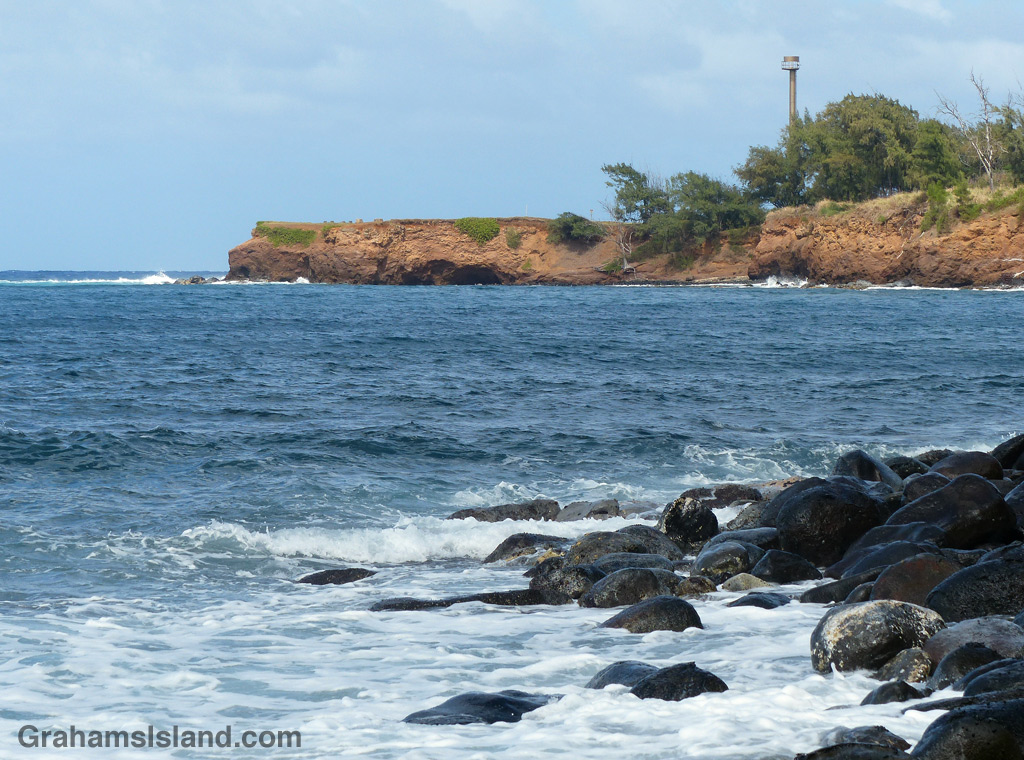
The new Kauhola Point Lighthouse on the north Kohala coast.

The Kauhola Point lighthouse is a modern affair, an automated light atop a tall metal pole. It replaced the previous, more traditional-looking lighthouse that was demolished in 2009. In the photo, the old base of that lighthouse can still be seen as several small block shapes toward the tip of the point. Therein lies the story.

The old lighthouse was demolished because erosion was eating away at the land near the base. The passing of time will surely remove even these remnants in the next few years.

In a way, this situation is a microcosm of the whole state. Many people think of the state of Hawaii as the eight main islands at the southeast end of the chain, but it encompasses hundreds of islands stretching away to the northwest for more than 1,500 miles. These small islands were formed over the same hotspot that fuels Kilauea Volcano today, but as the tectonic plate beneath the islands moved northwest, so the islands stopped growing and began to shrink under the forces of erosion. Over time, they too will disappear one by one.

Better Days: Honokane Nui Valley trail

Top of Rope section on Honokane Nui Valley trailA steep part of the rope section on Honokane Nui Valley trail

Last May, I posted here about the hike from the end of Highway 270 down to the beach at Pololū and up on to the ridge on the other side. There, a bench awaits the hardy hiker, as well as wonderful views along the coast and into Honokane Nui Valley. I’m happy to report that the bench, which was in bad shape last time I was there, has been replaced by one with a plastic frame. While this might be aesthetically less pleasing, it should last a good deal longer.

I also mentioned that not far beyond this point, the trail into Honokane Nui Valley got wiped out by a landslide in the earthquake of 2006. Now, instead of switch-backing down to the valley floor, the trail goes straight down. The precipitous drop is made passable by a series of ropes, to hang on to on the way down, and to haul on on the way up. It’s a great workout though not necessarily the safest one around. If a rope gives way, it could be a long and nasty fall. Let the user beware.

The top photo shows what the entry into this section of trail looks like. This part is steep, then it drops off out of view. The second photo shows a steeper section with two ropes to hang on to.

For more information about the Pololū hike, go to bigislandhikes.com/pololu-valley/.

Inter-island barge and Makali’i

An inter-island barge and Hawaiian voyaging canoe Makali'i at Kawaihae harbor.

This week’s posts are in response to the WordPress photo challenge on the theme of ‘transient.’

There are two commercial ports on the Big Island, Hilo on the east side, and Kawaihae on the west. This is a view of Kawaihae harbor with the inter-island barge unloading at the dockside. In Hawaii, many goods are shipped to Oahu and then distributed to the other islands on barges.

Also at the dock, beyond the barge, is the Hawaiian voyaging canoe, Makali’i. This boat had just returned to the water after a long refit on the island. The following day, it set off to join other boats in Oahu, welcoming home the Hawaiian voyaging canoe, Hokuleʻa, from its 3-year Mālama Honua Worldwide Voyage.

Two wildly different vessels, but both engaged in the very transient business of crossing open waters.

For more information about Hokuleʻa and the Polynesian Voyaging Society, go to www.hokulea.com.

Fa‘afaite Tahitian voyaging canoe

The Tahitian voyaging canoe Fa‘afaite off the coast of the Big Island of Hawaii.The Tahitian voyaging canoe Fa‘afaite off the coast of the Big Island of Hawaii.

Yesterday saw the return of the Hawaiian voyaging canoe, Hokuleʻa, from its 3-year Mālama Honua Worldwide Voyage. There was a ceremony on Oahu to mark the return featuring Hokuleʻa’s sister canoe, Hikianalia, and several other Polynesian voyaging canoes.

Earlier in the week, one of the canoes, Fa‘afaite, from Tahiti, was waiting for its sister canoe, Okeanos, off the Kohala coast, before carrying on to Oahu. These voyaging canoes use traditional instrument-free navigation on their travels.

For more information about Hokuleʻa and the Polynesian Voyaging Society, go to www.hokulea.com.

The Tahitian voyaging canoe Fa‘afaite off the coast of the Big Island of Hawaii.

Hula dancers

A hula dancer holds a rattleA hula dancer performs on Kamehameha Day in Kapaau.

Some more photos from the hula dancing at Sunday’s Kamehameha Day ceremony in Kapaau, North Kohala. The performers are members of Halau Hula O Napunaheleonapua.

For more information about the Kamehameha Day and the statue, go to kamehamehadaycelebration.org.
For more information about the Kamehameha’s history, go to nps.gov/puhe/learn/historyculture/kamehameha.htm.

Beads on the legs of hula dancersHula dancers performs on Kamehameha Day in Kapaau.Hula dancers perform on Kamehameha Day in Kapaau.Hula dancers perform on Kamehameha Day in Kapaau.

Kamehameha Day ceremony in Kapaau

A lei is draped over the spear of the statue of King Kamehameha 1 in KapaauA hula group performs on front of the statue of King Kamehameha 1 in KapaauA group pays its respect to the statue of King Kamehameha 1 in Kapaau

Yesterday was Kamehameha Day, celebrating Kamehameha 1, the king who first united the Hawaiian Islands under one leader. There’s a statue of the king at Kapaau in North Kohala, and this was the scene of a ceremony honoring him.

The ceremony began in steady rain, but the weather brightened so that proceedings ended in bright sunshine. After opening blessings, various groups approached the statue and paid their respects to the king. This was followed by the draping of leis on the statue. Finally, a hula performance in front of the statue concluded events – at least as far as this ceremony was concerned. An hour or so later, there was a parade featuring representatives of all the Hawaiian islands, and for the rest of the day, there were events and music in a local park.

The top photo shows a lei being draped over the king’s spear. The lei is made up of plumeria blossoms. The leis draped over his extended arm are mostly made up of ti leaves. In the second photo, members of one of the groups honoring the king performed a hula in front of the statue. Third, I think this is the order of Kamehameha presenting an offering which was carried up and placed at the base of the statue. Below, a red plumeria lei is hoisted over the king’s spear. Bottom, after all the lei were placed on the statue, another hula performance concluded events.

For more information about the Kamehameha Day and the statue, go to kamehamehadaycelebration.org.
For more information about the Kamehameha’s history, go to nps.gov/puhe/learn/historyculture/kamehameha.htm.

A lei is draped on the statue of King Kamehameha 1 in KapaauA hula group performs on front of the statue of King Kamehameha 1 in Kapaau

Kohala Girls School shadows

The old Kohala Girls School sits on land at ‘Iole in North Kohala.

The old Kohala Girls School sits on land at ‘Iole in North Kohala. ‘Iole is one of the few remaining ahupua‘a, a pie-shaped division of land stretching from the mountain to the ocean. It’s now managed by Kohala Institute as a retreat center and the recently renovated school is part of that setup.

I like the geometric order of the building – the squares of the windows, the straight lines of the roof and siding – as well as the light and shadows.


Kaloko fishpond

The wall of Kaloko Fishpond, in Kaloko-Honokohau National Historical Park

The wall of Kaloko Fishpond, in Kaloko-Honokohau National Historical Park, is currently under repair. According to the park’s website, work on rebuilding the wall began in 1998. This end looks good, but there’s still work to be done at the far end.

For more information about Kaloko-Honokohau National Historical Park, go to www.nps.gov/kaho/index.htm

For more information about Kaloko Fishpond, go to www.keolamagazine.com/ocean/kaloko-fishpond-a-valuable-cultural-resource/