This old thermometer is still firmly affixed to the concrete block wall of a farm building on the side of Pu’u Wa’awa’a. I like how the rusting metal seems almost to be part of the texture of the wall.

This old thermometer is still firmly affixed to the concrete block wall of a farm building on the side of Pu’u Wa’awa’a. I like how the rusting metal seems almost to be part of the texture of the wall.

Exploring tide pools one day, I found this unfortunate floating blenny. It was quite large, for a blenny, and in a small pool. The weather had been calm for a few days, without much ocean swell. I think the fish was trapped in the pool and, without fresh seawater reaching it, the pool had become stale and oxygen starved.
The macabre essence of the scene contrasted with its painterly quality, enhanced by the blenny’s coloration and the delicate creamy shells in the pool.
Updated 6-20-18
I’ve since learned that the ‘delicate creamy shells’ in the pool are actually a type of seaweed, Padina japonica. I’m also not sure about my oxygen starvation theory either since blennies are notoriously adept as jumping from pool to pool. Two things are unchanged however: the blenny is still dead and I still like the painterly quality.
One of those photos better taken with a telephoto lens, perhaps. This is by the old Civilian Conservation Corps Cabin near the Palila Forest Discovery Trail on the slopes of Mauna Kea.
For more information about Palila Forest Discovery Trail, go to dlnr.hawaii.gov/restoremaunakea/palila-forest-discovery-trail/.
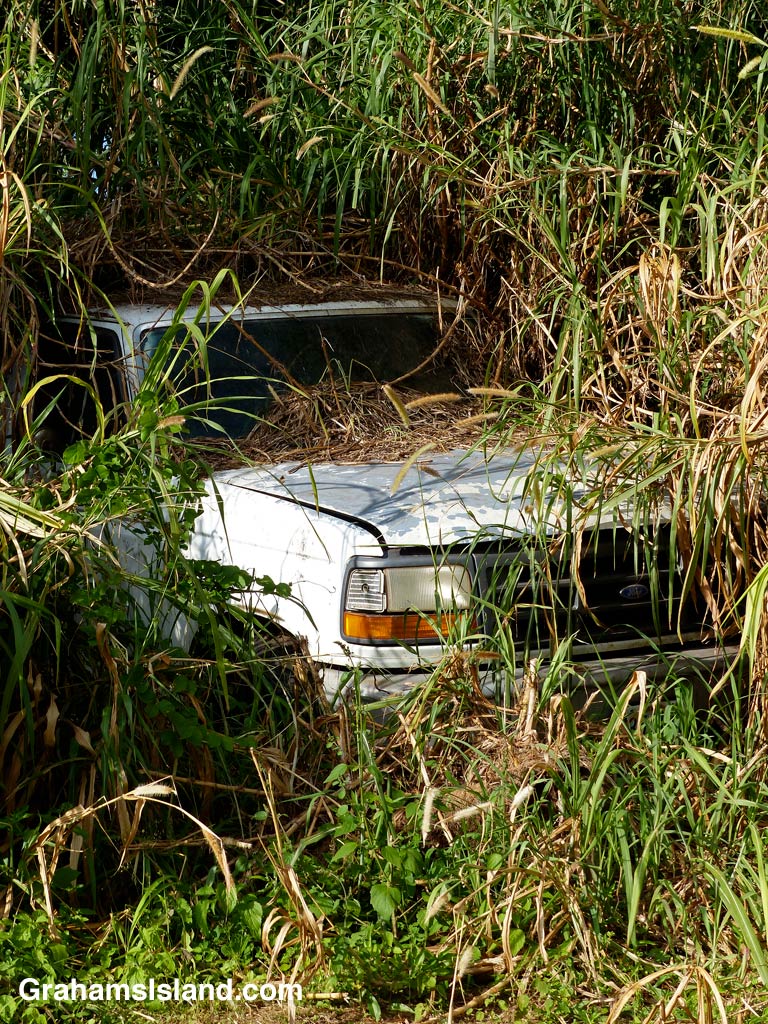
This old barn is losing the battle, both to encroaching vegetation, and neglect.
Posted in response to this week’s WordPress Photo Challenge to be a visual storyteller.
’Aimakapa Fishpond is one of two fishponds at Kaloko-Honokohau National Historical Park. The other is Kaloko Fishpond, which is separated from the ocean by a huge rock wall, currently being restored. ’Aimakapa Fishpond’s barrier is made up of sand dunes.
A channel was dug to the ocean to allow water to circulate back and forth and, at the ocean end (seen here), a sluice gate (makaha) installed. The sluice gate helped keep predators out. These days it isn’t used and so the channel has silted up with sand.
Fishponds are different to fish traps. Ponds allow for the rearing of fish from small fry. Traps are shallow walled enclosures, which fish can cross at high tide, but cannot escape from when the tide goes out.
For more information about Kaloko-Honokohau National Historical Park, go to www.nps.gov/kaho/index.htm.
This dead tree on the slopes of Pu’u Wa’awa’a did not die of natural causes. The pale strip near the bottom of the trunk is where the tree was girdled.
The tree is, I’m pretty sure, a silk oak. Native to Australia, these trees were introduced to Hawaii around 1880. When in bloom, they present a mass of brilliant orange flowers, but they seed prolifically and also produce an allelopathic substance that inhibits the growth of other plants. Because of this, they can crowd out native plants, of which there are many on Pu’u Wa’awa’a, so trees in areas where they have become too dense or are not wanted, are girdled.
For more information about Pu’u Wa’awa’a and its trails, go to puuwaawaa.org.
A few days ago I posted (here) about the view from an old blockhouse on the Pu’u Wa’awa’a trail. Today, I’m taking a look inside. As I mentioned before, the building is now a shelter for livestock with assorted detritus on the floor, but light through the empty windows still casts a bright image on the painted walls.
For more information about Pu’u Wa’awa’a and its trails, go to puuwaawaa.org.