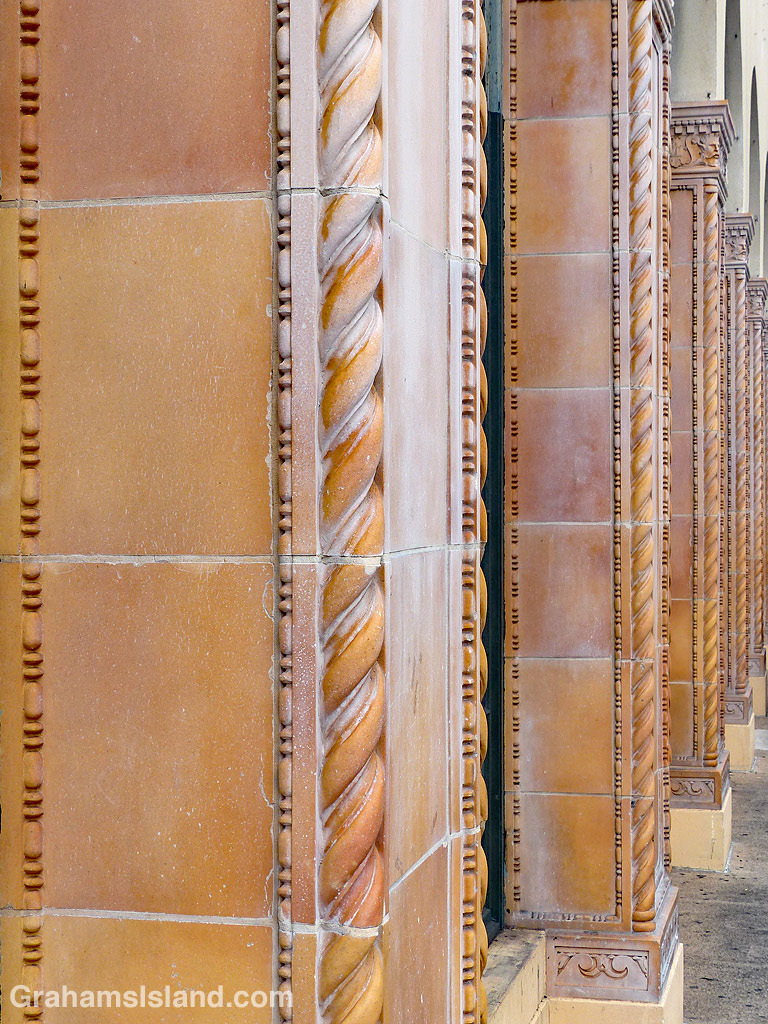
The front of the Hawaii Electric Building in Honolulu features these decorated columns.
Posted in response to this week’s WordPress Photo Challenge ‘Twisted.’

The front of the Hawaii Electric Building in Honolulu features these decorated columns.
Posted in response to this week’s WordPress Photo Challenge ‘Twisted.’

A photo of some colored lava rocks. But wait. Why are there tiny fish among those rocks? No, they’re not skittering about on minuscule legs, a living proof of evolutionary theory. Instead, they’re swimming in very shallow, very clear water near the edge of a freshwater-fed pool, just inland from Akahu Kaimu Bay, south of Waikoloa Resort.
On my last hike along that stretch of coast, I stopped here for a refreshing dip. The entry to the pool was over these somewhat rough lava rocks. While I was feeling my way across them, these little fish seemed greatly interested in my feet, which suggests life in the pool must be very dull indeed.
Posted in response to this week’s WordPress Photo Challenge ‘Liquid.’
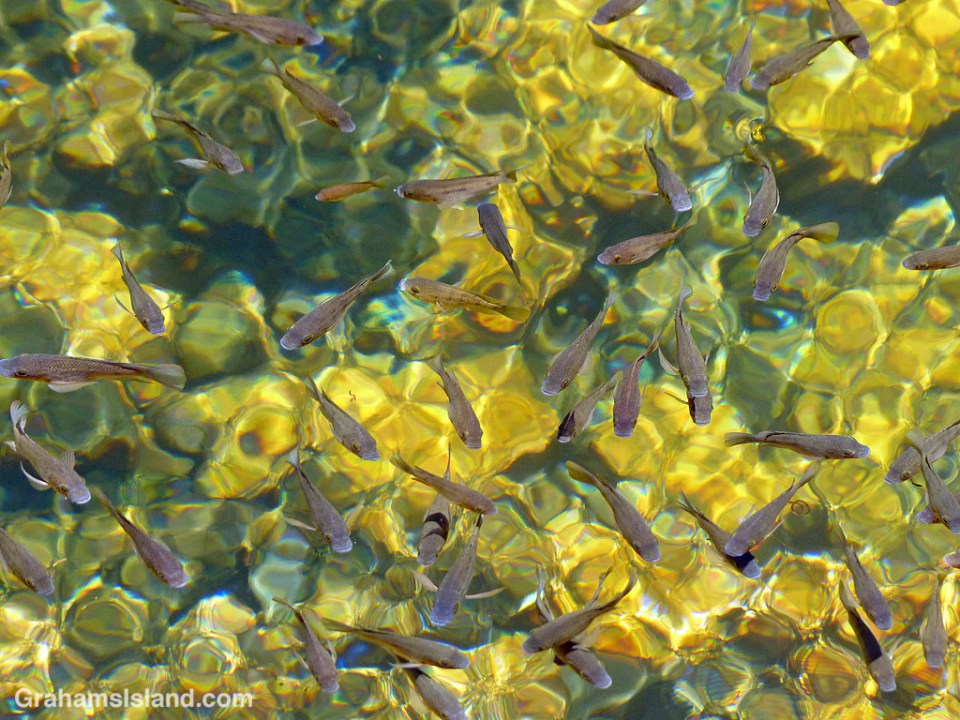
Something fishy indeed. Little fish milling around in one of the Golden Pools of Keawaiki, and looking for all the world as though they’re in a painting..

Exploring tide pools one day, I found this unfortunate floating blenny. It was quite large, for a blenny, and in a small pool. The weather had been calm for a few days, without much ocean swell. I think the fish was trapped in the pool and, without fresh seawater reaching it, the pool had become stale and oxygen starved.
The macabre essence of the scene contrasted with its painterly quality, enhanced by the blenny’s coloration and the delicate creamy shells in the pool.
Updated 6-20-18
I’ve since learned that the ‘delicate creamy shells’ in the pool are actually a type of seaweed, Padina japonica. I’m also not sure about my oxygen starvation theory either since blennies are notoriously adept as jumping from pool to pool. Two things are unchanged however: the blenny is still dead and I still like the painterly quality.

These three buildings in downtown Honolulu look, to me, like an architect’s drawing, all mirrored glass and carefully rendered lines. “Picture yourself living in the heart of downtown Honolulu, in a luxury apartment with its own private balcony.” Aaaargh.
Posted in response to this week’s WordPress Photo Challenge ‘Lines.’
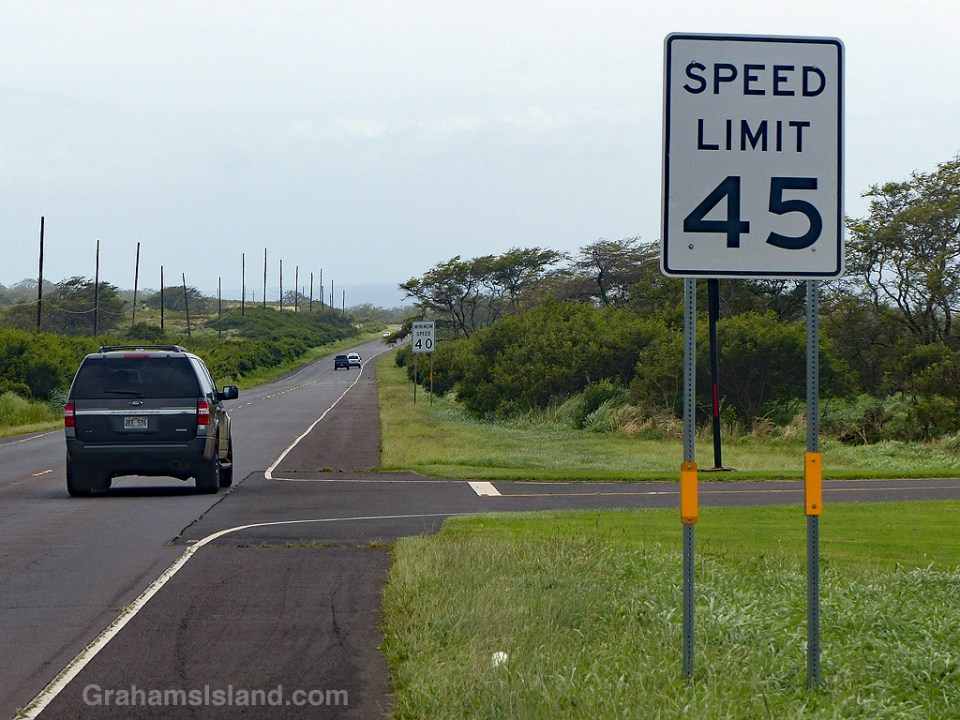 Recently, these two new speed limit signs appeared, alongside the main road, not far from where I live. Nothing too remarkable about that, you may say, but it is odd. The first sign gives the speed limit as 45 miles per hour, but the second sign mandates a minimum speed of 40 miles per hour. Seems like a prime area for tickets to be handed out. I can’t imagine anyone getting very far without breaching one of those two limits.
As it happens, about a quarter mile before this pair of signs, there’s another pair that have been there a long time. Those signs, which mark the departure from a more residential area to a largely uninhabited stretch of road, mandate a speed limit of 55 miles per hour, with the same minimum speed of 40 miles per hour.
So why would the county want people to speed up to 55 only to put the brakes on a few hundred yards down the road? They don’t. They just put up the wrong sign. It was gone a few days later.
This isn’t the first time the Hawaii County Department of Public Works has had a sign problem. In late 2016, a major new road project, the Mamalahoa Highway Bypass, south of Kailua-Kona, was completed. Where this new road joined the existing Mamalahoa Highway, a dangerous Y-shaped junction became a fully-signaled, four-road intersection.
Most people were thrilled with the new, safer setup, but not all. People unfamiliar with the area were perplexed. They didn’t know where to go because the major new highway intersection didn’t come with any signs. If that sounds like it must be an exaggeration, it is a bit. There was one sign, on the old road, that had not been removed during the project. Unfortunately, because of the intersection’s redesign, the directions it gave were wrong. It indicated the main highway went straight ahead, but that now sent traffic plunging down a steep, winding road into a populous residential area.
As with our local sign, after a few days the old highway sign disappeared and a week or so later proper signage was erected for the new intersection.
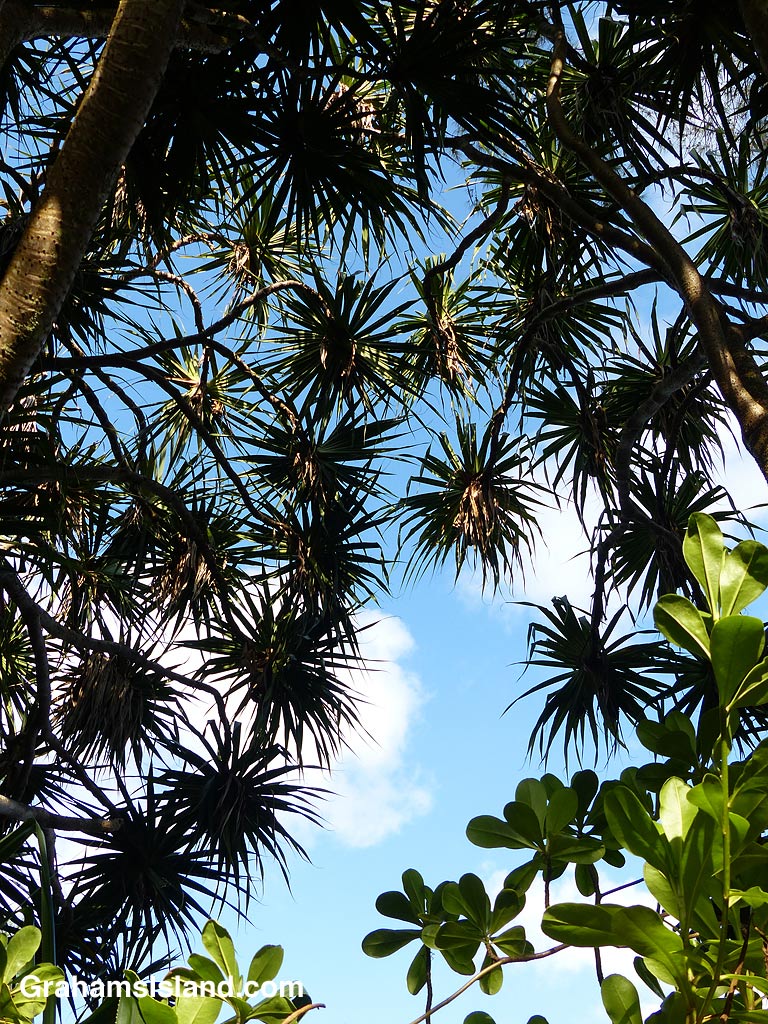
Hala (Pandanus tectorius) is an indigenous tree that might have arrived here on its own – the fruit floats and is salt tolerant – but was probably also brought over by the Polynesians. One feature of the tree is the dark green leaves, which are sword-shaped and bent, and which grow at the and of the branches. Here they look like star bursts against a blue sky.
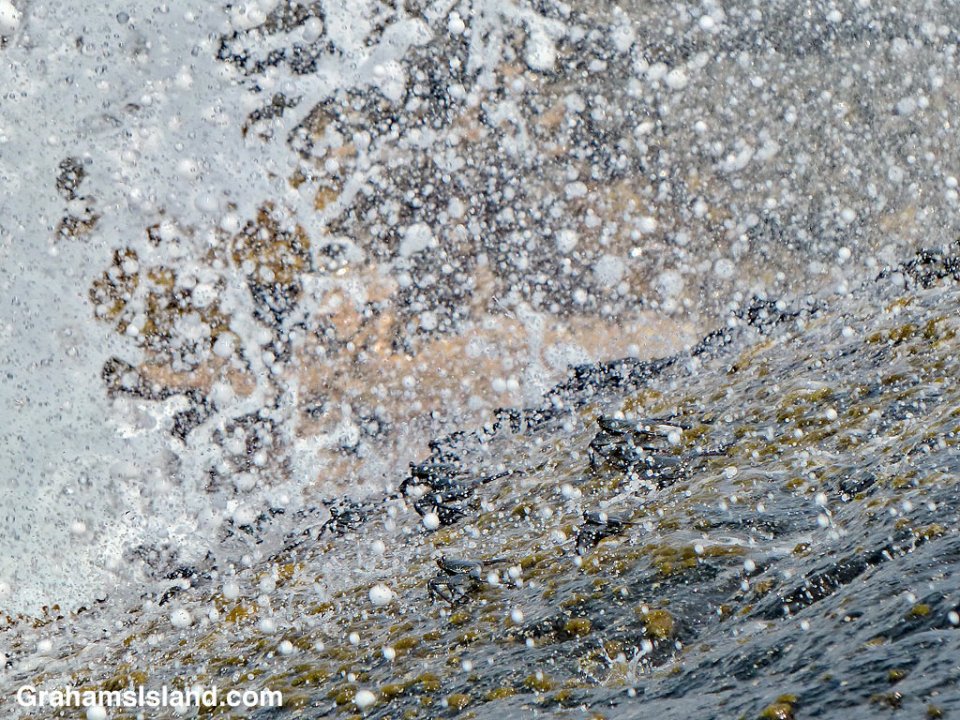
One of the first things anyone visiting a rocky seashore here will see is lots of little black shapes skittering away. Those shapes are a’ama crabs.
On this day, I had, as usual, spooked the crabs into motion, but after putting a little distance between me and them, they settled down again. Where they settled was on this sloping rock next to a blowhole. Moments later, water shot out of the blowhole creating this scene.
Where I would have been squealing and running from the sudden deluge, the a’ama crabs remained. I guess, living on these rocky shores, they are well used to this sort of thing.
 Graham's Island