Tag Archives: Goatfish

Place of Refuge and Two Step

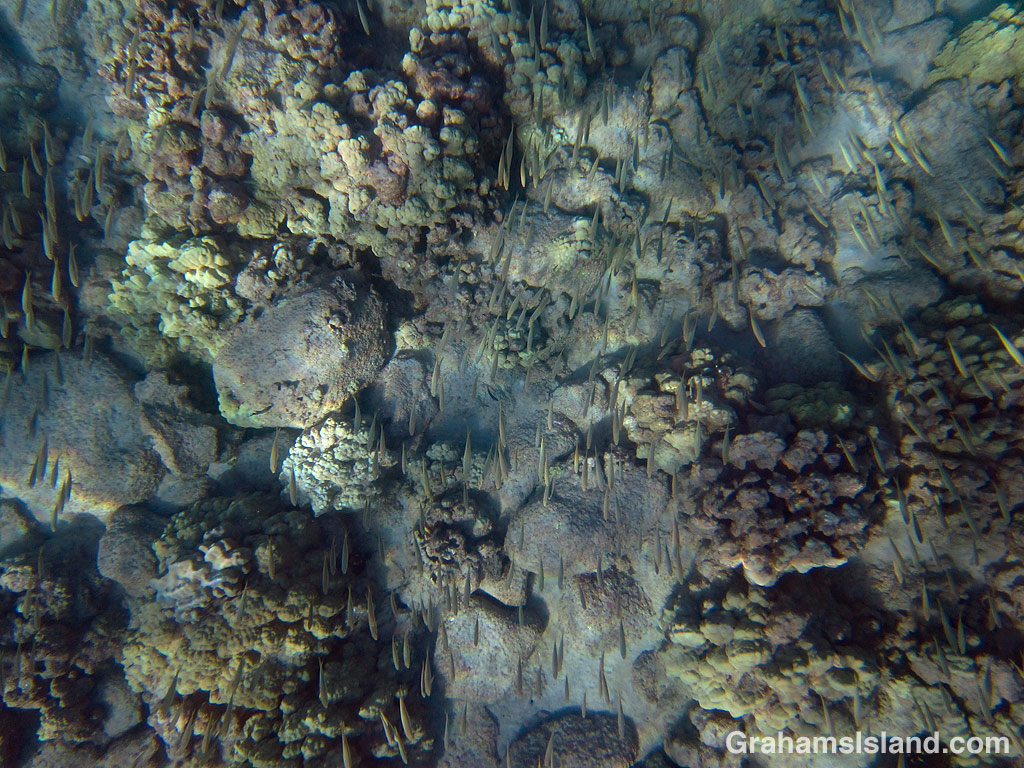
There’s a good variety of fish at Two Step including raccoon butterflyfishes, seen here mingling with goatfishes and yellow tangs.
A barred filefish swims by with a startled look on its face, which is just their usual look.
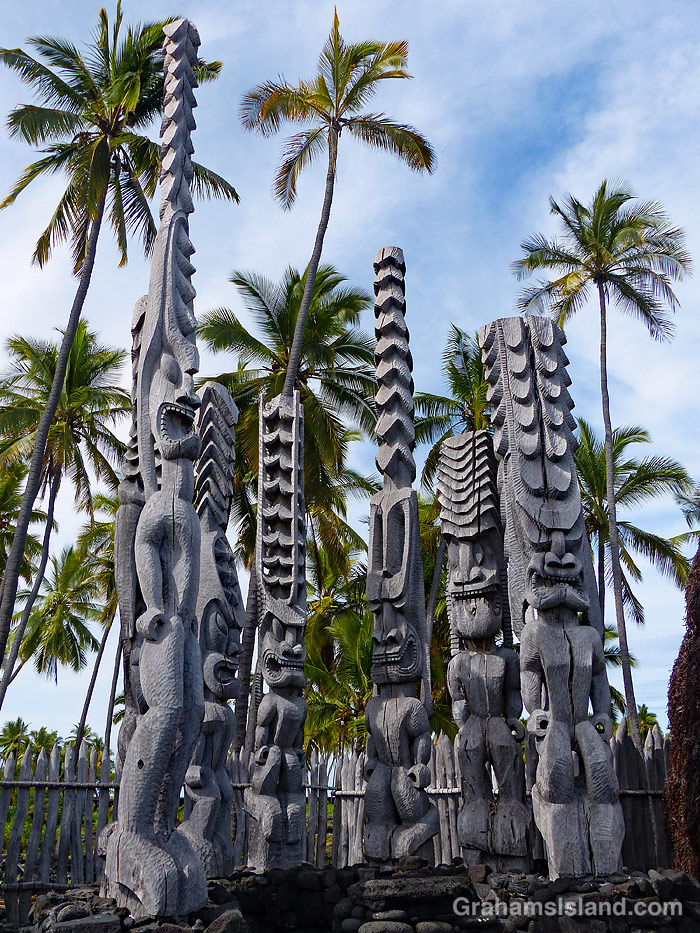
Ki’i at Pu’uhonua o Hōnaunau National Historical Park, better known as Place of Refuge.

This week’s Friendly Friday challenge theme is ‘Anniversaries.’ See more responses here.

Often, on our wedding anniversary, my wife and I go to Hawaii Tropical Bioreserve and Garden (formerly Hawaii Tropical Botanical Garden). This year the garden was shut, and still is, probably until tourists return to the islands. So a different anniversary is my birthday, which is not marked with candles on a cake, since that would be prohibitively expensive, but usually by a trip somewhere and a meal out. This year we went down to snorkel at Two Step and then had a wander around Pu’uhonua o Hōnaunau National Historical Park, otherwise known as Place of Refuge, which is right next door.

Two Step is a very popular snorkeling spot on Honaunau Bay, south of Captain Cook. This is a marine reserve so no fishing is allowed and the fish tend to be more numerous and mellow because of this. It’s a popular spot to see and swim with dolphins, though I haven’t done either of those things there. Currently, it’s not nearly as busy since there are very few tourists on the island and those that are here are diligently following quarantine rules (I’m trying to keep a straight face writing this!).

After our swim we made the short walk to Pu’uhonua o Hōnaunau National Historical Park. The park is on the south side of the bay and, at the moment, is fully open only on Fridays, Saturdays, and Sundays. However, on the other days, pretty much everything else is accessible, it’s just that the parking lot and visitor center are closed. What this means is that there’s basically nobody there so our visit was quiet and uncrowded. The park is an important place in Hawaiian history, and the location is beautiful. What’s not to like?

For more information about Pu’uhonua o Hōnaunau National Historical Park, visit https://www.nps.gov/puho/index.htm.

Palm trees reflect in one of the fishponds at Place of Refuge.

Gang activity

Bird Wrasse, Bluefin Trevally and Blue goatfish

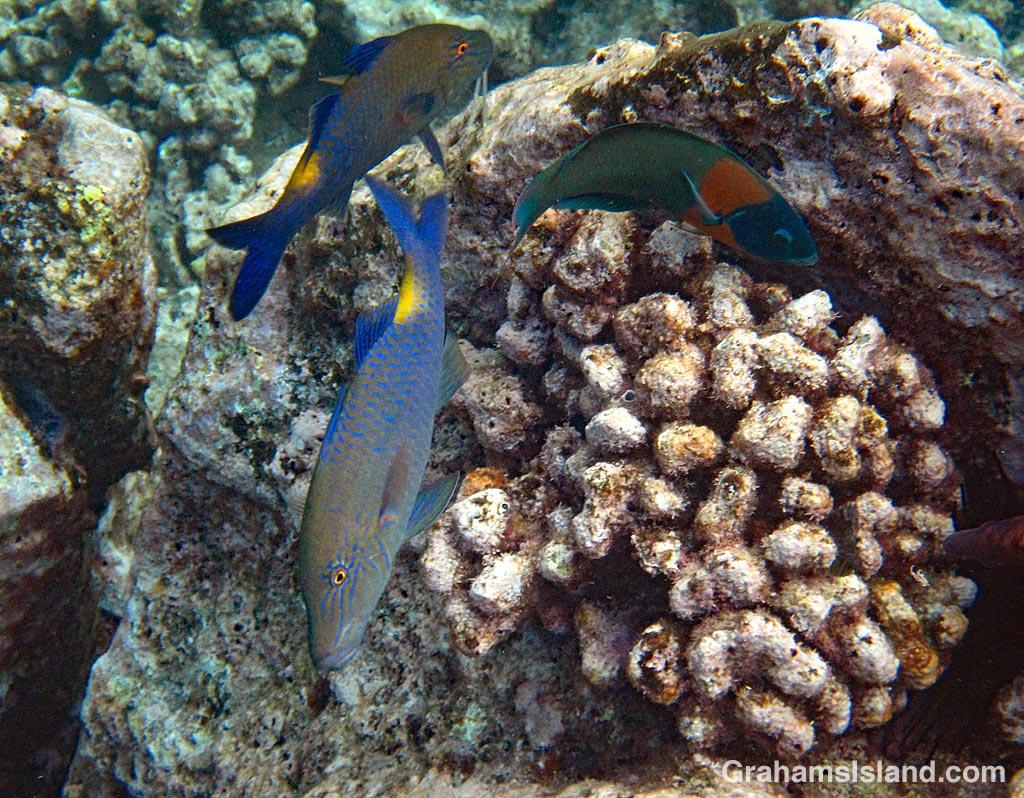
I happened upon this little gang of fish while I was swimming. At the top is a bluefin trevally, in the center a pair of blue goatfish, and at the bottom a male bird wrasse. Trevallies and goatfish regularly hunt together, often in the company of an eel or octopus. They try to flush out or ambush small fish as their prey. The bird wrasse eats mostly marine invertebrates but will also take small fish .

I often see fish like these hunting, but have yet to see any of them snag a meal, though they clearly are reasonably successful hunters.

Blue goatfish

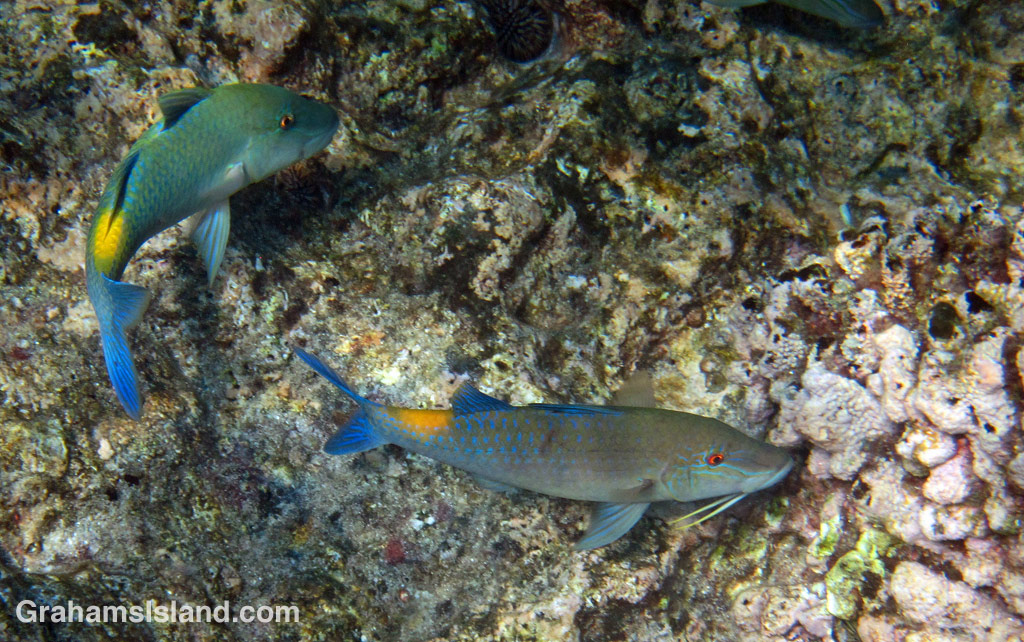
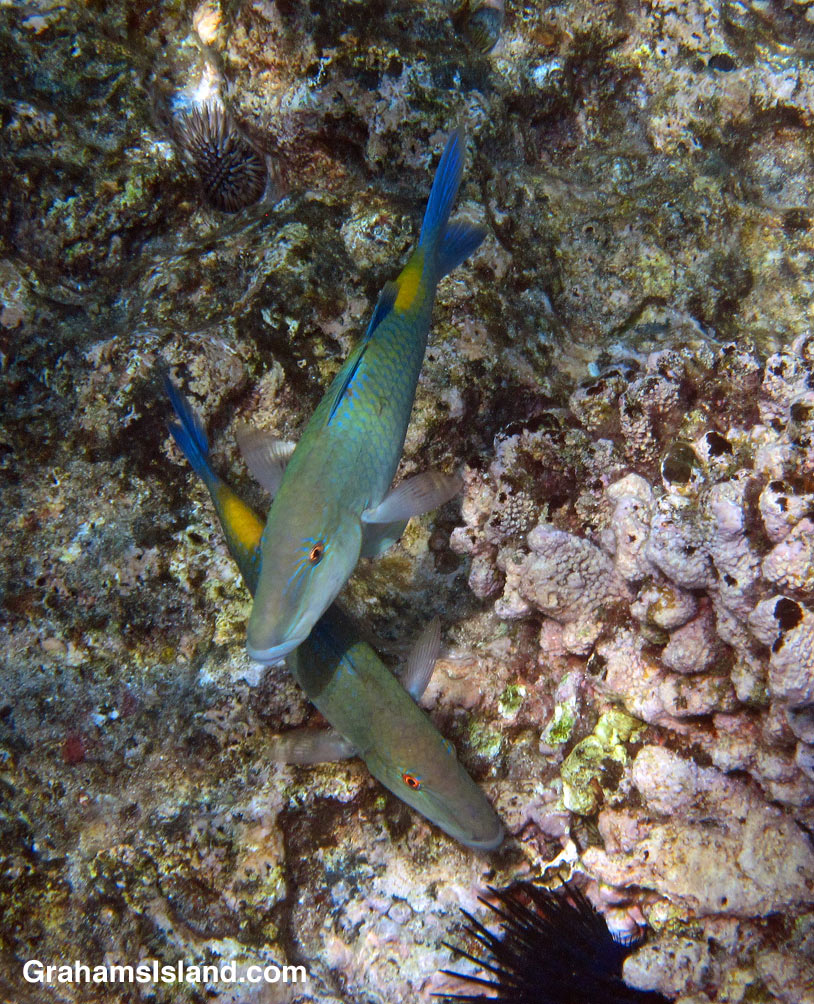
Blue goatfish are easy to identify with a good deal of blue on their bodies and a yellow patch in front of the tail.Blue goatfish are easy to identify with a good deal of blue on their bodies and a yellow patch in front of the tail.

Blue goatfish are easy to identify with a good deal of blue on their bodies and a yellow patch in front of the tail. When feeding, they move their long barbels forward and use them to roust small fish from cracks and coral heads.

Day octopus

A day octopus settles on a patch of coral off the Big Island of Hawaii.

A day octopus settles on a patch of coral. It will change its coloration from moment to moment depending on whether it wants to blend in or, perhaps, display an aggressive warning.

Spotting an octopus is a matter of chance. It helps if it’s on the move, but the presence of goatfish (in this photo, a manybar goatfish), is sometimes a tipoff.

Square-spot goatfish

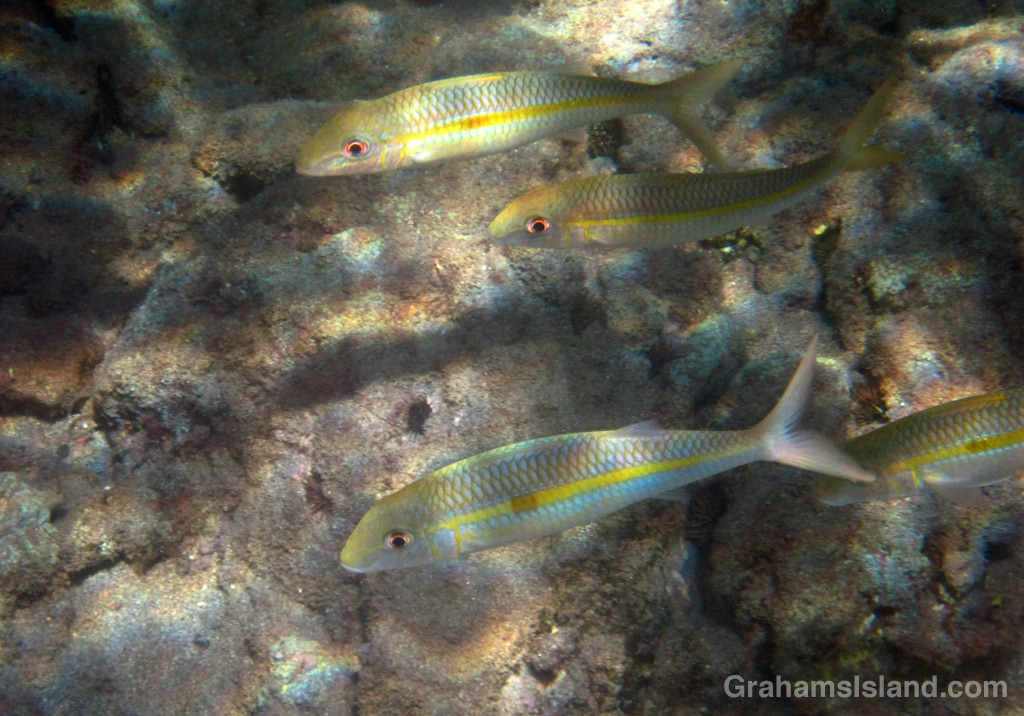
Square-spot goatfish swim in the waters off the Big Isalnd.
Square-spot goatfish are quite common and most easily distinguished by the square spot in the yellow stripe along their sides. However, the intensity of the square spot changes, darker during feeding, and fading (as with the fish in the photo) or disappearing altogether while resting or schooling. When the spot disappears, square-spot goatfish are hard to distinguish from yellowfin goatfish.

In my attempts to identify what I see in the water, I use John P. Hoover’s book The Ultimate Guide to Hawaiian Reef Fishes, Sea Turtles, Dolphins, Whales, and Seals. His website is hawaiisfishes.com.