Tag Archives: Jacks

Bluefin trevally

Bluefin Trevally

A couple of views of different bluefin trevallies. There are two things I particularly I like about this quite large fish. One is that they’re quite beautiful when the sun catches their blue markings. The other is that they tend to hunt in twos and threes, often times in the company of goatfish, and an eel or octopus. Indeed, if you want to see an octopus, one of the best ways is to watch for trevallies, especially if they’re just stooging around in one area for no apparent reason. In that case, it’s probably because there’s an eel or octopus present that can’t easily be seen.

Bluefin Trevally approaching

Gang activity

Bird Wrasse, Bluefin Trevally and Blue goatfish

I happened upon this little gang of fish while I was swimming. At the top is a bluefin trevally, in the center a pair of blue goatfish, and at the bottom a male bird wrasse. Trevallies and goatfish regularly hunt together, often in the company of an eel or octopus. They try to flush out or ambush small fish as their prey. The bird wrasse eats mostly marine invertebrates but will also take small fish .

I often see fish like these hunting, but have yet to see any of them snag a meal, though they clearly are reasonably successful hunters.

Threadfin jack juvenile

Threadfin Jack juvenile

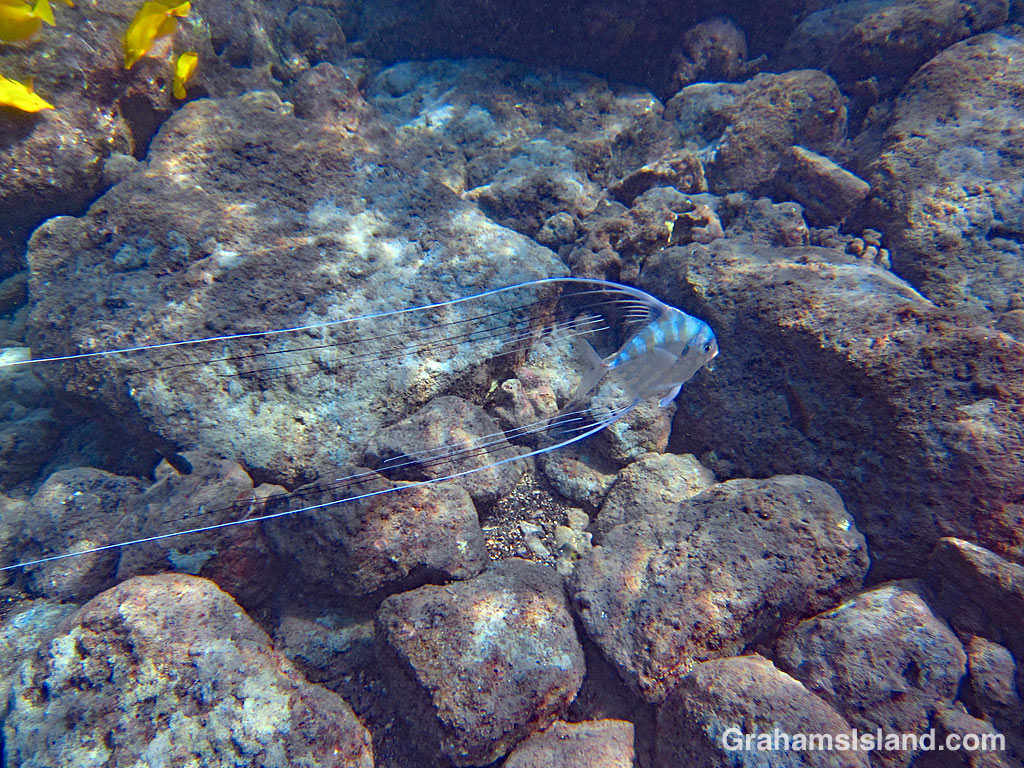
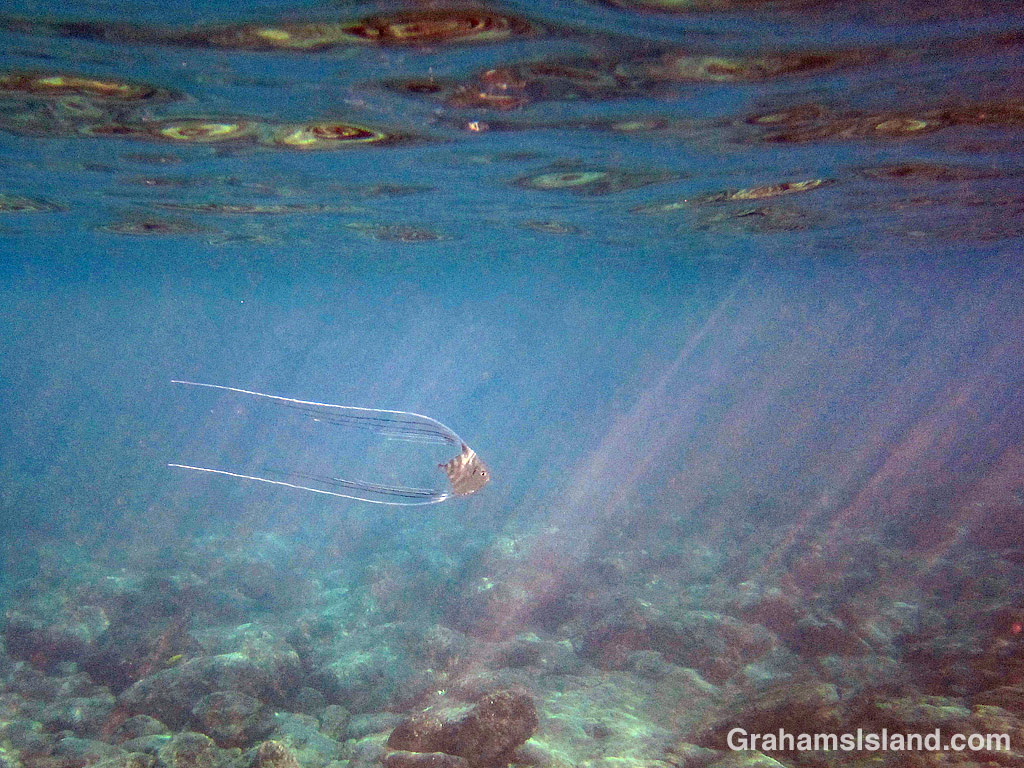
This is the time of year when juvenile threadfin jacks can sometimes be seen in inland waters. I’ve been on the lookout for them since May, but haven’t seen any. This doesn’t mean they’re not there; so small and shimmery, they’re easy to miss in murky shallow water.

Last week, my vigilance was rewarded. While the water wasn’t too clear, the swell was low so I headed among the rocks near the shore and saw my first threadfin of the year. I took the bottom photo which, while not great, does show the shallow area it tends to inhabit and the sun filtering through that water.

Next day, I went back to the same spot but didn’t see the fish. So I turned and headed out toward deeper water and almost bumped into it coming the other way. I quickly snapped the top photo as it went by, not sure if it was even in the frame, before it disappeared into the shallows.

In the past, these juveniles have stuck around for several weeks, so I’ll hopefully get to see this one a few more times. Ultimately, it will head out to deep water and grow up to be a stocky four-footer living up to 200 feet down.

Threadfin Jack Juvenile in sunlight

Fish farm

Fish farm net pen and boat

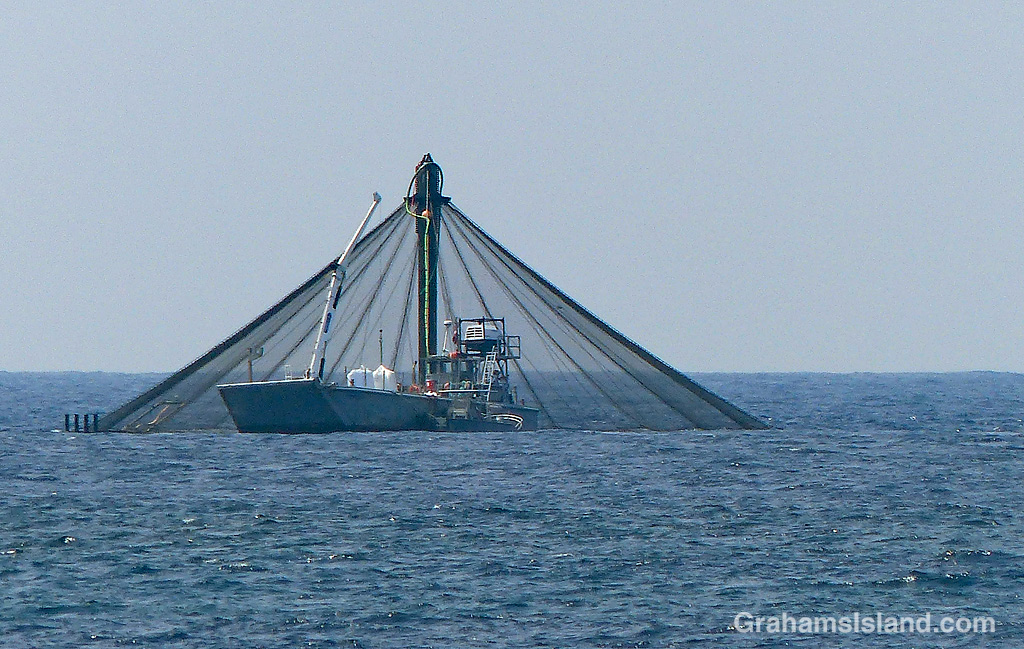
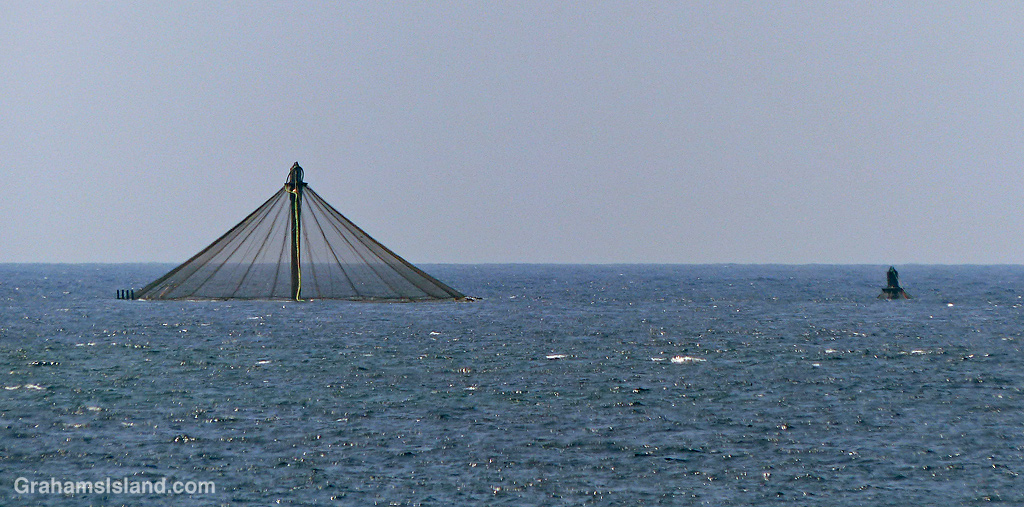
Not far off the Kona coast, near the airport, one or more of these nets can often be seen. They’re the submersible net pens of a fish farm run by Blue Ocean Mariculture. The farm raises Almaco jack which it markets under the name Hawaiian Kanpachi.

In the wild, the fish is prone to ciguatera, a toxin that can cause diarrhea, vomiting, numbness, and other unpleasant symptoms. This is the reason almaco jacks aren’t fished commercially. But the farmed fish are free of this problem. I have mixed feelings about farmed fish, but this farm seems to be well regarded and is approved by Monterey Bay Aquarium’s Seafood Watch.

Part of my ambivalence may be down to the fact that, last year, one of the few resident monk seals living around the island became trapped in a pen and drowned. I’ve since heard that when work is being done on a pen, it should be raised so part is above the surface. That way, if something swims into a pen and can’t get out again, it can at least surface inside the pens to breathe. Whether that happened in this case, I can’t say. The official word is that mariculture projects in Hawaii are under review by the Army Corps of Engineers and NOAA.

Fish farm net pens

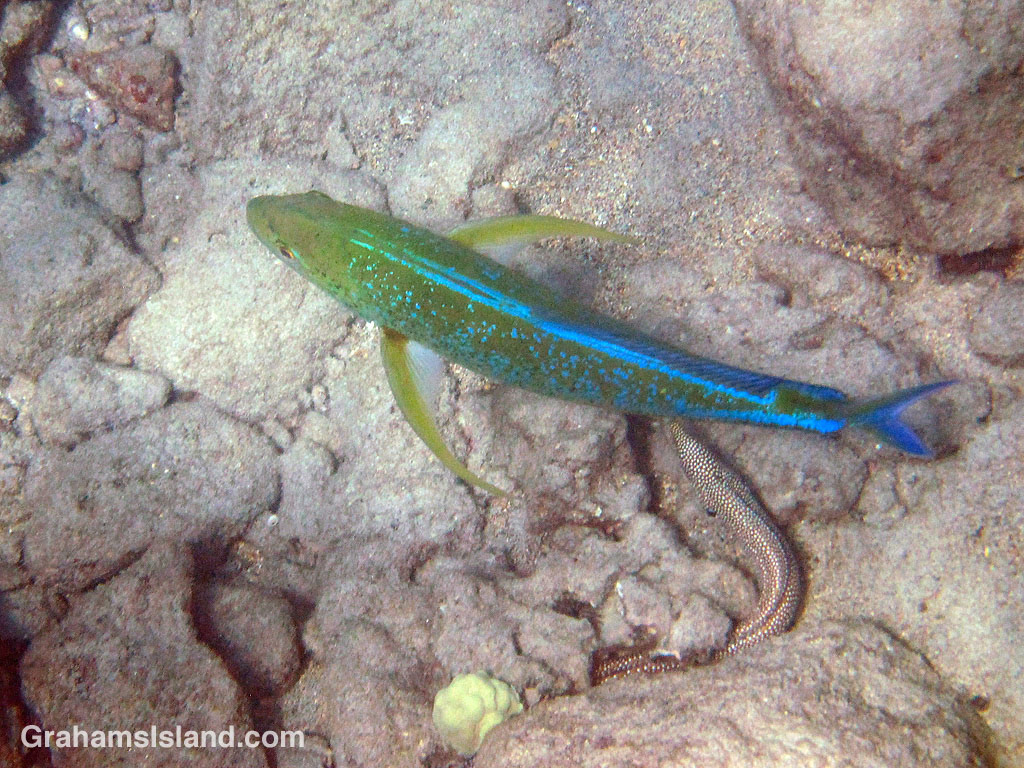
Bluefin trevally and whitemouth moray eel hunting

A Bluefin Trevally and Whitemouth Moray Eel hunting in the waters off the Big Island of Hawaii

There are a fair number of predatory fish in Hawaii, that eat other, smaller fish. These fish have a variety of hunting strategies, everything from ambush to outpacing their prey. Some fish team up with other predators.

Fish that employ this latter strategy include various goatfish and bluefin trevallies. These fish often accompany each other on hunts, but either or both can also be seen with other predators including eels and octopuses.

I followed this bluefin trevally and whitemouth moray eel for a few minutes and didn’t see them catch anything, but they were definitely traveling together. If the eel hung out for a while under a ledge, as they like to do, the trevally would hang around, passing back and forth or circling the spot.

This tendency is actually helpful for spotting eels and particularly octopuses. Several times I’ve seen a goatfish or two milling around a rock for no apparent reason, so I’ve waited and watched. Sure enough an eel pops its head out or, better still, the rock turns out, on careful examination, to be mostly octopus.

There you go, an actual useful tip for snorkelers.

Bluefin trevallies

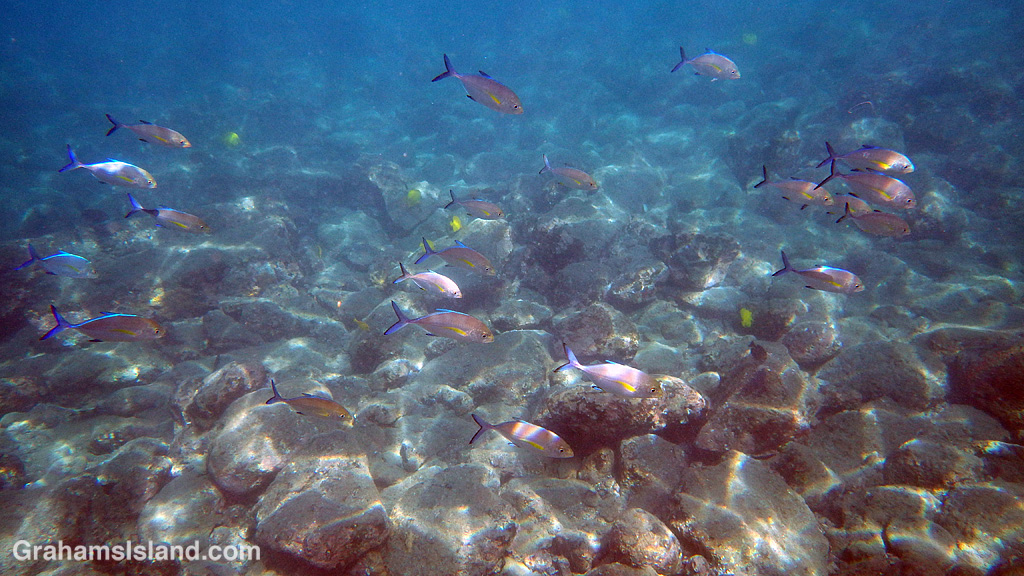
A shoal of young bluefin trevallies roams the shallows.

A shoal of young bluefin trevallies roams the shallows. Adult bluefin trevallies grow to a good size and can also often be seen close to shore. When they catch the light right, they reflect an almost neon blue.

Threadfin jack juveniles

A pair of Threadfin Jack juveniles swim in the waters off the Big Island of Hawaii

Adult threadfin jack are large, stocky, deepwater fish and rarely seen. Juvenile threadfins aren’t seen often either, even though they spend their time in shallow waters. One reason for this is that they don’t appear in great numbers. Another is that they’re easy to miss in the often stirred-up shallows. When they are seen, many people see their long, wavering filaments and think they’re jellyfish (I did the first time I saw one).

If the juveniles are to be seen, this is time of year for it. I’ve been looking out for them for a few weeks without success. Then, a few days ago, my wife saw one. A couple of days later, in the same area, we got in the water and saw one, then another, then a third. The water was quite murky and the threadfins quickly shimmied off among the rocks.

I managed to snap a couple of photos, but wasn’t sure the fish were even in the frame because they were hard to see on the camera screen. So I was thrilled that one of the photos had captured these two as they swam by. Hopefully, they’ll be around a few more weeks before they head out to deeper water, so I’ll get to see them again.


Bluefin trevally

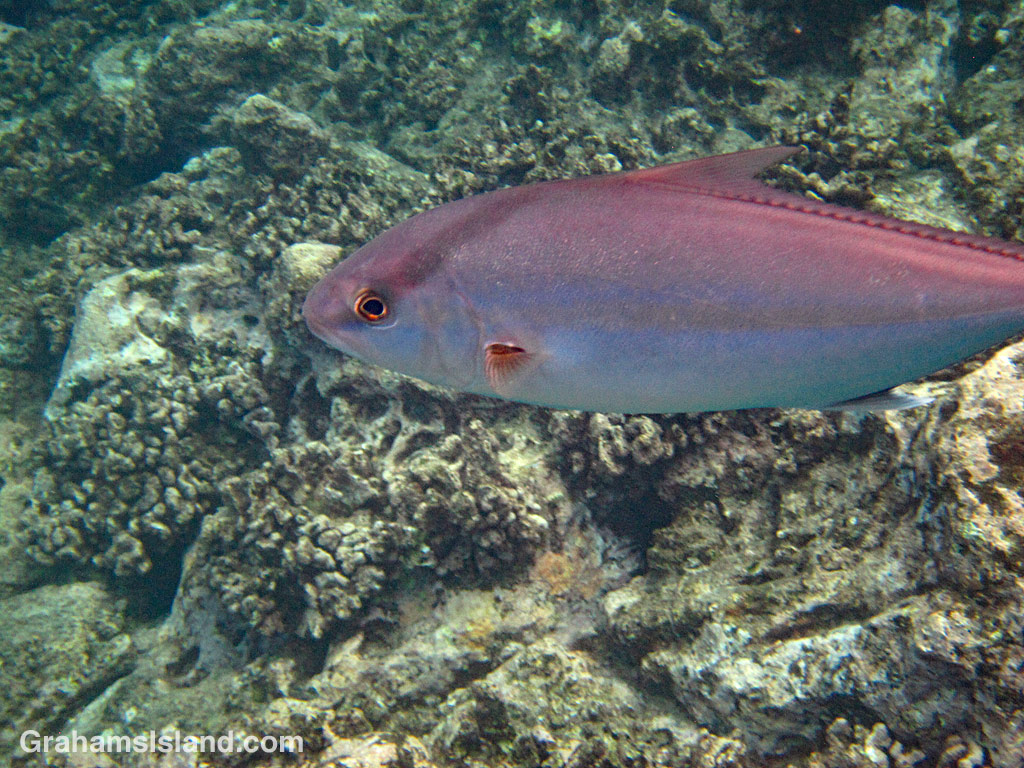
A large adult Bluefin Trevally.A bluefin trevally in Big Island waters.
These are another of those fish that look quite different when they catch the light, with blue highlights standing out. They also look different as they age. The top photo is a large adult, the other two, a small younger adult.

These fish are big time predators, eating many other species of fish. I find this interesting because I often see bluefin trevally when I’m in the water. I see them pass by other fish and I’ve never seen them strike or seen other fish particularly bothered by their presence. One day …

In my attempts to identify what I see in the water, I use John P. Hoover’s book The Ultimate Guide to Hawaiian Reef Fishes, Sea Turtles, Dolphins, Whales, and Seals. His website is hawaiisfishes.com.

A small adult bluefin trevally.