Photographers are encouraged to take advantage of the golden hour shortly after sunrise or shortly before sunset, when the light is soft and golden. Photos taken here during the golden hour showcase the wonders of Hawaii’s beaches, volcanoes, and wildlife.
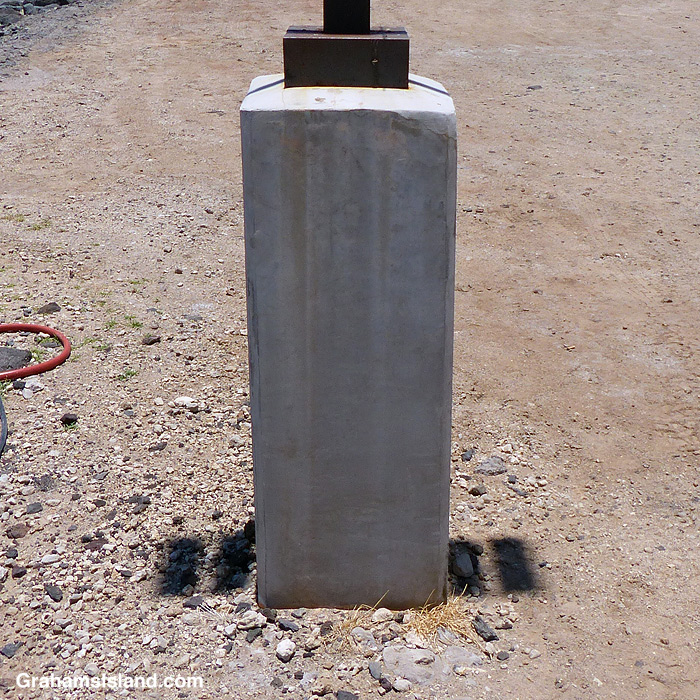
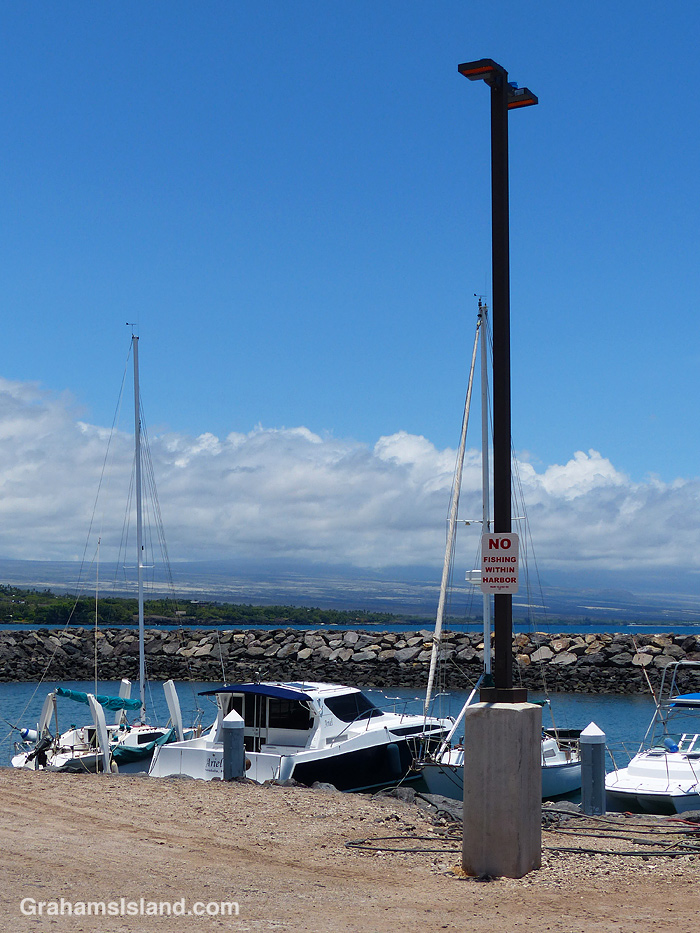
Taking that as my cue, I feature one of the wonders of Hawaii in these photos. No, it’s not concrete lamp bases, which can be found in most, if not all, states. Nor is it the golden hour. But only in Hawaii can you find a concrete lamp base like this one. It’s a sunny day. Those rectangular shadows are from the lights at the top of the lamp pole. But where’s the shadow of the concrete base? There isn’t one, because these photos were taken at Lāhainā Noon.
Lāhainā Noon, a name thought up by the good folks at the Bishop Museum, occurs when the sun is directly overhead on its apparent passage north and then south again, before and after the summer solstice. This phenomenon occurs in places located between the Tropic of Cancer and Tropic of Capricorn. Hawaii is the only U.S. state in tropics and so is the only place in the country to see this.
The timing of Lāhainā Noon varies from place to place, depending on latitude. It occurs twice a year, the first time in May as the sun appears to head north, and then again in July as it dips south again. These photos were taken yesterday in Kawaihae, but where I live in Hawi, Lāhainā Noon occurred two days ago. The last place on the island to experience it will be South Point, the most southerly point in the U.S.A, on July 27.
The bottom photo shows the Sky Gate sculpture in Honolulu. This sculpture, designed by Isamu Noguchi, casts a wavy shadow most of the time, but twice a year, at Lāhainā Noon, the shadow is perfectly round. The sculpture wasn’t particularly well-received initially, but now people visit from all over the world (when that’s possible) to see it do its thing.
I saw this Hawaii County Fire Department Search and Rescue helicopter flying over Mau’umae Beach, just south of Kawaihae. I think it was just on a training exercise, but we have had a run of missing fishermen and free divers so it might have been associated with one of those searches.
The body of one fisherman was located submerged along the coast, but no trace of the others has been found yet, to my knowledge. The standard practice on the Big Island is to search for three days. If nothing is found by the end of that time, then they call it off.
There are strong currents around the island and if a swimmer or fisherman is injured in the water, it’s easy for them to be swept out to sea, where the chances of finding them diminish rapidly. Sad as it is when a body is recovered, it’s almost harder when nothing is found and there is no sense of closure for families and friends.
This week’s Sunday Stills challenge theme is ‘Rise/Set.’ See more offerings here.
I decided to go with sunrise and sunset photos taken from more or less the same spot on Kawaihae harborside. Above, a man fishes from the end of the harbor breakwater around sunrise. Below, a fisherman seated on the shoreline at sunset, with the breakwater across the harbor in the background.
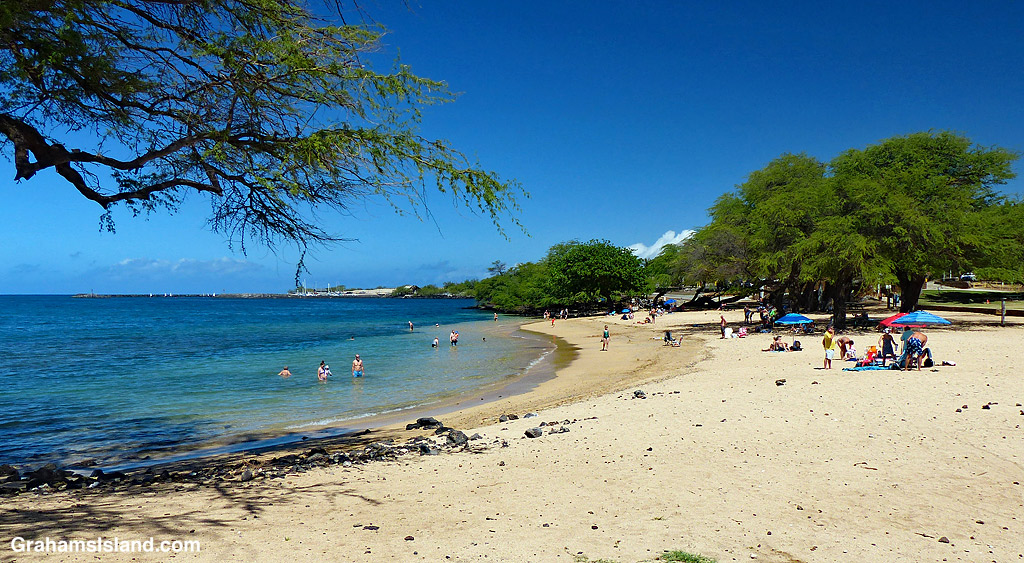
Spencer Beach Park, near Kawaihae, is a popular spot for families. With protected water, sand, shade, and facilities it’s got most everything little kids need. On weekends it can get crowded, but during the week it’s usually possible to find a quite spot.
The park is right next door to Puʻukoholā Heiau National Historic Site so it’s possible to visit both places from one parking spot.
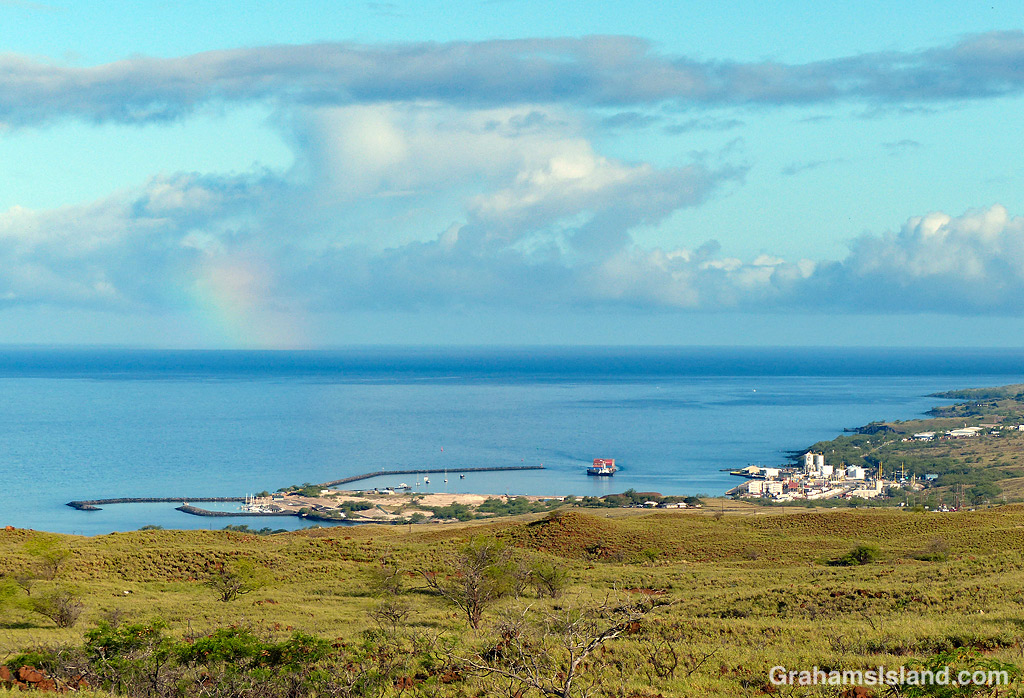
This week’s Sunday Stills challenge theme is ‘Waterworld.’ (See more offerings here.) So why this photo of Kawaihae harbor? Well, this was where the 1995 movie, Waterworld was filmed. Actually, most of the filming took place beyond the stubby rainbow in this photo, out there in the deep blue ocean.
The movie blew away its original budget, spectacularly overran its 96-day shooting schedule, and suffered a laundry list of disasters from start to finish. It started shooting without a finished script despite the efforts of multiple screenwriters. The director and the star had different ideas about how the movie should work. It was shot almost entirely on water. Actors and production crew got seasick. Two actors were dumped from a boat and then run over by it. Several of the cast were stung by jellyfish. A stuntman nearly died from the bends after a diving scene. The star himself was lashed to a mast, 40-feet up, for one scene but when it was over, a gale sprang up, and he and the boat couldn’t be retrieved for half an hour.
Bad weather often prevented any shooting and numerous delays carried the production into hurricane season. High winds duly destroyed one of the intricate and expensive floating sets.
The completion of filming didn’t end the movie’s traumas. The director quit before the editing was complete. Test audiences gave it a lukewarm reception leading to continued tinkering. Ultimately, the movie wasn’t a total disaster. While it didn’t do that well in the U.S.A., it covered its costs with overseas income. There’s even a popular Waterworld attraction at Universal theme parks.
I saw the movie when it came out and made it the subject of one of the weekly columns I wrote for my local newspaper. That column is reproduced below, as it was written at the time. Bear in mind that was 25 years ago and some things have changed in that time (if you don’t know what a VCR is, look it up!).
Waterworld on the rocks, no ice
I went to see Waterworld last week. That’s the movie that was supposed to be the most expensive ever made at around $100 million, but turned out to be the most expensive ever made at more than $175 million. It’s set way in the future when some cataclysm, such as the balancing of the Federal budget, has caused the polar ice caps to melt. The survivors live on wacky floating stage sets and dream of finding dry land and pizza without anchovies. Right from the start I was in trouble. Where was all this water coming from? I wondered. According to the Encyclopedia Britannica, if all the world’s ice melted, sea level would rise about 230 feet. While this would bode ill for the likes of New Orleans and Miami, there would still be quite a bit of land sticking up, such as Asia. I would have thought that someone, somewhere would have bumped into some of this land by the time the movie started, possibly during the previews of coming attractions. Still, as readers of this column know, I am not one to let facts get in the way of a story. Perhaps, in addition to the ice caps melting, it also rained a lot. Or, maybe, the cataclysm that caused the ice to melt was a gigantic alien intergalactic water tanker crashing into Earth. In any case, in this water-covered world the only clue as to the location of dry land is a little girl with a map tattooed on her back and a glossy real estate brochure offering view lots at attractive prices. This girl is sought by bad guys whose bad lifestyle includes riding jet skis, living on the Exxon Valdez, and worst of all, smoking cigarettes. (Presumably they’re stale cigarettes since there isn’t anywhere to grow tobacco and or any government to provide subsidies.) The bad guys are even called Smokers just in case anyone might not realize how thoroughly awful they are. Pitted against the bad guys is Kevin Costner sporting webbed feet, gills, and a mean temper. This may be because his last three movies bombed or it could be dissatisfaction at the amount of money being wasted instead of going into his pockets. Unlike Meryl Streep, who tends to research her character’s background and come up with appropriate behavior and accent, Costner acts in the John Wayne tradition. He sounds pretty much the same in Waterworld as he does in all his movies. For all I know his dialogue is the same. That could explain why the couple down the row from me decided to chat all the way through the movie. Now, I’m not an intolerant person (and anyone who says I am should be taken out and shot), but people talking through movies is one of my pet peeves. It drives me bonkers when something happens on screen and I hear someone ask, “What did he say?” By the time the explanation is given, another scene has gone by prompting the question, “What happened there?” They never catch up. This is why God invented the VCR. VCRs allow such people to have no idea what’s going on in the privacy of their own homes. They also avoid the risk of having me pour hot buttered popcorn on their heads. Playing opposite Costner in almost the only female role, apart from the girl with the map, is Jeanne Tripplehorne. You can tell hers is a supporting role because she did not get as much material for her costume as Costner and consequently ran short in the bosom area. Not that I’m complaining. One reason there are so few women in the movie is because Waterworld is an action/adventure movie. Hollywood rules state that in action/adventure movies, women cannot appear for more than about 20 minutes and during that time they must be either naked and/or get killed. Because it’s an action/adventure movie, it also features a stipulated number of explosions, fires and, of course, meaningless violent deaths. There is even a mandatory car chase, not an easy thing to work in when the freeways are deep under water. Actually that scene is one of the many tongue-in-cheek bits in the movie. In fact, apart from Costner being permanently cranky, everyone else seemed to be having a pretty good time, albeit while acting as though they’re desperate and starving. It may be that this lighthearted attitude spilled over to the accounting department of Universal, the company that made Waterworld. That was my first thought to explain where the $175 million went. But then I noticed that all those fires burning through the movie were fueled by studio executives throwing actual dollar bills into the flames. I understand that, in an attempt to recoup some of their costs, Universal plans a sequel. It’s about a movie studio that drowns in a sea of red ink when the accounting department’s computers crash and burn. It will be called Realworld.
I was on my way to work one morning when I noticed the sailboat in the top image. The array of white sails caught the early morning sun and stood out against the deep blue water. I pulled over, took this photo and headed on in to work.
I saw later that the boat had anchored in Kawaihae harbor, so on my way home I stopped by to check it out. The SSV Makani Olu is a three-masted staysail schooner (SSV stands for Sailing School Vessel), and is used as a training vessel for various programs run by Marimed Foundation. The boat is based at Kaneohe Bay, on the east coast of Oahu.
In the photo to the right, the boat appears to be four-masted, but that’s just because the mast of the boat behind it lined up perfectly.
For more information about SSV Makani Olu and Marimed Foundation, go to marimed.org.
Containers are unloaded from one of the inter-island barges at Kawaihae harbor. It’s not a forklift doing the work, more of a grip-n-raise, though I doubt that’s its official name. No prizes for guessing that the shipping company is Matson, but I like the repetition of their name in the images.