Tag Archives: On The Coast

V-22 Osprey

A V-22 Osprey lands at Upolu Airport.A V-22 Osprey banks as it approaches Upolu Airport.
Returning from a walk around Upolu Airport, I was startled by a loud thumping noise close by. Through the trees I saw this peculiar-looking aircraft touching down. The plane is a V-22 Osprey, a tiltrotor aircraft used by the military, in this case, the U.S. Marine Corps.

The plane made several loops, out over ʻAlenuihāhā Channel and back around to the airport to land, then do it all over again. It was actually quite fascinating to see the engines rotate from horizontal to vertical while in flight.

Eventually, the plane headed out over the channel and kept going, probably back to its base on Oahu.

Relaxed Hawaiian monk seal

A Hawaiian monk seal relaxes on the Big Island.
Hawaiian monk seals tend to hunt at night. During the day, they’ll often haul out on a beach or rocky shore to rest, which is when they’re most often seen by people. This seal is a 7-year-old male with the catchy moniker of IO5 (given him by the people who track seals and look out for their welfare). He’s the monk seal I see most often and he has a few distinctive characteristics.

Thus far, he has remained unscarred by encounters with boats or sharks. He usually appears to have an air of being rather pleased with himself, perhaps a certain confidence about what a fine fellow he is. And when he’s on shore, he doesn’t just look like he’s resting, he looks like he has found a deeper, Zen-like calm. Seeing him in such a state always makes me loosen my shoulders, take a deep breath, and relax.

For more information about Hawaiian monk seals, go to www.pifsc.noaa.gov/hawaiian_monk_seal/ or www.marinemammalcenter.org/hawaii.

Kiawes – a thorn in the foot

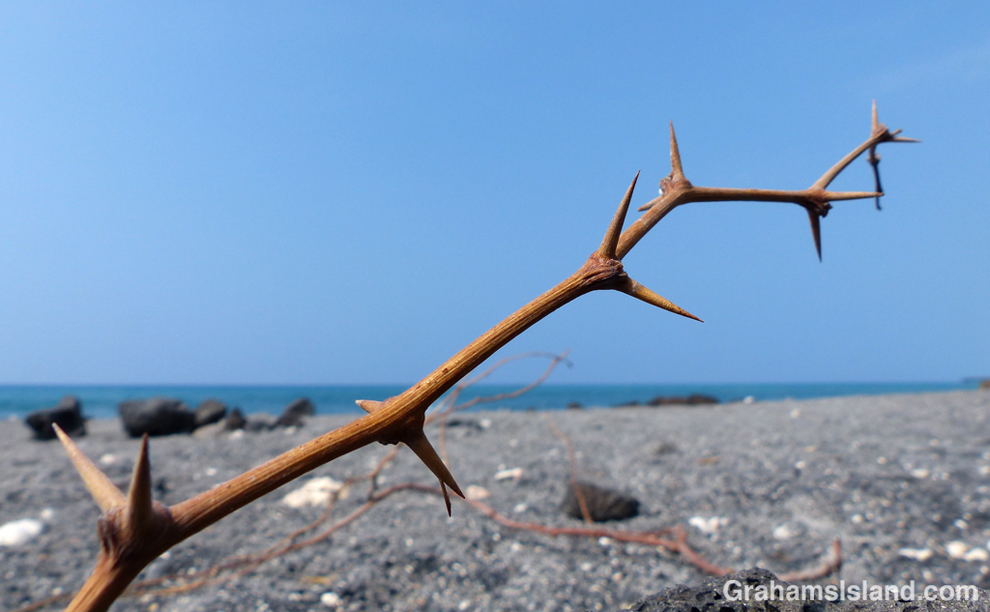
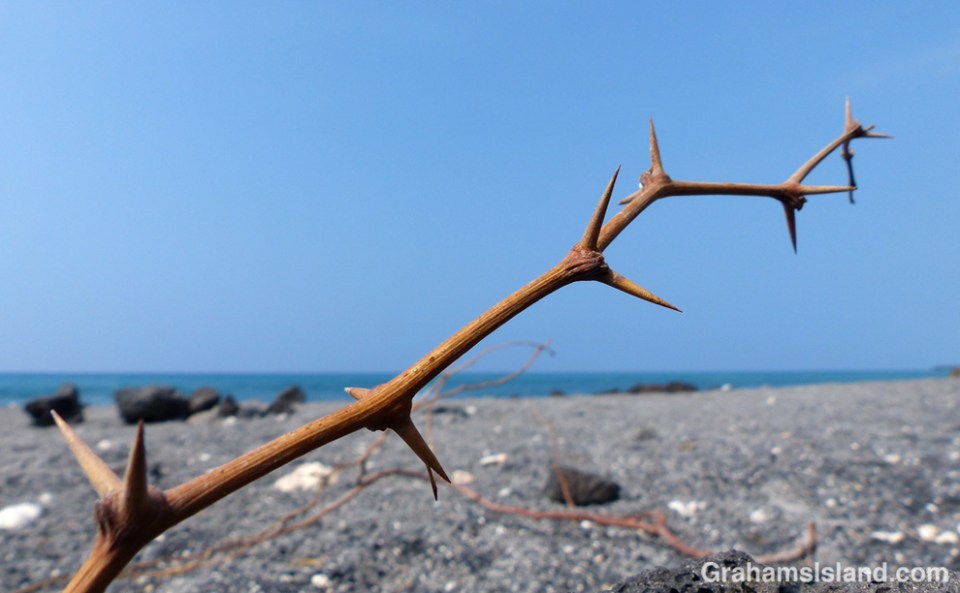
Kiawe thorns on a Big Island beach.

When twigs break off a kiawe, the thorns dry to hard, sharp spikes.
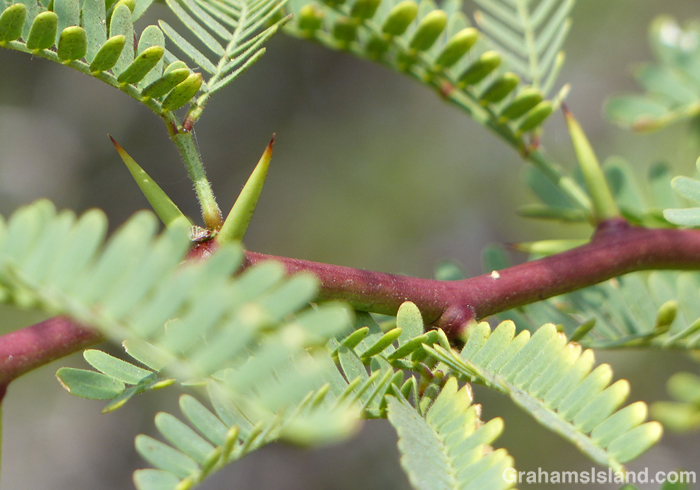
Kiawe thorns growing on a tree on the Big Island.

Kiawe thorns growing on the tree.

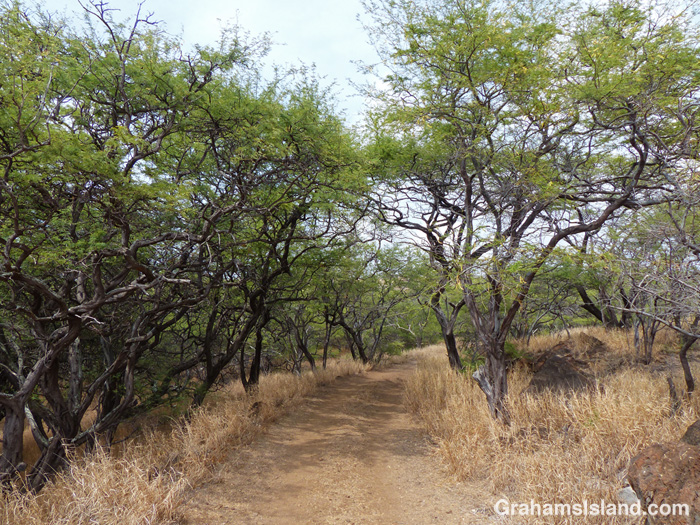
A stand of kiawe trees bordering a trail on the Big Island.

A stand of kiawe trees bordering a trail.

Hiking on the west side of the Big Island can be a hot and arid experience. The landscape is often barren lava or scrubby growth. If it’s scrubby growth, chances are that kiawe trees (Prosopis pallida) are prominent and if they are, it’s wise to tread carefully. That’s because kiawe trees produce long, tough thorns.

Hiking in slippahs (flip flops) is asking for trouble. A kiawe thorn will go through them like a knife through wet tissue. I’ve felt the jab of these thorns through my Tevas, which have robust soles of decent thickness. The first time I wore my new trail shoes, toward the end of the hike, crossing a kiawe-bordered beach, I felt a familiar prick in my foot. A thorn had buried itself in the ¾-inch thick sole and penetrated far enough to make itself felt. One of my routine tasks with my trail shoes, and the Tevas, is to examine the soles and extract any thorns with a pair of pliers. When a hike is over, it doesn’t mean the danger is past. Drive over one of these thorns and it can and does cause punctures.

But if all this makes it seem as if kiawes are reviled, that’s not the case. It’s widely used in smoking meats. The smell of burning kiawe is commonplace.

Kiawe isn’t a native tree; it originated in Peru. In fact, all Hawaii’s kiawes can trace their roots, as it were, back to a single seed planted by a priest in Honolulu in 1828.


Green Turtle sunbathing

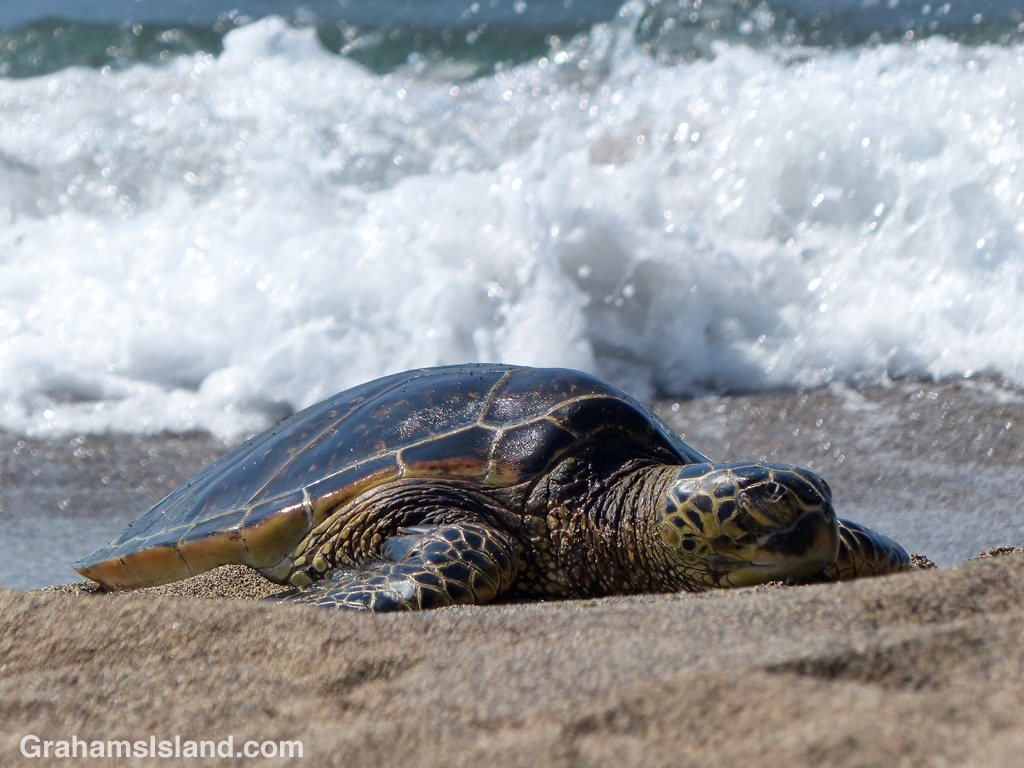
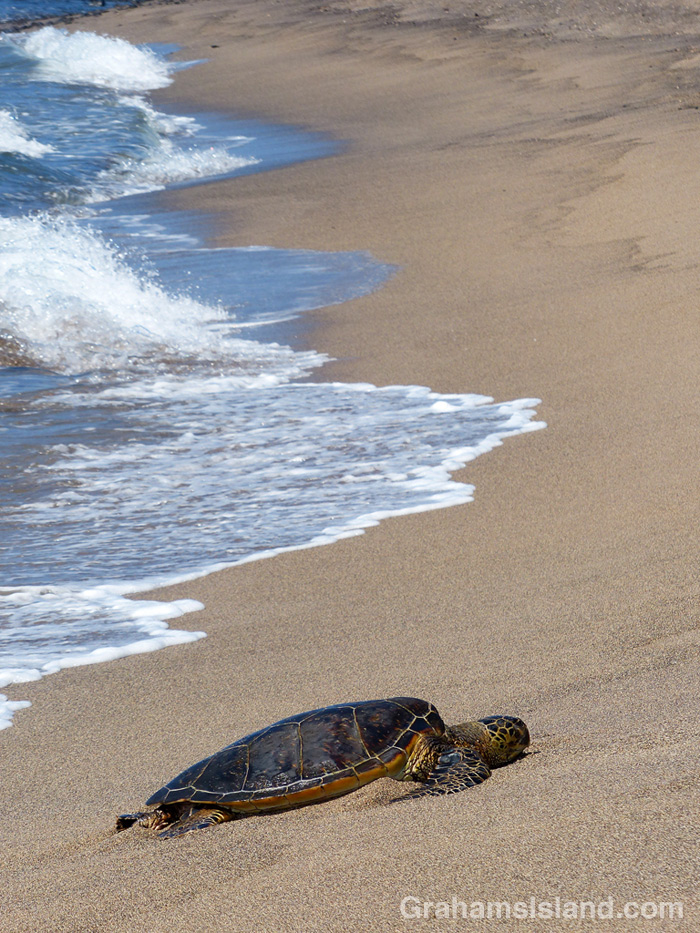
A Hawiian green turtle rests at Kaloko-Honokohau National Historical Park.A Hawiian green turtle rests at Kaloko-Honokohau National Historical Park.
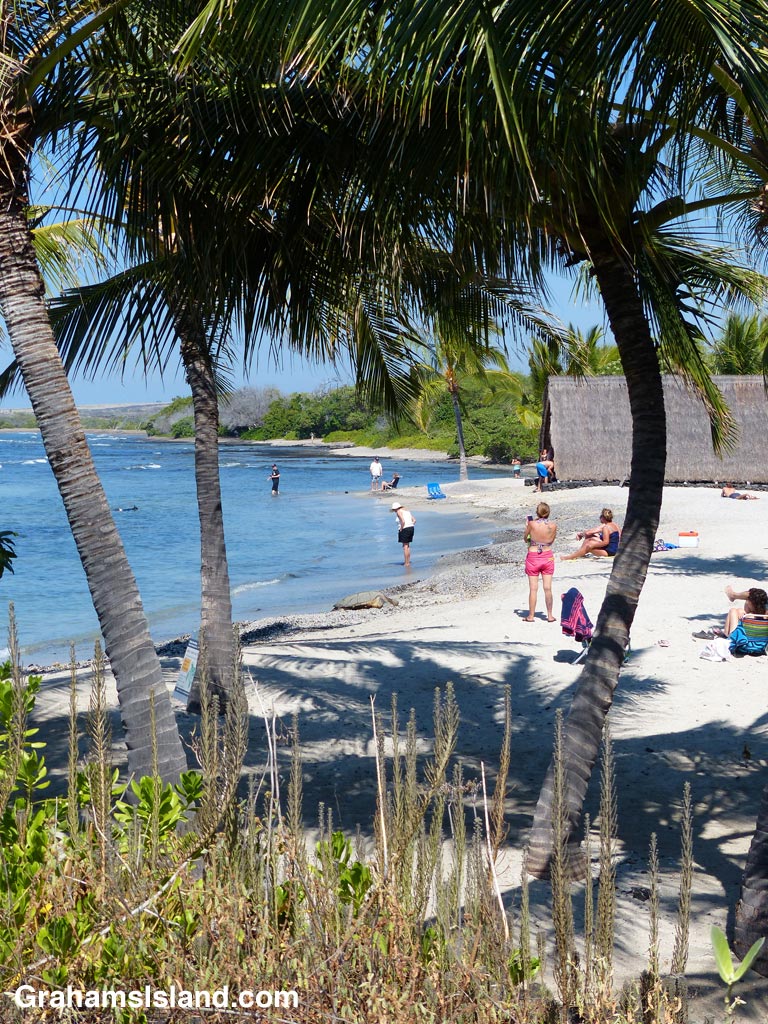
One of the attractions of Kaloko-Honokohau National Historical Park, north of Kailua Kona, is that it’s a popular resting spot for Hawaiian green sea turtles. This turtle was hauled out on a long curve of golden sand known as Honokohau Beach. He had the spot to himself, which is good. People are supposed to stay at least 20 feet away from turtles, but many don’t.

For more information about Kaloko-Honokohau National Historical Park, go to bigislandhikes.com/kaloko-honokohau-park/.

Opihi picker

An opihi picker scours the cost of the Big Island
This man was multi-tasking on the coast. After setting up his fishing rod, he went down to the shore to pick opihi. Such an undertaking is not for the faint of heart. Misjudge a wave, and he could be swept into the ocean in an instant.

Opihi are a kind of limpet and are a favorite delicacy here in Hawaii, most often eaten raw, straight from the shell.