Tag Archives: Snorkeling

Spotted eagle ray

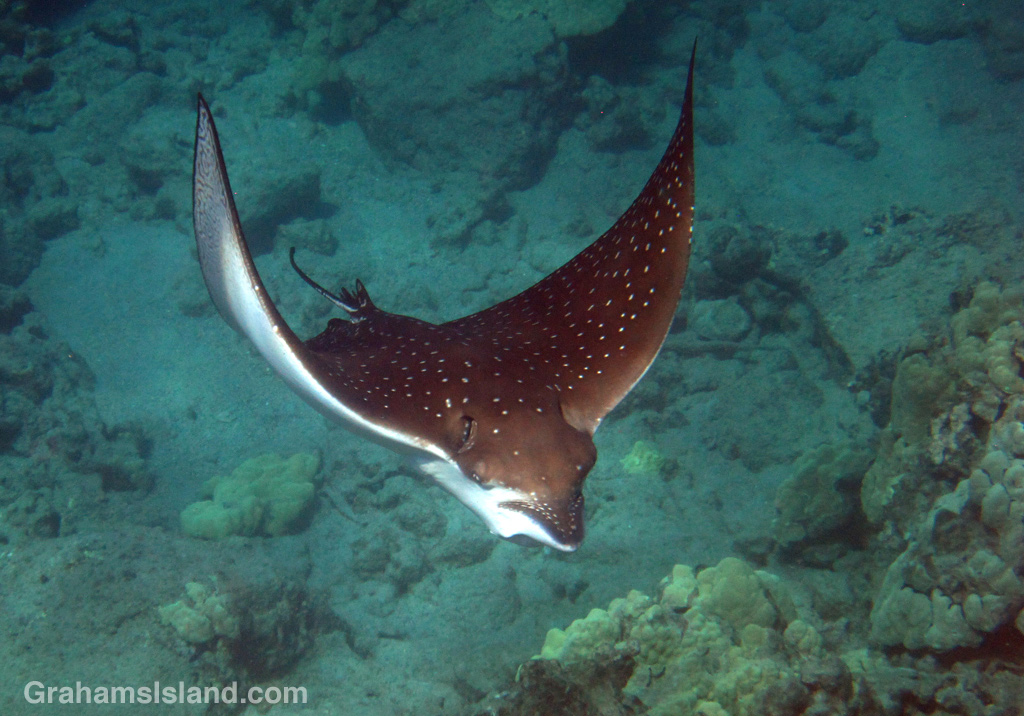
A spotted eagle ray swimming off the Big Island.A spotted eagle ray swimming off the Big Island.

During the summer months, the west coast of the Big Island sees more southwest or westerly swells. These tend to roil the waters and reduce visibility. So it was a pleasant surprise recently, to dip into the water and find good visibility for the first time in a while.

The good visibility wasn’t matched by the appearance of rarely seen, exotic fish. Only the ‘usual suspects’ were to be found, which is no bad thing. I enjoy watching even the most common of fish. However, I confess I was feeling a tad disappointed at having my camera and good conditions, but not seeing anything that especially fired my enthusiasm.

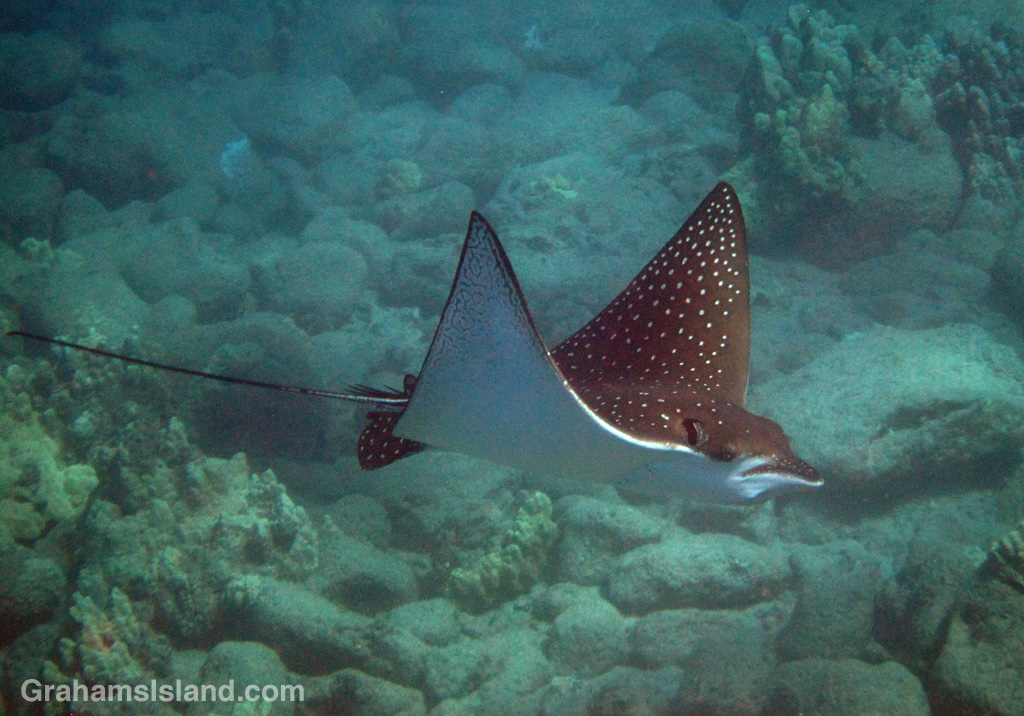
As if on cue, I looked up to see three spotted eagle rays coming toward me. One quickly slipped away and a second came and went. The third (second photo) cruised back and forth nearby, keeping an eye on me as I kept an eye on it. It had clearly lost its tail at some point. I’m not sure if a new one will grow back. In the bottom photo, the venomous spines at the base of the tail can be seen, though the venom is not nearly as toxic as that of some ocean dwellers.

After a while, the two remaining rays headed out toward deeper water and disappeared taking with them any disappointment I’d been feeling.

For more information about eagle rays, go to bioweb.uwlax.edu/bio203/s2014/hayward_paig/index.htm
A spotted eagle ray swimming off the Big Island.

Abstracts: Bubble machine

Surging water creates storms of bubbles.
In the water, it’s wise to be aware of what waves and swell are doing. Caught unawares, it’s easy to get tumbled over rock and coral. But I like to get close enough to see fish sluicing back and forth, and also to see the waves crashing around the rocks leaving little whirlpools and storms of bubbles.

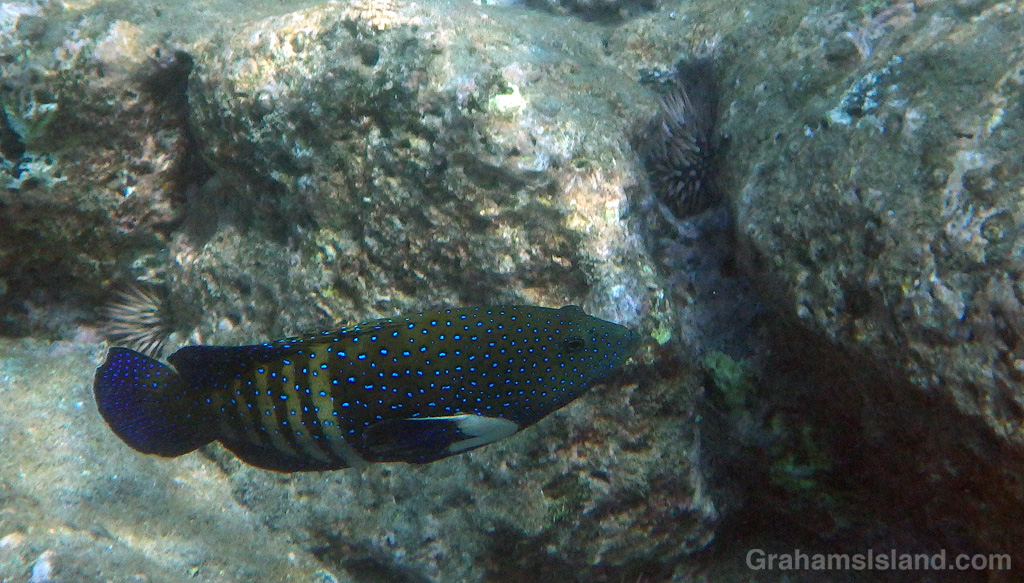
Peacock grouper

A young peacock grouper on the Big Island
One difference in taking photos as a snorkeler rather than a diver, is that I can’t follow fish when they dive or hug the bottom. Also, when a fish is 30 feet down, the water affects how they look and the sun doesn’t reach them as much.

I mention this because I most often see peacock groupers in 20 to 30 feet of water where they look somewhat dull in color. They also tend to be quite shy, hurrying for cover under ledges or whatever other shelter is at hand.

However, as with many kinds of fish, juveniles can often be found in shallower water. I happened on this young peacock grouper one day and it promptly headed for cover. Before it did though, I got a couple of good images that captured the sun bringing out the spectacular blue patterns that I never see when they run deeper.

In my attempts to identify what I see in the water, I use John P. Hoover’s book The Ultimate Guide to Hawaiian Reef Fishes, Sea Turtles, Dolphins, Whales, and Seals. His website is hawaiisfishes.com.

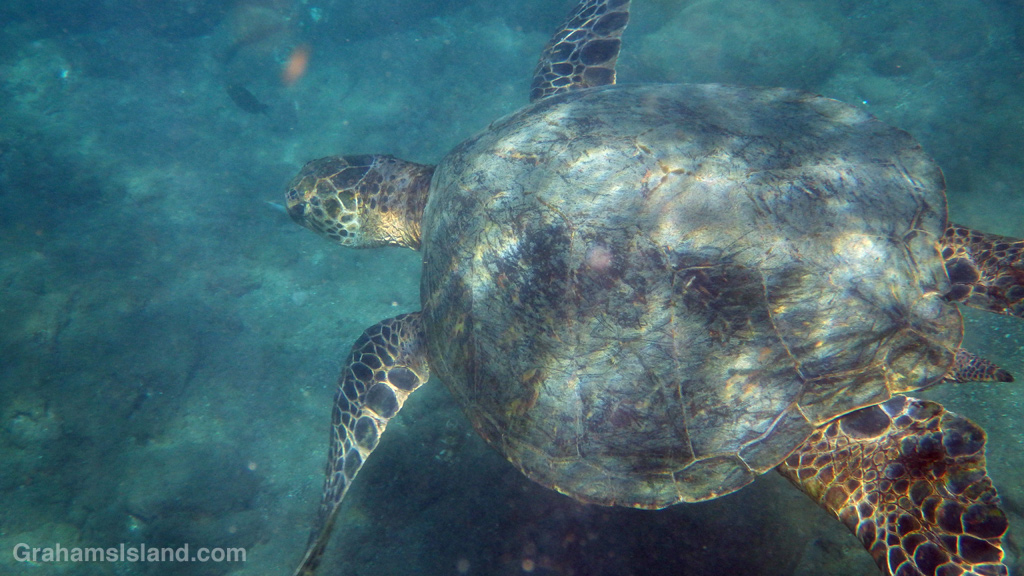
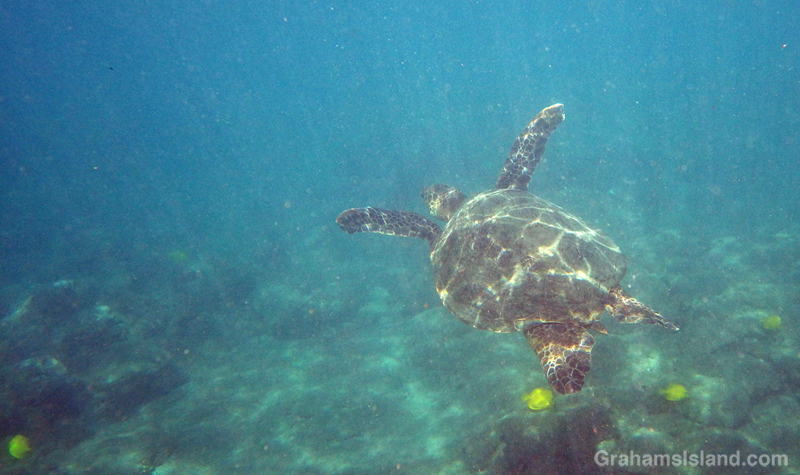
Green turtle swimming

A green turtle passes close by.
Green Turtle SwimmingOne day, when I got in the water, I dipped my head below the surface and saw a large barracuda idling a few feet away in murky water. Gathering myself, I took a few photos, none of which turned out.

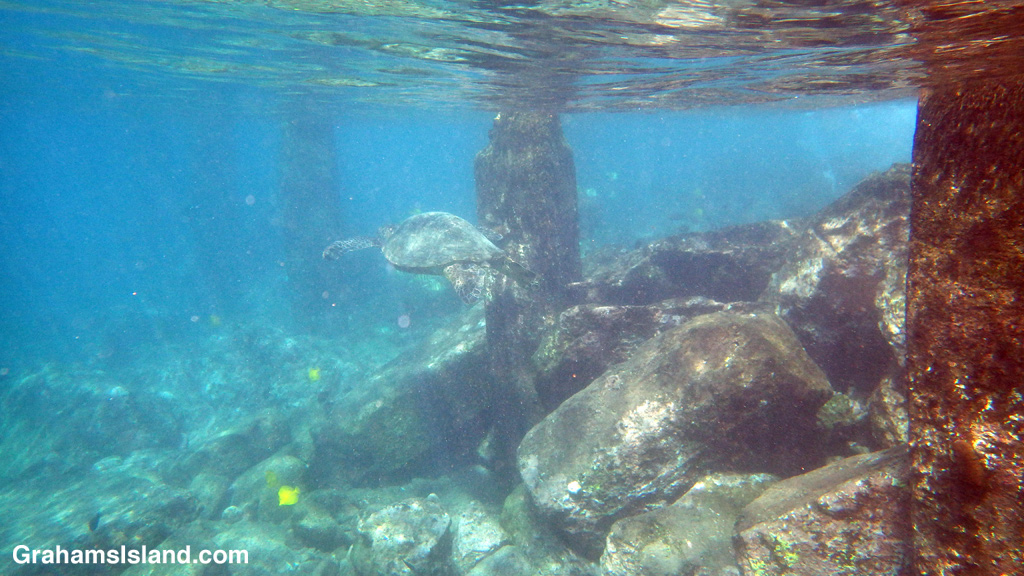
When the barracuda swam away, I tried to follow, but didn’t see it again. Instead, this green turtle slid by not two feet away. It pottered among the rocks, then came back out, passing me almost as close as before. I followed at a discreet distance, before it eased into the ruins of an old pier. I love seeing turtles in the water – they’re so graceful. First time I’ve had my camera with me.

In my attempts to identify what I see in the water, I use John P. Hoover’s book The Ultimate Guide to Hawaiian Reef Fishes, Sea Turtles, Dolphins, Whales, and Seals. His website is hawaiisfishes.com.

A green turtle swims through the remains of an old pier.

Reef fish

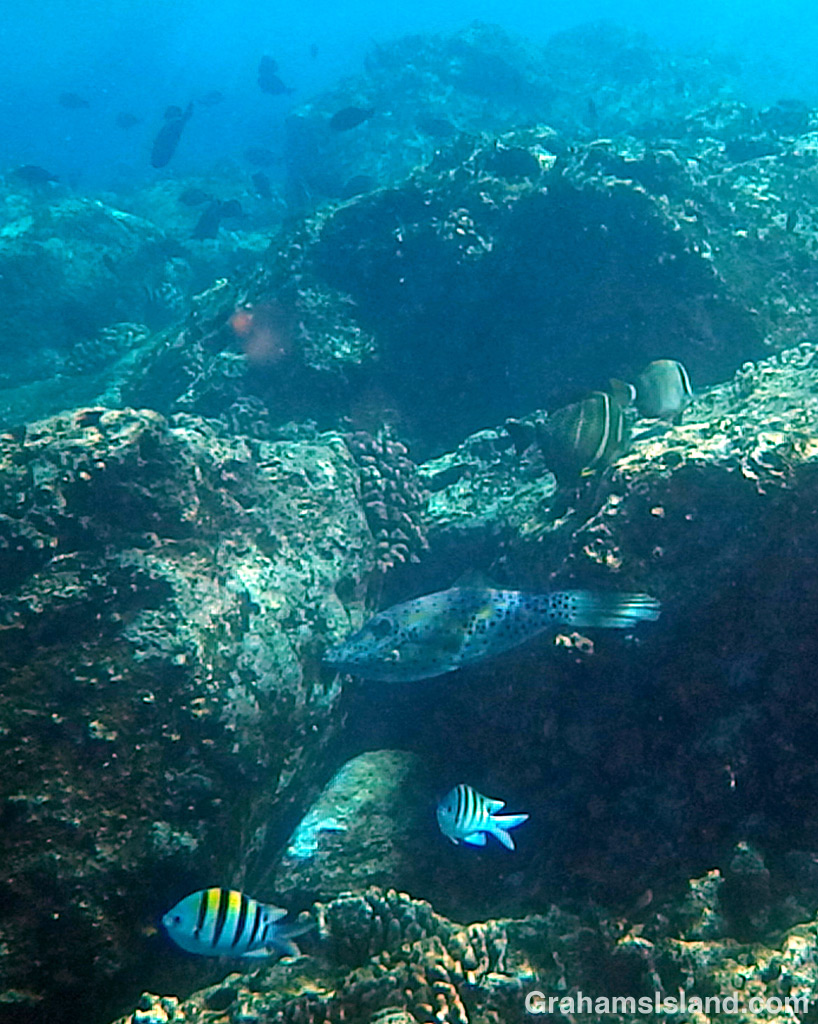
Many fish make the reef homeA great variety of fish make their home among the rocks and coral on the coast. From the bottom these are: two indo-pacific sergeants, a scrawled filefish, two or three whitebar surgeonfish, and in the background, a number of black triggerfish.

One of the pleasures of snorkeling here is that there’s always something to see and every day is different.

In my attempts to identify what I see in the water, I use John P. Hoover’s book The Ultimate Guide to Hawaiian Reef Fishes, Sea Turtles, Dolphins, Whales, and Seals. His website is hawaiisfishes.com.

Keeltail needlefish

Keeltail NeedlefishWhen snorkeling, the tendency is to look down where numerous reef fish can be seen darting through rocks and coral. Needlefish, on the other hand, are surface swimmers and, as such, can be a little unnerving. Many times I’ve looked up and found myself in the midst of a shoal of needlefish, circling around me. At such times, I try not to think of Custer’s Last Stand.

In my attempts to identify what I see in the water, I use John P. Hoover’s book The Ultimate Guide to Hawaiian Reef Fishes, Sea Turtles, Dolphins, Whales, and Seals. His website is hawaiisfishes.com.

Spotted eagle ray

12-15-15-Eagle-Ray-HW

I’ve seen this particular ray several times while snorkeling. I think it’s a young one, since it’s somewhat smaller than others I’ve seen. It glides over the coral with little effort, but sometimes shifts into high gear and shoots off with a good turn of speed. It’s not aggressive and doesn’t appear bothered by my presence, but since eagle rays have venomous spines near the base of the tail, I don’t get too close.

For more information about eagle rays, go to sailhawaii.com/rays.html.