
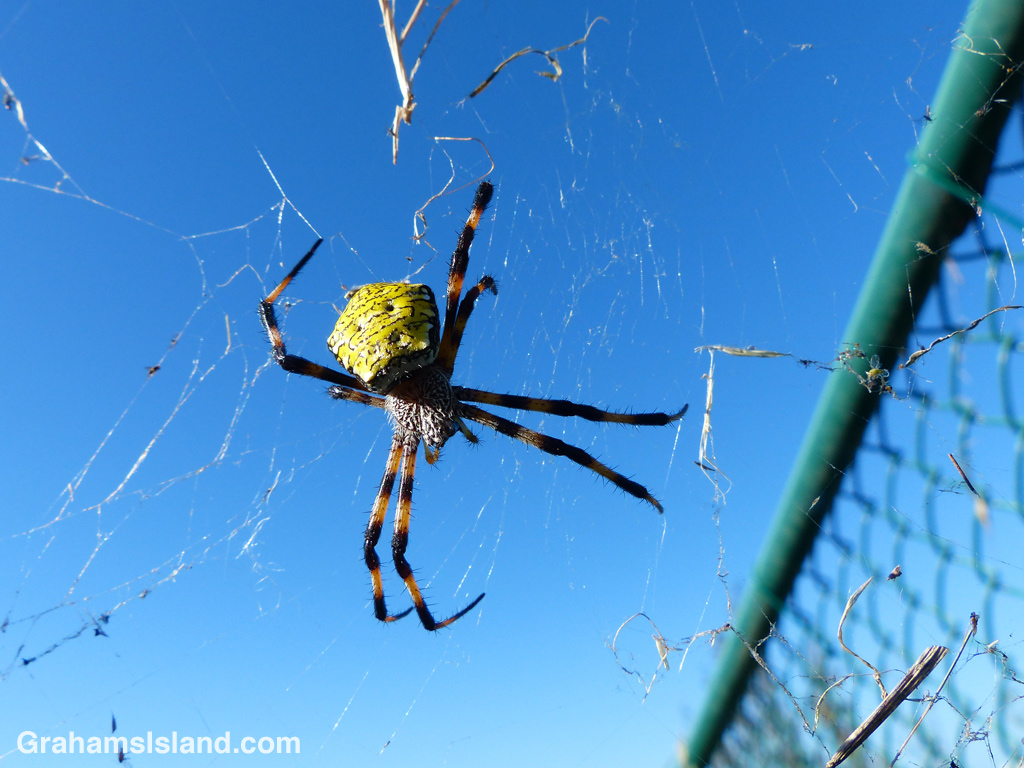
I came across this brightly-colored Hawaiian garden spider, the female of the species, in the late afternoon of a windy day. Her web shows debris that’s been blown in and likely encounters with bugs large and small. The web looks like it’s on its last legs and indeed it is because, at the end of the day, this spider will eat her web (or what remains of it) and start afresh in the morning.
Tag Archives: Spiders
Cane spider

The official unit of measurement for cane spiders is the tuna can as in, ‘that spider is the size of a tuna can.’ In the case of this particular cane spider that statement is true – the trim it’s resting on is a 1×4.
While large, cane spiders aren’t particularly aggressive. If threatened, they prefer to run off – and they are fast. If one does bite, it can inject venom, but it isn’t considered dangerous. On the plus side, cane spiders are hunters and include cockroaches amongst their prey. While I heartily endorse this activity, it’s a bit much for me to have a mobile, hairy tuna can scurrying around the house and leaping out at inappropriate moments.
The first time I saw a cane spider was while reading in bed, which was startling to say the least. There then followed a merry chase, involving moving furniture, before I was able to trap the beast and release it outside. That’s where I prefer to see them and I was happy to see this one on the side of the house. It stayed in this spot for quite a while until one time I went to look again and it was gone. At that point, the trick is to carry on as usual and not start wondering whether it followed me inside after the last time I saw it.
Neoscona theisi spider

I believe this is a neoscona theisi spider, which is one of the orb weaving spiders. What I know for sure is that when I walked up the trail 30 minutes earlier, the web wasn’t there. On my return, the sun caught the web and I was able to avoid blundering through it.
Sneaky Pete snags a spider
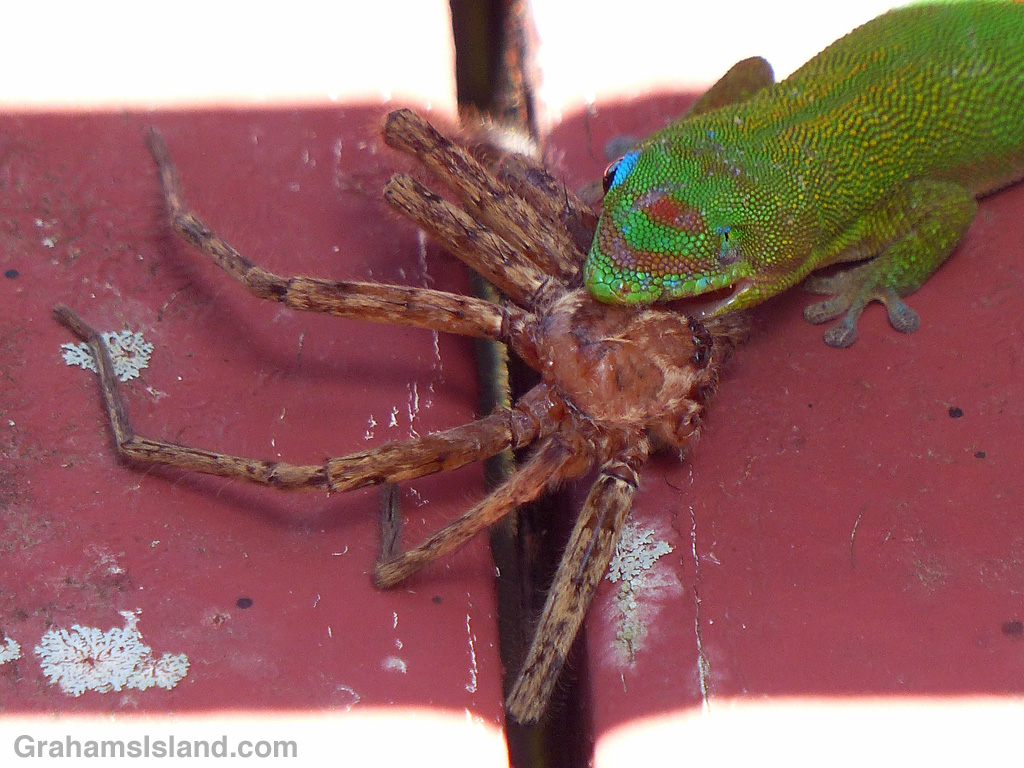
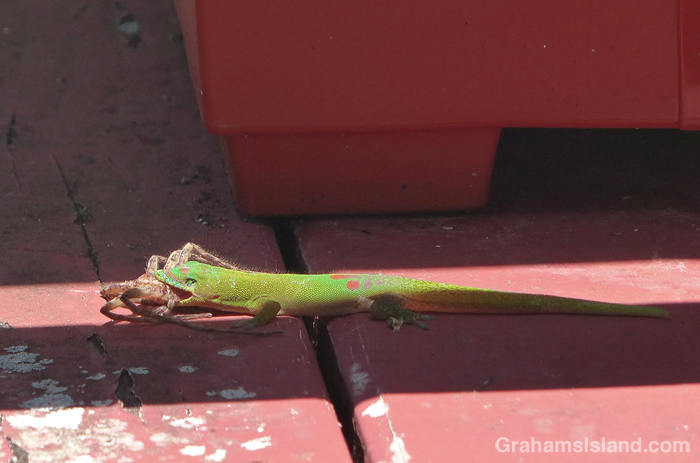
A gold dust day gecko wrangles a cane spider out on the front lanai. Cane spiders are large and extremely quick, so this capture was no mean feat. But who’s Sneaky Pete and isn’t this gecko missing something?
Explanations are in order. Sneaky Pete is the house gecko. He (though ‘he’ could be a ‘she’ for all I know) moved in some months ago. He goes in and out through a loose window screen, but lives mostly under the fridge, which is warm and dry and safe, except when I roll it out to clean. He got his name early in his residency because he was constantly sneaking around. He’d be spotted in one part of the house and then, moments later and unobserved, show up some distance away.
What it meant was that I’d go to do something and he’d shoot out from a hiding place I hadn’t seen him anywhere near. This is why, one day, I was closing up the house prior to going out, and a sliding window didn’t close. I thought the catch had snagged on something, checked it and tried again. Same result. It was only then that I saw Sneaky Pete tucked into the window slide. I hadn’t seen him. He didn’t look good. I felt terrible.
The result of that incident was that he lost his tail and an eye. The tail grew back, the eye, not so much. Soon after the accident, not surprisingly, he moved outside. I didn’t see him for some time, but worried about his welfare. Geckos are constantly looking around, peering over the edge of leaves, peeking around corners, watching for movement. A one-eyed gecko is at a big disadvantage.
But then I saw him again. His eye socket had healed and his tail was growing back. His head was tilted to one side and he’d obviously figured out a way to keep watch with his one good eye. All things considered, he looked pretty good. After that, I’d see him from time to time, outside on the lanai. I figured that was his new territory.
And it was for a few weeks, until he showed up again in the kitchen. Since then, he’s been back to his old routines. He often spends the night in the house, then usually goes out during the day unless it’s cool and/or wet, when he tends to remain under the fridge. At least as far as I know. He’s still sneaky. He pops up in unexpected places, shoots out from behind items I go to pick up. And from time to time I see him in the window, the same place I didn’t see him before. I look twice now before closing windows.
No fly zone


Crab spiders (also known as spiny-backed spiders) came to Hawaii in 1985. They spread through all the islands and are especially numerous here in the winter months. They build dense thickets of webs such as these between two tangerine trees. They look threatening, but aren’t particularly. People do get bitten, mostly if a spider falls on them or gets lodged in clothing.
I usually encounter them when I miss spotting a web and end up with it wrapped around my head. Their webs, which often span a 10 or 20 foot gap, seem especially strong and sticky.
For more information about crab spiders, go to gardenguyhawaii.com/2011/12/crab-spiders.html.
Hawaiian garden spider
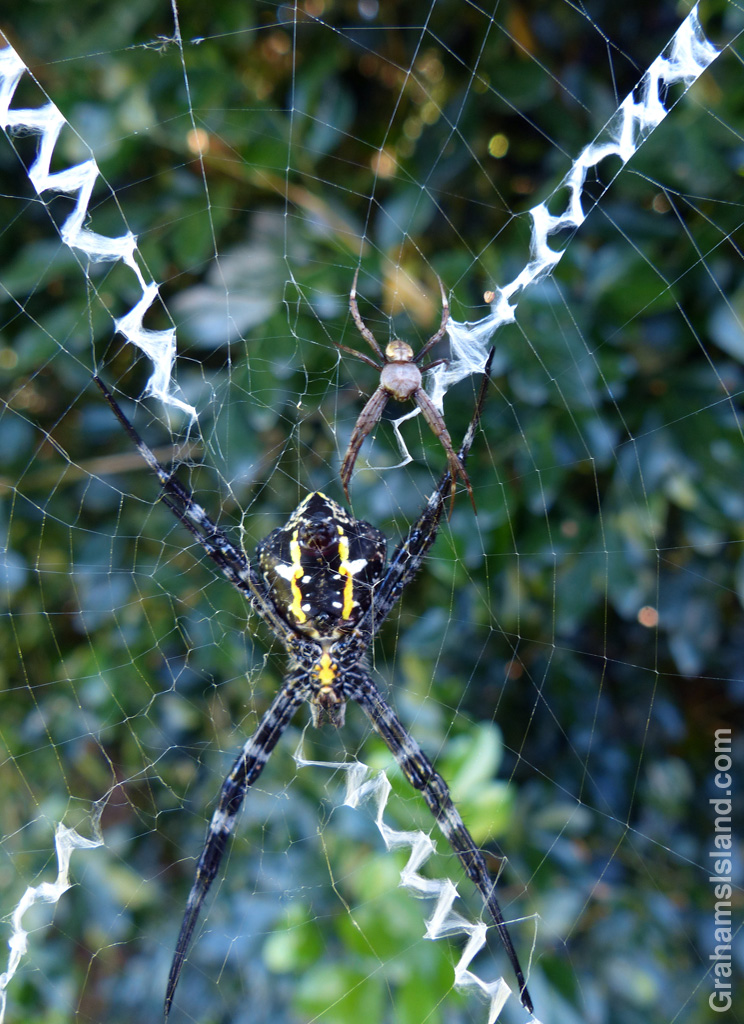
Sorry arachnophobes, but there are spiders in Hawaii. These are Hawaiian garden spiders (Argiope appensa), which came from Asia originally. Mostly it’s the female spider, the large, colorful one in the center of this web, that is seen. Indeed, this was the first time I’ve noticed a male, the much smaller, brown spider. Another web nearby also sported a male and female pair.
Their distinctive webs usually feature one or more broad zigzag lines of silk, called stabilimentum. I’ve read that this is to stabilize the web, but might also serve to lure prey or as a marker to birds and the like, so they don’t fly in to it.
For more information about the Hawaiian garden spider, go to insectidentification.org.

