Category Archives: Activities

Touching octopuses

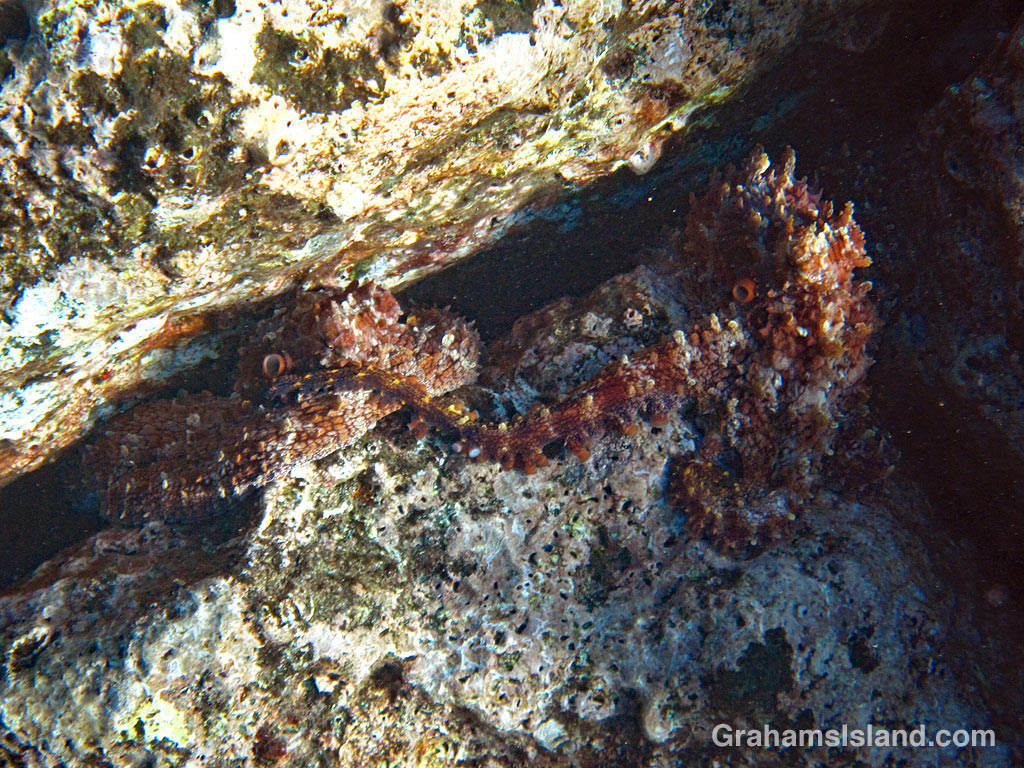
For Valentine’s Day I offer this photo of two day octopuses. It comes with a little story.

One day, while I was snorkeling, I noticed a stocky hawkfish about to plop onto a bit of coral. Before it could settle, a blue goatfish butted it away, getting my attention. I wondered if its presence might mean there was an eel or octopus around since they sometimes hunt together. Almost immediately, just beyond the goatfish, I noticed a day octopus glued to the side of a rock.

I took a couple of photos but knew they wouldn’t be very good; the octopus just looked like another lump of rock. So I began the usual dance I do with an octopus. I edge away, as though I’m leaving, keeping an eye on the octopus out of the corner of my eye. I know the octopus is watching me. Often, when I’ve gone a ways, the octopus will rise up onto whatever rock it’s hiding behind. If I’m quick, I can turn and get a photo before the octopus slides back down again. It’s like we’re connected by a line: I go away, the octopus rises. I return, the octopus sinks.

I swam behind a large chunk of rock, then peeked around the side. Still there, still hidden. A bit farther, another peek. Still there, still hidden. And again. And then I looked away momentarily and when I looked back, the octopus was gone. I think they, like many other creatures, watch a person’s eyes and if the person looks away, off they shoot.

It was a matter of a moment so I knew it couldn’t have gone far. I looked around, examining the rocks. Nothing. They can squeeze into tiny spaces so it was always possible I wouldn’t see it even if it was close by. Then, as I turned around, I caught a glimpse of movement and saw the octopus zip behind a bit of rock. Except then I immediately saw a second octopus follow the first.

I swam around the rock and saw the two of them, each in its own separate crack, a few feet apart. Again I took a couple of photos and then moved away. This time I went farther and waited, watching from a fair distance. Eventually, the octopus on the right of the photo emerged and moved toward the other one. I edged closer and began taking photos. It was then that that octopus slowly eased a tentacle toward the other one, sliding over the rock until it reached up and over the front of the other octopus. It was such a sweet and tender gesture, as though the octopus sought reassurance in making physical contact with its companion.

I took the photo and swam off, leaving them in peace.
Green Sand Beach

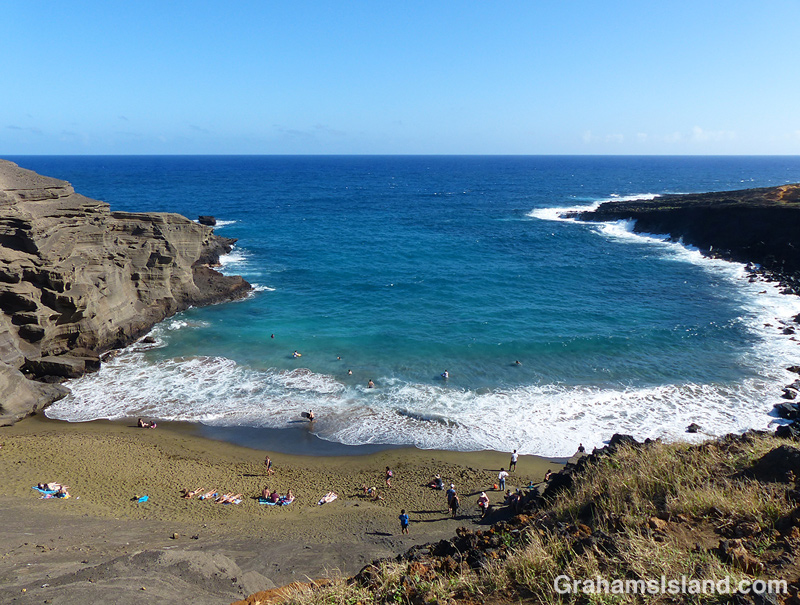
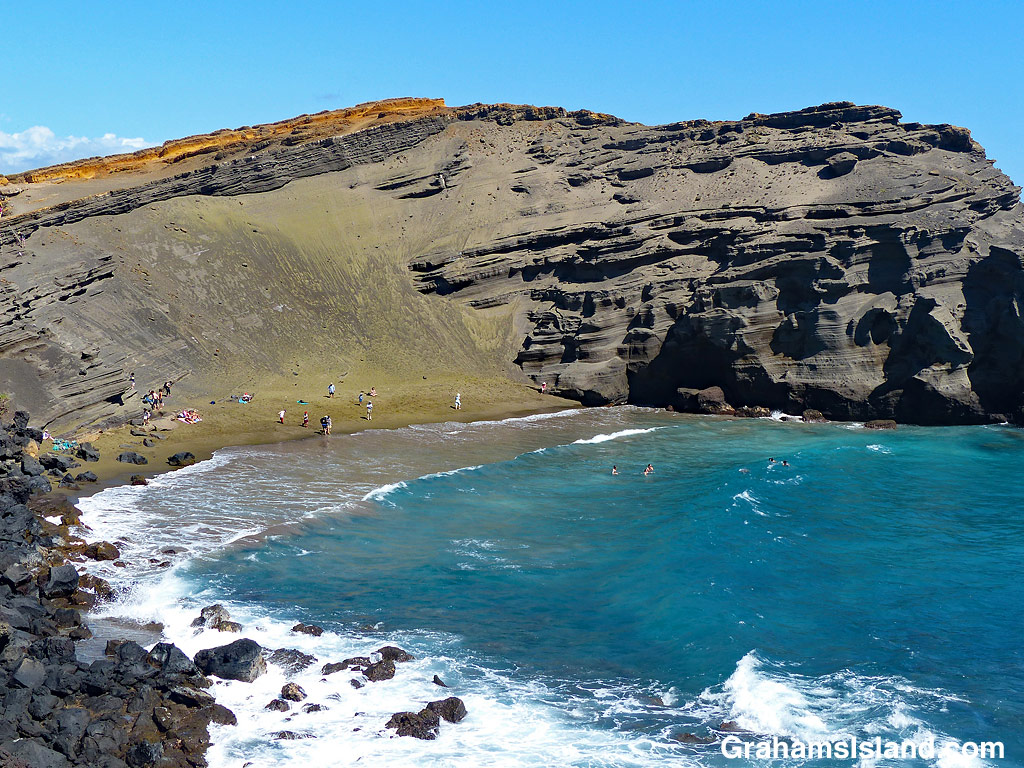
This week’s WordPress photo challenge is ‘Tour Guide’ which I’m happy to use as my theme for this week’s posts. Since this is Hawaii, a good place to start is at the beach. This one is Papakōlea Beach, better known as Green Sand Beach. It’s about 3 miles northwest of South Point, the most southerly point in the United States.

The beach lies in a bay formed when the ocean eroded one side of an old cinder cone, Pu’u Mahana. The green color of the sand is a result of olivine in the lava. Since it’s heavier than other things in the lava, it stays on the beach. Swimming is possible in the shelter of this deep bay, but be careful. This coast is notorious for dangerous surf and strong currents.

It’s 2 1/2 miles to the beach from the parking area. There’s a very rough four-wheel drive road, which you can drive, or locals will ferry you out for a fee. The other alternative is to hike out along the coast, which is what I did.

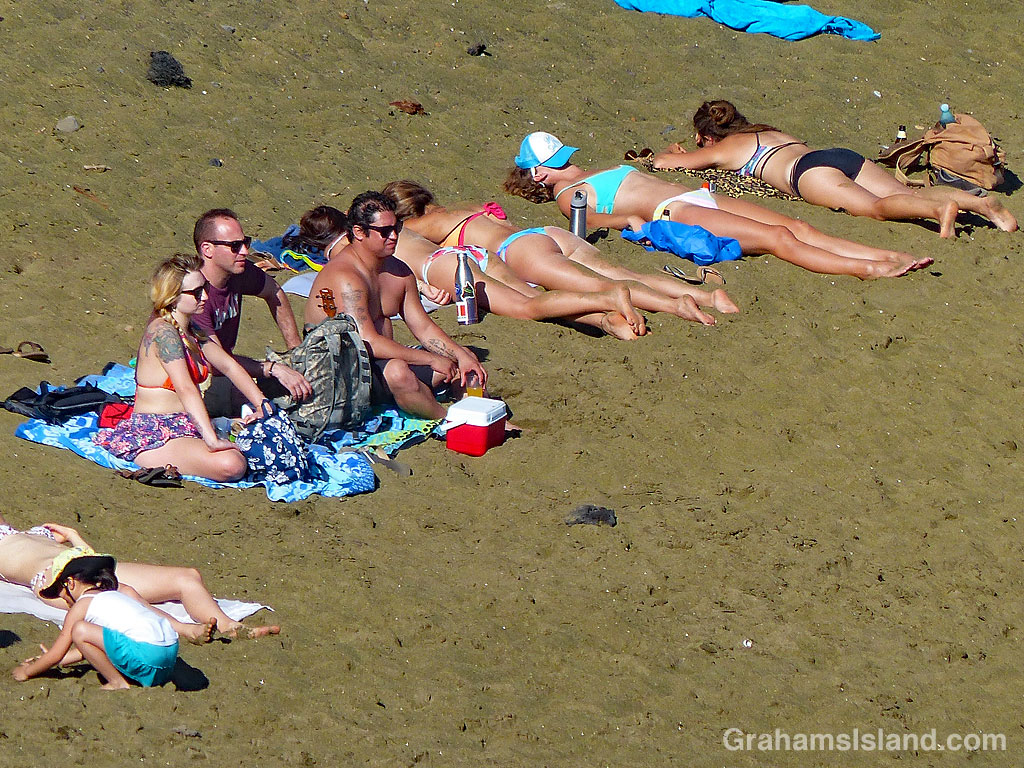
You’re not likely to have the beach to yourself, but you will have a share of a beautiful, remote beach, a view all the way to Tahiti (you might have to stand on a rock), and the opportunity to broil on the distinctive green sand.

Clouds from Pu’u Wa’awa’a

A few days ago I did another hike up Pu’u Wa’awa’a, a large cinder cone north of Kona. I planned the hike to coincide with one of the days of latest sunrise here, just after 7 a.m.. My idea was to arrive at the trailhead at 6 a.m., when the gate opens, and head up as quickly as I could in order to get the best shot at early morning light from the summit. This meant getting up by 4 a.m. and setting out by 5 a.m.

Defying all historical precedents, I was there five minutes early. The new automated gates opened before me and in no time I was hotfooting up the trail, flashlight in hand, in order to avoid breaking an ankle in the one of the many potholes in the old road that makes up the first part of the trail.

One advantage of hiking in the dark is that I didn’t stop every five minutes to take a photo of a goat or bug. Still, an hour into the hike, as the light improved, I couldn’t help but pause when I spotted a large wild pig excavating – no other word for it – a large hole in the hillside in the search for worms and the like (alas the photos weren’t great – not enough light).

By 7:30 a.m. I reached the top of the climb. I already knew I wasn’t going to get the hoped-for blaze of early morning sun – too many clouds from the get-go – but this photo shows the moody light that greeted me. I considered this a worthy consolation prize. And then there was the fact that I had the summit to myself for 90 minutes, and the mamane trees on the west side were in bloom and attracting Hawaii ‘amakihi and hordes of bees (look for several dozen photos of these in the near future!).

For more information about Pu’u Wa’awa’a and its trails, go to puuwaawaa.org.

Alakaha Ramp bench

At the top of the Alakaha Ramp, on the 1871 Trail from Pu’uhonua o Hōnaunau National Historical Park to Ho’okena, is this little weathered bench. It offers shade and a lovely view to the north, the point of land being the park.

For more information about the 1871 Trail, and other hikes on the Big Island, go to bigislandhikes.com.

For more information about Pu’uhonua o Hōnaunau National Historical Park, visit https://www.nps.gov/puho/index.htm.

Better Days: Girdled tree

A dead tree stands out on Pu'u Wa'awa'a

This dead tree on the slopes of Pu’u Wa’awa’a did not die of natural causes. The pale strip near the bottom of the trunk is where the tree was girdled.

The tree is, I’m pretty sure, a silk oak. Native to Australia, these trees were introduced to Hawaii around 1880. When in bloom, they present a mass of brilliant orange flowers, but they seed prolifically and also produce an allelopathic substance that inhibits the growth of other plants. Because of this, they can crowd out native plants, of which there are many on Pu’u Wa’awa’a, so trees in areas where they have become too dense or are not wanted, are girdled.

For more information about Pu’u Wa’awa’a and its trails, go to puuwaawaa.org.

Divers down

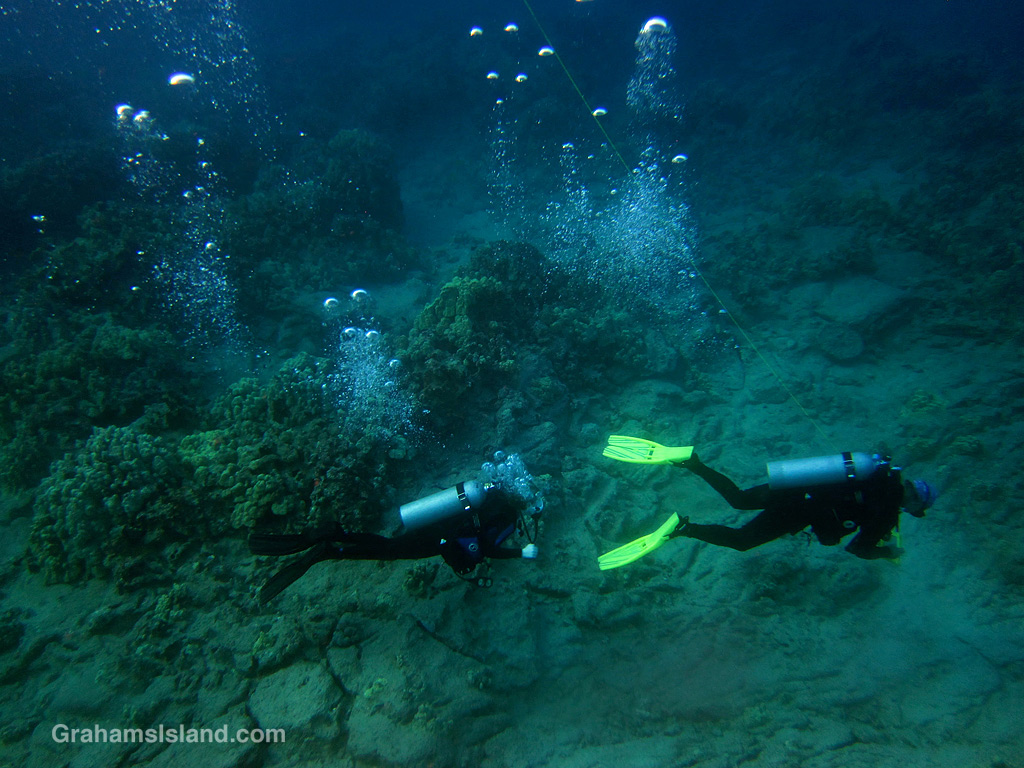
Divers in the waters off the Big Island of Hawaii.Divers in the waters off the Big Island of Hawaii.

Not surprisingly, Hawaii is popular with divers. Warm, clear waters and lots of fish and coral means there’s lots to see. For snorkelers, like me, the divers themselves are something to watch for.

I saw this group heading out toward deeper waters and liked how the light caught the bubbles of air, and also the colorful fins of two of the divers.

Divers in the waters off the Big Island of Hawaii.

Alakaha ramp on the 1871 Trail

Lookng down Alakaha Ramp with Keanae'e Cliffs on the rightA view of Alakaha Ramp and Alakaha Bay.

In 1871, an old trail from Nāpō’opo’o to Ho’okena was improved to make it passable for horses. Because of this, it became known as “Two Horse Trail.” The northern section of this trail was paved in 1918, but the southern section was left untouched and this became the 1871 Trail, which heads south from Pu’uhonua o Hōnaunau National Historical Park.

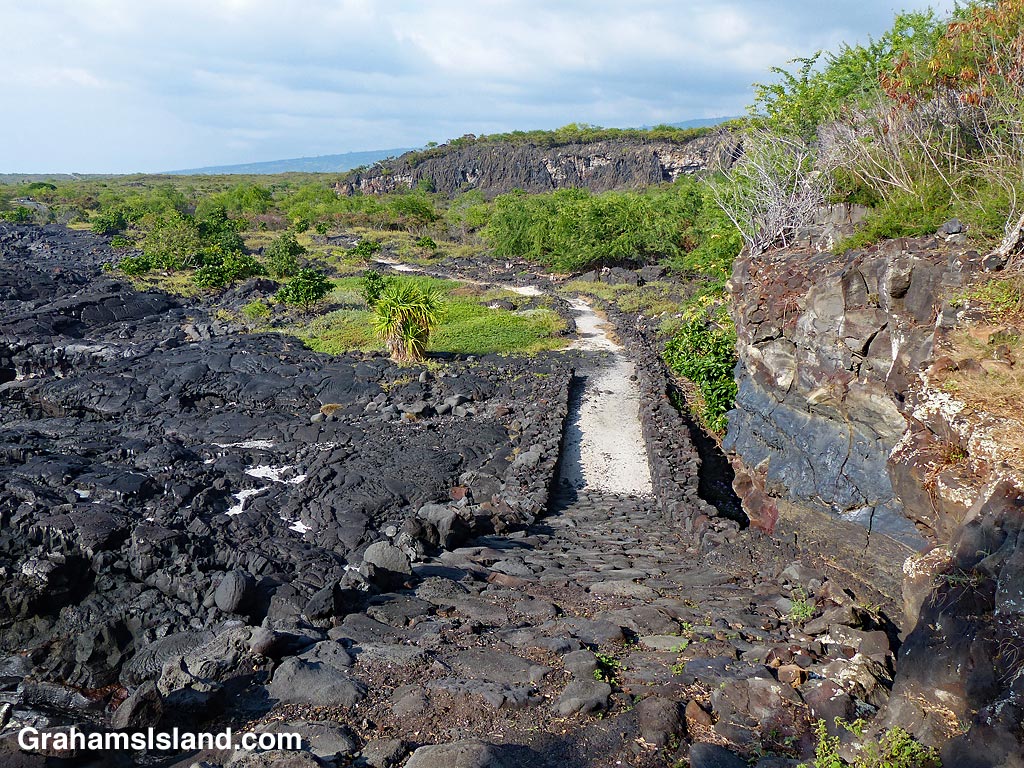
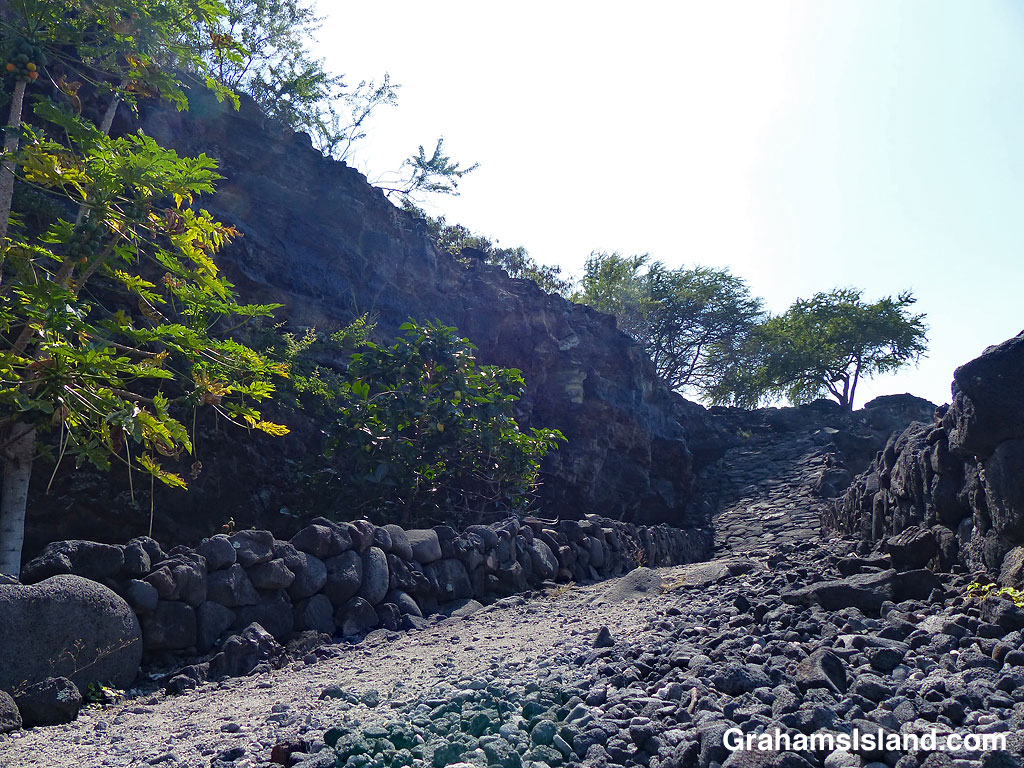
One feature of this trail is the Alakaha ramp at the southern end of Alakaha Bay. The ramp was built to allow trail users to safely ascend Keanae’e Cliffs.

According to bigislandhikes.com, “Prior to the construction of the ramp, access to Ki’ilae (an ancient village) was by ladder or rope only. The earliest mention of the ramp is from 1868, but the ramp likely existed prior to that time. The ramp requires periodic maintenance. It had deteriorated so much in the early 1900s that cowboys called the ramp the “one foot out trail” because they always kept one foot out of the stirrups in case they needed to bail off their horse.”

The top photo looks down the ramp with Keanae’e Cliffs on the right. In the middle photo, the ramp and trail with Alakaha Bay on the left. Below, hiking up toward the ramp with Keanae’e Cliffs on the left.

For more information about the 1871 Trail, and other hikes on the Big Island, go to bigislandhikes.com.

For more information about Pu’uhonua o Hōnaunau National Historical Park, visit https://www.nps.gov/puho/index.htm.

Lookng up Alakaha Ramp with Keanae'e Cliffs on the left.