When I first saw this bug, I thought it was a Japanese beetle. Later, I realized I was wrong and it was a stink bug. They get their name because they can emit a foul-smelling substance when disturbed. Luckily, I didn’t disturb it enough to provoke that response, though there was no way I was going to leave it be on the basil plant where I found it. Most mornings see the plant with new holes or bite marks. Seems to be a favorite of just about every bug around.
Category Archives: Animals
Green anoles fall for each other
I found these two thrashing about under the eaves. At first I thought they were fighting, such was the violence of their activity, but I learned that’s just part of their mating ritual.
The key here is the larger male getting a grip with his jaws on the back of the female’s neck. He doesn’t let go. In this encounter, a series of skirmishes interspersed bouts of wrestling with periods of rest. All the while the male maintained a firm grip.
After one tussle, the male lost his footing and ended up hanging off the back of the female, his jaws still clenched on her neck. The female hung on with a couple of claws, as they swung side to side. Then she lost her grip.
The pair plunged onto a ti plant where the male immediately puffed out his dewlap. The female took the opportunity to scamper off. He pursued for a while but lost track of her and gave up. The female meanwhile looked somewhat the worse for wear, a clump of darkened skin bunched up from her neck.
Clearly anoles are one species where relationships can literally be a pain in the neck!
For more information about green anoles, go to en.wikipedia.org/wiki/Carolina_anole.
Abstracts: Where’s the dragonfly?
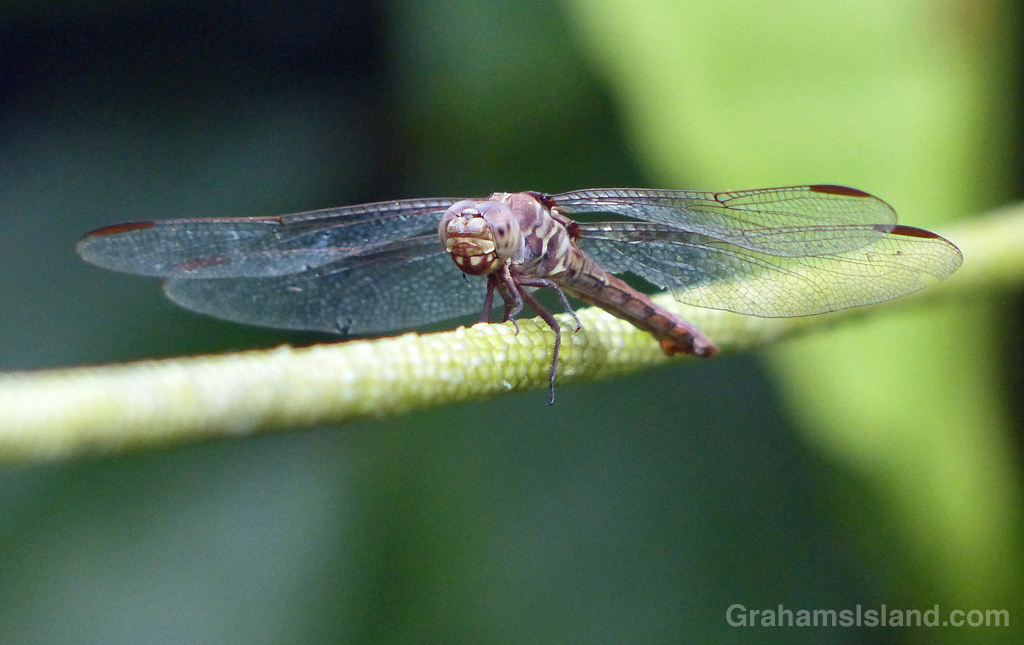
I was walking through a stand of kiawes when a dragonfly jitterbugged by. I hoped it might loop back so that I could get a photo of it, but instead it headed toward the top of a tree and disappeared. I thought I saw where it went and got as close as I could, which was still a good distance away. I trained my camera in its direction and took a few photos, not sure if it was even in shot. I thought I might just be taking pictures of a twig. It wasn’t until I got home and looked at the photos that I saw I’d been right about its location all along.
Gold dust day gecko
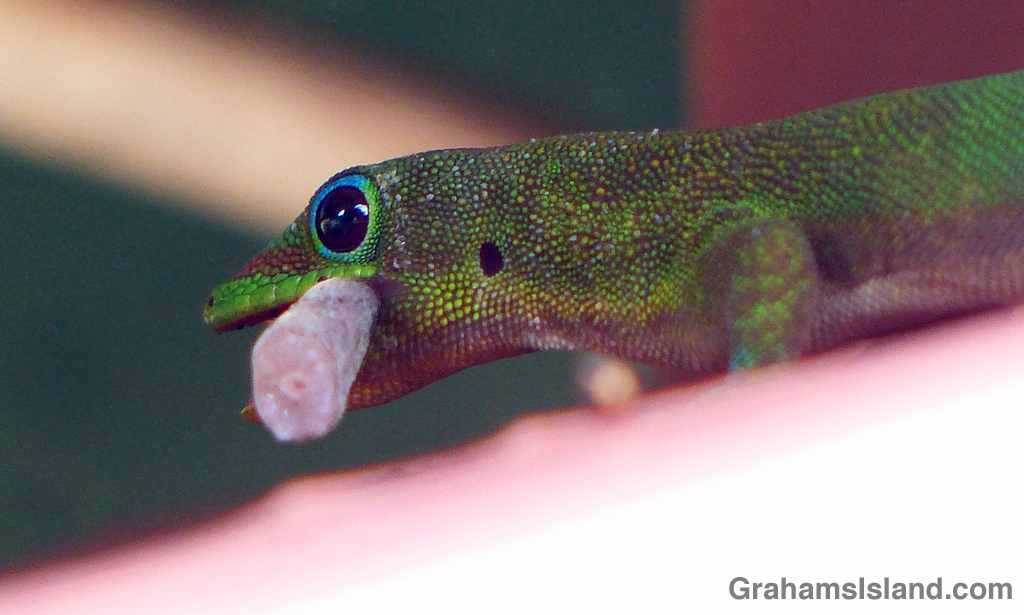
This gecko is probably the most commonly seen here, given that it’s diurnal, numerous, and not shy. It doesn’t hurt either that it’s so brightly colored. Its brilliant green and gold body has red markings on the head and back. A striking blue above the eyes and matching blue feet complete the ensemble.
The intensity of the colors can dull to a dowdy hue at certain times but when they’re at their brightest, they really are like little jewels.
For more information about geckos, go to geckoweb.org.
Anoles on wire

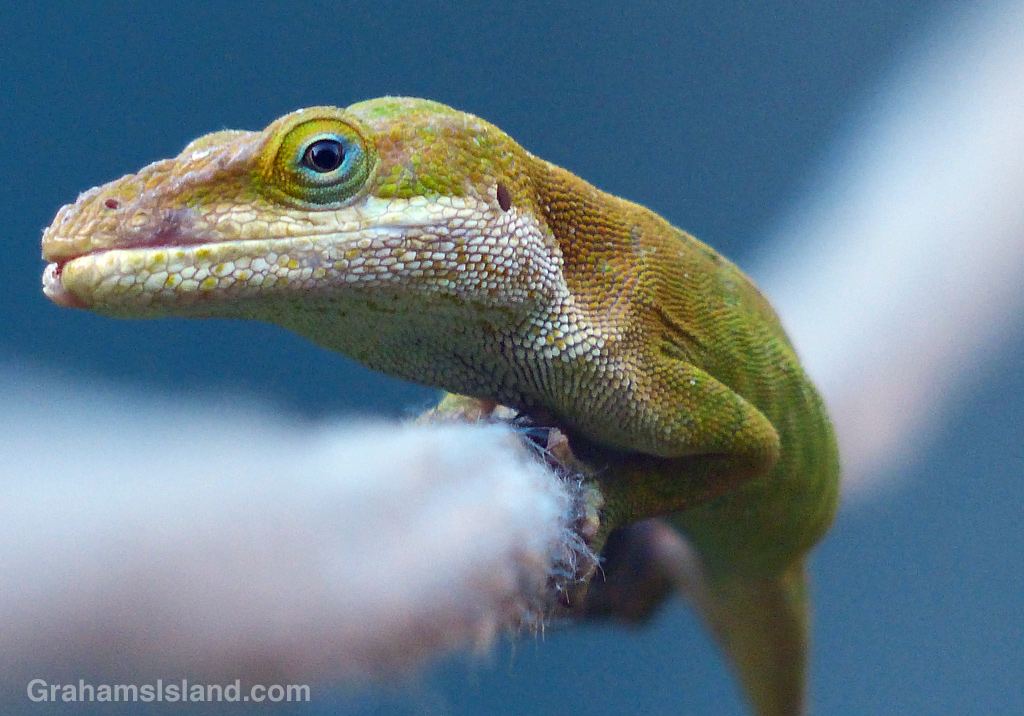
There’s something of a daily ritual here involving the green anoles who live under the roof. Each morning two or three small anoles will head out on the cable wire and jump off into the cane grass. I call it the anole commute.
On this particular morning, a large green anole was out on the wire first. When one of the smaller ones approached, the big anole got agitated as anoles are wont to do. He began his ritual of head bobbing and puffing out his dewlap. The little fellow came on, sliding to the side of the wire. Suddenly it jumped onto the nearby telephone wire, scooted past, and leapt into the cane grass. The big anole spun around, but too late. He continued to extend his dewlap for a while to let any watchers, including me, know that this was his territory and he was not to be messed with. Point taken.
For more information about green anoles, go to en.wikipedia.org/wiki/Carolina_anole.
Abstracts: A reflective grasshopper
Mourning gecko
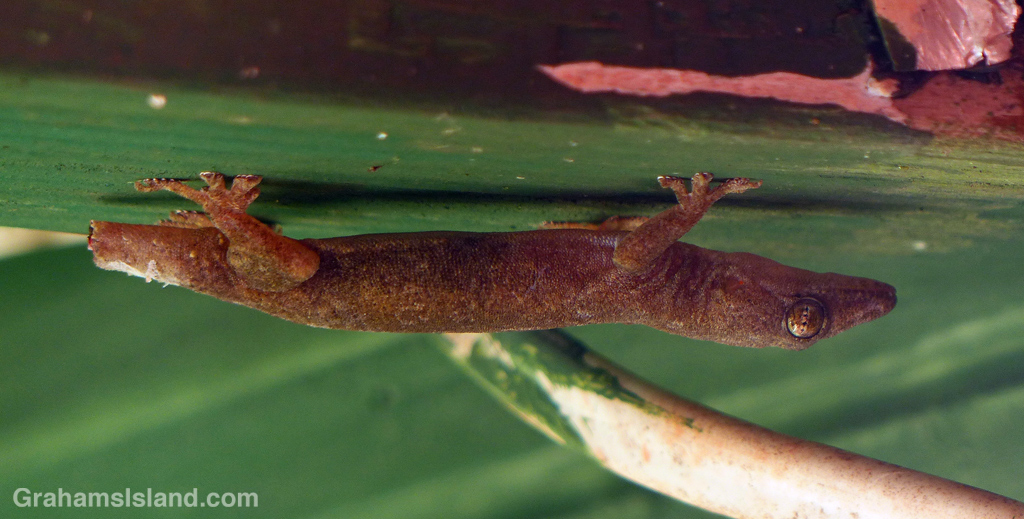
Mourning geckos are nocturnal so it’s a bit unusual to see one, especially an adult, out and about in daylight. That this one was sporting a still raw stump of a tail suggests it was ousted from its daytime resting place, losing its tail in the process. I say ‘its’ tail, but I could confidently say ‘her’ tail, since mourning geckos are an all-female species, reproducing through parthenogenesis.
For more information about geckos, go to geckoweb.org.
Assassin bug
This striking creature is an assassin bug, (Haematoloecha rubescens). Got to love a name like that, which lets you know right away what it’s about. This one is a predator of millipedes, which is no bad thing either. This species is believed to have arrived in Hawaii in the 1970s, probably from Asia.