Category Archives: Animals

Kohala pastoral

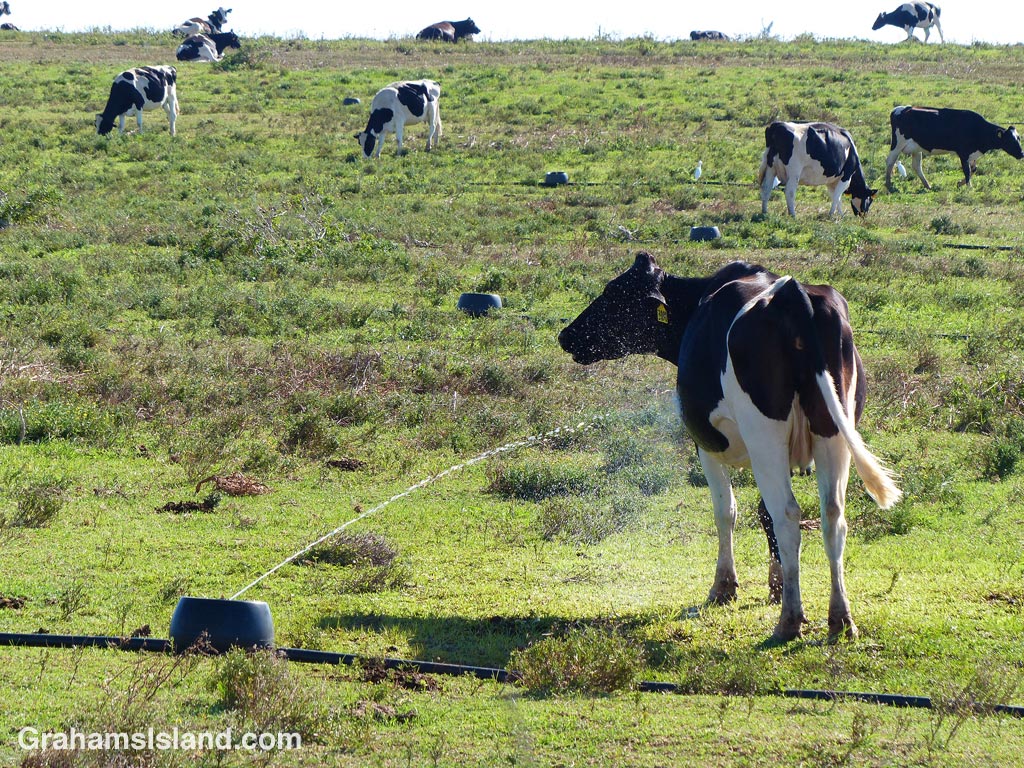
Horses and cattle in North Kohala

A lot of North Kohala is agricultural land. The drive along the mountain road from Hawi to Waimea passes through ranch land, lush and green on the mountain side of the road becoming dry and browner as it slopes towards the ocean. This is cattle country with a good number of horses for the paniolos (cowboys) who tend them – though it has to be said that these days much of the paniolo’s work is carried out on ATVs.

This view is from just off the mountain road looking down toward the ocean.

Sneaky Pete snags a spider

Gold dust day gecko captures a cane spiderGold dust day gecko with a grip on a cane spider
A gold dust day gecko wrangles a cane spider out on the front lanai. Cane spiders are large and extremely quick, so this capture was no mean feat. But who’s Sneaky Pete and isn’t this gecko missing something?

Explanations are in order. Sneaky Pete is the house gecko. He (though ‘he’ could be a ‘she’ for all I know) moved in some months ago. He goes in and out through a loose window screen, but lives mostly under the fridge, which is warm and dry and safe, except when I roll it out to clean. He got his name early in his residency because he was constantly sneaking around. He’d be spotted in one part of the house and then, moments later and unobserved, show up some distance away.

What it meant was that I’d go to do something and he’d shoot out from a hiding place I hadn’t seen him anywhere near. This is why, one day, I was closing up the house prior to going out, and a sliding window didn’t close. I thought the catch had snagged on something, checked it and tried again. Same result. It was only then that I saw Sneaky Pete tucked into the window slide. I hadn’t seen him. He didn’t look good. I felt terrible.

The result of that incident was that he lost his tail and an eye. The tail grew back, the eye, not so much. Soon after the accident, not surprisingly, he moved outside. I didn’t see him for some time, but worried about his welfare. Geckos are constantly looking around, peering over the edge of leaves, peeking around corners, watching for movement. A one-eyed gecko is at a big disadvantage.

But then I saw him again. His eye socket had healed and his tail was growing back. His head was tilted to one side and he’d obviously figured out a way to keep watch with his one good eye. All things considered, he looked pretty good. After that, I’d see him from time to time, outside on the lanai. I figured that was his new territory.

And it was for a few weeks, until he showed up again in the kitchen. Since then, he’s been back to his old routines. He often spends the night in the house, then usually goes out during the day unless it’s cool and/or wet, when he tends to remain under the fridge. At least as far as I know. He’s still sneaky. He pops up in unexpected places, shoots out from behind items I go to pick up. And from time to time I see him in the window, the same place I didn’t see him before. I look twice now before closing windows.


Small Asian mongoose

A small Asian mongoose
Here is a great candidate for exhibit A in ‘good intentions gone wrong in Hawaii.’ Back in the late 1800’s, rising rat numbers on the Big Island were causing concern, especially among sugar plantation owners. I mean, nobody wants rats around. They bite. They carry disease. They breed like crazy. They kill native birds and eat their eggs. They’re just generally nasty and a menace.

So the plantation owners brought in the small Asian mongoose (Herpestes javanicus) to control the rat population. What could possibly go wrong? Well, for starters, mongooses are diurnal, operating mostly during the day. Rats are nocturnal, active at night. So apart from the twilight hours, never the twain shall meet. In consequence, mongooses had next to no effect on the rat population. The plan was dead on arrival. Still, no harm done, right?

Not exactly. Since the mongooses weren’t subsisting on a diet of fat, juicy rats, they needed something else to eat. And one of the many things on their menu was native bird eggs. The net result was that, instead of eliminating rats, the mongoose extended the problems they caused to 24 hours a day. The effect on native birds in particular, was especially damaging. Kaua’i has a far greater abundance of birds than the Big Island, in large part because it is still, theoretically, mongoose-free.

In Hawaii, mongooses are the poster animals for the devastation wrought by invasive species because, well, they bite, they carry disease, they breed like crazy, they kill native birds and eat their eggs. In fact, they’re just generally nasty and a menace.

Here on the Big Island, mongooses are most often seen scooting across highways. A generous scattering of squashed corpses attests to those that didn’t make it.

For more information about the small Asian mongoose, go to instanthawaii.com/cgi-bin/hawaii?Animals.mongoose.

No fly zone

Crab spider webs and fruit
A crab spider sits in its web
A crab spider sits in its web.,

Crab spiders (also known as spiny-backed spiders) came to Hawaii in 1985. They spread through all the islands and are especially numerous here in the winter months. They build dense thickets of webs such as these between two tangerine trees. They look threatening, but aren’t particularly. People do get bitten, mostly if a spider falls on them or gets lodged in clothing.

I usually encounter them when I miss spotting a web and end up with it wrapped around my head. Their webs, which often span a 10 or 20 foot gap, seem especially strong and sticky.

For more information about crab spiders, go to gardenguyhawaii.com/2011/12/crab-spiders.html.

Garden skink

A garden skink looking watchful
Also known as the delicate skink (Lampropholis delicata), I saw this one sunning itself at the foot of the lanai steps. Unlike geckos and anoles, which mostly just look curious when I show up, skinks tend to zip away.

This one didn’t notice me, so I eased away to get my camera, returned, and took a couple of photos. The skink looked out into the grass. I edged closer, took a couple more photos. The skink looked off to the side. After a couple more, similar moves, the skink finally looked behind and up at me. Its wonderful expression made me laugh, which the skink took as its cue to scoot for cover.

Cuckoo wasp

Cuckoo wasp on a frangipani.Cuckoo wasp on a frangipani.

I saw this small, bright insect flitting about on the new growth of a plumeria. The cuckoo wasp gets its name from its practice of laying eggs in the nests of other wasps and bees. Once hatched, the cuckoo wasp eats the host wasp or bee larva. Then it eats the food placed in the nest for the host’s offspring. Probably not an insect to invite to your next dinner party.

For more information about cuckoo wasps, go to bugguide.net/node/view/6946.

Breakfast strikes back

Breakfast strikes backAt first, this green anole had the bug in its mouth, but then events took a turn for the worse. At first I thought the bug was a larder beetle, but now I believe it’s a Chinese rose beetle, though I wouldn’t bet the farm on that. In the end, it got away. The anole did not look pleased to have these events witnessed.

For more information about green anoles, go to en.wikipedia.org/wiki/Carolina_anole.