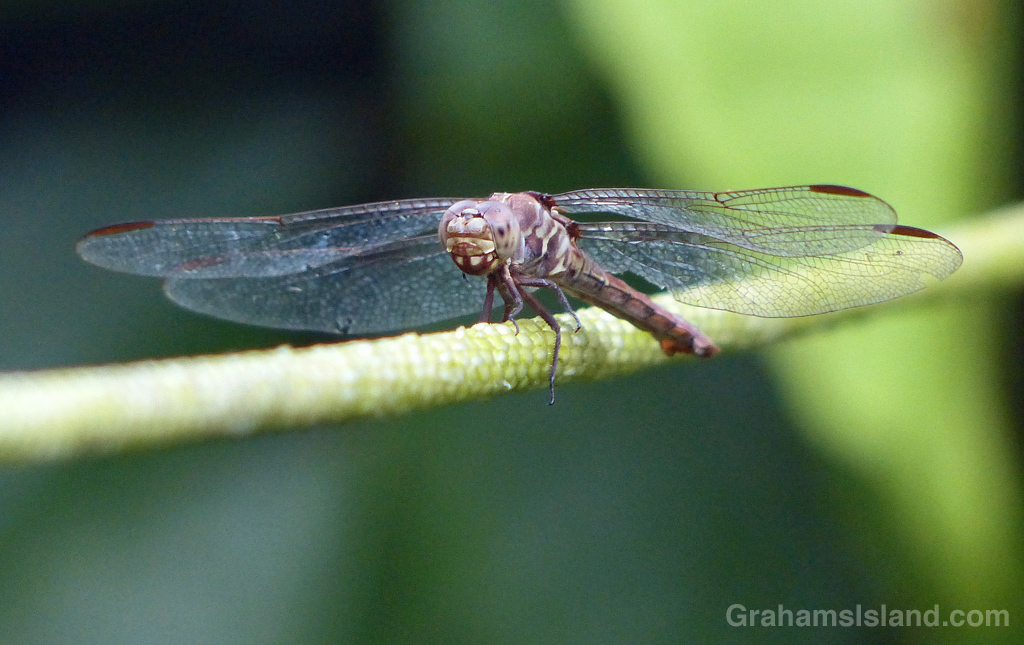
This dragonfly landed on the washing line one day and rested there for a while. Looks like that line could use a clean.
Category Archives: Animals
Lesser grass blue butterfly
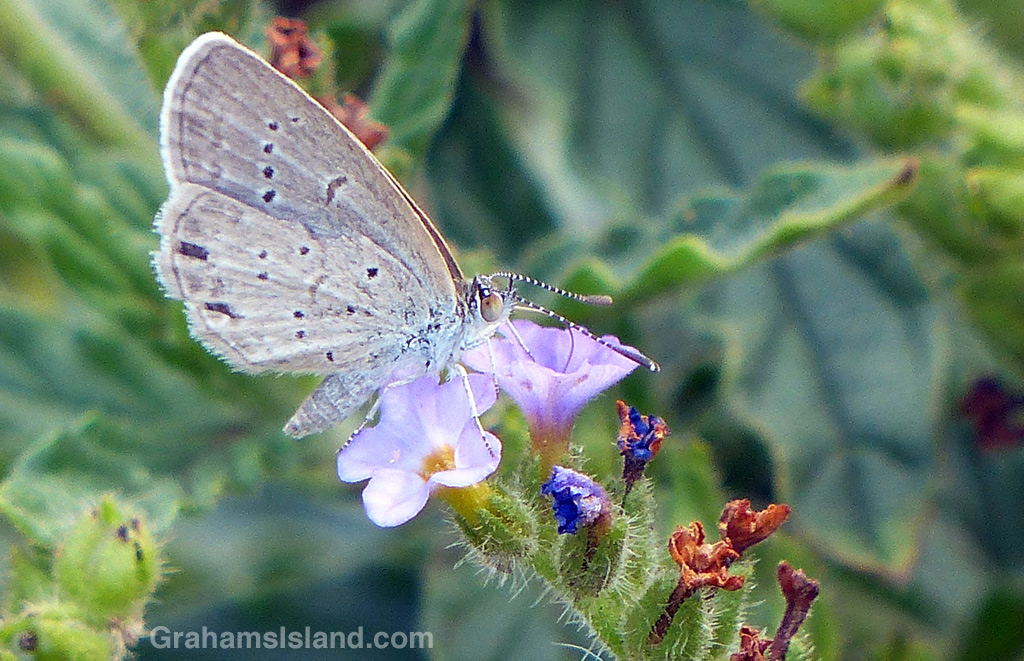
A lesser grass blue butterfly takes a drink from a small purple flower.
Tree tobacco

Tree Tobacco (Nicotiana glauca) heralds from South America, but in Hawaii, it’s an invasive species. The chances of eradicating it are slight. Controlling its spread is a more realistic possibility. But tree tobacco is one invasive species in Hawaii that does have something going for it.
Enter Blackburn’s sphinx moth (Manduca blackburni), a large, endemic moth, once thought extinct, and a long-time resident on the endangered species list. Among its problems is that its host species, ‘aiea, (Nothocestrum spp.) has been on the decline for a while. ‘Aiea belongs to the nightshade family (Solanaceae) as does tree tobacco.
It seems that the moth, in the interests of survival, decided tree tobacco is not so bad. So we have an endangered species becoming reliant on an invasive species. Hmm. As I said, control is the most likely approach with tree tobacco and that will undoubtedly involve checking to see whether Blackburn’s sphinx moth is present before removing areas of tree tobacco.
That’s good news for the plant in this photo. I found it at Pu’u Wa’awa’a, a State Forest Reserve on the northern slope of Hualalai. Pu’u Wa’awa’a is home to a variety of endangered plants and animals including Blackburn’s sphinx moth.
For more information about tree tobacco, go to cabi.org/isc/datasheet/36324.
For more information about Blackburn’s sphinx moth, go to fws.gov/pacificislands/fauna/bsmoth.html.
For more information about Pu’u Wa’a Wa’a, go to puuwaawaa.org.
Abstracts: Moth wing

I like these colors and patterns on the wing of a black witch moth.
The spooky horses of Waipi’o Valley
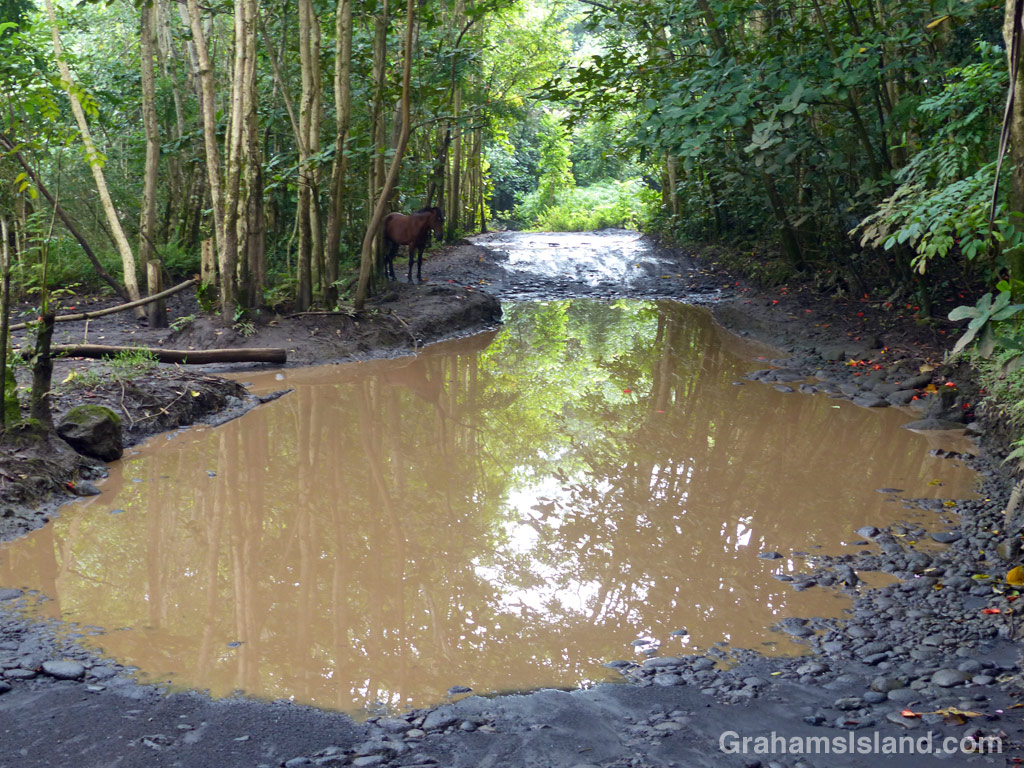

Yesterday, I posted about my hike into Waipi’o Valley. One feature of the valley is that wild horses live there. These appear to be ‘wild’ in the sense that they aren’t owned, but they’re not the wild mustangs of the wide open west.
I saw the first of them when I came to this large lake spanning the sandy road leading to the beach. At first I didn’t notice it, but as I looked for my best path around the pond, I saw it standing off to the side, by the trees. My best path would take me in the horse’s direction; the other side looked too muddy.
I looked at the horse again. It hadn’t moved. Not at all. Not a swish of the tail, not a flick of an ear. It was eerily still, so still I wondered for a moment if it wasn’t a super-realistic, life size model set there to disconcert tourists. No matter. I had to go by it and it would surely move then. As I approached, I spoke to it. Still nothing. I passed behind it. Not a twitch, not a blink. I walked to the other side of the road and took another photo. Nothing from the horse. A few more photos and finally the horse flicked its tail, the first sign of life since I initially saw it. After a while, the horse gathered itself, turned around, and eased into the trees.
Later, on my return after going a little way up the Muliwai Trail, I took the trail which runs through the trees behind the beach. A short way along the trail I just got a certain feeling. I turned around and there was a horse following me only about 10 feet behind. I hadn’t seen it. I hadn’t heard it. It looked at me, then turned toward the ocean. I walked on a few paces, then looked back. The horse was gone, nowhere to be seen.
For more information about the Waipi’o Valley trail, go to bigislandhikes.com/waipio-valley/.
Centipede in a sandal
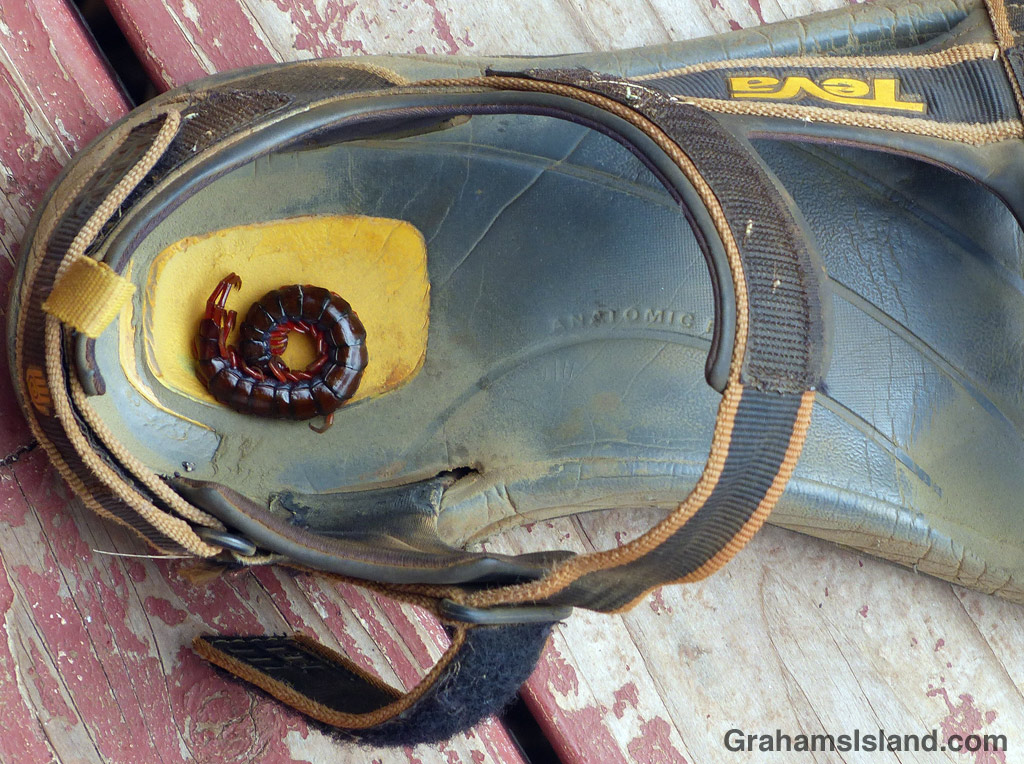
This is why it’s wise here to check clothes and shoes before use. Getting ready to go out for a walk, I glanced down and saw this centipede curled up in the heel of my sandal. Centipedes can give a very painful bite, so I’m told. I haven’t experienced one – yet. While this one wasn’t exactly lively, it was still alive. I can neither confirm nor deny that the poor fellow was overcome by fumes from the sandal.
From a gecko’s point of view

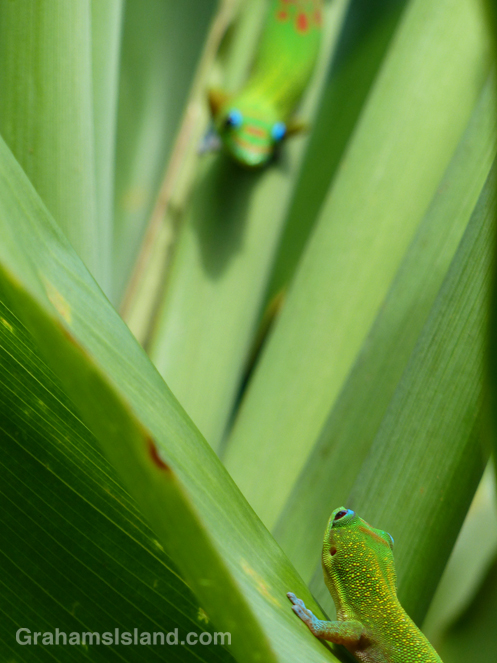
Two gold dust day geckos spot each other on a ti plant. Such frequent, daily encounters can be matter of life and death. More often, they result in a clarification of the pecking order in a given territory.
Prepare to pupate


This Hawaiian monarch butterfly caterpillar was getting ready to pupate. It attached itself to the underside of a ti leaf with a silk pad. Just a few hours later it had molted into the blue-green chrysalis to the left.
Only a small percentage of monarch eggs make it all the way to adulthood, so I hope the geckos don’t get to this one. I’ll keep an eye on it over the next week or so.

