
A green anole casting shadows on a window.
For more information about green anoles, go to en.wikipedia.org/wiki/Carolina_anole.
A green anole casting shadows on a window.
For more information about green anoles, go to en.wikipedia.org/wiki/Carolina_anole.

I’m not sure why this little grasshopper sitting on the trail caught my eye, but it’s probably a good thing it did because it was about to be stepped on. I took some photos and thought, ‘Maybe I can get one of it jumping away.’ So I scuffed a foot in its direction. I knocked my water bottle over with a thud. I leaned in, casting an ominous shadow its way. It twitched a couple of times, skittered to face a different way, but no jump. Of course, I knew exactly what would happen. I straightened, putting my camera away and admitting defeat and the grasshopper duly pinged away into the grass.
With those kind of survival skills it will have a good chance of attaining the size of the grasshopper below, which I saw on the lanai some time ago. When I got close, it leapt straight into a railing, but it too survived. They’re both Schistocerca nitens I think. It’s one of those troublesome invasive species so common in Hawaii.


There’s a window in the house that doesn’t get opened much and this anole took up residence between the window and the screen. Actually, three or four smaller ones live in there too. At night, they disappear up into the window frame. In the morning they come down and warm up in the sun. This big guy ventures out, coming and going in one corner of the window where the screen is loose.
It’s a green anole (officially called the Carolina anole) despite its brown coloration. Green anoles can turn brown, but brown anoles can’t turn green. Life is unfair.
And, yes, the window and screen look grimy. They have since been washed. The anoles weren’t best pleased, but quickly settled back into their routines once I was done.
For more information about green anoles, go to en.wikipedia.org/wiki/Carolina_anole.


A young gold dust day gecko emerges, with some trepidation, from between weathered boards on the lanai.
For more information about geckos, go to geckoweb.org.

Gold dust day geckos are not endemic to Hawaii. A native of Madagascar, Hawaii’s population stems from the release of 8 geckos by a student on the University of Hawaii campus in 1974. It’s not known if beer was involved.
While this makes the gold dust day gecko something of an invasive species, it’s hard to feel bitter about such an endearing little creature. With their striking coloration, they can be seen sticking to any surface or zipping about whether they’re right side up or upside down. They’re not bothered by close examination, usually just staring back with a goofy expression. Turn away though, and they can be gone in an instant.
This gecko was engrossed by the potential of this pink banana. Not sure if it was looking for water, nectar, or the possibility of insects within.
For more information about this and other geckos, go to geckoweb.org.
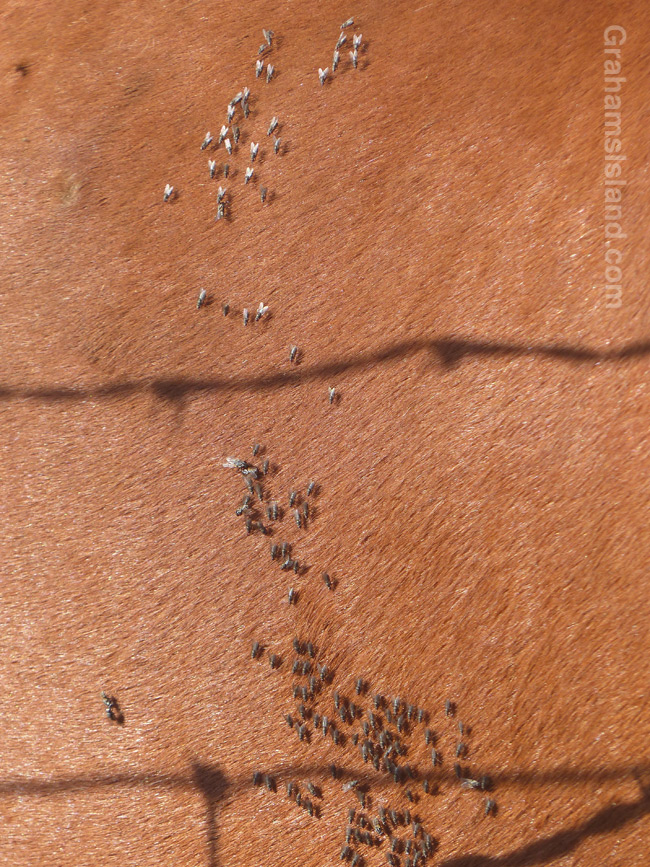
What can I say? I liked the contrast of the horse hair, the flies and the shadow made by the barbed wire fence.

Praying mantis are fairly common around here, though they can be difficult to spot since they blend in so well on various plants. This one wasn’t hard to spot for obvious reasons.

Got you.

Let’s go for a spin.

That’s good eating.

Well, I enjoyed it.
This green anole has snagged a bug for lunch. He looks pretty pleased with the situation. Not sure the bug shared that opinion.

