Category Archives: Fish

Place of Refuge and Two Step

There’s a good variety of fish at Two Step including raccoon butterflyfishes, seen here mingling with goatfishes and yellow tangs.
A barred filefish swims by with a startled look on its face, which is just their usual look.
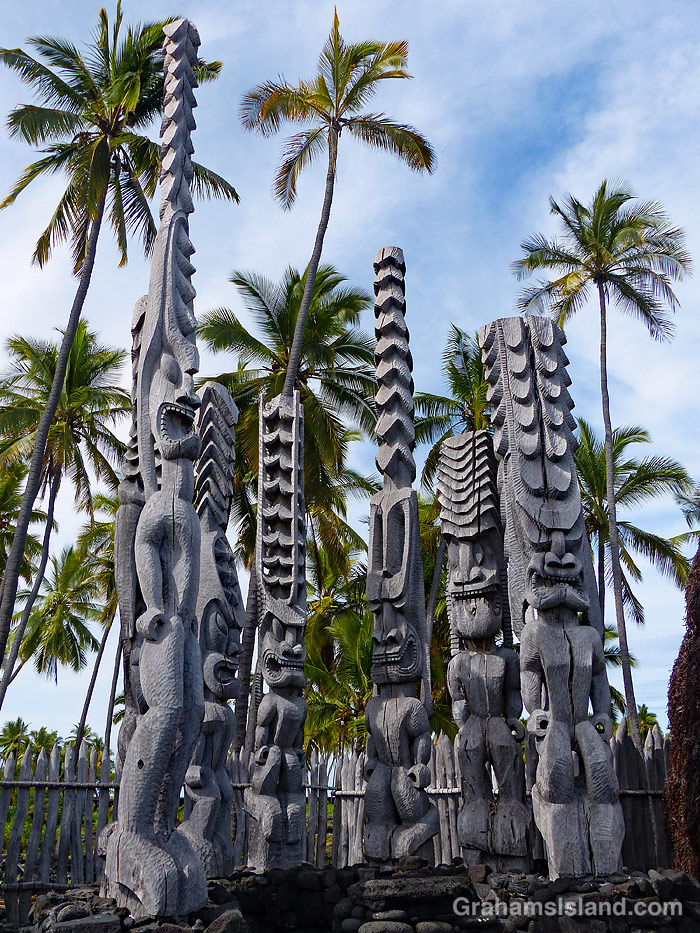
Ki’i at Pu’uhonua o Hōnaunau National Historical Park, better known as Place of Refuge.

This week’s Friendly Friday challenge theme is ‘Anniversaries.’ See more responses here.

Often, on our wedding anniversary, my wife and I go to Hawaii Tropical Bioreserve and Garden (formerly Hawaii Tropical Botanical Garden). This year the garden was shut, and still is, probably until tourists return to the islands. So a different anniversary is my birthday, which is not marked with candles on a cake, since that would be prohibitively expensive, but usually by a trip somewhere and a meal out. This year we went down to snorkel at Two Step and then had a wander around Pu’uhonua o Hōnaunau National Historical Park, otherwise known as Place of Refuge, which is right next door.

Two Step is a very popular snorkeling spot on Honaunau Bay, south of Captain Cook. This is a marine reserve so no fishing is allowed and the fish tend to be more numerous and mellow because of this. It’s a popular spot to see and swim with dolphins, though I haven’t done either of those things there. Currently, it’s not nearly as busy since there are very few tourists on the island and those that are here are diligently following quarantine rules (I’m trying to keep a straight face writing this!).

After our swim we made the short walk to Pu’uhonua o Hōnaunau National Historical Park. The park is on the south side of the bay and, at the moment, is fully open only on Fridays, Saturdays, and Sundays. However, on the other days, pretty much everything else is accessible, it’s just that the parking lot and visitor center are closed. What this means is that there’s basically nobody there so our visit was quiet and uncrowded. The park is an important place in Hawaiian history, and the location is beautiful. What’s not to like?

For more information about Pu’uhonua o Hōnaunau National Historical Park, visit https://www.nps.gov/puho/index.htm.

Palm trees reflect in one of the fishponds at Place of Refuge.

Hawaiian silverside shoals

I’ve posted photos of shoals of little fish before, making the assumption that these were juveniles of some fish species or other. However, this year the local snorkeling spot has been thick with these fish. It’s not been unusual for me to get in the water and find myself surrounded by a swirling ball of fish. It can actually be quite disorienting.

Because of this bumper crop, it occurred to me that I really should try to identify these fish. I think the answer is that they’re Hawaiian silversides, an endemic species. The problem is that there are a couple of other possible species, the goldspot sardine and the Hawaiian anchovy. Short of catching a few and examining them in the light of day, it’s hard to tell them apart.

Regardless of species, it’s been fun interacting with the shoals. Swim toward them and the shoal will part, then recombine behind. Point a camera in their direction and they jet off in another direction. It’s best just to float in the water, with the camera pointed in the right general direction. Then they’ll get quite close and I’ll snap a photo or two hoping something will turn out.

In the top photo, a shoal surges by in front of me. Below, the silvery stripe along their bodies can be seen.

Abstracts: Water painting

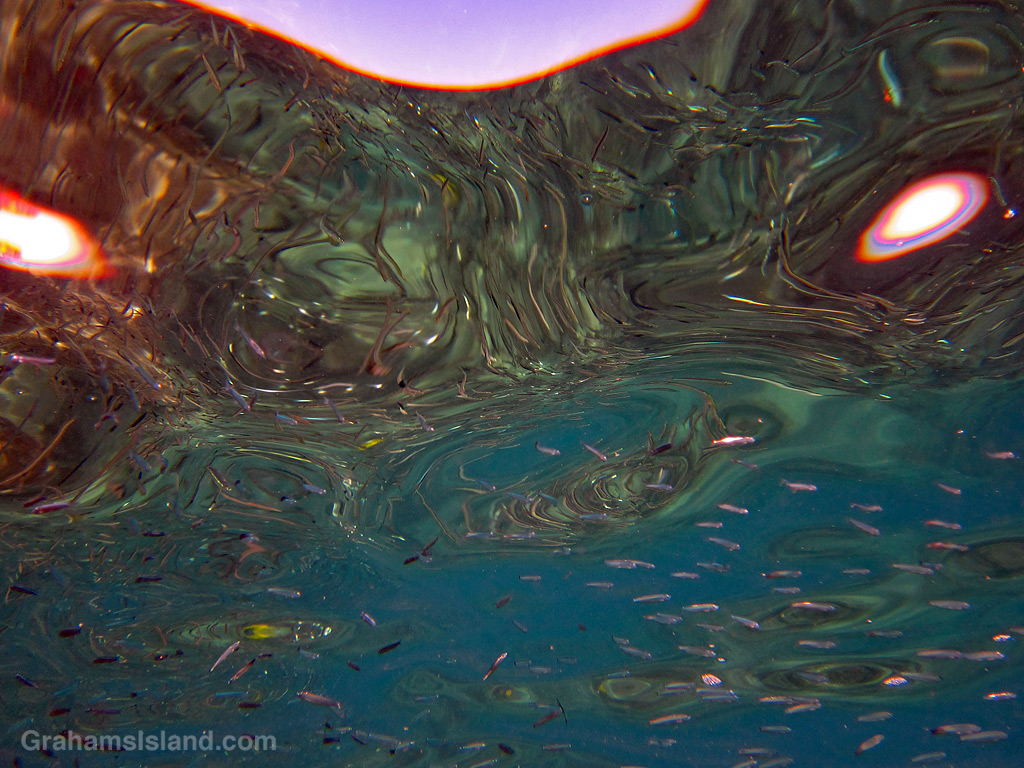
Recently, I’ve been taking photos of shoals of little fish I see when I get in the water. I thought I’d try shooting them from underneath and, while this hasn’t resulted in decent fish photos, I rather like the look of the water that’s shown up in some of the photos. This one has the added bonus that even the fish can be seen, too.

Blackstripe coris

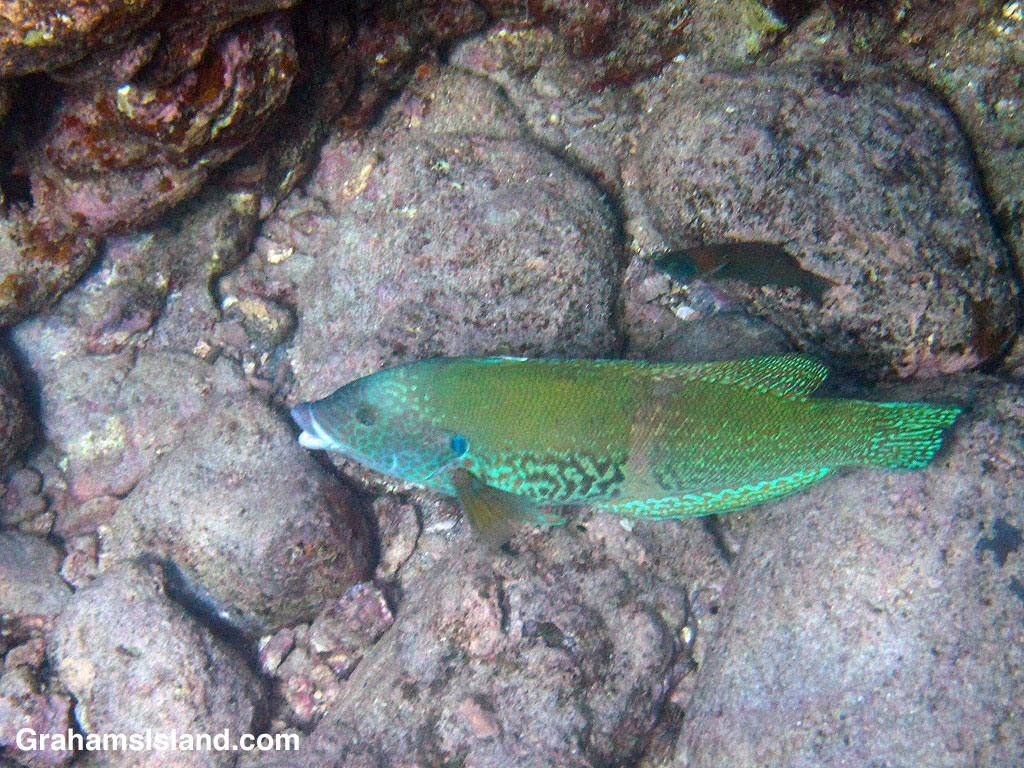
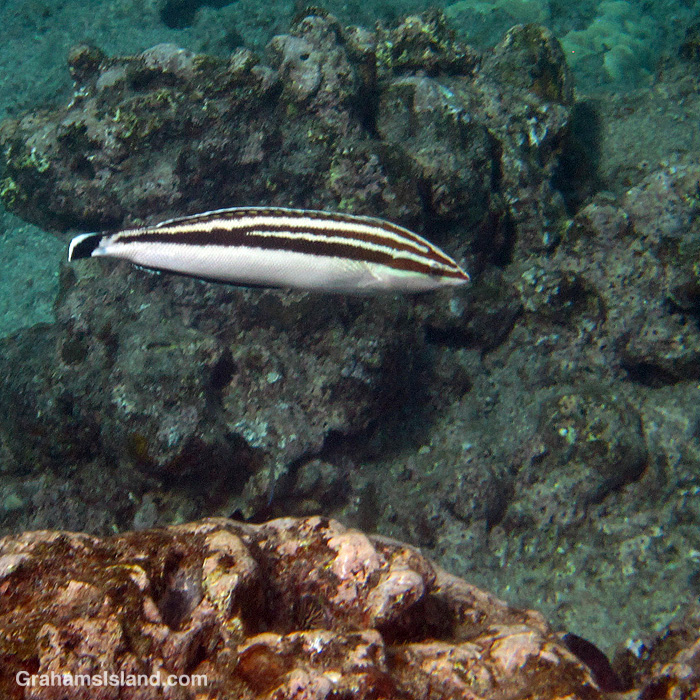
The blackstripe coris, also known as the yellowstripe coris, is an endemic wrasse. According to my fish book, John P. Hoover’s The Ultimate Guide to Hawaiian Reef Fishes, Sea Turtles, Dolphins, Whales, and Seals, it’s most abundant around the northwestern islands of the Hawaii chain. Around the main islands, mature females are uncommon and males rare.

The fish in the top photo is a large male. It has no black stripes, yellow stripes, or stripes of any kind, because this is one of those species where the male and female look radically different. This male was sparkling green in a variety of patterns. The other photo shows a female, which gives a better idea of why the fish got its name.

Snowflake moray eel

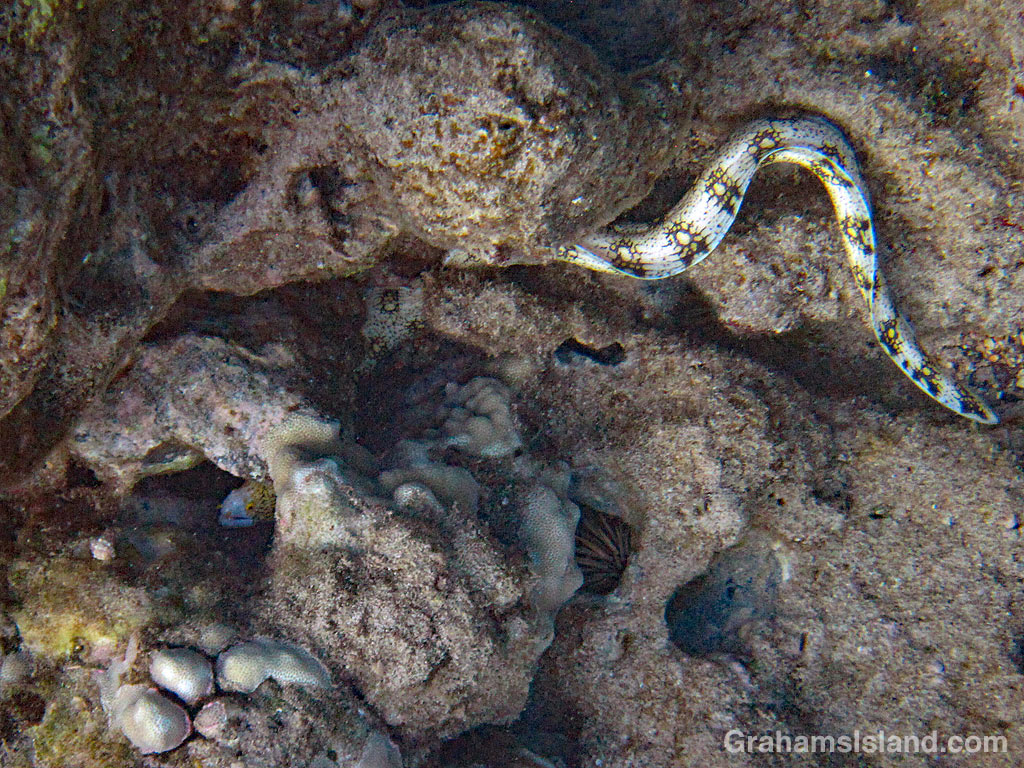
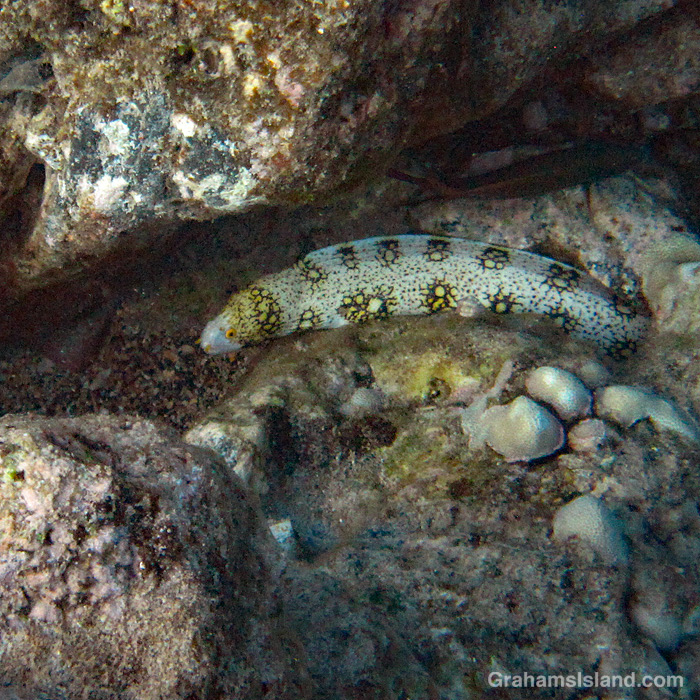
I saw this fairly small snowflake moray eel sliding over and around a shallow rocky area recently. Often times, eels will vanish into barely visible holes in the reef, but this one stayed in sight for quite a while before doing so. I like how, in the top photo, it’s peeking out to see if I’m still there.

Snowflake eels are probably the prettiest eels to be seen in the waters around here.

Kayak fisherman

This week’s Friendly Friday challenge theme is ‘Color Harmonies.’ See more responses here.

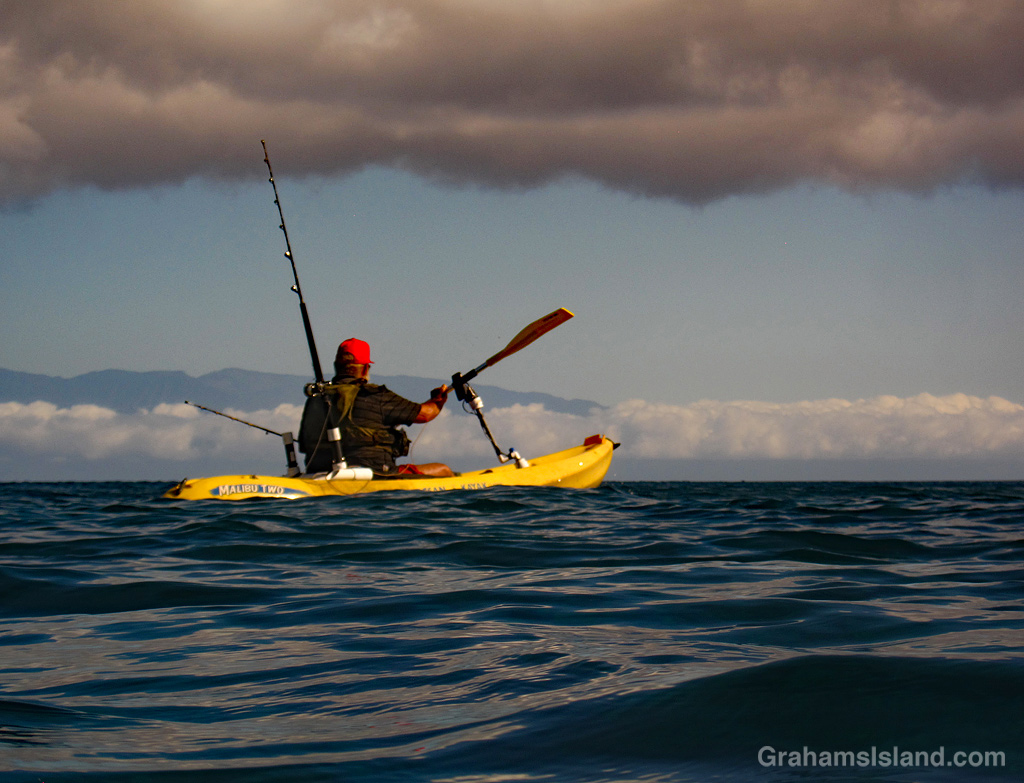
I like the colors in this photo of a kayak fisherman, with his red hat and yellow kayak. He has a fairly typical setup, with two or three rods attached in one way or another. He’ll have some bait in the kayak and probably a few beverages and snacks.

I was surprised to see him passing so close, but figured that he’d seen me and was being careful. In the end, I was glad I stopped to take this photo because just after I started swimming again, a large lure and hook passed in front of me on his unseen trailing line. Had I not stopped I’d probably have been hooked, reeled in, gutted, and barbecued. Not a bad way to go, really, I guess.

Better Days: Eel on the hook

I hope this photo doesn’t ruin anyone’s breakfast, but I run it for a couple of reasons. First, a lot of people fish around the island and most of them don’t like eels. Snag an eel on your line and there’s not much to be done. The eel will wrap itself in knots and the only way to be rid of it is to cut the line. The person fishing could try removing the hook and releasing the eel, but even if they were so inclined, the feeling is, ‘why release an eel so that it can tie itself in knots next time you throw a line in?’

And that brings us to the other reason for running the photo, and which also explains another reason no one wants to remove that hook. Look at those teeth! Rows of them, front and back, side to side. Reach for that hook and chances are you’re going to get bitten. This is also why it’s not a good idea to mess with anything in the water. Even little fish that look harmless can have a powerful bite, or sharp spines, or some other nasty surprise.

What color is this octopus?

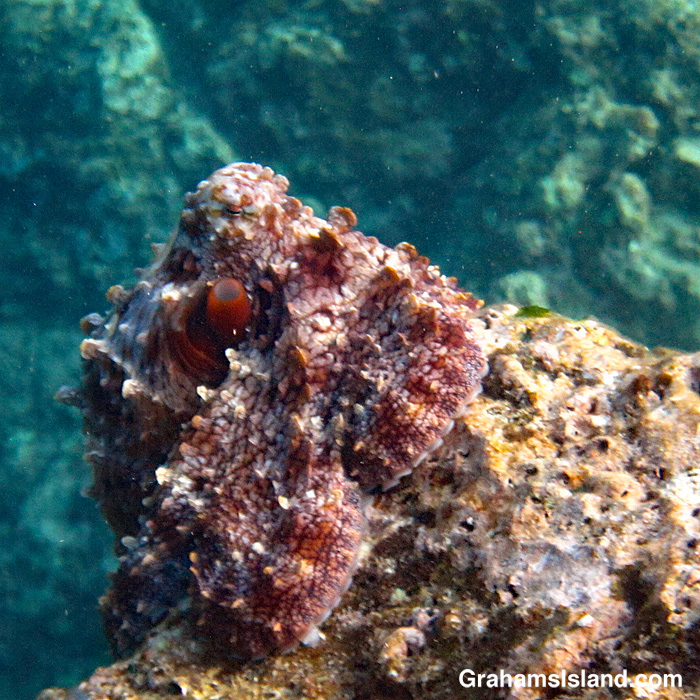
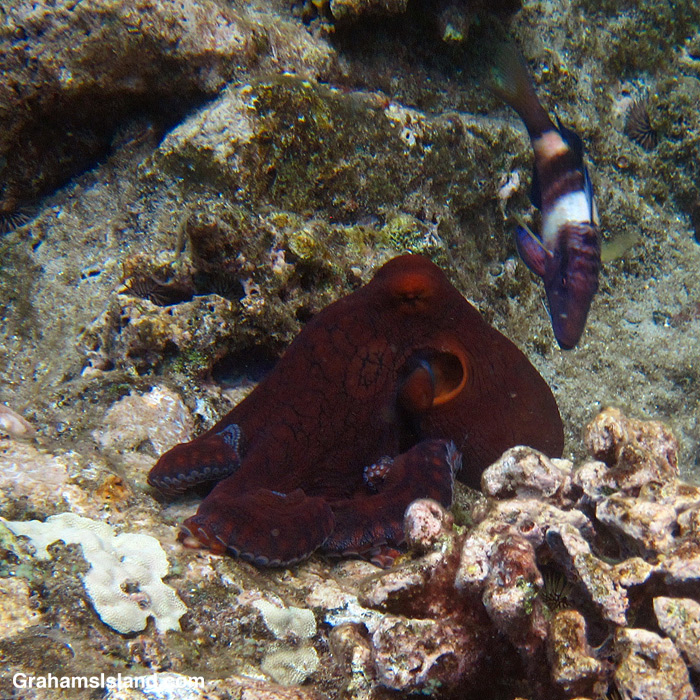
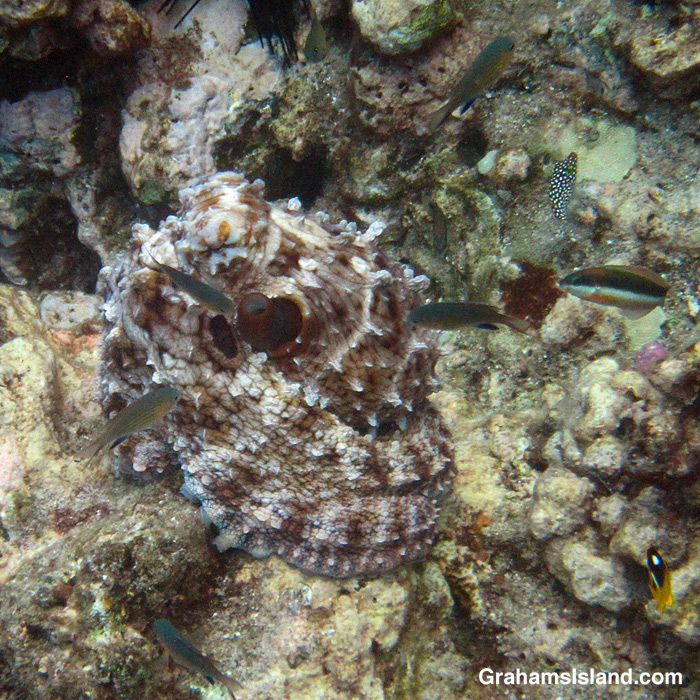
The answer to the headline is that it depends on the moment and the background. I surprised this day octopus when I came around a corner and it instantly changed color. Then it moved and changed color again. I edged away and it moved and changed color again. It changed about five times over the course of a few minutes and each change was like hitting a light switch – one moment this, next moment that.

Their default color is a gray-brown, but I didn’t see that on this occasion. The red of the center photo is a reaction to being surprised and the two mottled patterns are camouflage attempts.

Posted in response to Becky’s July Squares challenge theme of ‘Perspective.’ See more responses here.