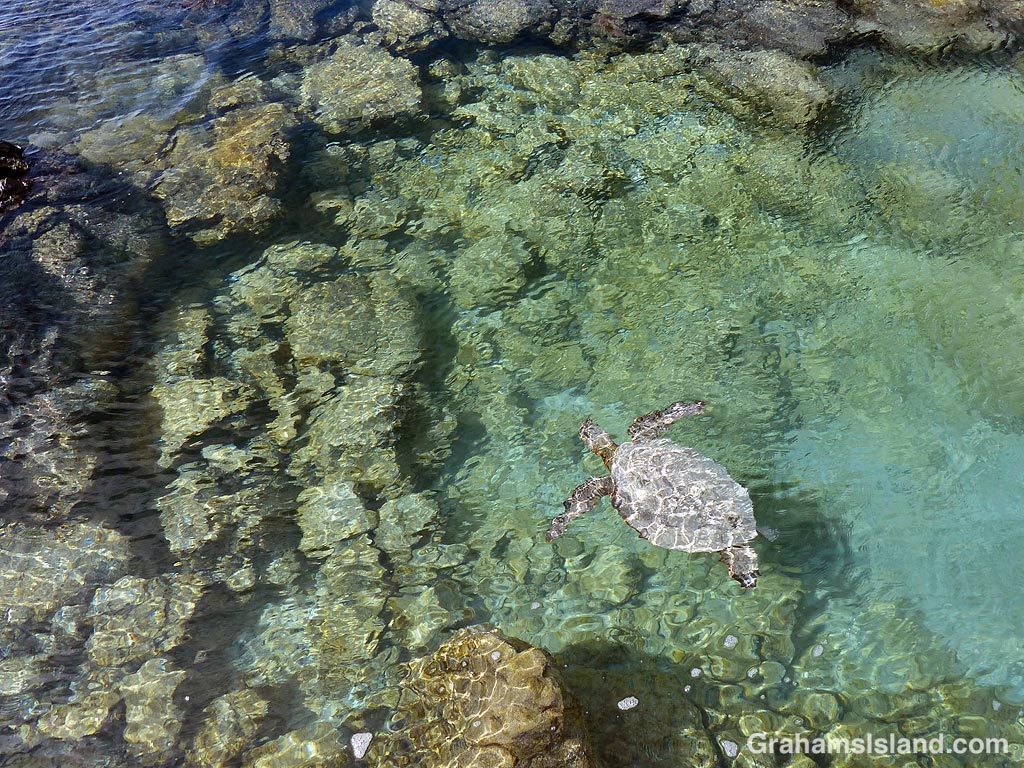
The last time I was down at Kiholo Bay I saw this green turtle in one of the pools around the edge the lagoon. When the turtle saw me, it might have felt a bit vulnerable in such shallow water. It immediately headed for the lagoon proper, at a leisurely pace, before cresting a ridge and easing into deeper water. Once there, it popped up for a breath, then disappeared into the milky waters.
The engine, prop shaft, and propeller of the SS Kauai, an old wooden steamship, that sank in 1913. Now it’s home to a variety of fish and is a moderately popular dive site.
I’ve mentioned before that great barracudas give me the willies more than sharks do. But the truth is, that while they look menacing, I’ve yet to see one being aggressive. The black fish in this photo wasn’t far from the barracuda, but was ignored by it as it swam by.
Even though they unnerve me, there are times when I just have to laugh. A couple of weeks ago I was snorkeling, puttering along as I looked around for things of interest, and I happened to look behind me. One of the very large barracudas was following me, about a body length behind. The instant I looked back, the barracuda turned away. It could have been a great photo, but I wasn’t ready for it and then the fish was gone. It was also a good illustration of the fact anything that might attack me in the water is highly likely to take me completely by surprise.
Barracudas will follow spear fishers in the water, hoping to snatch their catch, and I think because of this, they’ll follow anyone in the water in the hope that they might be in the fish acquisition business, too.
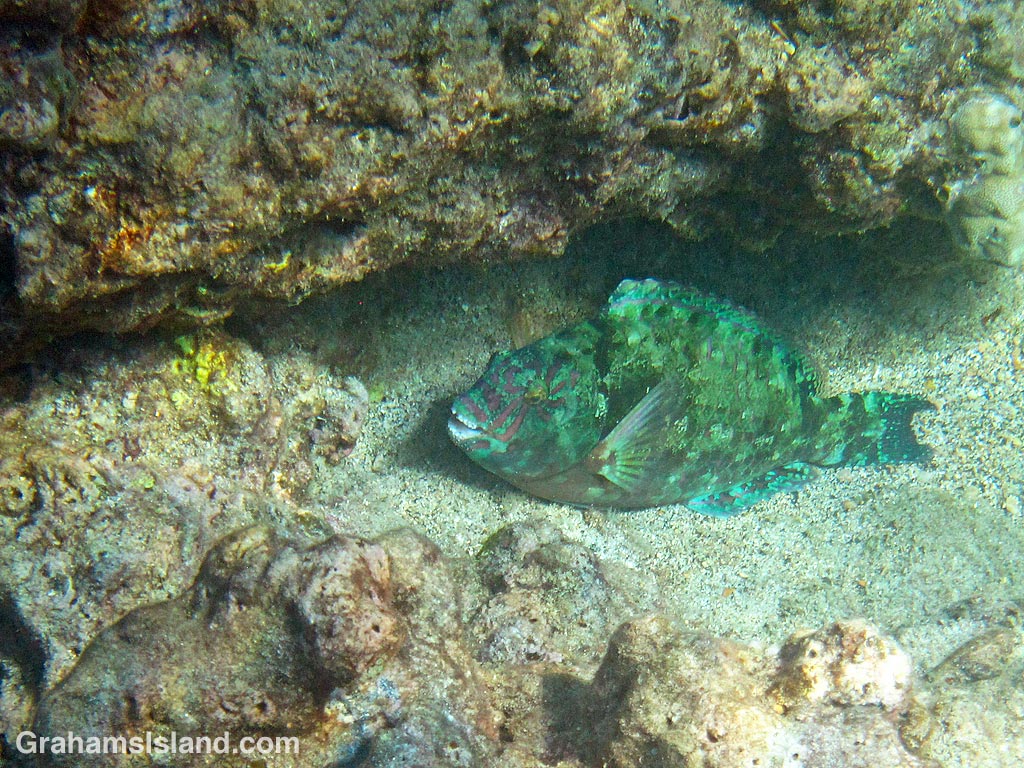
I saw this rather splendid stareye parrotfish sitting motionless on a patch of sand with its dorsal fin raised. It’s the first time I’d seen a parrotfish do this and I don’t know the reason. At night they will find a crack in the reef to sleep, but during the day they typically cruise around and are very skittish around people.
This photo shows the ‘beak’ of the parrotfish, which is made up of individual teeth that are fused together and are incredibly strong. It uses this ‘beak’ to scrape algae off rocks and also to dig into the coral. After grinding this up and extracting the organic matter, the residue is expelled. This parrotfish poop forms most of Hawaii’s fabulous white sand beaches!
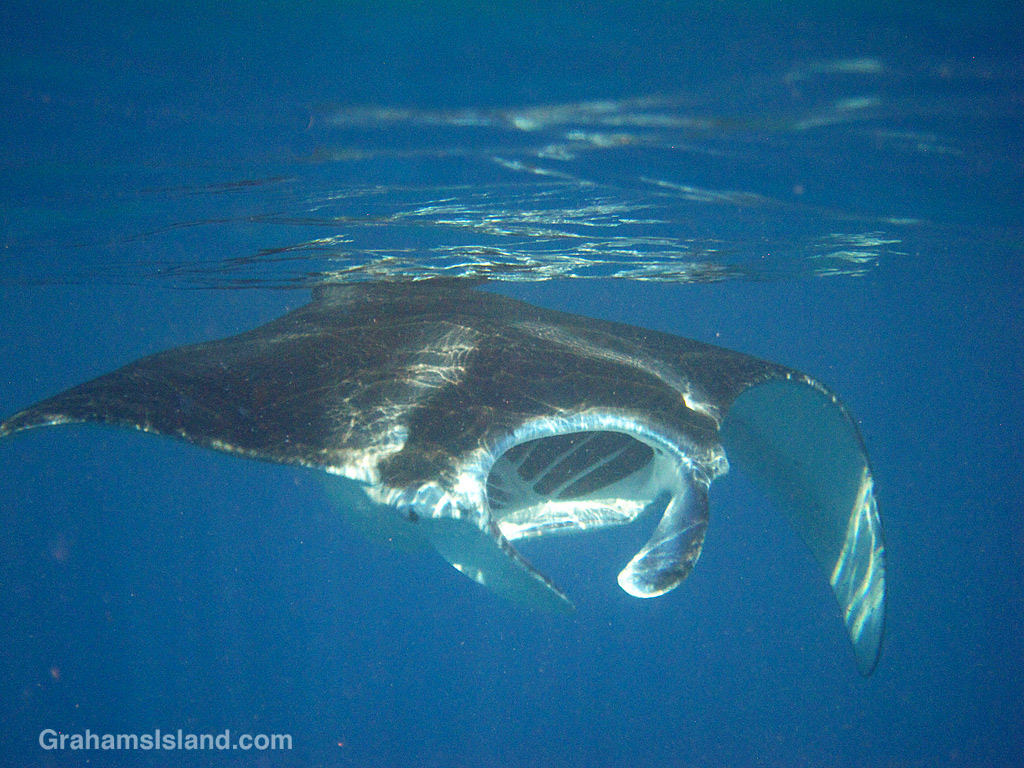
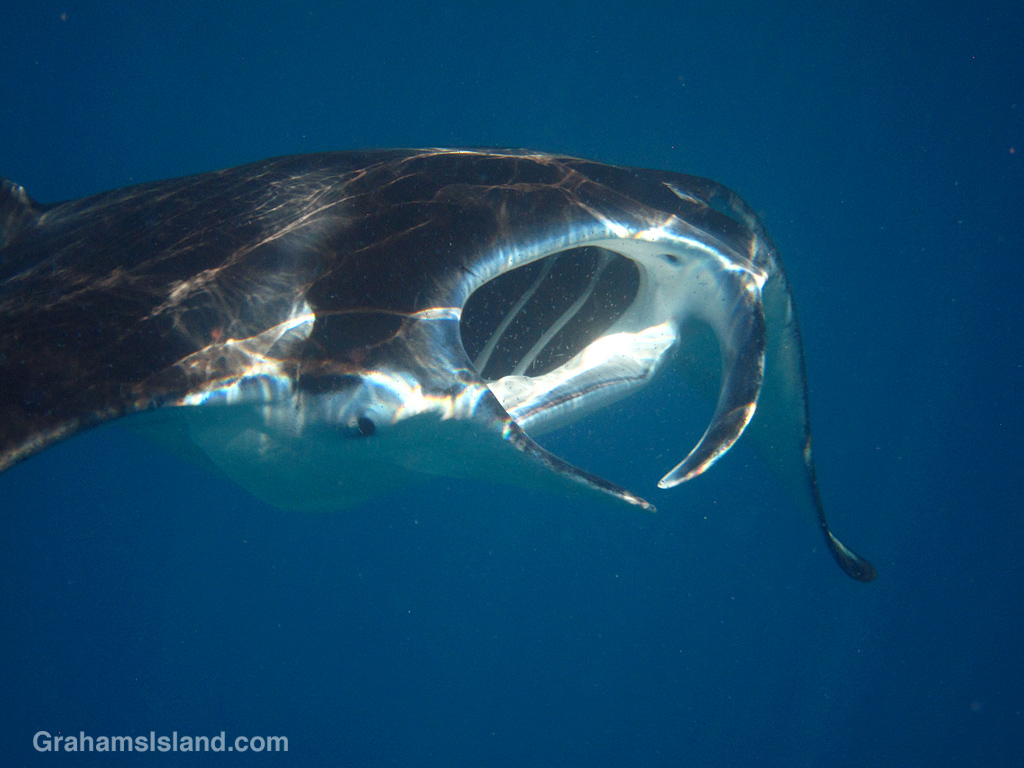
A manta ray approaches.A close up view.The spots on the underside are unique to each manta ray. This shot also gives a good view of the gill slits and cephalic flaps.
Yesterday, my wife and I went snorkeling at our usual spot. The visibility was pretty good so, on our way back, we decided to cross the bay and see how it was on the other side. The visibility got worse, not awful, but with more particles in the water.
Suddenly, I saw something large off to my left. I pointed to it and turned to my wife to see her pointing in the same direction. We’d seen this coastal manta ray at the same time. The ray was crossing in front of us and I snapped a couple of photos knowing they wouldn’t be good, but to at least have a record of the encounter.
A close up of the manta ray’s head.
The manta ray makes a turn.
The ray looked set to disappear into the murk, but then it turned and came back towards us. It passed in front of us again, turned again. Back and forth the ray went. On different occasions, it went by so close in front of each of us that we could have reached out and touched it. It was clearly as curious about us as we were entranced by it. Finally, it made one last pass and seemed to wave at us as it receded into the distance.
Mutual curiosity as manta ray meets snorkeler.The water was quite murky, so more distant photos show suspended particles.
The manta makes a dive and turn.
This was a smaller ray with maybe a 6- to 8-foot wing span and most of this time it was swimming near the surface, so we got great views of it. Manta rays are plankton feeders and have no poisonous spines so they’re amongst the least dangerous creatures in the ocean. I hadn’t seen one since last August so this made the occasion even more special for me.
After it left, we headed back in. It would have been hard to top that encounter.
Finally, the manta waves goodbye as it heads out into deeper waters.
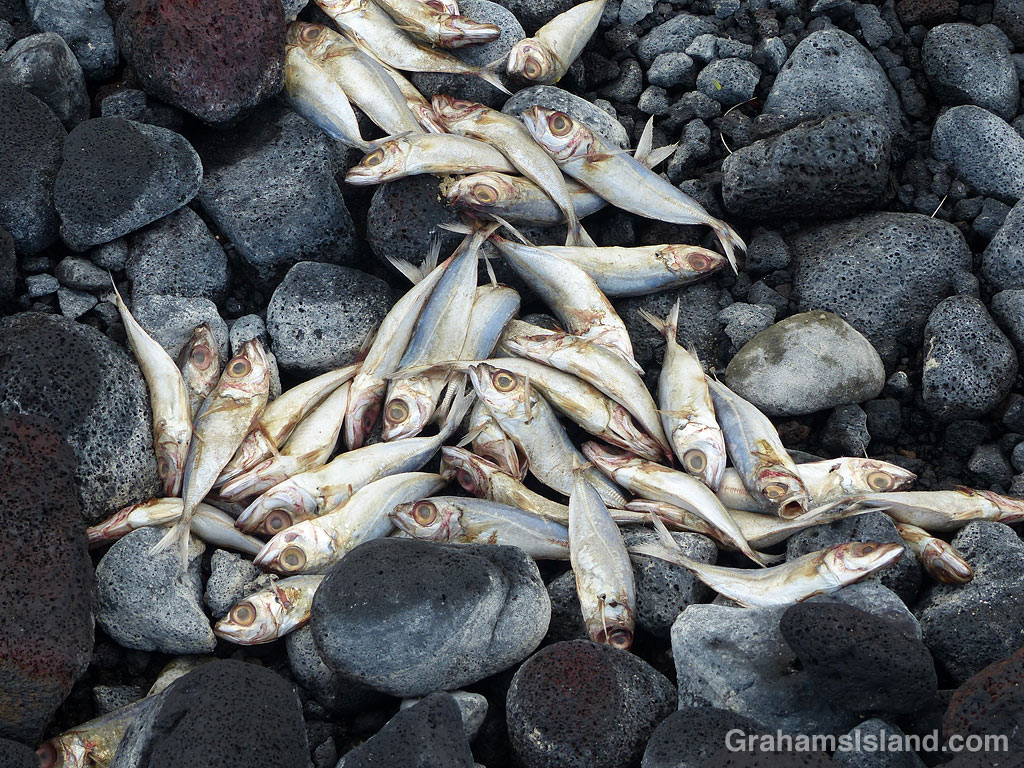
On a walk at Kiholo, I noticed a bit of a ripe smell in the air. When I got to the top end of the lagoon I found the reason for it. The shoreline was littered with clumps of these dead fish. There must have been several hundred of them all told. I don’t know the reason for the stranding, but the scene reminded me of images of fish markets or still life paintings.
This is the fifth of my rainbow colors in response to Becky’s April Squares challenge theme of ‘Bright.’ (See more responses here.) It’s also where I get into trouble. Cyan? What’s cyan doing in a rainbow? What happened to blue?
Well, blue is coming. What’s gone is indigo. The traditional rainbow colors are red, orange, yellow, green, blue, indigo and violet. These colors were assigned by Sir Isaac Newton way back in the 1600s. In fact, he started with just five colors – red, yellow, green, blue and violet. Later, he added orange and indigo to the color spectrum. These days though, what Newton called blue is today called cyan, and what he called indigo is now called blue.
In reality, there are no bands of color in a rainbow. There’s a continuous gradation of color. The bands are seen because the human eye is limited in the colors it perceives. Converted to black and white, the bands dissolve.
So, for my rainbow colors, I looked at my photos and what I see are red, orange, yellow, green, cyan, blue and violet. Of course, if you look at the colors on the inside of a rainbow, you’ll see they keep going, back through the same sequence. And where the red of this supplementary rainbow overlaps the violet of the primary, the result is more of a purple color.
Having labored through all that, today’s rainbow is a small, bright segment on the ocean, with a black and white version of the same image. Then we have a patch of sand underwater, showing different patterns and colors. Finally, a bullethead parrotfish, bashes its beak on some coral in its pursuit of food.







 Graham's Island