Last week, I posted about an encounter with three spotted eagle rays (here). A few days after that I ran into one of the small eagle rays a little farther up the coast. The visibility wasn’t good – those pink spots are small organisms floating in the water – but the ray came so close that I was able to get a few photos. I’m pretty sure this was the same one that was so curious on the first encounter. This time it didn’t hang around but drifted by, disappearing into the murky water.
The easiest way to spot an octopus is to see it swimming (top photo). They’re not large creatures but they’re quite distinctive when they swim.
If they’re not swimming, one thing to look for is certain fish, such as goatfishes and jacks, just hanging around in a spot for no apparent reason. When these fish are hunting alone, they tend to be more active in probing the rocks and trying to disturb prey. But when they’re hunting with an octopus, they seem more content to let the octopus do the work and snapping up whatever emerges. I’ve found that goatfishes are particularly helpful as an octopus indicator.
A while back, there were videos online of an octopus apparently punching a goatfish. I wasn’t surprised by this. The octopuses I’ve seen don’t seem best pleased by the presence of goatfishes. Part of this might be down to feeling that the goatfishes are not pulling their weight in the hunt. But another factor might be that if goatfishes give away their position, for the octopus that can be fatal.
Octopus is a popular food in Hawaii and has long been so. If I’ve learned to look for goatfish as an indicator of their presence, then no doubt spear fishermen have too. These days, if I see an octopus when anyone’s spear fishing nearby, I don’t do anything to draw attention to it.
On a recent snorkeling outing, my wife and I hadn’t gone far when we saw these three spotted eagle rays cruising around. The one was bigger than the other two and I wondered if this was a family group.
The three went back and forth before disappearing in the direction we’d come from. Or rather two of them did. The third, the smallest of the three, looped around a few times and seemed keen to demonstrate just how quickly it could turn and swoop and soar. Eventually, it followed the others.
We swam a little farther, then turned and headed back. It wasn’t long before we ran into the two juvenile rays again. Both were zipping around, carving turns, dipping down and rocketing up. Again, the smallest one was the most demonstrative and I got the feeling it was just having a ripping good time, practicing its acrobatics.
But it was also clearly quite curious. A couple of times it came straight up to me and I could see it looking at me, probably wondering what this cumbersome creature was in the water. I like to think I helped confirm its own superior swimming skills as I splashed my way back to the shore.
I was running early to work recently, so I decided to stop in Kawaihae, as I often do. With more time, I’d have gone for a walk along the coast, but I had only 15 minutes so I plumped for a visit to the south end of the harbor to see if there were any herons around.
I found two there, but one quickly disappeared. The other stood on a rock in shallow water, a popular fishing spot for them. I took a few photos and noticed the heron leaning forward. It had spotted something. An instant later, it plunged into the water and then emerged with a fish on its beak. It returned to the rock and paused. The fish appeared to be impaled on the heron’s beak, but extracting the beak risked losing the fish before it could be eaten.
A moment later, the heron hopped over to the small beach where I was. There, it popped the fish into the air and swallowed it in one slick movement. This whole sequence took less than three minutes. The heron stayed on the beach and I returned to my car and headed off to work, very glad that I’d stopped by.
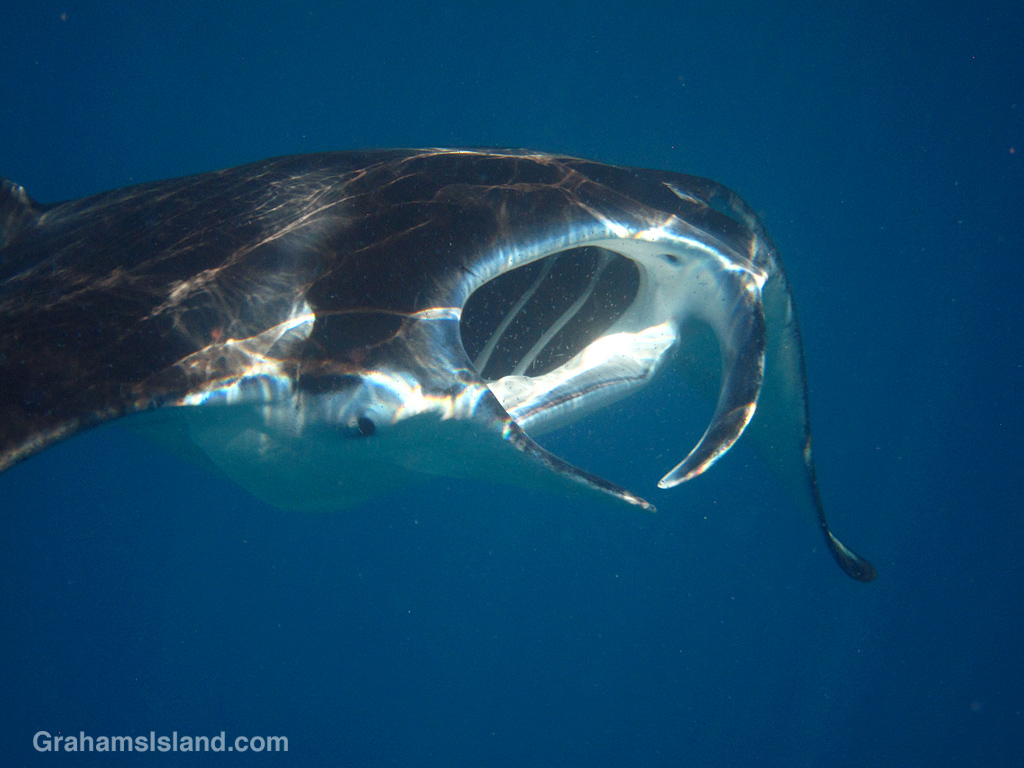
My most recent manta ray encounter was notable for the sheer exuberance of the ray. It swam up to my wife and me, then curved away, then came back again. At one point it moved farther off, into murkier, shallow water (which is why I didn’t get photos) and did several loop de loops for no apparent reason. It swam along with us for a while, closer to the shore, until we lost sight of it.
The top photo shows it approaching. I love it when they come straight towards me. They look so strange and yet so amazing, and there’s nothing to fear whatsoever since they’re plankton eaters and among the least dangerous creatures in the water. It wasn’t until I processed my photos that I noticed the acute halfbeaks passing between us. Ironically, this might be one of my better photos of them, captured unintentionally.
The bottom photo shows one of the ray’s curving passes with its mouth closed which, when I think about it, might be the first time I’ve seen that.
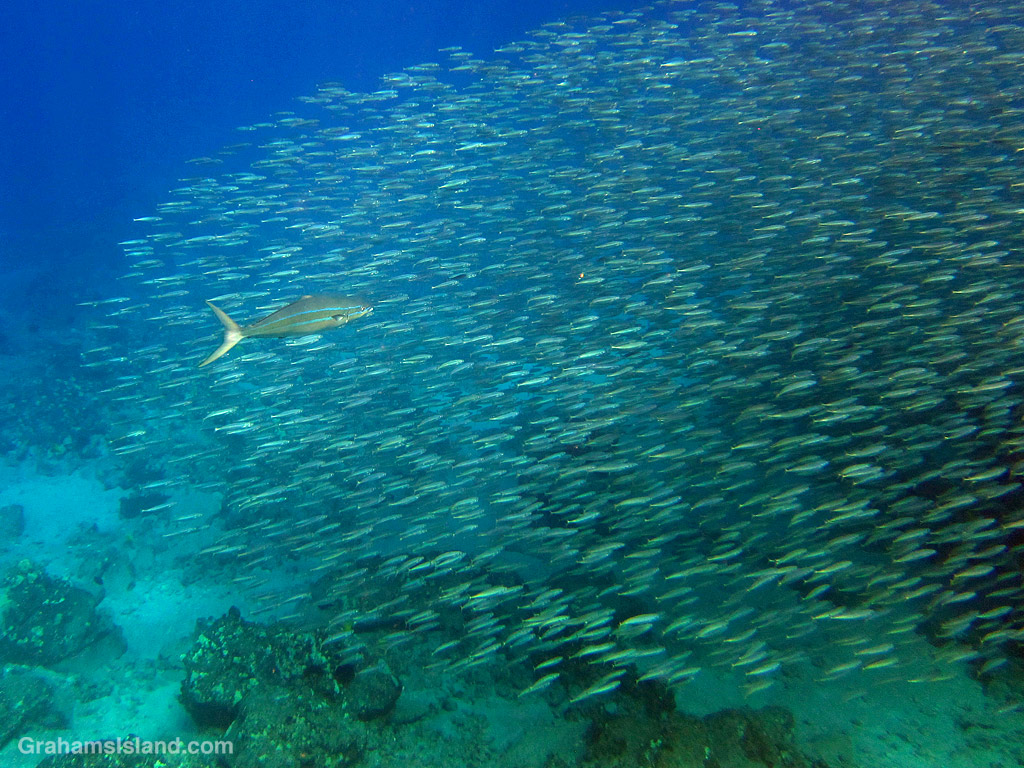
Leatherbacks are members of the Jack family and are most often seen singly or in pairs. I see them quite often and always try to get a photo of them and almost always fail. That’s because they have a tendency to surge upwards to feed and then zip back down.
On this occasion, a group of a dozen or more leatherbacks went by in the company of several bluefin trevallies and other fish. As usual, they were traveling at speed, but the numbers meant I had a better opportunity to get this photo.
I was amused by this sign on the beach in front of the Four Seasons Resort Hualalai. Spiny urchins in the rocks are like white lines on the highway. But of course, a visitor is not necessarily aware of this and the Four Seasons wouldn’t want any of its guests impaling themselves on spiky marine life, especially if they were likely to complain about it later.
This sign wasn’t far from another one that basically said you’d die if you set foot on the beach (here). Perhaps this was why the very lovely beach was deserted when I was there.
The male spotted boxfish (top) is blue with orange highlights and white spots along the back, whereas the female (second photo) is a fairly uniform brown with white spots all over. Despite their shape, boxfishes are nimble swimmers boasting a good turn of speed and surprising maneuverability.
I got these photos because the male boxfish came up to check me out a couple of times and the female was unperturbed by my presence as she searched for food on an old pier piling.