
A female pearl wrasse catching a bit of sun, which really makes her colors shine.

A female pearl wrasse catching a bit of sun, which really makes her colors shine.
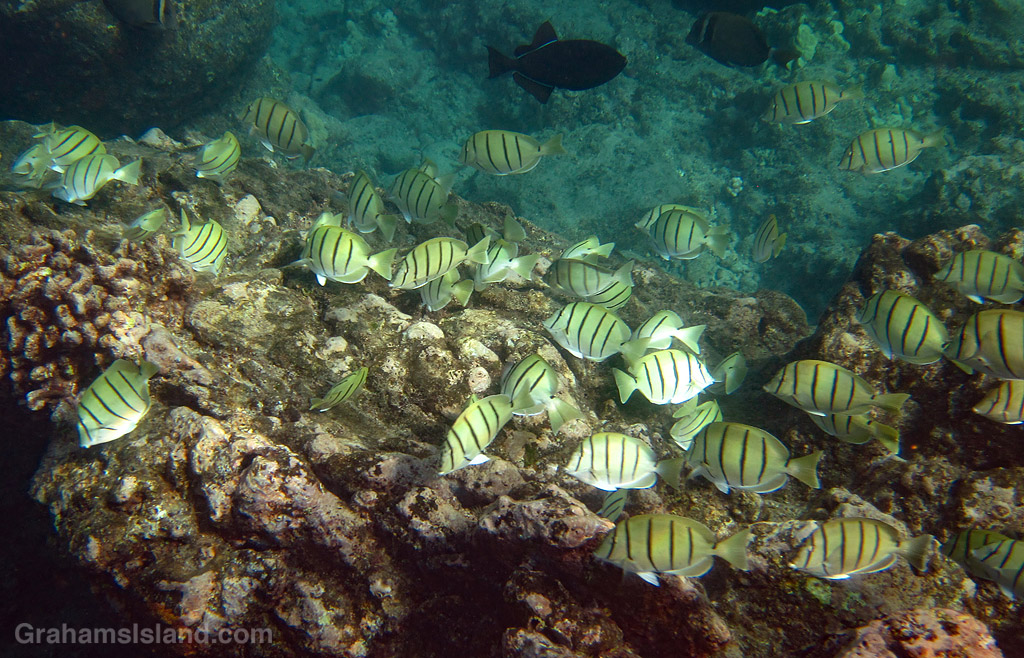
This is a second response to this week’s Sunday Stills challenge theme of ‘Waterworld.’ (See more responses here.) Yesterday, I posted about the movie Waterworld. Today, it’s a probably more expected response.
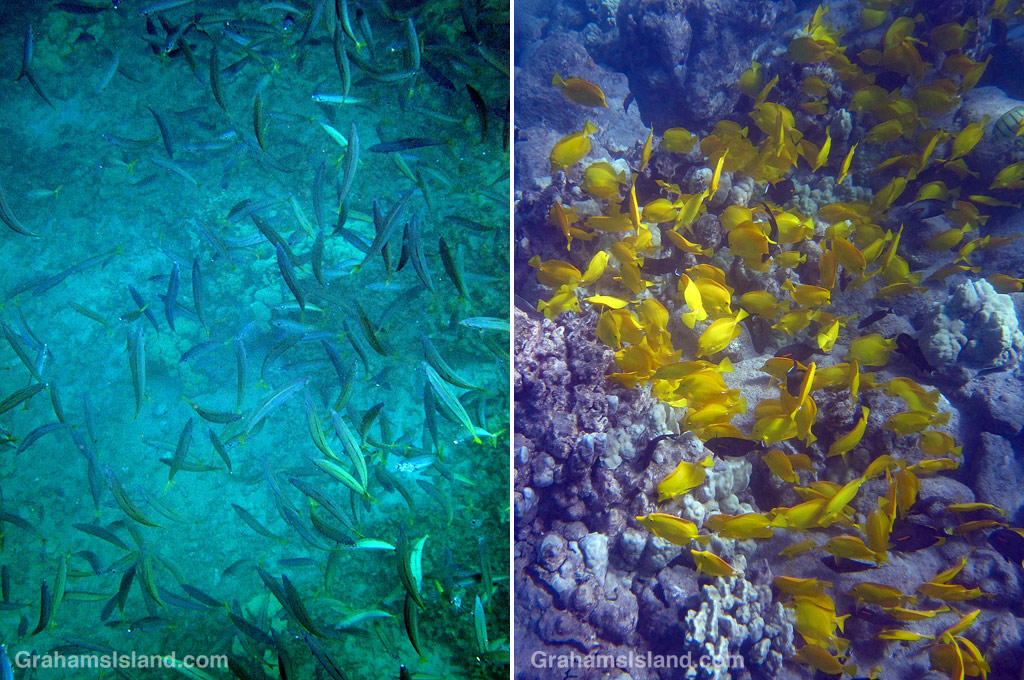
These are photos I took during my swim yesterday. Visibility in the water was patchy with some good areas and some not so good. I didn’t see anything startling, though the mackerel shads aren’t a common sight. Last time I saw such a shoal there was a great barracuda lurking on the other side. I looked around and, sure enough, there was another one looking interested as it cruised low down, too low for a decent photo.
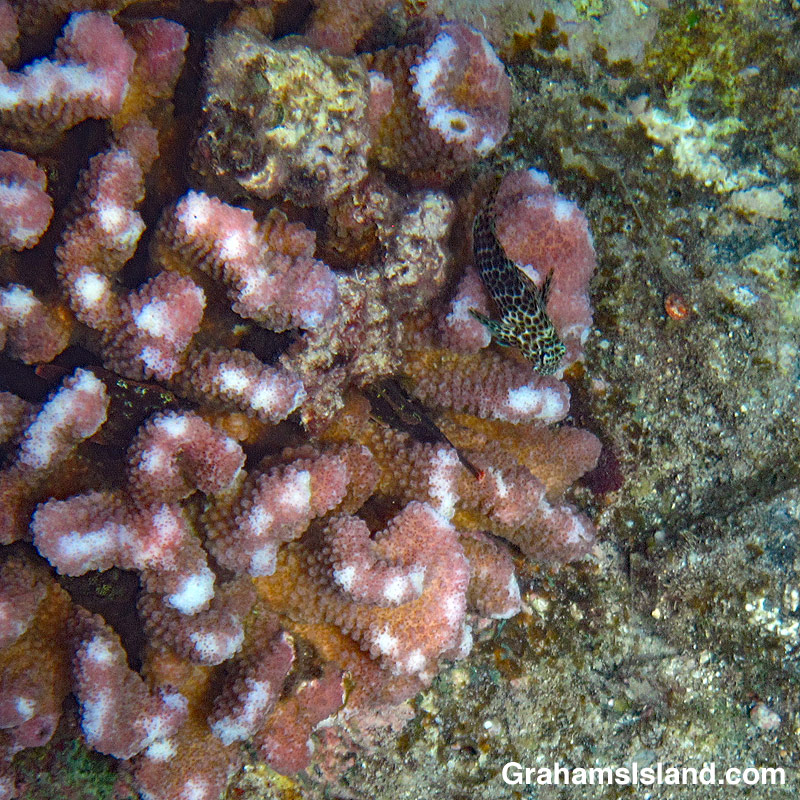
The other oddity was in the photo at left. I saw what I think is a spotted coral blenny on this patch of cauliflower coral, and snapped a quick photo before it took off. But it was only when I processed the photos that I saw something else, to the left and slightly below the blenny. I think it’s a small trumpetfish, but it could be something else. A lot of small fish and other creatures hide in coral heads so I must pay more attention from here on.
In short, it was a fairly typical swim.


This week’s Friendly Friday challenge theme is ‘Surprise.’ See more responses here.
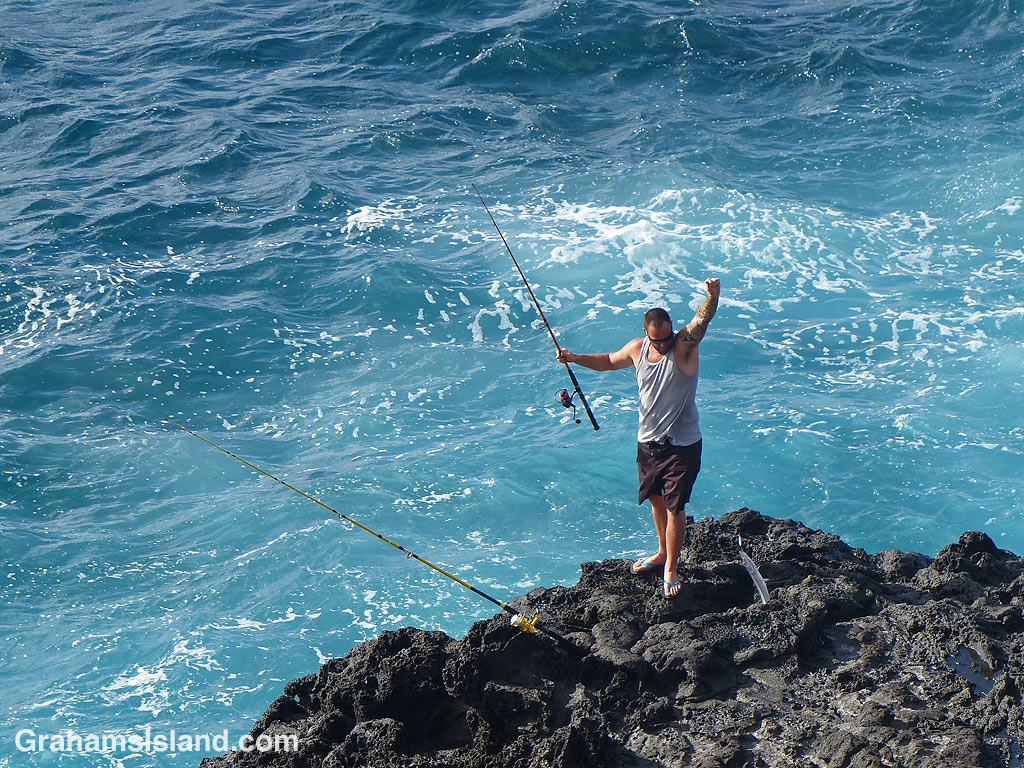
I see a lot of fishermen when I’m out walking and they undoubtedly catch fish, but I never see them doing so. I’m as good at getting photos of that moment as I am at catching fish myself.
When I first saw this fisherman he was reeling in an empty line, as per usual. I kept walking, but moments later I heard a cry, turned to look, and saw him winding away on his line. I nipped back to take photos, fully expecting it to be a false alarm – his line was snagged in the rocks or he’d hooked some debris. So I was surprised when he hauled this fish from the water. I don’t know what kind it was, but it was a decent size and probably destined to be that evening’s supper.

The Hawaiian hogfish is an endemic species. Mature fish live in deeper water around the Big Island so juveniles and subadults are more often seen. However, this one is a mature female and, while they’re not commonly seen while snorkeling, they do pop up on a regular basis. They feed on molluscs, urchins, crabs, and stars amongst other things.

A variety of reef fish – including yellow tang, goldring surgeonfish, whitebar surgeonfish, brassy chub, and ember parrotfish – forage on a shallow rocky shelf.
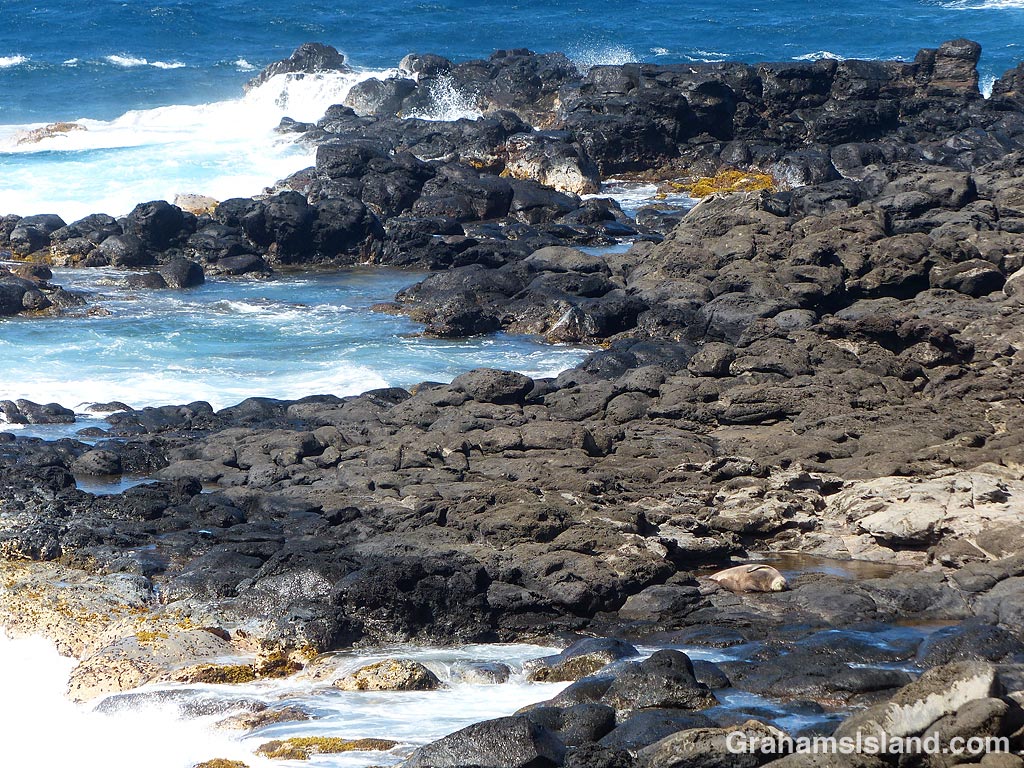

When I first saw this monk seal on the North Kohala coast a couple of days ago, I thought it was IO5. He’s the seal I see most often in this part of the island. But as I got closer, I saw this one was a female. I took photos, including some of the red ID tag. I wasn’t sure if, at that distance, I’d be able to read it, but luckily I could make out ‘A2’ in a couple of photos. There was space after the ‘2’ as if a number had rubbed off, so I wondered if this was RA20, the monk seal who raised pups on a Kona beach in 2018 (here and here) and 2019 (here and here).
I sent the photos to the Big Island Hawaiian monk seal response network, which tracks the movements and welfare of the monk seals. They confirmed this was RA20 and was the first sighting of her since she was released from Ke Kai Ola Hawaiian Monk Seal Hospital after suffering from a bacterial infection. The hospital’s veterinarians think RA20 recently lost a pregnancy and that the infection may have caused, or resulted from, the loss.
The good news is that she certainly appeared healthy and in good shape when I saw her.
For more information about Hawaiian monk seals and Ke Kai Ola Hawaiian Monk Seal Hospital, go to www.marinemammalcenter.org/hawaii.


There are two kinds of longnose butterflyfish in Hawaii, the common longnose and the big longnose. Neither name is especially flattering, but I think this is a big longnose butterflyfish. It feeds mostly on small shrimp, which it catches by thrusting its long nose into small crevices and swallowing its prey whole.
The little bright-eye damselfish on the left might have been startled by the butterflyfish, but not threatened. They can be quite aggressive in defending their small territories.

This multiband butterflyfish was cruising past the top of a head of coral. The dark stripe through its eye is a feature seen on many fish species, helping to confuse predators.
Posted in response to Becky’s April Squares challenge theme of ‘Top.’ See more responses here.
 Graham's Island